Hyundai's R&D Chief Says China Is Moving Faster
At its Silicon Valley talent forum, Hyundai's leadership admitted Chinese robotics rivals are outpacing it, betting decades of engineering discipline can close the gap.


Hyundai Motor Group's own head of research and development stood in front of a room of prospective engineers in Silicon Valley this week and said the quiet part out loud: "Our competitors, especially the Chinese, are challenging us strongly and moving far faster." Manfred Harrer's admission, delivered at the Group's HMG Tech Talent Forum on September 17 and 18 at the San Jose McEnery Convention Center, is a more candid public assessment of the competitive gap than most automakers offer, and it frames a two-day recruiting event as something closer to a strategic mobilization: Hyundai is telling engineers directly that the company believes it is behind, and that it is trying to hire its way back into contention through physical AI and robotics rather than through incremental vehicle engineering alone.
The forum, hosted jointly by Hyundai Motor, Kia, and Group technology units including Boston Dynamics, Motional, and 42dot, brought together roughly a dozen Group affiliates under the theme "Go Beyond Together" to court AI, robotics, and autonomous-driving talent across six Tech Session tracks and sixteen hands-on exhibition displays. The event itself is a recruiting exercise, but the language used inside it, from the CEO down, was strategy, not HR marketing, and it gives buyers and industry watchers a rare, on-the-record view of how Hyundai's leadership privately ranks its own competitive position against China's robotics and automotive sectors.
A CEO Redefining the Company, Not Just Recruiting for It
José Muñoz, Hyundai's president and CEO, opened the forum by rejecting the premise that Hyundai should be evaluated as a conventional automaker at all: "We are not an ordinary automaker that simply builds cars, but a physical AI and technology company." That is a bigger claim than most car company executives make in public, and Muñoz backed it with specifics rather than leaving it as a slogan, citing the Group's plan for more than one hundred new model launches and a supply agreement to provide Ioniq 5 vehicles for Waymo's robotaxi fleet as evidence that Hyundai's manufacturing scale is already being repurposed toward autonomy and robotics partnerships rather than conventional car sales alone. He also invoked founder Chung Ju-yung's signature question, "Have you even tried it?", explicitly framing the China competition not as a reason for caution but as a reason to move faster.
That framing matters for how buyers should read Hyundai's robotics roadmap going forward. A company that still primarily thinks of itself as a carmaker with a robotics side project tends to under-invest relative to dedicated robotics competitors. A company whose CEO publicly redefines the entire enterprise as a physical AI company, backed by a real Group-wide talent recruitment push, is signaling a different capital and staffing trajectory, one closer to what RobotAIGeek reported when Hyundai completed full ownership of Boston Dynamics and set a target of 30,000 robots a year by 2028. Muñoz's language at this forum is the clearest confirmation yet that the 2028 target is being treated internally as a company-defining bet rather than a side venture.
The R&D Chief's Diagnosis Is More Useful Than the CEO's Ambition
Harrer's specific admission deserves more attention from procurement and automation buyers than Muñoz's rebrand, because it is a technical diagnosis rather than a motivational statement. Harrer, who leads Hyundai's global research and development organization across European, US, Chinese, and Indian engineering centers, described the Group's ambition as becoming "the benchmark for a truly advanced engineering organization" by combining "decades of accumulated real-world engineering experience with virtual development." Read against his acknowledgment that Chinese competitors are moving faster, that statement amounts to a bet that Hyundai's advantage lies in decades of physical manufacturing discipline layered onto newer simulation and AI tooling, rather than in matching China's iteration speed directly.
Whether that bet pays off is precisely the question a buyer evaluating Hyundai's robotics platforms, including Boston Dynamics' Spot and the Group's own MobED mobile robot, should be asking over the next two years. China's humanoid and mobile-robot sector has demonstrated an ability to ship new hardware generations and software updates on a compressed timeline that Western manufacturing organizations, with their longer validation and safety-certification cycles, have historically struggled to match. Harrer's implicit argument is that manufacturing rigor eventually beats iteration speed in commercial deployment, where reliability and safety certification matter more than how quickly a demo video gets published. That argument has not yet been tested at scale in robotics the way it has in automotive manufacturing, and buyers should treat it as a thesis rather than a settled fact.
The Robots on the Exhibition Floor Show Where the Bet Is Concentrated
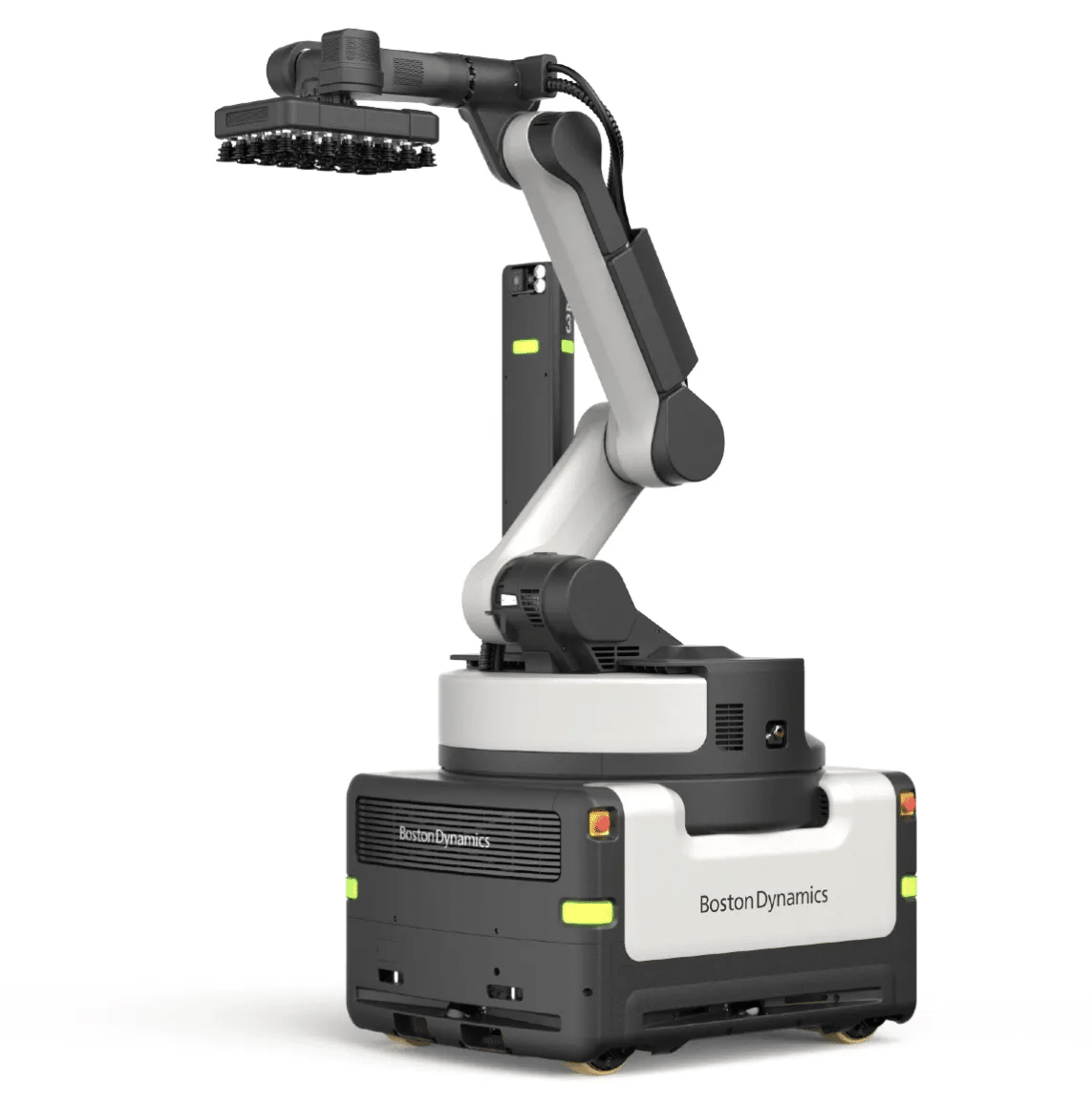
The forum's exhibition floor gave a concrete sense of where Hyundai is actually placing that bet rather than just where it is talking about it. Boston Dynamics' Spot quadruped, already commercialized for autonomous patrol and precision inspection work, appeared alongside MobED, the Group's own next-generation mobile robot platform built around four independently steerable wheels, positioned for facility logistics and flexible indoor mobility rather than Spot's inspection niche. The two platforms are not redundant: Spot targets inspection and monitoring tasks where legged mobility over uneven terrain matters, while MobED targets structured indoor environments where wheeled efficiency and payload capacity matter more. Showing both together signals that Hyundai intends to compete across multiple robot form factors rather than consolidating around a single humanoid bet the way several Chinese and American rivals have.
The exhibition also included CODA, Hyundai's cabin and mobility concept work, and the redesigned NEXO hydrogen fuel-cell platform, both positioned less as robotics products than as evidence that the Group's physical AI ambitions extend across its full technology portfolio rather than sitting in a single ring-fenced robotics division. That breadth is deliberate: Hyundai's pitch to the engineers in the room was that physical AI touches propulsion, autonomy, and robotics simultaneously inside one organization, which is a materially different value proposition than a standalone robotics startup can offer a prospective hire choosing between employers.
Min-woo Park, who heads the Group's Advanced Vehicle Platform Division and also serves as CEO of autonomous-driving unit 42dot, offered the forum's most direct articulation of what Hyundai believes will actually decide the competition: "The winner will not be whoever has the most data, but whoever learns from data the fastest." That statement, paired with Harrer's admission about Chinese speed, suggests Hyundai's leadership has converged on a specific theory of the competition: the fight is not over raw data volume, where China's manufacturing scale gives it a structural advantage, but over the learning pipeline that turns data into deployable capability. RobotAIGeek's survey of robotaxi companies building on NVIDIA's compute stack found Hyundai Motor already among roughly thirty companies converging on shared autonomy infrastructure, which is consistent with Park's framing: Hyundai appears to be betting on infrastructure and learning velocity rather than trying to out-manufacture China's robotics sector on hardware volume alone.
What This Means for Buyers Weighing Korean Against Chinese Platforms
For an automation buyer deciding between a Hyundai-affiliated robotics platform and a Chinese alternative over the next procurement cycle, this forum offers a genuinely useful signal: Hyundai's own leadership does not dispute that China currently leads on speed, and it is not pretending otherwise to recruits or, by extension, to customers. What Hyundai is offering instead is a claim about durability, certification rigor, and multi-form-factor coverage across Spot, MobED, and its autonomous-driving stack, built on decades of automotive-grade manufacturing discipline that newer entrants, Chinese or otherwise, have not yet had to prove at the same scale or over the same safety-critical timeframe.
The recruiting event itself is also a competitive data point worth taking seriously on its own terms. Hyundai is not simply publishing a strategy document; it flew engineers and Group leadership to Silicon Valley specifically to compete for the same pool of AI and robotics talent that Chinese humanoid makers, US robotics startups, and the major AI labs are all recruiting from simultaneously. A talent war fought openly, with a CEO willing to reframe the entire company's identity in front of prospective hires and an R&D chief willing to admit a competitive deficit rather than paper over it, is a different posture than the traditionally conservative, incremental communication style automakers have used for decades. That shift in itself may matter as much to Hyundai's robotics trajectory as any single platform shown on the exhibition floor, since the constraint on scaling Boston Dynamics and MobED deployment over the next several years is likely to be engineering headcount and specialized talent at least as much as capital.
That is a real differentiator, but it is not a guarantee, and Harrer's own words leave no room to pretend the gap has closed. The next twelve to eighteen months of Boston Dynamics and MobED deployment data will show whether accumulated engineering discipline actually converts into faster reliable deployment than China's speed advantage delivers, or whether Hyundai's own diagnosis of its position, honest as it is, turns out to have understated how much ground there is left to close.
This analysis draws on public remarks by Hyundai Motor Group executives at the HMG Tech Talent Forum 2026 in San Jose, California. It is for general information purposes only and does not constitute investment, financial, or legal advice.
Hero image credit: Hyundai Motor Group.