Hyundai Deploys Boston Dynamics Atlas at FIFA World Cup 2026
Hyundai deployed a production-version Boston Dynamics Atlas humanoid at a FIFA World Cup 2026 match, signaling a shift from lab demonstrations to live-environment commercial activations.

Hyundai Deploys Boston Dynamics Atlas at FIFA World Cup 2026
The gap between a controlled laboratory demonstration and a live public environment is the most severe filter in robotics commercialization. On July 5, 2026, Hyundai Motor Company pushed the Boston Dynamics Atlas humanoid across that threshold, integrating a production-version unit into a live FIFA World Cup match at the New York/New Jersey Stadium [1].
This activation represents more than a marketing spectacle. It serves as a public stress test for the hardware and control systems of a platform that is moving toward industrial deployment.
The Live-Environment Stress Test
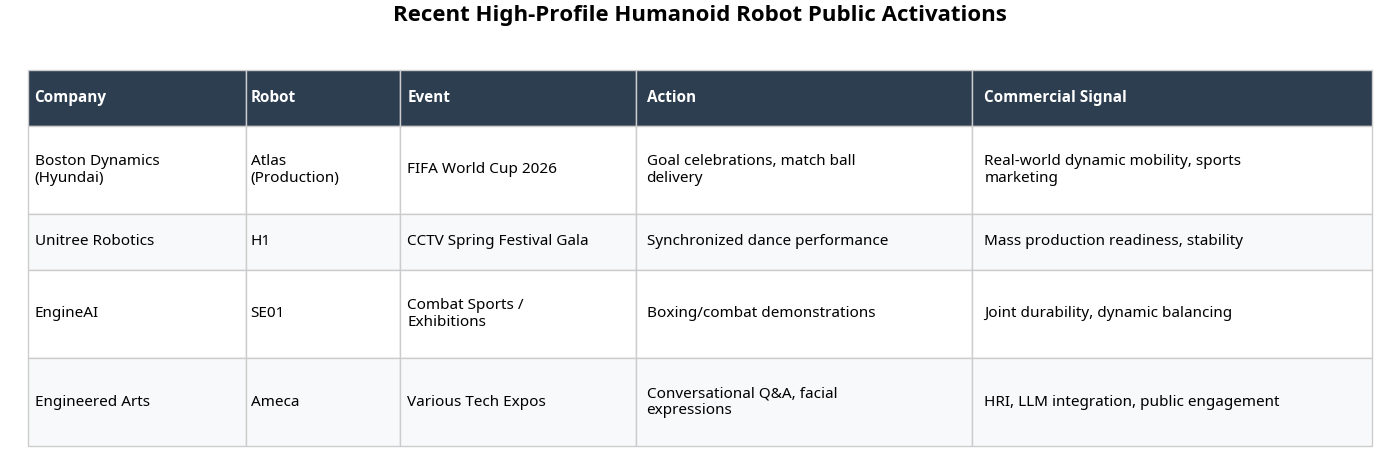
During the halftime of a Round of 16 match, the Atlas humanoid emerged from the player tunnel, performed goal celebrations mimicking star players, and delivered the ceremonial match ball to the referee to start the second half [1]. The technical foundation for this deployment relies on retargeting technology to translate human movements, reinforcement learning trained across thousands of simulations, and whole-body control [1]. According to Alberto Rodriguez, Director of Robotics Behavior at Boston Dynamics, the robot was trained for this event using the same methodologies applied to industrial applications [1].
The significance of this event lies in the transition from the laboratory to the field. The production version of Atlas, first introduced at CES 2026, represents a significant leap forward in hardware maturity [1]. The robot stands approximately five feet tall and features 56 points of movement, allowing it to execute complex dynamic motions [2]. By deploying this system in a live stadium environment, Hyundai and Boston Dynamics are demonstrating a level of reliability that is critical for commercial adoption. The robot must work through unstructured terrain, interact with humans, and perform its tasks without the safety nets typically present in research settings.
The specific actions performed by Atlas during the halftime show highlight the advanced capabilities of its control systems. Mimicking the goal celebrations of players like Harry Kane, Erling Haaland, Matheus Cunha, and Son Heung-min requires precise coordination and balance [1]. These movements are not simple, repetitive tasks; they involve dynamic shifts in weight, rapid changes in direction, and complex interactions between different parts of the robot's body. The ability to execute these actions flawlessly in front of a live audience is clear evidence of the robustness of the underlying software architecture.
 The Commercial Reality
For procurement teams and operations leaders evaluating humanoid readiness, public activations serve as a proxy for system stability. A robot that can reliably work through a stadium tunnel, execute complex dynamic movements, and interact with a human referee in an unstructured environment demonstrates a level of control maturity necessary for factory floors and logistics centers.
Hyundai's strategy connects this public demonstration directly to its commercial roadmap. The company plans to deploy Atlas units at its Metaplant facilities, moving the platform from a research project to a functional industrial tool [1]. This World Cup appearance functions as a highly visible proof of concept for the underlying technology stack. The integration of Atlas into the Hyundai manufacturing ecosystem represents a critical step in the commercialization of humanoid robotics. By proving the technology in a high-stakes public setting, Hyundai is building confidence among potential enterprise customers.
The broader market context is equally important. The humanoid sector has seen a surge in activity, with numerous companies showcasing prototypes and early-stage products. However, the transition from prototype to production is fraught with challenges. Hardware reliability, software robustness, and integration capabilities are all critical factors that must be addressed before widespread adoption can occur. The successful deployment of Atlas at the World Cup suggests that Boston Dynamics and Hyundai are making significant progress in these areas.
In addition, the "Next Starts Now" campaign, spearheaded by Sungwon Jee, Executive Vice President and Global Chief Marketing Officer at Hyundai, underscores the strategic importance of this deployment [1]. It is not merely a one-off event but part of a broader initiative to position Hyundai as a leader in the integration of advanced robotics into everyday life and industrial operations. The accompanying "School of Football" content series and the BBC StoryWorks film "The Training Ground" further amplify this message, providing a behind-the-scenes look at the rigorous preparation required for such a deployment [1].
Strategic Implications
The humanoid market is currently saturated with prototype videos and controlled demonstrations. By placing Atlas in a live, unpredictable environment, Hyundai and Boston Dynamics are establishing a new baseline for capability claims. When evaluating humanoid vendors, operations buyers must distinguish between systems that require highly structured environments and those capable of handling real-world variability. The retargeting and reinforcement learning techniques demonstrated here indicate that the software layer is catching up to the hardware capabilities, reducing the integration friction that typically delays enterprise adoption.
The competitive field is also evolving rapidly. Companies like Unitree and EngineAI are pushing the boundaries of humanoid capabilities, with public demonstrations ranging from dance performances to boxing matches [1]. These events, while entertaining, also serve as important indicators of technological progress. They demonstrate the ability of these systems to perform complex, dynamic tasks in real-time. For procurement managers, these demonstrations provide valuable insights into the maturity of different platforms and their potential suitability for industrial applications.
The integration of advanced AI techniques, such as reinforcement learning, is a key driver of this progress. By training robots in simulated environments, developers can rapidly iterate and improve their control algorithms. This approach allows robots to learn complex behaviors without the need for extensive physical testing, significantly accelerating the development process. The application of these techniques to the Atlas platform has enabled it to perform the dynamic movements showcased at the World Cup, demonstrating the power of this approach.
The Industry Reality
While the World Cup activation is impressive, it is important to recognize that a stadium halftime show is still a partially structured event. The robot performed a specific set of pre-trained actions rather than demonstrating generalized autonomous decision-making. However, the underlying control architecture required to execute these actions reliably in front of a live audience is the same architecture required to handle the variability of a manufacturing environment. The transition from lab to stadium is a necessary precursor to the transition from lab to factory.
The limitations of current humanoid technology must also be acknowledged. While robots like Atlas are capable of impressive physical feats, they still lack the cognitive capabilities required for true autonomy. They rely on pre-programmed behaviors and extensive training to perform specific tasks. The development of generalized artificial intelligence for robotics remains a significant challenge, and it will likely be several years before we see humanoids capable of operating independently in complex, unstructured environments.
Despite these limitations, the progress being made is undeniable. The hardware is becoming more robust, the software is becoming more sophisticated, and the integration capabilities are improving. As these trends continue, we can expect to see humanoids playing an increasingly important role in a wide range of industries, from manufacturing and logistics to healthcare and customer service.
The challenge for operations leaders is to identify the specific use cases where humanoids can deliver the greatest value. This requires a deep understanding of both the capabilities and limitations of the technology, as well as a clear vision for how it can be integrated into existing workflows. It is not simply a matter of replacing human workers with robots; it is about reimagining processes to take full advantage of the unique capabilities that humanoids offer.
Operational Impact
The successful deployment of a production-version Atlas in a live environment signals that the timeline for industrial humanoid adoption is accelerating. As the hardware stabilizes and the control software matures, the focus will shift from technical feasibility to integration economics. Operations leaders should begin evaluating their facilities not just for traditional automation, but for the specific infrastructure and safety requirements of humanoid deployments.
The procurement implications are significant. As humanoids become more capable and reliable, they will increasingly be viewed as viable alternatives to human labor in certain applications. This will require procurement teams to develop new evaluation criteria and sourcing strategies. They will need to assess not only the technical capabilities of different platforms but also their total cost of ownership, integration requirements, and long-term viability.
The transition to humanoid robotics will also require significant changes to operational processes and infrastructure. Facilities will need to be adapted to accommodate these new systems, and workers will need to be trained to interact with them safely and effectively. This will require a coordinated effort across multiple departments, including operations, engineering, human resources, and IT.
The deployment of the Boston Dynamics Atlas at the FIFA World Cup 2026 is a significant milestone in the commercialization of humanoid robotics. It demonstrates the growing maturity of the technology and its potential to transform a wide range of industries. For procurement managers and operations leaders, it serves as a clear signal that the era of industrial humanoids is rapidly approaching, and that now is the time to begin preparing for this transformative shift. The lessons learned from this public deployment will undoubtedly inform the development of future systems, paving the way for more robust, capable, and reliable humanoids in the years to come.
References
1. PR Newswire. "Hyundai Motor Brings Atlas Humanoid Robot to FIFA World Cup 2026 in First-Ever Live Match Environment Robotics Integration." July 5, 2026. https://www.prnewswire.com/news-releases/hyundai-motor-brings-atlas-humanoid-robot-to-fifa-world-cup-2026-in-first-ever-live-match-environment-robotics-integration-302818037.html
2. Fortune. "Humanoid robot delivered game ball at Brazil-Norway World Cup match." July 5, 2026. https://fortune.com/2026/07/05/humanoid-robot-delivered-game-ball-brazil-norway-world-cup-match-fifa-boston-dynamics-hyundai/
3. Chosun English. "Hyundai's Atlas robot mimics star celebrations at World Cup." July 6, 2026. https://www.chosun.com/english/industry-en/2026/07/06/FNKDZB4FN5E6FB6ROKT7Z7VEMU/
4. Aju Press. "Asia's humanoid race beyond the dance floor." July 6, 2026. https://www.ajupress.com/view/20260706174531304