GigaDevice launches humanoid MCUs as 2026 MCU demand tops 10 million
GigaDevice introduced two microcontrollers tailored for humanoids and robot dogs with claims of industrial safety, low power, and EtherCAT timing. The company projects a 2026 global market of more than 10 million MCU units for these robots, with around 60 chips needed per humanoid.
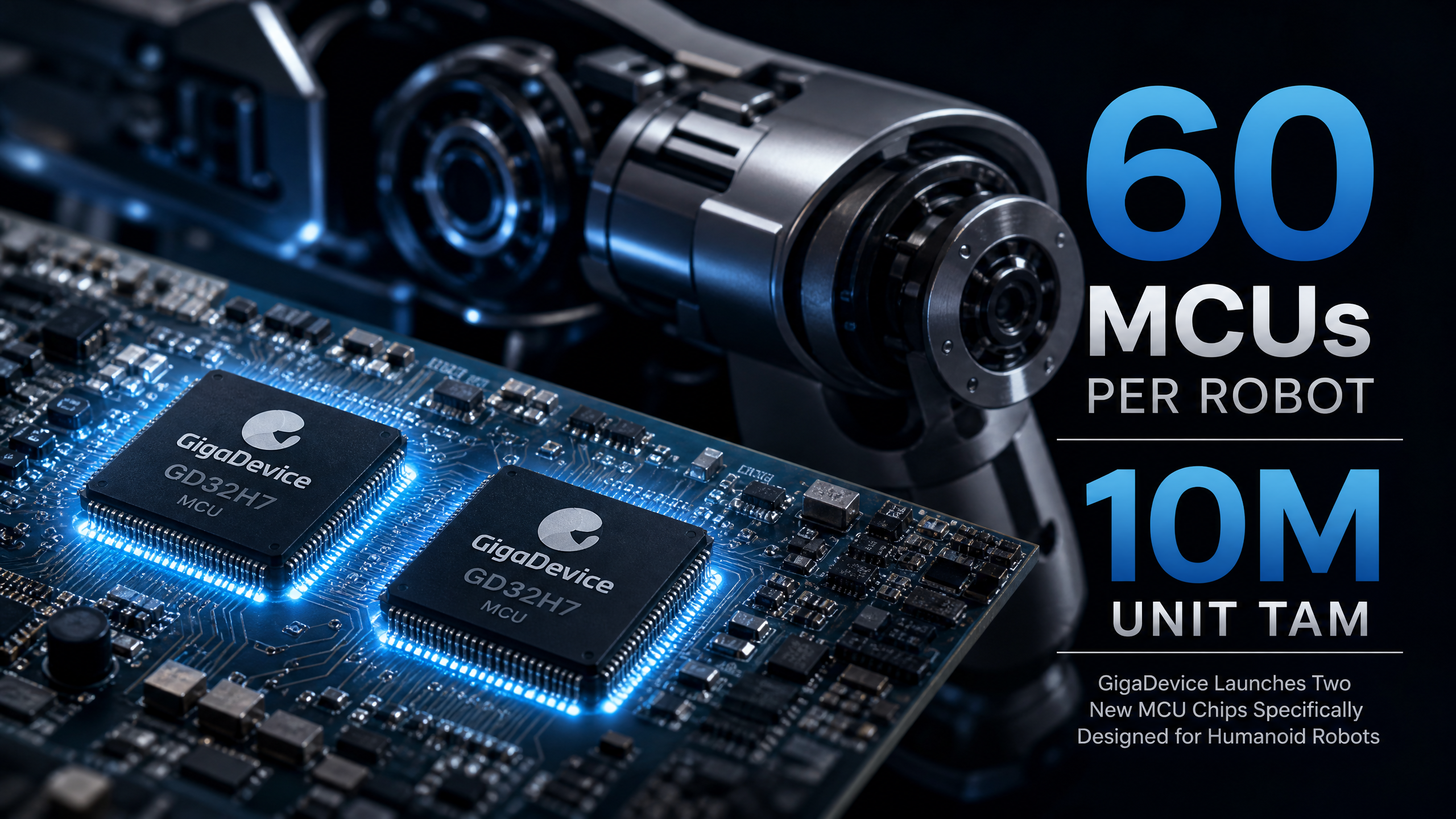
Beijing-based GigaDevice Semiconductor 603986.SH launched two humanoid-focused microcontrollers on August 6 for embodied intelligence. The GD32H77R targets small servos and joints with a 600 MHz ARM Cortex M7 core, EtherCAT support with 62.5 microsecond sync accuracy, a 9 by 9 millimeter BGA169 package, and SIL3 functional safety.
The GD32F50MxxG addresses humanoids, cobots, and dexterous hands with a 252 MHz Cortex M33, integrated gate driver and operational amplifiers, SIL2 safety, and an 8 by 8 millimeter QFN80 package. Marketing manager Li Xiaojian said a humanoid uses about 60 MCUs, and projected a 2026 global MCU TAM above 10 million units.
GigaDevice positions its MCUs at the heart of robot control
Headquartered in Beijing, GigaDevice has built a broad embedded portfolio that spans flash memory, analog components, and the GD32 microcontroller family. The company now moves to anchor the control layer of humanoids and robot dogs, a space where motor control, safety, and fast fieldbus networking are as decisive as peak compute. The pitch is simple and aggressive. Standardize joint and hand modules on domestic MCUs that match industrial timing and safety benchmarks while undercutting on power and integration.
The new parts split duties. GD32H77R is aimed at time critical motion control nodes in compact actuators that need EtherCAT synchronization and functional safety. GD32F50M is for more integrated mechatronic modules such as upper limb joints, hands, and cobots where the inclusion of a gate driver and op amps helps collapse bill of materials and reduce board area. Both sit in small packages to fit within space constrained actuator housings.
This push also reflects a supply chain playbook that China based OEMs understand well. A single vendor that can deliver MCUs, companion analog, and flash memory reduces vendor count and speeds qualification. GigaDevice can bundle support across these categories and promise long term availability, which matters in industrial robots that have service lives measured in many years and cannot tolerate frequent redesigns. If the firm offers lifecycle commitments and last time buy windows that match industrial norms, its appeal rises against piecemeal sourcing.
There is a competitive undertone aimed at displacing entrenched boards built on STM32, NXP i.MX RT, and TI C2000 families. Those vendors pair silicon with mature motor control suites, evaluation kits, and local field support. GigaDevice is attempting to meet that bar with tuned firmware and EtherCAT timing while using domestic presence and cost structure to court China first design wins. The playbook is to prove parity in motion quality, then press power and integration advantages to tip total cost of ownership in its favor.
The product aims to anchor local control in humanoid joints
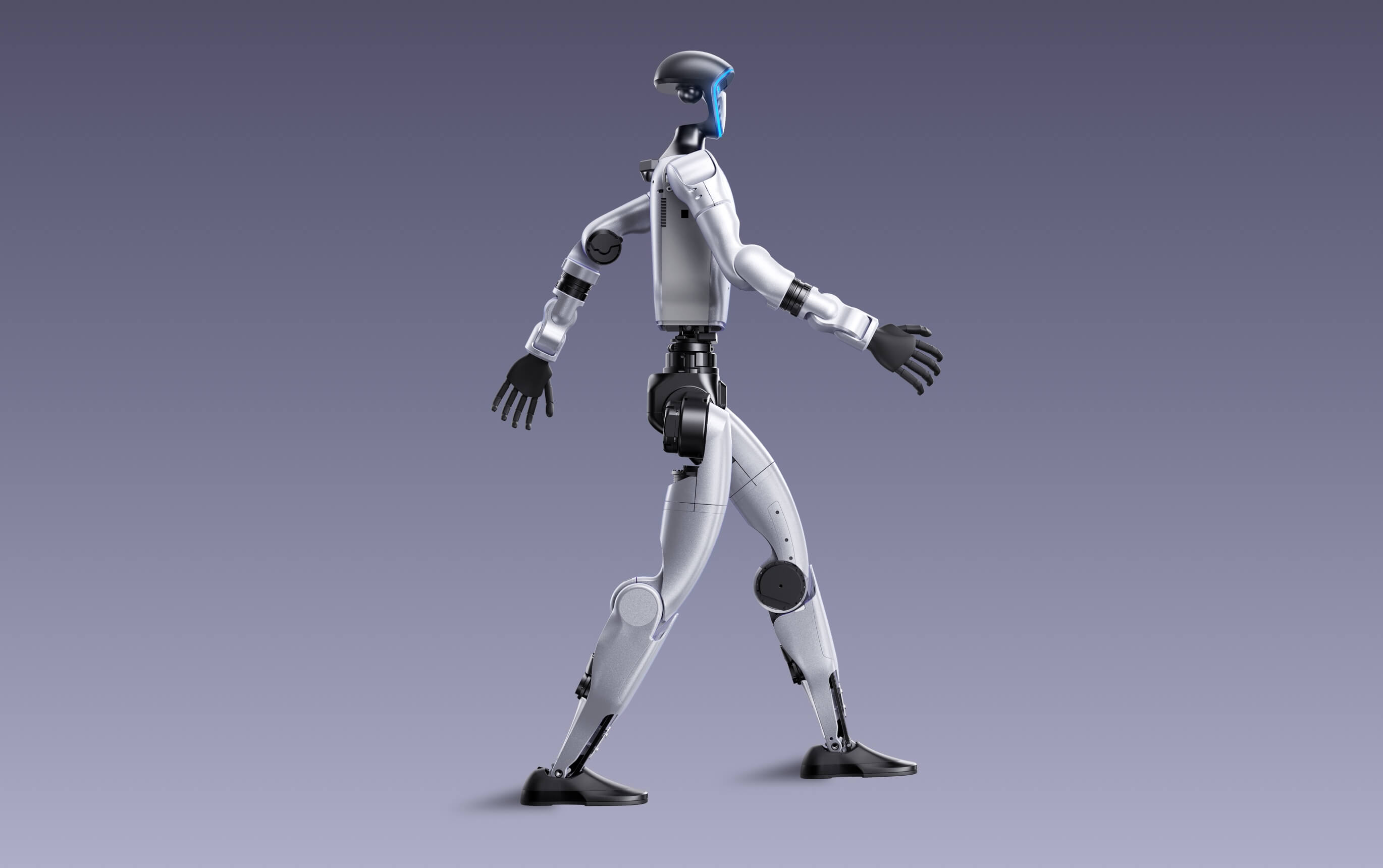
A humanoid is a bag of electric muscles. Each joint has a servo with a controller that must talk on a deterministic network while keeping loop timing stable across an entire body. GigaDevice is offering the nerves and spinal microcontrollers for those muscles. EtherCAT with 62.5 microsecond synchronization accuracy signals a push into distributed clock schemes that keep many joints in lockstep. SIL3 on the M7 part and SIL2 on the M33 part aim to meet the bar expected in industrial robots and collaborative systems where safe torque off, controlled stop, and fault reactions are non-negotiable.
This is a robotics specific design posture rather than a repurposing of a consumer MCU. The 600 MHz M7 is at the high end of Cortex M performance and aligns with applications that push field-oriented control, current sampling, and complex kinematics in real time. The 252 MHz M33 with integrated analog suggests GigaDevice wants to win sockets where board space and power budgets are tight and where OEMs want fewer external components.
Timing budgets in humanoids are unforgiving because many axes must be coordinated without visible jitter. EtherCAT cycle times for servo loops often sit between 250 microseconds and 1 millisecond, and some high-performance drives move faster to tighten response. A system that can support 62.5 microsecond cycles gives headroom for oversampling of currents and finer interpolation on trajectory segments. The gain is smoother gait transitions and better disturbance rejection when a foot slips or a hand meets unexpected resistance.
Another pragmatic angle is wiring complexity. Distributed control with deterministic Ethernet reduces bespoke harnesses and heavy cable bundles that can impede movement. If each actuator pod contains a controller with EtherCAT slave capability and local safety functions, a designer can route thin cables through limbs and keep high current runs short. That can lower electromagnetic interference, help thermal management, and simplify field service when a module fails.
Domestic substitution becomes explicit in the control layer
GigaDevice states that these devices represent domestic silicon replacing foreign chips in the robot control layer. That is a strategic through line in China electronics. Domestic substitution started in memory and general purpose MCUs and is now moving into verticalized products with specific protocol support and safety claims. For humanoids and cobots, a working domestic control stack will include EtherCAT or an equivalent real time network, motor control firmware, safety certified software libraries, and a stable toolchain. Each of those elements can be a dependency that keeps a design tied to a foreign vendor.
By expanding GD32 into these function specific nodes, GigaDevice positions itself against STM32H7, STM32G4, NXP i.MX RT crossover MCUs, Renesas RA6 series, Infineon XMC and AURIX auxiliaries, TI C2000, and Microchip dsPIC and SAM families in motion control. The differentiation claims hinge on lower dynamic power between 20 and 50 percent compared with competing MCUs, smaller packages for dense actuator designs, and integrated analog that replaces discrete components.
Domestic substitution here is not only about patriotism. It is a hedge on geopolitics and currency swings, and a practical lever in government backed procurement. If GigaDevice can bundle EtherCAT slave stacks, safety libraries, and code examples in Chinese and align with local certification houses, it lowers barriers for emerging robot makers. It also reduces reliance on imported development tools that can be a sticking point in controlled environments. The end state is an all domestic control chain from firmware to silicon at the joint level.
EtherCAT timing and safety are positioned at industrial grade
EtherCAT remains a benchmark for deterministic Ethernet in robotics. The 62.5 microsecond sync accuracy quoted by GigaDevice aims to signal compliance with distributed clocks and cycle times used in servo driven machinery and robots. That is in the range where coordinated motion of multiple axes stays within acceptable jitter for smooth movement. Bringing this capability into compact joint controllers allows humanoids to scale to dozens of axes without a maze of local wiring.
Safety levels are equally important. SIL2 and SIL3 align with IEC 61508 requirements and are common in industrial motion. The inclusion of safety claims is a statement of intent to chase not only hobbyist or consumer robot dogs but also factory floor cobots that must satisfy integrators and auditors. Certification timelines and tool availability will matter just as much as datasheet numbers. OEMs will ask for pre certified safety libraries, fieldbus stacks with vendor support, and a track record of passing conformance tests. GigaDevice will need to back these chips with an ecosystem that matches established rivals.
In practice, safety ready hardware needs to expose diagnostic features such as clock monitoring, lockstep or redundancy, memory error detection, and safe state outputs that can cut power stages. The M33 part adds TrustZone style partitioning for integrity of safety functions, and the M7 can host safety kernels that isolate drive logic from application code. The test is whether third party assessors will validate these implementations to the stated safety levels and whether reference designs pass real factory acceptance tests.
A humanoid needs dozens of controllers which multiplies MCU sockets
Li Xiaojian pegged a single humanoid at around 60 MCUs. That tally can make sense when every actuator, sensor cluster, and power node embeds its own controller for real time loops and communications. Think of a human body with many small reflex centers. A robot body mirrors that pattern. Shoulder, elbow, wrist, hip, knee, and ankle assemblies each house multiple servo stages and sometimes embedded drivers. Hands and feet add further nodes for tactile sensing and micro actuators. The torso adds power management, battery supervision, and cooling control. Each of these becomes a microcontroller socket if the architecture favors distributed intelligence.
This count drives attractive unit economics for semiconductor suppliers. If shipments of humanoids and agile quadrupeds scale into the low hundred thousands in the next few years, a per robot count above 50 controllers can lift MCU shipments into the multi million range quickly. GigaDevice sets a target of more than 10 million MCU units in 2026 for these categories. That is a slice of a much larger overall MCU market, yet it is large enough to justify dedicated silicon and software investments.
A reasonable split shows how the math works. A midrange humanoid might carry 28 to 34 actuators with one primary controller each, plus separate MCUs for hand submodules, battery and power boards, cooling, and sensor hubs. That gets to 50 to 70 devices depending on redundancy. A robot dog can run with 12 to 16 actuators and still add power and sensing nodes, often landing between 18 and 30 MCUs. If the 2026 total is 10 million units and the mix is half humanoids and half quadrupeds, that could imply roughly 90 to 120 thousand humanoids and 180 to 280 thousand quadrupeds, which aligns with an early scaling phase rather than mass consumer volumes.
Disclaimer: This analysis is provided for informational purposes only and does not constitute investment, legal, or procurement advice. RobotAIGeek does not endorse specific vendors or guarantee the performance of early-stage technologies.