Auve Tech Runs Airport Shuttle in Estonia Without a Safety Operator
Auve Tech demonstrated its MiCa shuttle operating at Tallinn Airport without an onboard safety operator, a remote-supervised milestone Europe's airports have been working toward for years, though the near-term use case is staff logistics, not passengers.

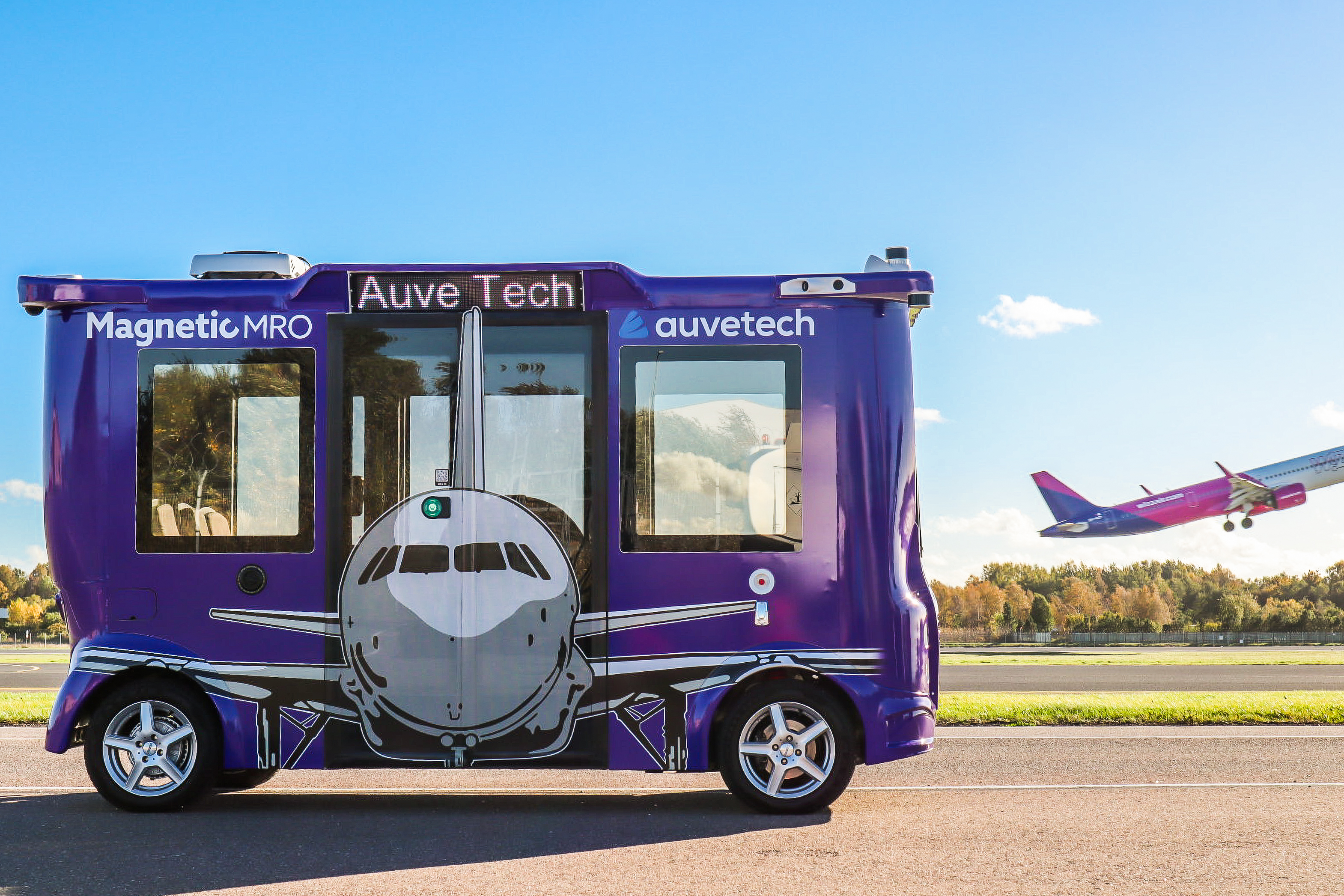
Auve Tech demonstrated its MiCa autonomous shuttle operating at Tallinn Airport without an onboard safety operator on October 7, in front of government officials, aviation regulators, and media, a milestone the Estonian autonomous-vehicle maker and the airport's board both describe as the first authorization of its kind at a European airport. The shuttle ran under remote supervision rather than full unsupervised autonomy, the detail that separates this announcement from a true driverless milestone, but removing the person physically on board, rather than simply removing their hands from the controls, is itself the regulatory threshold that has stalled most airside autonomous-vehicle programs in Europe for years.
The demonstration's immediate commercial application is narrower than the headline suggests. The MiCa shuttle is currently moving staff and equipment for Magnetic MRO, an aircraft maintenance, repair, and overhaul company, between hangars on the airside portion of Tallinn Airport, not carrying airline passengers between terminal and gate. Magnetic MRO's chief executive Risto Mäeots and Tallinn Airport board chair Riivo Tuvike both appeared at the demonstration, and the airport's framing treats passenger transport as a future extension of the same authorization rather than the service being launched today. For airport operators and ground-handling companies evaluating whether autonomous shuttles belong in their own operations, the realistic near-term use case this proves out is internal airside logistics, staff and equipment movement between facilities, not the passenger people-mover application that tends to dominate autonomous-shuttle marketing.
What Regulatory Approval Without a Safety Operator Actually Requires
Auve Tech says it received regulatory authorization in August to operate the MiCa shuttle without an onboard safety operator, a clearance that took roughly two years to reach from the company's account of testing that began in 2023, with commercial operations starting in 2025. That timeline is the detail procurement teams evaluating any autonomous-vehicle vendor's regulatory claims should pay closest attention to, because the gap between a vehicle technically capable of driving itself and a regulator willing to certify that capability without a human physically present has proven to be the longest and least predictable phase of every serious autonomous-vehicle program, far longer than the engineering development that precedes it. A vendor quoting a near-term timeline for removing a safety operator from a pilot program should be able to point to a specific regulatory pathway and an estimated approval timeline grounded in a jurisdiction's actual precedent, not an aspirational target, and Auve Tech's two-year approval process at one of Europe's smaller, more agile national aviation regulators is itself a useful benchmark for what that pathway realistically requires even in a comparatively fast-moving regulatory environment.
The operating statistics Auve Tech disclosed alongside the demonstration are the figures that matter most for any buyer assessing whether this approach is viable beyond a single showcase event. The company says its shuttles cover roughly 1,000 kilometers per week combined across its operations, with a 99.9 percent autonomy rate, meaning remote human intervention is required in a small fraction of operating time, and that a single remote operator can supervise multiple vehicles simultaneously. That last figure is the one with the clearest economic implication: if one remote supervisor genuinely can monitor several shuttles at once without a meaningful increase in intervention rate as fleet size grows, the labor cost of running an autonomous shuttle fleet scales far more favorably than a model requiring either an onboard operator per vehicle or a one-to-one remote supervision ratio. Airports and ground-handling companies evaluating a similar deployment should request the actual supervision ratio Auve Tech is running in production, not just the capability claim, since the commercial case depends entirely on how many vehicles one remote operator can safely and legally watch at once under the specific regulatory framework governing that deployment.
Remote Supervision Is Not the Same as Full Autonomy
Buyers should also be precise about what "without an onboard safety operator" does and does not mean here, because the distinction between remote supervision and genuine unsupervised autonomy is the one most likely to get collapsed in secondhand coverage of this kind of milestone. A remotely supervised vehicle still has a human in the control loop, able to intervene, slow down, or stop the vehicle if its onboard systems flag a problem or a remote operator notices one visually. What has changed is where that human sits and how many vehicles they can watch at once, not whether a human remains part of the safety architecture. That is a meaningful and commercially useful milestone, since it eliminates the cost and staffing complexity of putting a trained operator physically inside every vehicle, but it is a different claim from full driverless autonomy with no human oversight at all, and procurement teams should hold vendors to that more precise language when evaluating comparable pitches, rather than accepting "no safety operator" as shorthand for "fully autonomous."
The Airside Logistics Opportunity Other Airports Should Watch
Airside logistics, the movement of staff, baggage, equipment, and cargo between terminals, hangars, and aircraft stands within an airport's secured perimeter, is a less visible but potentially larger near-term market for autonomous shuttles than the passenger people-mover concept that has attracted more public attention. Airside vehicles operate within a controlled, access-restricted environment with lower pedestrian density than a public terminal concourse, fixed and well-mapped routes between known points, and an operator, the airport or a ground-handling tenant like Magnetic MRO, that already runs its own vehicle fleet and safety procedures rather than needing to build an entirely new regulatory relationship from scratch. Those conditions make airside logistics a more tractable environment to prove out remote-supervised autonomy than a passenger-facing deployment, which is precisely why Auve Tech's first no-operator authorization landed here rather than on a passenger route.
For other European airports and ground-handling operators watching this demonstration, the near-term question is not whether a comparable system could work at their own site, but whether their own national aviation regulator has an equivalent certification pathway, and how long it realistically takes to walk that pathway from pilot testing to an operator-free authorization. Auve Tech's two-year timeline through Estonia's regulatory process offers a concrete reference point, but regulatory pathways differ enough across European Union member states, and more significantly between the EU and non-EU markets, that no airport operator should assume a comparable authorization elsewhere would move at the same pace. The more durable signal from this demonstration is that a defined, auditable path from piloted testing to remote-supervised, operator-free commercial operation now exists and has been walked successfully once, which gives other airports and their autonomous-vehicle vendors a template to point to rather than an unproven theory.
How Auve Tech's Path Compares With Larger Rivals
Auve Tech is a small player next to the autonomous-shuttle and robotaxi companies that dominate headlines elsewhere, and that scale difference is worth putting in context rather than treating as a disadvantage on its own. Waymo and other robotaxi operators have pursued full passenger-facing autonomy in dense urban environments, a far harder regulatory and technical problem than airside logistics, and have done so with far larger balance sheets and years more testing data behind them. Auve Tech's strategy, starting in a controlled, access-restricted airside environment with a single enterprise customer rather than the general public, reflects a smaller company's more constrained resources as much as it reflects a deliberate crawl-before-you-run philosophy, but the outcome is the same either way: a working regulatory template that other operators, including larger ones with bigger ambitions, can study. Airports evaluating a shuttle vendor should not assume a larger, better-funded robotaxi company will necessarily reach an equivalent airside authorization faster, since regulatory approval in this space has consistently rewarded the narrowest, best-controlled initial use case rather than the most technically ambitious one.
The Baltic region more broadly has positioned itself as a proving ground for autonomous-vehicle regulation, with Estonia in particular running a comparatively permissive and fast-moving approach to testing new mobility technology relative to larger EU member states with more entrenched automotive and aviation regulatory bureaucracies. That regional pattern matters for buyers because it suggests the fastest path to a comparable authorization elsewhere in Europe may run through a similarly smaller, more agile national regulator rather than through the largest aviation markets first. A ground-handling company or airport operator in a larger EU state considering a similar pilot might reasonably look to partner with a vendor that already has Estonian or similarly fast-moving regulatory experience, using that track record as leverage when approaching their own national authority, rather than starting a certification conversation from zero.
The economic case for airside autonomous shuttles rests on a comparison most operators have not yet run with real numbers: the fully loaded cost of a driven shuttle, including staffing, shift coverage, and the overtime and scheduling complexity that comes with round-the-clock airside operations, against the cost of a remote-supervised autonomous fleet plus the ongoing cost of the remote operations center that replaces those drivers. Auve Tech's claimed 99.9 percent autonomy rate suggests that comparison favors the autonomous option once a fleet reaches sufficient scale to spread the remote operations center's fixed costs across more vehicles, but a single-shuttle pilot at one airport is unlikely to reach that scale on its own. The operators most likely to see a near-term return are large hub airports and ground handlers running enough vehicles simultaneously to make the remote supervision model's labor efficiency gains outweigh the fixed cost of standing up that capability in the first place.
This analysis synthesizes company statements and public regulatory disclosures as of the publication date and should not be read as investment, financial, or professional advice; it is provided for general information purposes only.