Anyverse Dynamics Ran a Live Robot Coffee Bar at WRC 2026
Anyverse Dynamics ran a fully operational coffee bar with its K15 wheeled humanoid at WRC 2026, in partnership with Korean chain HOLLYS, serving real customers unscripted for five days. The demonstration follows the K15's EU industrial CE certification in July and roughly US$100 million in orders, and is a more commercially realistic test than the week's sport-style humanoid demos.
A Robot Served Real Customers for Five Days, and Nobody Reset the Scene
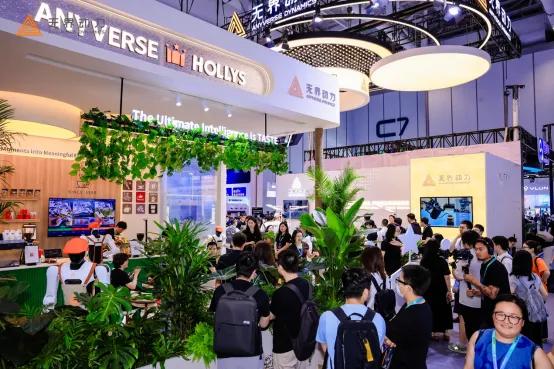
The most useful robot demonstration in Beijing last week was not a record attempt. It was a coffee bar. At the 2026 World Robot Conference, which ran from August 19 to 23 in the Yizhuang district, the embodied-intelligence company Anyverse Dynamics operated a working coffee counter inside the exhibition hall with its K15 robot handling service tasks, in partnership with HOLLYS, the Korean coffee chain owned by KG Group.
The distinction that matters is the word working. Visitors ordered what they wanted, when they wanted, and walked through the service area without warning. The robot delivered drinks, cleared tables, collected rubbish, sanitised hands, and repositioned chairs, and the company says it did so without preset trajectories or remote operation, driven by its own general-purpose model rather than a scripted sequence.
Why a Coffee Counter Is a Harder Test Than It Looks
Trade-show robotics is built around control. A demonstration cell has known object positions, a rehearsed task order, a cordon keeping the public at a fixed distance, and an engineer who can reset the scene between runs. Almost every impressive humanoid clip circulating this year was produced under some version of those conditions.
A public coffee bar removes most of them. Customers arrive at unpredictable intervals and order in an unpredictable mix. Cups end up in the wrong place. Chairs move. People stand where the robot needs to go and do not move when asked. The task sequence is not one manipulation repeated for the camera but a chain of small, dissimilar jobs that has to keep running for hours across five consecutive days.
None of that is technically glamorous. Pouring a drink is a lower bar than a backflip or a tennis rally. But it is a far closer approximation of what a commercial buyer in hospitality or facilities management actually needs, which is a machine that keeps working through a shift in a space designed for humans rather than for robots.
What Is Underneath the K15
K15 is Anyverse Dynamics' second-generation wheeled humanoid, a form factor that a large share of Chinese manufacturers have converged on for commercial service work because it avoids the balance problem of bipedal locomotion while retaining a human-height reach envelope. The company specifies a wrist flip radius of 30 millimetres and stable operation within an omnidirectional workspace width of 800 millimetres, numbers that matter in the confined space behind a counter.
The control layer is the part the company promotes hardest. Anyverse Dynamics calls it MWA, a general-purpose embodied brain built on what it describes as a latent-space world model combined with reinforcement learning. The architectural claim is that the system reasons about physical cause and effect in a compressed representation rather than predicting future video frames pixel by pixel, which the company argues yields faster real-time decisions in a cluttered, changing environment.
That claim is not independently verifiable from a demonstration, and buyers should treat it as a design philosophy rather than a proven advantage. What is checkable is that the company has published a benchmark figure, an average success rate of 75.2 percent on Stanford's RoboCasa GR1 evaluation suite for household and service manipulation, which at least gives an outside evaluator a common yardstick rather than a company-produced video.
The Company Behind It
Anyverse Dynamics, known in Chinese as Wujie Dongli, was founded in Beijing in 2025 by Zhang Yufeng, previously a vice president at Horizon Robotics, where he led the automotive intelligent-driving business. The founding team draws additional people from intelligent-mobility and autonomous-driving backgrounds.
The funding history is unusually front-loaded. An initial angel round of RMB 300 million (approximately US$42 million) was led by Sequoia China and Linear Capital, with participation including Hillhouse, Horizon Robotics, Zhongding Capital, and BV Baidu Ventures. By late April 2026 the company announced an angel-plus-plus round that took cumulative angel-stage funding past US$200 million, jointly invested by Envision Group and the Beijing municipal artificial-intelligence industry investment fund, with existing shareholders following on.
Envision is also a commercial partner rather than only an investor, having signed an agreement covering global deployment and joint development for overseas markets across Europe and Asia valued at more than RMB 500 million. That relationship is the most plausible explanation for how a company founded in 2025 arrived at the roughly US$100 million in domestic and international orders it reported entering delivery earlier this summer.
Where a Wheeled Humanoid Fits, and Where It Does Not
The form factor deserves a comment, because it is the quiet consensus of Chinese commercial robotics this year and it is frequently misread abroad as a compromise.
A wheeled base removes the hardest unsolved problem in humanoid robotics, dynamic bipedal balance under load, while keeping the two features that make a humanoid useful indoors: a torso height that reaches the same shelves and counters people use, and two arms that can perform tasks designed for two hands. In a coffee shop, a hotel corridor, or a hospital supply room, floors are flat and continuous by building code, so legs buy very little and cost a great deal in reliability, power draw, and price.
The trade is real, though. A wheeled machine cannot manage a step, a kerb, or a narrow staircase, which rules out a large share of older European retail and hospitality stock without a lift. Buyers evaluating K15 for a specific site should walk the actual route the robot will take before treating a convention-hall demonstration as evidence about their own floor.
That constraint also explains why the certification work matters so much to this particular company. A machine restricted to flat, continuous indoor floors is a machine that lives in commercial buildings, and commercial buildings in Europe come with an inspection regime attached.
The Regulatory Groundwork That Preceded the Demo
The coffee bar also functions as a showcase for a piece of paperwork the company secured six weeks earlier. On July 9, Anyverse Dynamics announced that K15 had cleared the European Union's industrial-grade full-scope CE certification, covering machinery safety, radio equipment, electromagnetic compatibility, and functional safety, together with the EN 18031 cybersecurity standard, and described it as a first for an embodied-intelligence robot.
That certification is the less photogenic half of the story and arguably the more consequential one. CE marking requires third-party laboratory assessment against published European standards rather than self-reported benchmarks, and the cybersecurity provisions now applied to connected devices sold into the European market have become a genuine bottleneck for Chinese hardware exporters across categories. A robot that has already cleared those tests can be shipped and operated legally in Europe. A robot that has not is a prototype with a sales deck, whatever its manipulation scores look like.
What Is Still Unanswered
Several things a serious buyer would need are absent from the announcement.
The company has not disclosed how many drinks were served, how many interventions a human operator made across the five days, or how many task attempts failed. A demonstration that runs for five days with three staff quietly correcting it is a different product from one that runs for five days untouched, and only the operator knows which happened.
Unit price and service terms are undisclosed, as is the split within the reported order figure between firm purchase orders and framework agreements, a distinction that Chinese humanoid order books routinely blur. Nor has the company published throughput comparisons against the obvious alternative, which in a coffee shop is not another robot but a person who costs less than the machine's depreciation.
The RoboCasa figure, useful as it is, was generated in simulation-derived evaluation rather than on a specific customer's floor plan, and a 75.2 percent average success rate on benchmark manipulation tasks would be unacceptable if it translated directly to a paying customer's drink order. One order in four going wrong is a queue of annoyed customers by mid-morning, so the operative question for a buyer is which tasks in the real sequence the robot fails at, and whether those failures are recoverable without a person walking over.
The Signal Worth Keeping
Strip out the marketing and one thing separates this from the rest of the week's demonstrations. Anyverse Dynamics chose to run an ordinary, low-prestige, commercially realistic task in an uncontrolled space for five days, then invited people to walk through it. Most of its competitors chose sport.
Both choices are rational. Sport produces the footage that travels, and travelling footage raises money. But the buyer signing a deployment contract is not buying footage, and the vendors that will convert this year's attention into next year's revenue are the ones accumulating hours in environments they do not control. A coffee counter in a convention hall is a small version of that, with a real customer queue and no reset button.
The test worth watching is whether the same platform is still pouring drinks in a HOLLYS store in six months, with the failure data published, rather than in a booth for five days with the numbers kept in-house.
Image: Sina Finance.
Disclaimer: This article is for general information purposes only and does not constitute investment, legal, or procurement advice. Readers should verify details with primary sources before making business decisions.