Anyverse Dynamics' K15 Robot Clears Full EU CE Certification
Anyverse Dynamics says its K15 service robot is the first embodied-AI machine to clear the EU's complete industrial CE certification suite, including the EN 18031 cybersecurity standard, as it ships roughly US$97 million worth of orders to European customers.

The Paperwork That Actually Unlocks the European Market
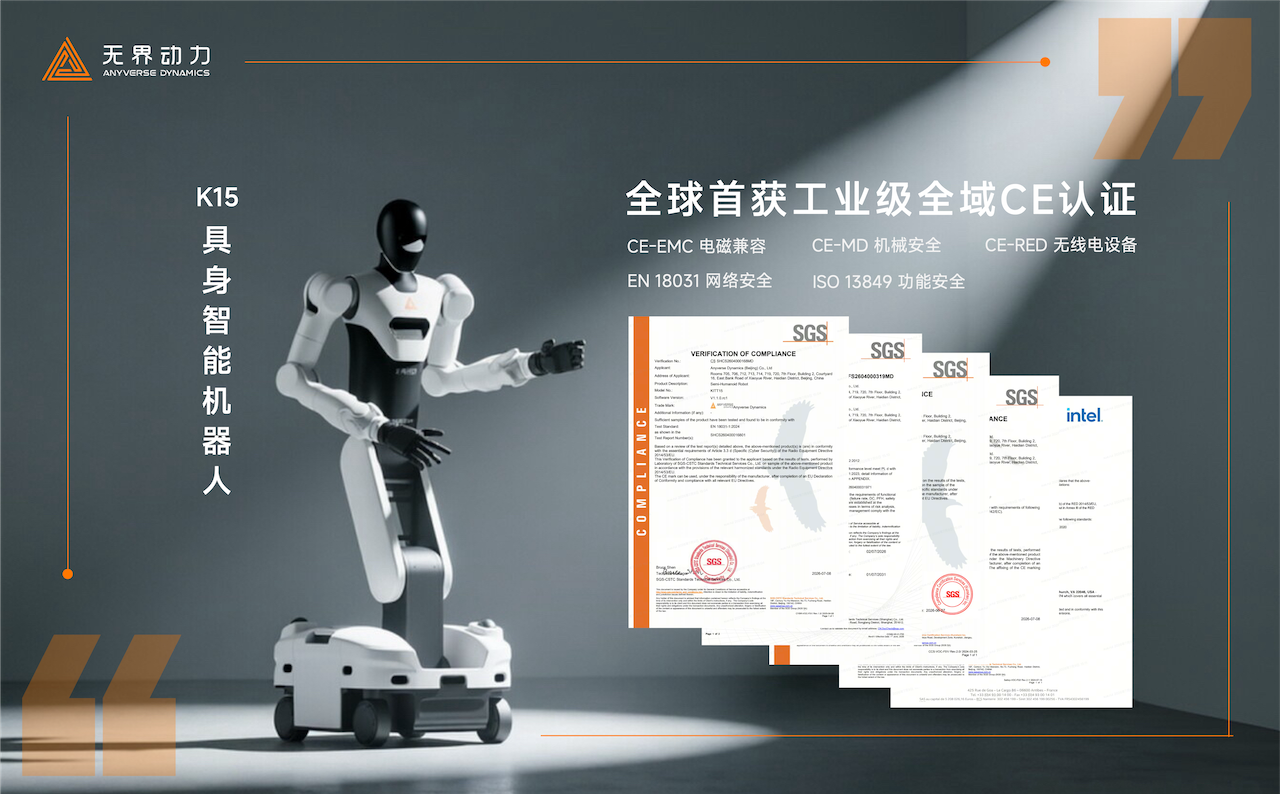
A stack of five European compliance certificates, not a new demo reel, is the headline product news out of Anyverse Dynamics this week. The Beijing-based embodied-intelligence startup said its K15 wheeled-humanoid robot has cleared the European Union's full industrial-grade CE certification suite, covering machinery safety, radio equipment, electromagnetic compatibility, functional safety under EN ISO 13849, and, notably, the EN 18031 cybersecurity standard, making it, by the company's account, the first embodied-AI robot worldwide to pass that combined set. Certification is rarely the story in a market driven by flashy demos, but for any operator planning to run a robot on a European warehouse or hospitality floor, it is the one document that actually determines whether a purchase order can proceed.
Anyverse Dynamics, known in Chinese as Wujie Dongli, is a Beijing startup founded by former Horizon Robotics vice president Zhang Yufeng, focused on building a general-purpose embodied brain for commercial service robots. The company disclosed more than RMB 300 million (approximately US$42 million) in a recent angel-plus funding round backed by Sequoia China, Linear Capital, and Hillhouse, and it used this week's World Robot Conference appearance to pair that European certification with a commercial claim: roughly RMB 700 million (approximately US$97 million) in orders for K15 units, with first shipments now heading to European customers.
What K15 Actually Does Behind the Espresso Machine
The company's chosen showcase for the certification, a fully operating coffee bar staffed by K15 units inside the exhibition hall and, before that, a trial run at a commercial coffee shop and a live partnership with the Hollys coffee chain during the show, was deliberately mundane. A wheeled humanoid making espresso is a lower bar technically than a bipedal robot playing sport, but it is a far closer approximation of the environment most commercial buyers actually operate in: crowded floor space, customers walking through the work area without warning, and a sequence of small tasks, taking an order, pulling a shot, clearing a cup, sanitizing a surface, that has to run continuously for hours without a human minder resetting the scene between demonstrations.
Anyverse Dynamics attributes that continuous operation to what it calls its MWA, or latent-space world model, an architecture the company says prioritizes physical understanding, predicting how objects and space will behave, over pixel-level video prediction, which it argues produces more efficient real-time decisions in a dynamic environment. The company has published a benchmark result of 75.2 percent average success rate on Stanford's RoboCasa GR1 evaluation suite, a widely used academic benchmark for household and service manipulation tasks, giving outside evaluators at least one third-party reference point rather than relying solely on the company's own demonstration footage.
Reading the Order Book Correctly
The RMB 700 million (approximately US$97 million) order figure is the number most likely to draw attention, and it is also the number that requires the most caution before a buyer treats it as evidence of market validation. Order books in China's humanoid sector routinely include letters of intent, framework agreements, and multi-year delivery commitments alongside firm, paid purchase orders, and Anyverse Dynamics has not broken out how much of the total represents revenue already recognized versus contracted future delivery. What the figure does establish credibly, paired with the CE certification, is that the company has moved past the stage of exhibiting a single robot at a trade show and into fulfilling actual delivery schedules, since the announcement specifically frames European shipments as already underway rather than planned.
The certification itself is the more verifiable claim, since CE marking requires third-party laboratory testing against published EU technical standards rather than a company's self-reported benchmark. For a European buyer, that distinction matters immediately: a robot without EN 18031 cybersecurity certification, in particular, cannot legally be sold as a connected consumer or commercial device in the EU market from August 2025 onward under the Radio Equipment Directive's expanded cybersecurity requirements, which makes Anyverse Dynamics' claimed first-mover status on that specific standard a genuine, checkable differentiator rather than marketing language.
That regulatory detail is easy to skip past, but it is the reason a European distributor or systems integrator should read this announcement differently than a typical product launch. The Radio Equipment Directive's cybersecurity provisions apply to any connected device sold into the EU, not just robots, and Chinese hardware exporters across categories, from consumer electronics to industrial IoT, have spent much of the past two years discovering how expensive and slow third-party cybersecurity conformity testing actually is. A humanoid robot vendor that has already cleared that bar has removed one of the more common causes of a shipment being held at customs or a deal stalling in legal review, a mundane but real advantage over a competitor still waiting on lab test slots.
The Competitive Logic Behind Chasing Certification First
Most Chinese humanoid makers have prioritized capability demonstrations, dexterity, speed, task variety, over regulatory paperwork, betting that certification can be handled later once a design stabilizes. Anyverse Dynamics is making the opposite bet: that in a market as crowded as commercial service robotics has become, the company that can legally ship into Europe today, rather than the one with the most impressive video, wins the actual purchase order. That is a reasonable strategy for a company whose backers include some of China's most experienced growth-stage investors, since regulatory clearance is a slower, more capital-intensive process than another iteration of a manipulation demo, and a well-funded startup can absorb that cost ahead of competitors still focused on domestic showcases.
It also signals something about where Anyverse Dynamics expects its near-term revenue to come from. Hospitality and food service, coffee, quick-service dining, hotel concierge work, are lower-stakes environments than a manufacturing line or a hospital ward, with less regulatory friction beyond the equipment certification itself and lower liability exposure if a task fails. That makes it a sensible first market for a company still building out a track record, even if the long-term ambition, implied by a general-purpose world model rather than a single-task robot, clearly extends toward logistics and industrial settings where the margins and order sizes are larger.
The founder's background reinforces that reading. Zhang Yufeng spent years at Horizon Robotics, a Beijing chipmaker best known for automotive-grade AI processors used in autonomous driving systems, before starting Anyverse Dynamics, giving the company an unusually strong internal understanding of the edge-compute constraints that determine whether a world model can actually run in real time on a robot's onboard hardware rather than a data-center GPU cluster. That background may help explain why Anyverse Dynamics chose to compete on certification and reliability rather than headline dexterity numbers: a team that spent years optimizing perception models to run within an automotive chip's power and latency budget is likely to treat a coffee shop's continuous-uptime requirement as the more natural extension of its existing expertise than a manipulation benchmark designed to impress conference attendees.
What a Procurement Team Should Actually Verify
A buyer evaluating K15 for a European deployment should treat the CE certification as necessary rather than sufficient. It confirms the robot can be legally imported and operated, not that it will perform reliably on a specific customer's floor plan or task mix; the RoboCasa benchmark score is a useful academic reference point but was not generated on the buyer's own environment. The open questions that actually determine total cost of ownership, unit price, service and parts logistics for a robot now shipping outside China, mean time between required interventions during a full shift, and how the 700 million yuan order figure splits between signed contracts and pipeline, have not been disclosed, and a serious procurement process should press for those numbers directly rather than inferring them from the certification announcement.
What Anyverse Dynamics has proven this week is narrower but real: that its K15 platform has cleared the specific legal hurdle that stops most Chinese embodied-AI hardware from reaching European commercial buyers at all. Whether the company converts that opening into the kind of sustained order volume its funding round implies investors expect is the test its next disclosure will need to answer, and it is a test measured in shipped units and repeat orders, not in another certificate on the wall.
The broader signal for the rest of China's humanoid sector is that regulatory readiness is becoming a competitive axis in its own right, separate from and arguably as consequential as the dexterity and speed benchmarks that have dominated coverage of the industry so far. A robot that cannot legally clear customs in a target market is not a viable vendor in that market regardless of how impressive its manipulation footage looks, and the companies treating certification as a first-year priority rather than an afterthought are the ones positioning themselves to actually collect the international order volume the industry's more ambitious revenue projections assume will materialize.
Disclaimer: This article is for general information purposes only and does not constitute investment, legal, or procurement advice. Readers should verify details with primary sources before making business decisions.