Google DeepMind Launches Gemini Robotics 2 for Whole-Body Humanoid Control
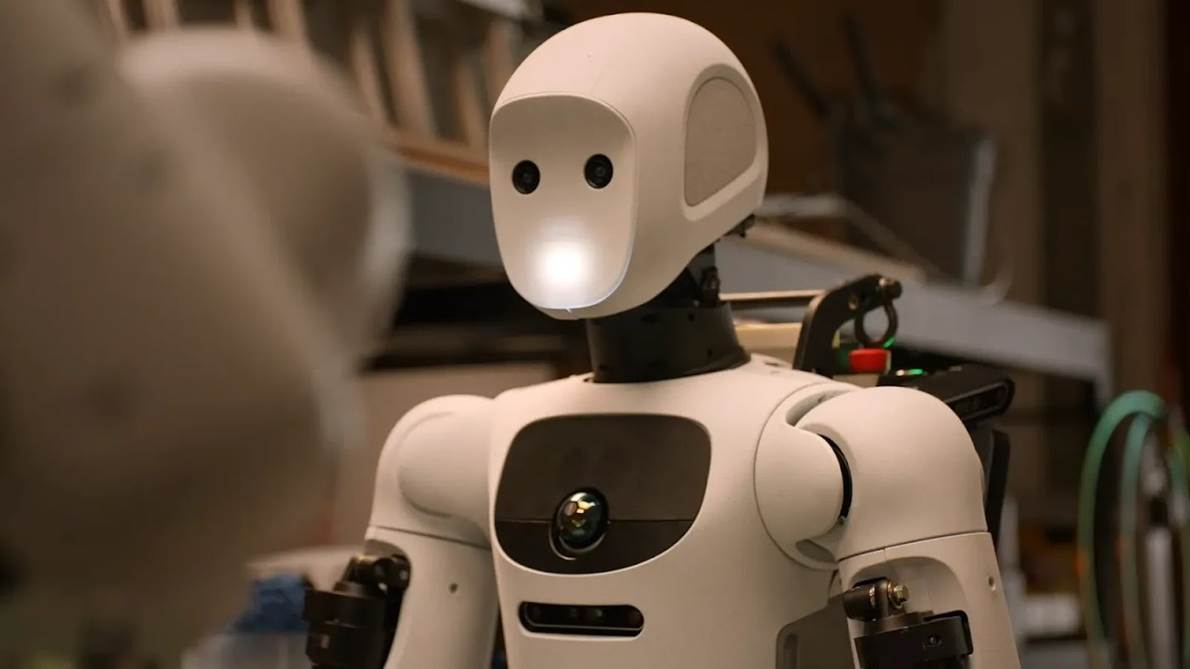
Google DeepMind has launched the Gemini Robotics 2 family, a suite of three foundation models designed to bring whole-body control and advanced reasoning to humanoid robots. The release includes a vision-language-action (VLA) model capable of controlling 22-degree-of-freedom multifingered hands, an embodied reasoning (ER) model for multi-robot coordination, and an on-device variant that adapts to new hardware in hours. Demonstrated on platforms from Apptronik, Franka, and others, the models show significant progress in intricate manipulation tasks, though published benchmarks reveal the persistent difficulty of fine motor skills like screwing in a light bulb. The ER 2 model is now available in public preview via Google AI Studio, signaling a shift toward broader developer access in the robotics foundation model space.
Ninety-two percent success in unscrewing a light bulb, but only thirty-six percent success in screwing one back in. This stark contrast in Google DeepMind’s newly published benchmarks for its Gemini Robotics 2 family encapsulates the current frontier of physical artificial intelligence. On July 30, 2026, the technology giant unveiled a trio of foundation models designed to push humanoid capabilities beyond basic locomotion and parallel-jaw gripping into the realm of whole-body, multifingered dexterity. The release, comprising a vision-language-action (VLA) model, an embodied reasoning vision-language model, and a highly adaptable on-device variant, represents a significant architectural leap from the original Gemini Robotics platform launched in March 2025.
The introduction of Gemini Robotics 2 arrives at a critical juncture for the automation industry. As hardware platforms mature, the bottleneck has decisively shifted from mechanical engineering to software intelligence. Procurement managers and operations leaders evaluating humanoid deployments are no longer asking if a robot can walk across a warehouse floor; they are asking if it can reliably manipulate the diverse, unstructured objects that define human-centric work environments. By publishing detailed failure rates alongside success metrics, DeepMind is providing a rare, unvarnished look at the deployment gap that still exists for fine motor skills.
The new family of models is structured to address different layers of the robotics software stack. The flagship Gemini Robotics 2 is a VLA model that provides whole-body control, extending from the robot's feet to its fingertips. This includes the sophisticated coordination required for dexterous multifingered hands, a capability demonstrated on the Apptronik Apollo 2 humanoid equipped with SharpaWave 22-degree-of-freedom hands and Inspire hands. Apptronik, headquartered in Austin, Texas, develops general-purpose humanoid robots primarily targeting logistics and manufacturing applications. The VLA model's ability to manage the high-dimensional action spaces of these advanced end-effectors marks a departure from earlier systems that relied heavily on simpler parallel grippers.
The Architecture of Embodied Reasoning
How does the Gemini Robotics ER 2 model function within a multi-robot deployment? The ER 2 model acts as an agentic brain, utilizing advanced spatial understanding and video reasoning to handle task planning and multi-robot coordination across a facility. It processes visual and linguistic inputs to coordinate intricate workflows, effectively serving as the high-level cognitive layer that directs the lower-level VLA control policies.
This separation of reasoning and action is a crucial architectural choice. The ER 2 model, which achieved approximately 60 percent on video frame completeness assessments and 90 percent on key moment identification in DeepMind's internal testing, is designed to understand the broader context of a task. It can interpret a command, break it down into sequential steps, and assign those steps to different robots based on their capabilities and proximity. This capability is particularly relevant for operations leaders looking to deploy heterogeneous fleets of robots that must collaborate seamlessly to achieve a common goal.
The decision to make Gemini Robotics ER 2 available in public preview on Google AI Studio (under the model ID gemini-robotics-er-2-preview) is a significant market signal. It allows integrators and software developers to evaluate the reasoning layer immediately, without requiring a formal hardware partnership or access to the underlying VLA models. This decoupling of the cognitive and physical control layers lowers the barrier to entry for building advanced robotics applications and accelerates the development of the broader ecosystem.
Adapting to New Embodiments
One of the most persistent challenges in robotics is the "sim-to-real" gap and the difficulty of transferring learned behaviors across different hardware platforms. The Gemini Robotics On-Device 2 model addresses this directly. Designed to run locally on robot hardware, this variant can adapt to entirely new robot embodiments in a matter of hours, requiring fewer than 200 demonstration examples for fine-tuning.
This rapid adaptation capability was demonstrated across a variety of platforms, including Dexmate, SO101, and Trossen systems. For procurement teams, this translates to reduced deployment friction and lower integration costs. The ability to quickly retrain a model for a specific end-effector or a novel hardware configuration means that automation solutions can be customized more efficiently, without the need for massive data collection campaigns or extensive cloud computing resources.
The on-device execution also addresses critical concerns regarding latency and connectivity. In industrial environments where network reliability can be inconsistent, relying on cloud-based inference for real-time control is often a non-starter. By processing the VLA policy locally, the On-Device 2 model ensures that the robot can maintain safe and responsive operation even in disconnected scenarios.
The Economics of Attributable Mass
The performance benchmarks published by DeepMind offer a sobering reality check against the often-hyperbolic claims of the robotics industry. While the models achieved impressive success rates in certain tasks, such as a 76.3 percent success rate for picking up objects from a shelf and an 89.6 percent success rate for precise insertion using parallel grippers, the multi-fingered hand tasks reveal the immense difficulty of replicating human dexterity.
The 36 percent success rate for screwing in a light bulb and the 32 percent success rate for sweeping with a dustpan highlight the intricate interplay of force feedback, spatial awareness, and fine motor control required for these actions. These numbers are not an indictment of the technology, but rather a transparent baseline that operations buyers must factor into their ROI calculations. When evaluating a humanoid for a specific workflow, the failure rate dictates the level of human supervision required and the frequency of necessary interventions.
Think of the difference between a robot grasping a solid metal block and a robot handling a fragile, irregularly shaped object like a ripe piece of fruit; the former requires simple geometry, while the latter demands a nuanced understanding of material properties and continuous, micro-adjustments of force that current models are only just beginning to master. This is the deployment gap that separates a compelling laboratory demonstration from a reliable industrial solution.
The Competitive Environment of Foundation Models
The launch of Gemini Robotics 2 intensifies the competition among technology giants and specialized startups to establish the dominant foundation model for physical AI. The market is rapidly fragmenting into different architectural approaches and deployment strategies.
NVIDIA's Isaac GR00T N1.6, released in May 2026, represents an open-model approach, providing humanoid upper body and locomotion control via the GR00T stack and integrating with the Cosmos Reason world model. Physical Intelligence's pi-0.5, updated in April 2026, offers open-source weights for mobile manipulators and arms, appealing to researchers and developers who prefer self-hosted solutions. Meanwhile, Figure AI's Helix model remains proprietary, tightly integrated with the Figure 02 and 03 humanoids, utilizing System 2 language reasoning for full upper-body control.
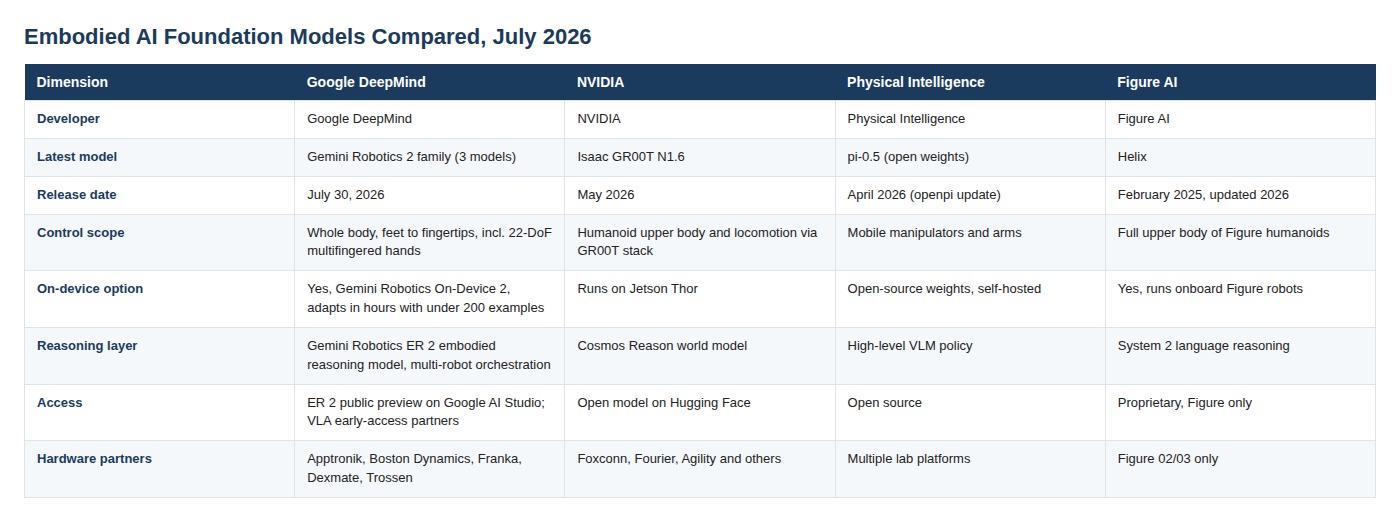
DeepMind's strategy appears to be a hybrid approach, offering the reasoning layer (ER 2) in public preview while restricting the VLA and On-Device models to early-access partners. This allows them to seed the developer ecosystem with their cognitive tools while maintaining tight control over the physical execution layers, likely to ensure safety and performance standards are met during these early stages of deployment. The concurrent release of the ASIMOV-Agentic safety benchmark on Hugging Face and a comprehensive safety technical report underscores this cautious approach to physical embodiment.
Strategic Implications for Hardware Partnerships
The hardware partnerships announced alongside Gemini Robotics 2 provide critical insight into DeepMind's broader ambitions. While the initial demonstrations heavily featured the Apptronik Apollo 2 and the Franka FR3 Duo bi-arm platform, the revelation that testing is also underway on Boston Dynamics hardware is a significant development.
This cross-OEM testing signals that DeepMind is not content to be the intelligence layer for a single hardware provider. By validating their models on diverse platforms, from the bipedal Apollo to the highly dynamic systems developed by Boston Dynamics, they are positioning Gemini Robotics as a universal operating system for physical AI. For procurement managers, this trend toward hardware-agnostic foundation models is a positive indicator. It suggests a future where the intelligence layer can be decoupled from the physical chassis, allowing buyers to select the best hardware for their specific environmental constraints without being locked into a proprietary software ecosystem.
The integration of Gemini Robotics 2 into the broader Google ecosystem also presents unique advantages. The ER 2 model's availability via the Gemini Enterprise Agent Platform suggests a seamless pathway for enterprise customers to connect their robotics deployments with their existing cloud infrastructure and data analytics tools. This level of integration is essential for moving robotics out of isolated pilot projects and into core operational workflows.
As the industry moves forward, the focus will inevitably shift from the impressive capabilities demonstrated in controlled environments to the messy, unpredictable realities of the factory floor and the warehouse aisle. The transparent publication of failure rates by DeepMind is a necessary step in maturing the conversation around humanoid robotics. It acknowledges that while the cognitive reasoning capabilities of these systems are advancing rapidly, the physical execution of intricate, multifingered tasks remains a formidable challenge. The true test of Gemini Robotics 2 will not be its performance on a laboratory benchmark, but its ability to deliver consistent, reliable value in the hands of the operations teams tasked with deploying it.
Disclaimer: This article is for informational purposes only and does not constitute investment advice, endorsement, or verification of any claims made by the companies mentioned.