Why Skild AI Taught a Robot Soccer Instead of a Warehouse Job
Skild AI used self-play, not human demonstrations, to train a humanoid robot to play soccer, testing whether robots can learn physical skills beyond what any human teacher could show them.

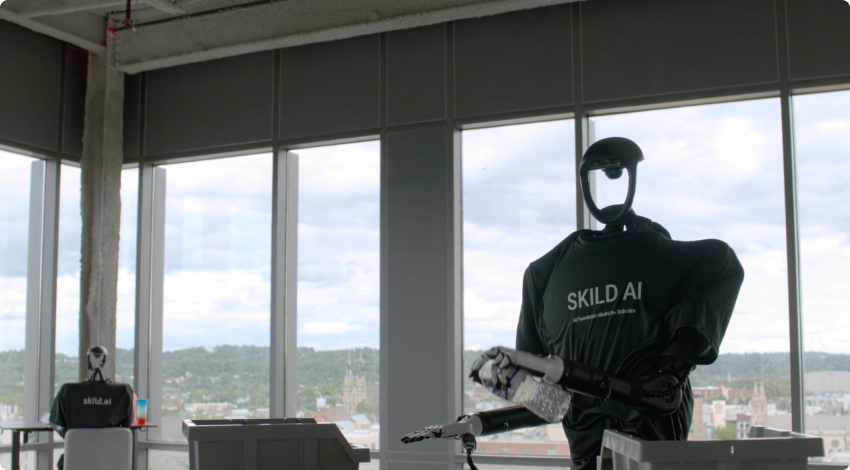
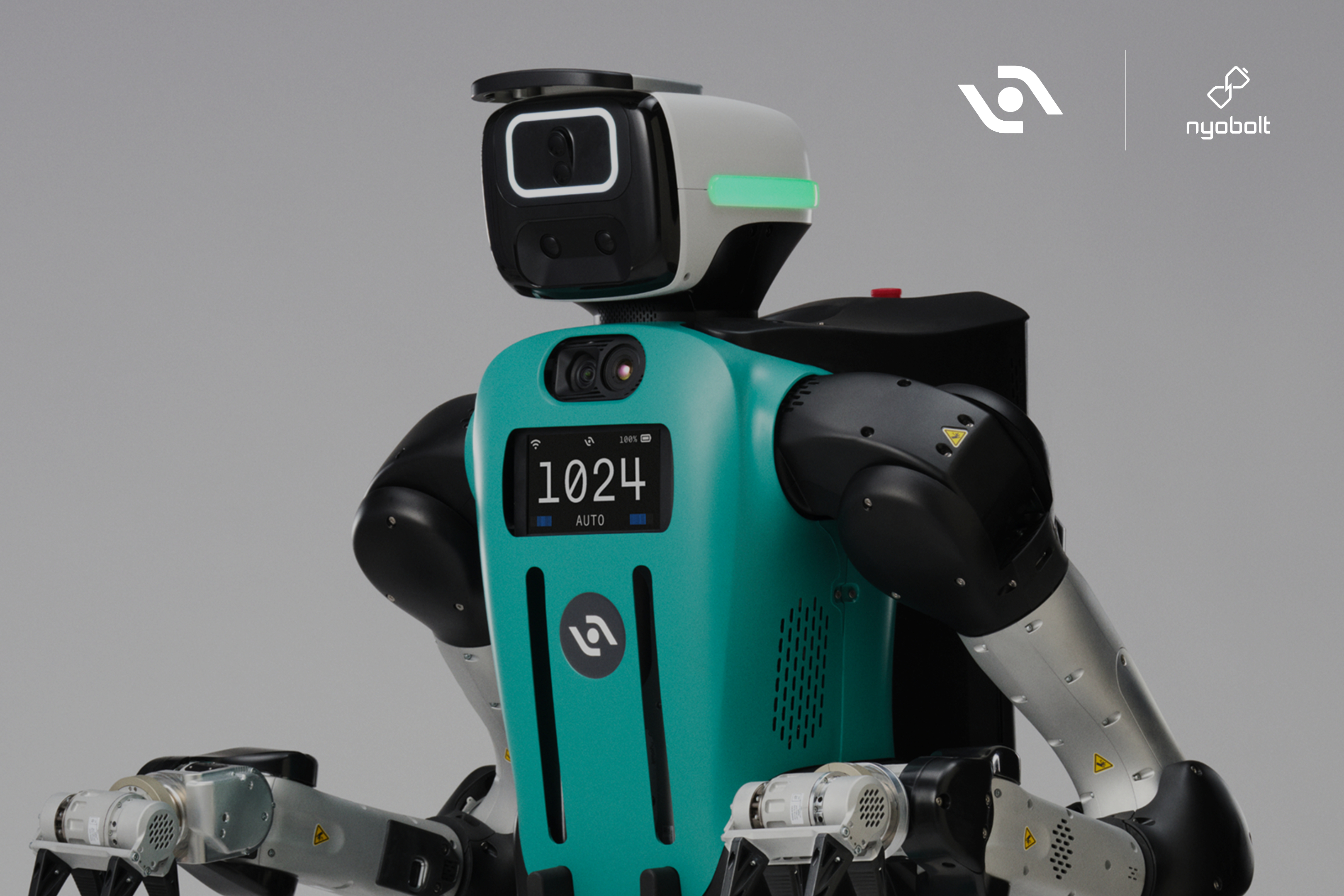
Every robot that learns to move by imitating a person inherits that person's ceiling. A robotic-arm policy trained on thousands of hours of human teleoperation footage can get very good at the tasks captured in that footage, but it cannot get better than the demonstrations it was shown, because imitation learning optimizes for matching a human's behavior rather than for exceeding it. Skild AI, a Pittsburgh-based robotics foundation-model company founded in 2023 by Carnegie Mellon researchers Deepak Pathak and Abhinav Gupta and backed by a SoftBank-led funding round that has pushed its valuation above US$14 billion, published results this month arguing that a different training method, self-play, can break that ceiling. The company trained a humanoid robot to play soccer using no human demonstrations of the sport at all, then transferred the resulting policy from simulation onto physical hardware.
The training ran inside NVIDIA's Isaac Sim simulator with a single objective written into the reward function: score a goal. Skild did not separately program dribbling, tackling, shielding the ball, or recovering from a fall. Each of those behaviors emerged on its own as a side effect of a policy repeatedly trying to win against an opponent that was, every round, a slightly improved version of itself, the same self-play structure that DeepMind used to train AlphaGo past human champions and that both OpenAI and DeepMind used to train competitive agents in StarCraft II and Dota 2. What is new here is not the training method, which has a decade of precedent in purely digital games, but its application to a physical humanoid body that has to translate a simulated policy into real joint torques, real balance constraints, and a real risk of falling over.
Why a Human-Data Ceiling Is a Real Commercial Constraint
For a buyer evaluating robot-learning vendors, the human-data ceiling is not an abstract research concern. Most commercially deployed robot-manipulation systems today, including the ones handling warehouse picking, assembly-line tasks, and increasingly service work, are trained at least partly on human teleoperation or video demonstration data, because collecting that data is more tractable than designing a reward function sophisticated enough to let a robot discover a good policy from scratch. The tradeoff is that a vendor's robot can only be as skilled as the demonstrators who generated its training data, and demonstrations are expensive and slow to collect at the scale needed to cover every edge case a deployment will eventually encounter. A warehouse robot trained only on demonstrated grasps will struggle with an object shape or orientation nobody happened to demonstrate; a robot trained through self-play against a reward signal, in principle, keeps improving against that signal indefinitely, independent of what any human operator has shown it.
That distinction is why Skild frames the soccer demonstration as evidence for a broader capability claim rather than as a product in itself. Nobody is buying a soccer-playing humanoid for a factory floor. The claim worth scrutinizing is whether the underlying technique, letting a policy improve against its own increasingly difficult past versions rather than against a fixed library of human demonstrations, generalizes to the kinds of contact-rich, physically adversarial tasks that show up in logistics, construction, and field-service work: tasks where a robot has to recover from an unexpected collision, adapt to a shifting load, or handle an object that behaves differently than the training data suggested it would.
From a Simulated Goal to a Standing Robot
The practical difficulty in this kind of work has never been getting a policy to perform well inside a simulator. Reinforcement learning has produced impressive simulated behavior for years. The difficulty is the transfer step: a policy tuned against a simulator's approximate physics, approximate friction models, and approximate sensor noise frequently fails, sometimes dangerously, when it is loaded onto an actual robot with real motor backlash, real battery-voltage sag under load, and a real floor surface the simulator did not model precisely. Skild's demonstration did complete that transfer, moving the trained soccer policy from Isaac Sim onto a physical humanoid that then played against opponents in the real world, which is the harder and more commercially relevant half of the result. A simulation-only achievement would have been a research curiosity; a policy that survives the jump to physical hardware is a signal about the robustness of the underlying training approach.
Early in training, by Skild's own account, the simulated robot could barely walk. The progression from that starting point to a policy that dribbles around defenders, shields the ball from an opponent, executes tackles, and recovers its balance after being knocked down illustrates what self-play is actually good at: discovering a broad behavioral repertoire from a sparse, simple objective, rather than requiring an engineer to anticipate and hand-code every situation the robot might face. That is a meaningfully different development process than demonstration-based training, where every new behavior typically requires new human-collected examples of that specific behavior.
What the Multi-Agent Experiments Suggest About Coordination
Skild also ran early four-agent soccer experiments, moving beyond a single robot playing against a single opponent toward multiple robots that needed to coordinate as teammates. The company reports that passing and coordination behavior emerged from those experiments as well, again without being explicitly programmed. If that result holds up under more rigorous testing, it points toward a capability with direct relevance beyond sport: coordinated multi-robot behavior is exactly what a warehouse running a fleet of mobile manipulators, or a construction site running multiple robots on the same structure, actually needs, and it is historically one of the harder problems in multi-robot systems, since coordination failures compound in ways that single-robot failures do not.
Skild has stated that its next research steps extend the self-play approach toward collaborative manipulation and navigation tasks, and more broadly toward everyday robotics applications beyond the soccer demonstration itself. The company's stated commercial thesis is that this reduces how much human-generated demonstration data a robot-learning system needs to reach a given capability level, which, if it holds up at the scale commercial deployments require, would lower one of the more expensive and slow-moving cost centers in building a general-purpose robot-foundation model.
How This Fits Against Rival Approaches to the Same Problem
Skild is not alone in trying to push robot learning past imitation's ceiling. Physical Intelligence, Figure, and a cluster of other well-funded robotics-foundation-model companies have each published variations on reinforcement learning layered over demonstration-based pretraining, and simulation-to-real transfer has been an active research problem across humanoid-robotics labs for several years, including at NVIDIA itself, whose Isaac Sim platform Skild used for this work. What differs across these efforts is less the underlying technique, self-play and reinforcement learning are both well-established tools, than the specific domain each company chooses to demonstrate the approach in and how directly that domain maps onto a sellable commercial capability. A locomotion-and-balance demonstration, which is closer to what most legged-robot research groups have published, maps fairly directly onto a warehouse or field-service robot's core requirement to stay upright and move reliably. A ball-sport demonstration maps less directly onto most commercial use cases, which is precisely why Skild is explicit that the soccer result is a capability proof rather than a product, and why the company's stated next step, applying the same self-play structure to collaborative manipulation and navigation, is the result procurement teams should actually wait for before treating this as evidence of near-term deployable capability.
The competitive stakes in this specific research question are high because whichever foundation-model vendor demonstrates the most convincing, most general self-play results first has a plausible claim to a durable technical lead: a training methodology that keeps improving a robot's skill ceiling without a proportional increase in expensive human-data collection scales more cheaply than a pure-imitation approach as a company tries to cover more tasks and more robot embodiments. That is the commercial logic behind why a result as narrow as robot soccer is drawing this much attention from a company with Skild's funding and valuation: it is a public, falsifiable test of a training methodology the company is betting its broader product roadmap on, not a product announcement in its own right.
The Gap Between a Demonstration and a Deployable System
None of this makes self-play a substitute for the S1 foundation model's existing demonstration-based pretraining, and Skild is not presenting it that way. S1 was introduced in August 2026 pre-trained on human video, glove-capture data, simulation data, and teleoperation data, and the self-play work described this month is explicitly framed as a post-training extension layered on top of that base model rather than a replacement training pipeline. The practical architecture, in other words, still starts with human data to establish a baseline of competent behavior, then uses self-play to push specific skills past what that baseline data alone could teach. That is a more modest and more defensible claim than "self-play replaces human data entirely," and it is the version of the claim a procurement team evaluating Skild, or any competing foundation-model vendor making a similar argument, should hold the company to.
The distinction between a demo and a deployable system is the one buyers should keep returning to as more robotics vendors publish self-play results over the coming year. A soccer-playing humanoid is a controlled, well-defined, sparse-reward environment: scoring and ball possession are easy to measure precisely, and a losing policy is unambiguous. Commercial deployment environments are messier, with reward signals that are far harder to specify cleanly, like "successfully fulfilled this order without damaging inventory," and measurement systems that cannot always tell a vendor's self-play loop whether a given attempt actually succeeded. Whether Skild's technique transfers from a game with an obvious scoreboard to a warehouse floor with a much fuzzier definition of success is the open question this demonstration raises rather than answers, and it is the question worth asking directly of any vendor citing this result as evidence their robots are approaching general-purpose competence.
This account synthesizes October 16, 2026 reporting on Skild AI's self-play soccer demonstration, cross-referenced against public reporting on the company's funding history and its S1 foundation model, as of the stated publication date.
This article is provided for general information purposes only and does not constitute investment, procurement, legal, or engineering advice. Figures reflect the sources listed above as of the stated information cut-off and may change without notice.