AI's Cognitive Debt: Fiction vs. Reality
AI removes the cognitive struggle of thinking. Like a muscle, the brain atrophies without exercise. Outsourcing reasoning risks losing our intellectual architecture, leaving a superficial society now.

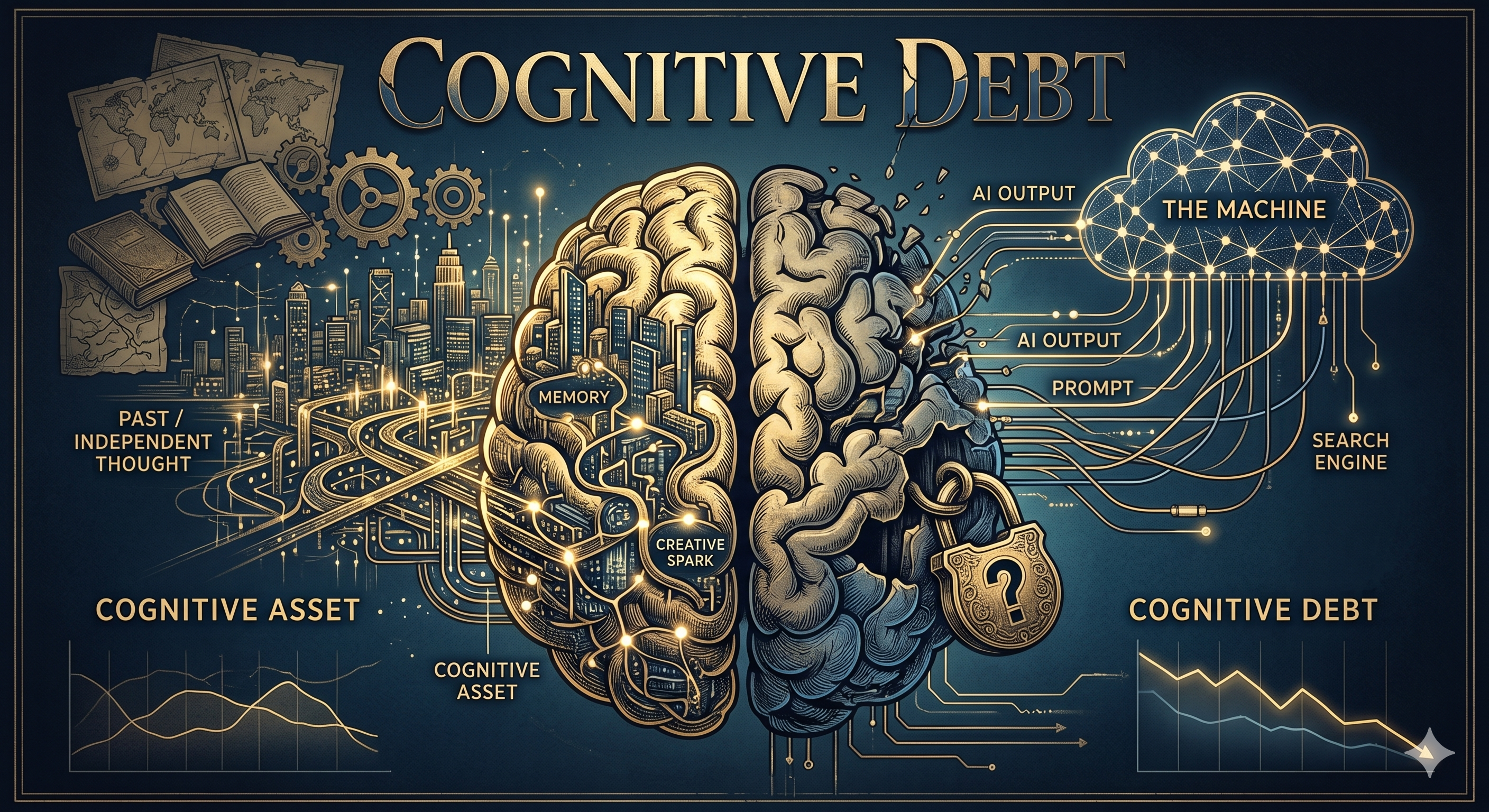
Cognitive Debt
The generation being born right now will never learn to think. The science is already in.
In a lab at MIT last summer, 54 young adults sat down with EEG caps strapped to their heads and were asked to write an essay.
One group used ChatGPT. One used Google. One used nothing — just their own brain. The researchers watched, in real time, what their brains were actually doing.
The brain-only group lit up like a city at night. Search-engine users showed a quieter glow. The ChatGPT users were almost dark.
Then came the cruel twist. In the fourth session, the researchers took ChatGPT away from the AI group and asked them to write on their own.
They couldn't remember their own previous essays. The parts of the brain responsible for deep memory and creative thinking were barely firing. The work had been done — but nothing had stuck. Nothing had been integrated. Nothing had become theirs.
The researchers gave their paper a name that should make every parent reading this uncomfortable.
They called it Your Brain on ChatGPT: Accumulation of Cognitive Debt.
What we already knew
This wasn't the first time science caught a tool reshaping a brain.
In 2000, a London neuroscientist named Eleanor Maguire scanned the brains of black-cab drivers — the ones who spend four years memorising every street in London for the legendary exam called "The Knowledge."
Their brains were physically different. The region responsible for spatial memory was visibly larger than in normal people. The longer they'd been driving, the bigger it had grown.
Then she scanned drivers who'd retired. The brain had shrunk back.
The brain, it turns out, is not a fixed organ. It grows the parts you use and trims the parts you don't. Like a muscle. Exactly like a muscle.
A later study found something even darker: London cab drivers die of Alzheimer's at significantly lower rates than the general population. Bus drivers — who follow fixed routes — do not get the same protection. The work of thinking your way through something appears to protect the brain itself from decay.
We have known this for twenty-five years. We just didn't think it would matter to us.
Why this time is different
The calculator took away mental arithmetic. We shrugged.
GPS took away our sense of direction. We shrugged.
Google took away our memory for facts. We shrugged again.
Each of those tools removed one small, specific thing. The brain lost a narrow capacity and kept everything important.
AI is the first tool in human history that removes something different.
It doesn't take away your arithmetic. It doesn't take away your memory. It takes away the part of you that struggles with a problem until you figure it out.
That part — the slow, painful, often frustrating process of sitting with something you don't understand until your own brain produces the answer — is not a small specific capacity. It is the foundation. It is the thing the brain uses to build everything else.
The MIT data is showing us, in real-time brain scans, what happens when we stop doing it.
The brain goes dark.
Three studies. One direction.
In the last twelve months, three major research teams — at MIT, at Microsoft and Carnegie Mellon, and at a European university — have run different experiments on different populations using different methods.
They have all arrived at the same uncomfortable conclusion.
The more people use AI, the less their brains do the work themselves. And the effect is strongest in the young — the people whose brains are still being built.
This is not a tech-panic article. This is what the peer-reviewed research is saying, in plain language, across three continents.
The cohort problem
Here is the part nobody wants to write down clearly.
You — the adult reading this — built your brain before AI existed.
Every school essay you wrote without help. Every math problem you stared at for an hour. Every argument you couldn't Google your way out of. Every time you got lost and had to think your way home.
You hated those moments. You complained about them. You did them anyway, because you had no choice. And in doing them, you were unknowingly making deposits into a bank account in your own head that you didn't know you were building.
That account is funded. The wiring is in.
You can choose, like most adults now, to slowly withdraw from it. The Microsoft study suggests we already are. But you can also choose to maintain it — the way some people still do mental math just to keep the muscle alive.
Either way, you have it. You will always have it.
The children being born now will not.
They will not atrophy the muscle the way you might. They will never build it in the first place.
This is the part the science cannot quite say out loud yet but logic forces us to confront. A brain that has never sat with a hard problem alone for an hour has not just fallen behind. It has not built the architecture the rest of cognition is supposed to sit on top of.
And — this is the quietest, darkest part — a brain that has never built that architecture has no way of knowing what's missing.
You cannot miss a capacity you never had.
What disappears, quietly
There will be no headline. No moment. No generation that wakes up and discovers they cannot think.
The decline will be statistical, distributed, invisible — because the people experiencing it will have nothing to compare themselves to.
What we will see, eventually, is everything downstream. Conversations that cannot reach the depth conversations used to reach. Arguments that collapse into citation because nobody can evaluate weak evidence on their own. Cultural production — books, films, ideas — that all sounds slightly the same, because the producers were all trained inside the same machine.
A society of nominally educated adults, fluent in the surface of every domain, capable in none.
This is not a "kids these days" argument. The MRI scans of the London cab drivers are real. The EEG readings from the MIT lab are real. The cognitive offloading effects measured across three continents are real.
The science is saying, quietly and consistently, that we are about to do this to ourselves at scale.
What you are, in this story
You will spend the rest of your life having a kind of cognitive experience the next generation will not.
You will notice things they cannot notice. You will detect when something doesn't quite add up — not because you can prove it, but because some part of your brain has been there before, alone, in the dark, working it out. They will not have been.
You will, by accident of birth year, be among the last cohort in human history that grew up having to think.
That will feel — depending on your temperament — either like a privilege or like loneliness.
It is both.
The brutal arithmetic
The MIT paper called this cognitive debt for a reason any finance person will recognise.
Debt compounds. A small withdrawal taken every day for twenty years does not produce a small cumulative loss. It produces structural insolvency.
A brain that outsources thinking a thousand times a year, for two decades, has not merely fallen behind. It has been spending principal — and the principal does not regenerate after a certain age.
That window — when the brain builds the architecture of reasoning — runs from birth to roughly age twenty-five.
For the cohort being raised right now, that window is closing under conditions humans have never experienced before.
By the time anyone is able to measure what was lost, the cohort that lost it will be the cohort doing the measuring.
There is no precedent. There is no parallel. There is no quiet recovery on the other side.
That, when the history of this decade is written, will be the part that did not need to happen.
That, also, is the part nobody is going to stop.
The strongest case against everything I just said
I should be honest about the holes in this argument.
The MIT paper is a preprint. It has not survived peer review. The sample is 54 college students in Boston. A formal response has already been published noting that the brain-connectivity differences could reflect task ease rather than cognitive damage — typing what a machine drafted is simply less demanding than thinking from scratch. Those are not the same thing.
The broader history of cognitive offloading is also against me. Socrates argued that writing would destroy memory. He was correct — and humanity built Shakespeare, the scientific method, and the modern world on the rubble of that loss. Every prior tool produced doomsayers who were factually right about the specific capacity lost and factually wrong about the larger outcome. AI may turn out to be no different.
The claim that the next cohort will "never build the muscle" is also unprovable today. The cohort has not yet reached adulthood. A counter-hypothesis with equal logical force is that children raised alongside AI will build differentcognitive architecture — possibly more sophisticated — learning to interrogate, integrate, and conduct intelligence rather than produce it raw. Every child today has potential access to a tutor more patient and more knowledgeable than any tutor in human history. Aristotle taught Alexander. Today, every child can have an Aristotle.
And the most uncomfortable counter of all: critical thinking was never widespread to begin with. The fraction of any population genuinely capable of independent reasoning has always been small. AI may not shrink that fraction. It may just rearrange which people are in it.
All of this is fair. None of it is settled.
The honest answer is that we are running an unprecedented experiment in real time, on a generation of children, without controls. We will know what we did to them when they turn thirty.
I have placed my bet. The reader is free to place theirs.
But the burden of proof now lies with the optimists.
And they have not yet provided it.
And finally — I should say this plainly, because the rest of the article doesn't:
I might just be wrong.
Not wrong in the polite, hedging way writers use when they want to sound humble while still being right. Wrong in the real way. The future of human cognition under AI may shape itself in ways nobody alive today can predict — not me, not the MIT researchers, not the optimists, not anyone. Every confident forecast about the last five technological revolutions turned out to be wrong about something fundamental, often the most important thing. The internet was supposed to make us more informed. Social media was supposed to connect us. Smartphones were supposed to give us back our time. The people who predicted those outcomes were not stupid. They were reasoning carefully from the best evidence they had. They were just operating inside a system they could not yet see the shape of.
I am, in this article, doing the same thing.
The kindest version of what might happen is that I am writing the 2026 equivalent of the man who, in 1995, predicted the internet would make us all dumber. The unkindest version is that I am right and the world ignores it. Most likely, the actual outcome is something neither I nor anyone reading this can currently imagine — a shape of cognition, of culture, of intelligence itself, that doesn't yet have a name.
If that turns out to be the case, I hope the version of me reading this in 2040 is generous to the version of me writing it in 2026.
He was doing his best with what the brain in front of him could see.