Will AI Robots Take My Job?
Most people asking this question are already working in a role that is changing. The people who lose the most are not the ones robots replace outright — they are the ones who don't notice the change until the job description has already been rewritten around them. This affects warehouse workers, insurance processors, junior lawyers, and mid-level analysts equally. The question worth asking is not whether robots are coming. It's whether you're in position before they arrive.

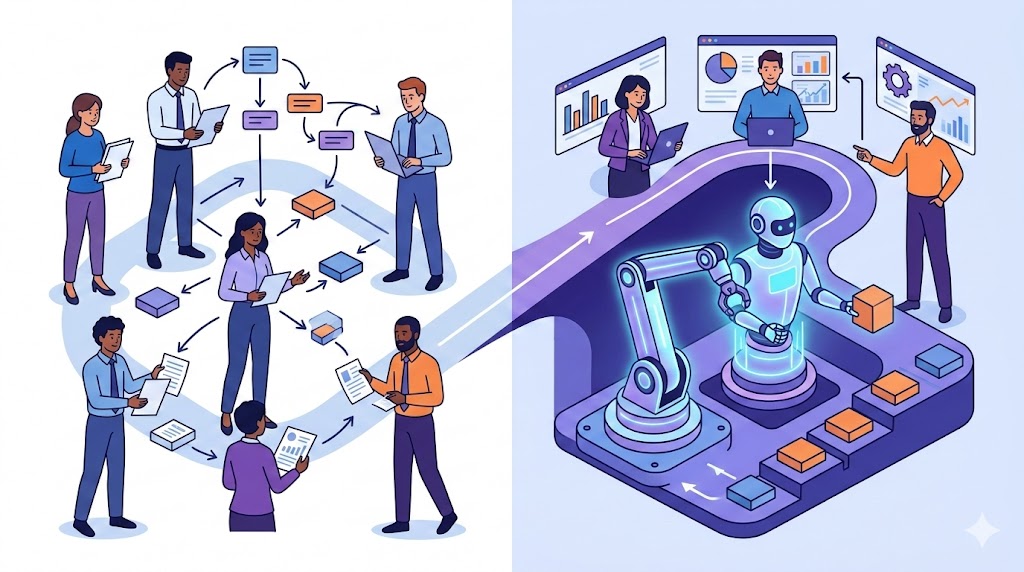
Marcus has worked in a warehouse for eleven years. Last spring, his company installed a fleet of autonomous picking robots. Within three months the robots were handling roughly 70% of the physical work he used to do all day. His job title is the same. His pay went up by 22%. He now coordinates the robot fleet, manages exceptions when systems fail, and runs onboarding for new staff. He is also genuinely unsure whether this version of his job would exist at all in five more years without this change. He cannot tell if the robots saved his career or just slowed its disappearance.
That uncertainty is the actual story of robots and work — and it is not a warehouse problem. It is showing up in logistics, healthcare, manufacturing, legal services, and accounting. The question is not whether AI robots will change your work. They will. The question is whether you end up with more control, more pay, and more security on the other side — or whether you get squeezed out while the productivity gains flow somewhere else. That split is already happening across every industry that runs on predictable tasks, and which side of it you end up on is one of the most consequential choices you will make in the next five years.
What Is Job Automation Risk from AI Robots?
Job automation risk is the measurable probability that machines will take over the predictable, repeatable portions of a human role — removing those tasks from the job without necessarily eliminating the position itself. It exists because the cost of automating routine physical and cognitive work is now falling faster than workers and organisations can adapt their skills to stay ahead of it. For the people it affects, this changes not the total number of jobs available but the composition of every job that survives: the routine layer gets stripped out, the judgment layer remains, and workers who cannot operate at that judgment layer lose ground in pay, security, and career relevance.
How Are AI Robots Actually Affecting Jobs Around the World?
The clearest picture of job automation risk emerges from looking at where robot deployment is already densest — and what happened to the workforce there.
South Korea sits at the sharpest end of this shift. It has the highest robot density on earth at 1,012 robots per 10,000 manufacturing employees, according to IFR World Robotics 2024 — nearly seven times the global average of 151 per 10,000. That figure tells you something important about how fast workforce restructuring can happen when deployment is driven by competitive industrial pressure rather than caution. Korean manufacturing workers have been living with this reality for years, adapting into supervisory, technical, and systems-coordination roles that simply did not exist in the previous generation of that industry. The transition was not smooth or equally shared. But it did not produce mass unemployment. It produced a bifurcated labour market with a steep premium on human-machine collaboration and persistent pressure on those who did not acquire those skills.
Europe is further behind on deployment but accelerating. McKinsey's 2024 analysis of nine EU countries plus the UK found that up to 12 million occupational transitions could be required by 2030, affecting around 6.5% of current employment. Production work, customer service, and office support roles are projected to keep declining — not because companies suddenly dislike those functions, but because the share of predictable, data-handling tasks inside them is high enough for automated systems to absorb at lower cost. The hardest-hit countries will be those where manufacturing still dominates employment and where skills-transition infrastructure — retraining pipelines, vocational pathways into robotics roles — is slowest to respond.
The United States is grappling with the most unsettling number in this picture. McKinsey's November 2025 report, "Agents, Robots, and Us," found that current AI and robotics technologies could already automate activities accounting for 57% of US work hours — nearly double the estimate from just two years prior. The headline is alarming; the interpretation matters more. That figure describes technical potential across tasks, not a forecast that half the workforce gets displaced next year. What it means in practice is that the roles most exposed to robot task displacement — routine production, data processing, basic cognitive work — have a shorter adaptation window than most workers and most employers currently assume.
What Does "Robots Take Tasks, Not Jobs" Actually Mean in Practice?
Robots automate the predictable, repeatable activities within a role — they do not replace the full bundle of skills, relationships, and judgment that makes a person employable.
Think about managing a sports team. A head coach does not personally scout every player, fill out every fixture form, or re-film every training session. Those tasks get delegated or systematised. What the coach cannot hand off is reading the room at halftime, making the substitution call that changes a match, or rebuilding trust with a player who has lost form. Those judgment-heavy responsibilities are where the irreplaceable value sits. A club that automates everything it can — match data analysis, scheduling, nutrition tracking, injury prediction — does not eliminate the need for a head coach. It needs a better one, because the data is richer and the decisions are harder. That is precisely how robots affect jobs: they strip out the routine layer and leave the judgment layer exposed. Workers who can operate at that layer become more valuable. Workers whose entire skill set sat in the routine layer face the hardest future of work transition.
"McKinsey's November 2025 report found that AI and robotics could now automate 57% of US work hours — but more than 70% of the skills employers seek today appear in both automatable and non-automatable work." (Source: McKinsey "Agents, Robots, and Us," November 2025)
The Shift in Motion
Automation Claimed the Physical, Predictable Layer First
The first phase of industrial automation targeted tasks that were not just routine but physically predictable: moving goods, welding joints, painting surfaces, sorting packages. These were roles where a machine repeating an action with sufficient precision was simply cheaper and more reliable than a human performing it across an eight-hour shift. The displacement was geographically concentrated — felt hard in Detroit, the Ruhr Valley, the textile towns of the American South — not spread evenly across the economy. Nationally, the macroeconomics looked acceptable. Locally, the damage was lasting and slow to heal. This phase established the defining pattern of job automation risk: pain concentrates in specific communities and specific skill levels long before national headline numbers reflect it.
AI Moved the Pressure Into Cognitive Work
The second phase is the one most workers are now living through, and it is qualitatively different from the first because it reaches into white-collar roles that were previously considered safe. The pressure has shifted from workers doing physical repetition to workers doing cognitive repetition — processing insurance claims, drafting routine contracts, handling first-tier customer queries, categorising data, writing standard reports. McKinsey found that demand for AI fluency at work — the practical ability to use and manage AI tools — grew sevenfold in two years in US job postings, from roughly one million jobs explicitly requiring it in 2023 to about seven million in 2025. The survival pressure is now falling equally on a logistics manager in Chicago and a paralegal in Frankfurt, and the workers who are treating that as someone else's problem are repricing themselves out of their own careers.
The Labour Market Split Became Permanent
The survival strategy is not to compete with robots on speed or consistency — it is to move into the supervisory, exception-handling, and judgment-calling layer that robots cannot reach. South Korea's experience is instructive: the country with the world's densest robot deployment has not seen its manufacturing workforce collapse. It has reorganised, with a clear premium on workers who can maintain, coordinate, and troubleshoot automated systems. That reorganisation was not painless, and it was not equally accessible to everyone. But it is the direction of travel everywhere robot deployment reaches scale — and the gap between workers who adapted and workers who waited is widening faster than retraining programs can close it. Workforce restructuring, in this phase, is not a temporary disruption. It is the new operating condition.
Is Asking Workers to "Just Adapt" a Real Answer — or a Way to Blame Them for a Structural Problem?
Two genuine fears run through this conversation, and both are held by rational people with real evidence behind them.
The first fear is that the disruption is manageable and that new jobs will emerge around the technology the way they always have. Every previous wave of automation — mechanisation, electrification, computing — destroyed some categories of work and created others. Aggregate employment survived each time. In this reading, the anxiety is real but the outcome is not fundamentally different from what workers have navigated before.
The second fear is that this wave is structurally different in ways that matter. For the first time, the technology is moving up the skill curve into cognitive and professional work that was never before exposed to robot task displacement. Workers in their forties and fifties, who built careers on skills now sitting in the routine zone, cannot simply retrain in two years and step into a robotics coordination role. The transition cost is real, it is unequally distributed, and most countries' social safety nets were not built for this velocity of change.
Both fears are grounded in real data. The hard truth that neither fear fully addresses is this: the human-machine collaboration premium is already embedded in the labour market, rising faster than policy or public conversation has acknowledged, and it is not waiting for workers to feel ready. Demand for AI-fluent workers grew sevenfold in two years in US job postings. Robotics technician roles pay roughly 30% more than comparable non-robotics manufacturing positions at entry level. The companies restructuring their workforces toward supervision and exception-handling are not doing it as a values exercise — they are doing it because it produces lower cost per unit and fewer errors. The workers who fared best in every previous automation wave were the ones who stopped competing in the layer the machines were about to absorb — and did it before the machines arrived.
This question sits at the intersection of skills, governance, and the economics of machine deployment, and no single article can fully contain it.
This development reinforces:
Who Owns Robot Data: The same systems reorganising your job are generating operational data about your performance and your workplace — and in most current contracts, your employer or their vendor owns that data, not you, which means the leverage question runs deeper than the job title.
Future of Work: The skills premium for human-machine collaboration is already priced into global hiring data — understanding where that premium moves next is the difference between positioning early and scrambling late.
Ethics & Governance: Displacement pain from automation lands unevenly across income levels and communities, and the policy frameworks designed to manage that unevenness are not moving at anything close to the speed of the technology reshaping those communities.
Marcus still doesn't know if the robots saved his job or just postponed the question. But the workers who are clearest about their position are not the ones who answered the "will robots take my job" question definitively. They are the ones who stopped asking it and started asking something harder: what will I be worth to an organisation that already has the robots? That is the version of the question that has an answer you can actually act on.
1. Will AI robots take my job completely? In most cases, no — but they will remove the most predictable parts of it. McKinsey's November 2025 report found that current technologies could technically automate 57% of US work hours, but more than 70% of the skills employers value today appear in both automatable and non-automatable work. The jobs most at risk of disappearing entirely are those built almost entirely on repetitive, predictable tasks — data entry, basic assembly, routine document processing — with little judgment or coordination involved.
2. Which jobs are most at risk from AI and robot automation? Roles built primarily around predictable, repeatable tasks face the most pressure right now. Transportation and logistics, basic data processing, manufacturing assembly, and customer service processing are the categories with the highest automation potential and the shortest window to adapt. McKinsey's 2024 research found that up to 12 million workers in Europe alone could need to change occupations by 2030, with production work and administrative office support among the fastest-declining categories.
3. What skills become more valuable when robots enter the workplace? Skills in the judgment and coordination layer that automated systems cannot reliably replicate become more valuable: supervising autonomous systems, handling exceptions when they fail, interpreting outputs in context, and making decisions in novel or ambiguous situations. Demand for AI fluency — the practical ability to use and direct AI tools at work — grew sevenfold in two years in US job postings, reaching roughly seven million explicit listings by 2025, according to McKinsey's "Agents, Robots, and Us" (November 2025).
4. Why is South Korea used as a case study for robot job displacement? South Korea has the highest robot density in the world at 1,012 robots per 10,000 manufacturing employees — nearly seven times the global average of 151, according to IFR World Robotics 2024. It is the most advanced real-world example of how a manufacturing economy reorganises around dense automation at scale. The result was not mass unemployment but a bifurcated labour market: a premium on workers who supervise and coordinate automated systems, and sustained pressure on those who did not make that transition.
5. How can I tell if my job is at risk from automation? Ask what proportion of your daily tasks are predictable enough that a well-trained system could perform them consistently with access to the right data. If the honest answer is more than half, you are in the zone where task substitution is already underway or approaching. The more important follow-up is whether the remaining parts of your role — the judgment calls, exception-handling, and relationship work — are skills you are actively developing, or ones you have been neglecting because the routine work kept you too occupied to notice.