




DESCRIPTION
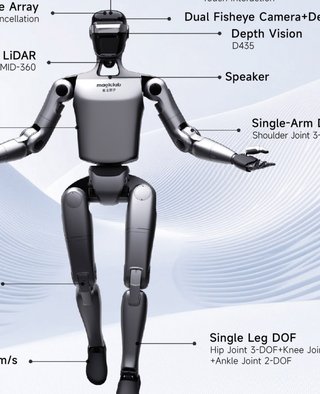
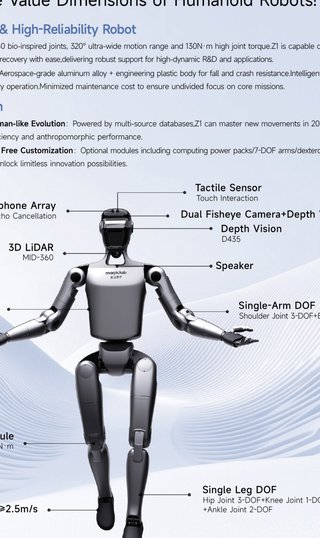
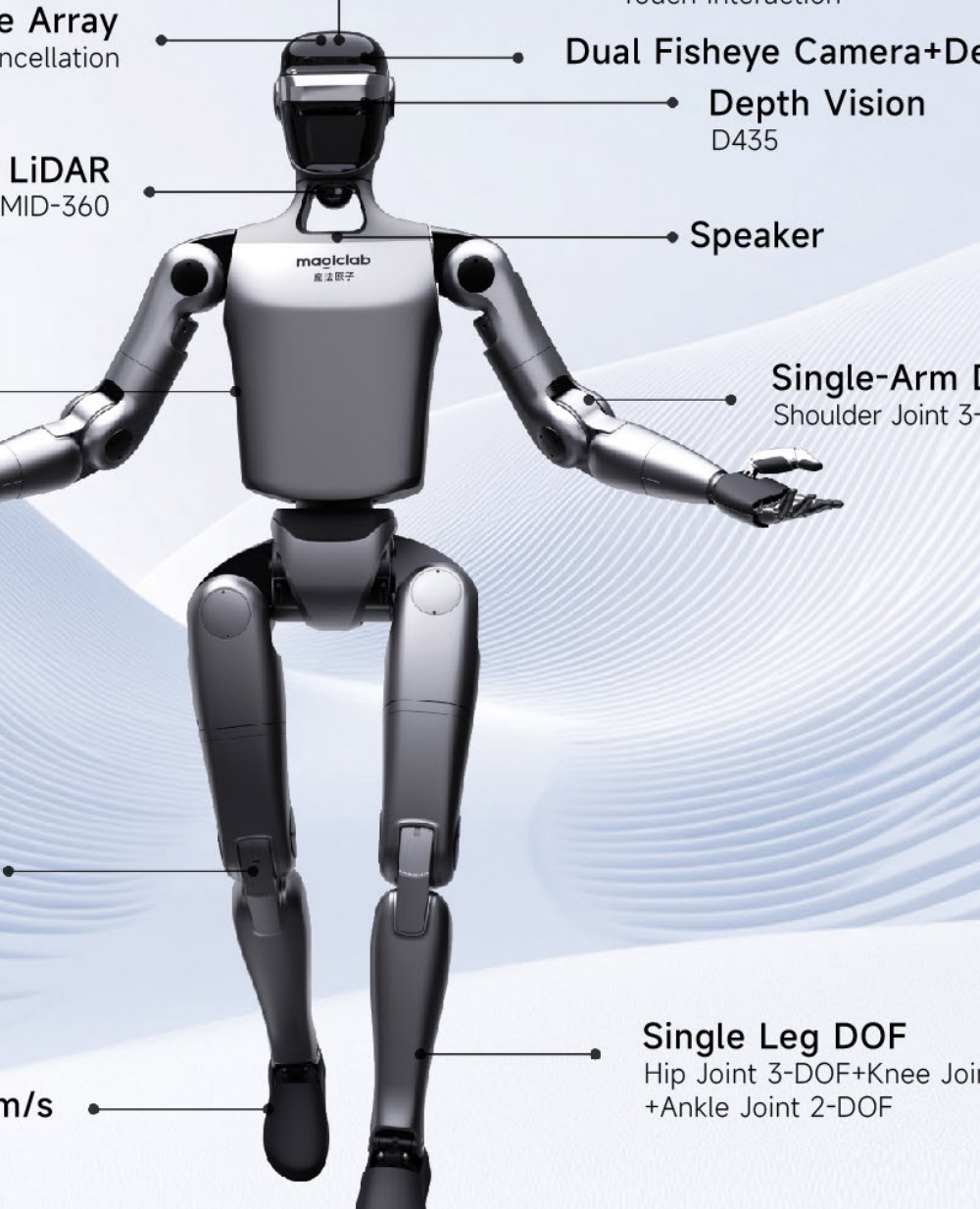
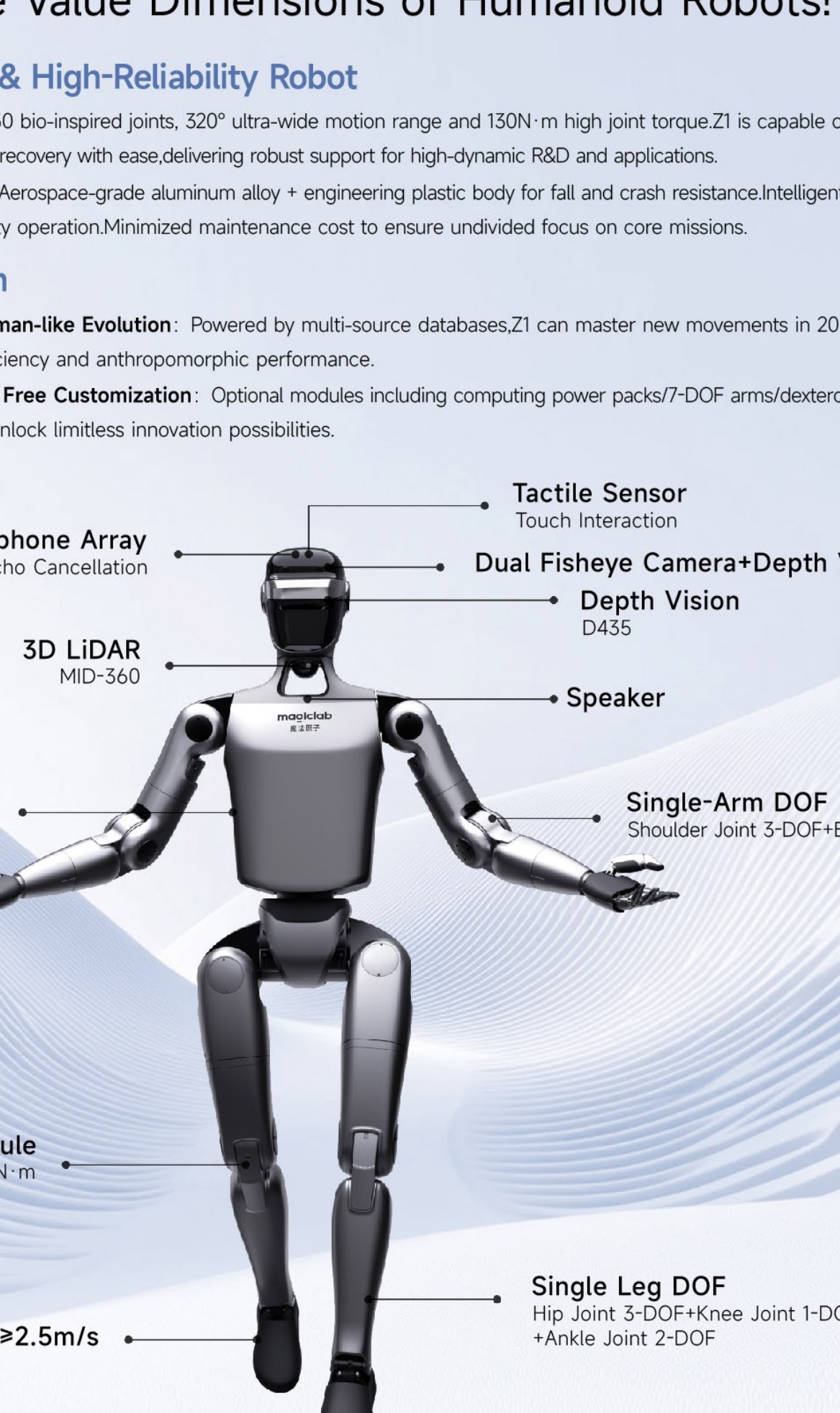
The MagicBot Z1 is MagicLab's small bipedal humanoid, and its defining trait is configurability rather than raw size. It stands 1,369 mm and weighs upward of 40 kg with battery, but the degree-of-freedom count is quoted as a range — 24 to 50 — because almost everything is optional: 5 or more degrees per arm with two more available, and an optional 11-DOF tactile dexterous hand at each wrist. That makes it as much a research platform as a finished product, and MagicLab backs that reading with a secondary development kit, OTA support and an open AI ecosystem. Its 130 N·m knee torque and 320-degree ultra-wide joint motion give it a trotting speed above 2.5 m/s, and MagicLab demonstrates anthropomorphic walking, anthropomorphic running and automatic fall recovery — the last being the practically important one, since a bipedal robot that cannot stand itself up needs an operator. Perception combines 3D LiDAR, depth vision, dual fisheye cameras and a head tactile sensor, and a quick-release 10,000 mAh smart battery keeps swaps fast. MagicLab positions it across STEM education, exhibition and cultural tourism, commercial performance and home companionship.
FEATURES
- 1,369 x 422 x 200 mm standing at 40 kg or more with battery
- configurable 24 to 50 total degrees of freedom, with 1 head, 1 waist, 6 per leg and 5 or more per arm plus 2 optional arm degrees
- optional 11-DOF tactile dexterous hands
- 130 N·m maximum knee torque with 320-degree ultra-wide joint motion
- 3 kg maximum arm payload
- 0.5 m arm span and 0.6 m lower-leg-plus-thigh length
- trotting speed above 2.5 m/s
- anthropomorphic walking, anthropomorphic running and automatic fall recovery
- 3D LiDAR with depth vision, dual fisheye cameras and a head tactile sensor
- 8-core high-performance CPU with an optional high-performance computing module
- quick-release 10,000 mAh smart battery
- OTA updates and a secondary development kit
- voice command and chatbot interaction
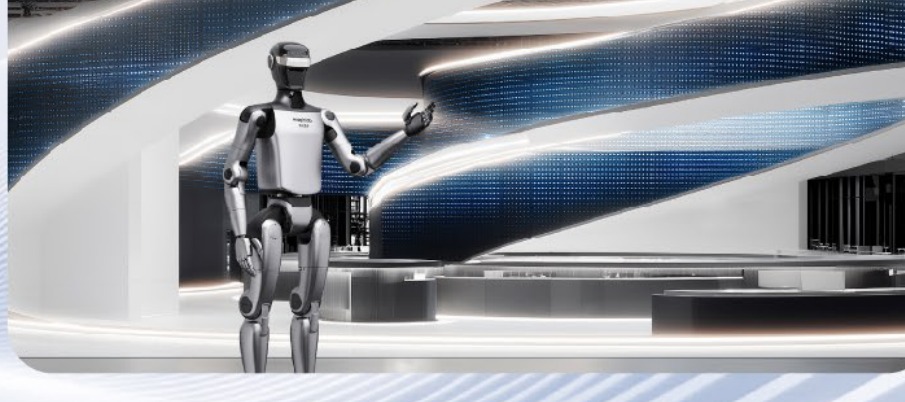
- exhibition guide function
- aerospace-grade aluminium alloy and engineering plastic body for fall and crash resistance.
TECHNICAL SPECIFICATIONS
Verified| Physical | |
| Weight | 40 kg |
|---|---|
| Dimensions | L 200 mm × W 422 mm × H 1.37 m |
| Payload | 3 kg |
| Mobility | |
| Movement Type | Bipedal |
| Degrees of Freedom | 24 |
| Speed | 9 km/h |
| Actuators | Bipedal humanoid with 6 degrees of freedom per leg, 5 or more per arm, 1 at the waist and 1 in the head; 130 N·m maximum knee torque; knee range 0-152 degrees, hip P±160 R-30 to +110 Y±160, waist Z-axis ±160, head Z-axis ±40 |
| Power | |
| Battery Life | 10000 mAh quick-release smart battery |
| Sensing & Compute | |
| Sensors | 3D LiDAR, depth vision, dual fisheye cameras, head tactile sensor, microphone array with noise reduction and echo cancellation, speaker |
| Software / AI | Multi-source database learning with OTA updates and a secondary development kit; voice command and chatbot interaction |
TECHNICAL SPECIFICATIONS
Verified| Physical | |
| Weight | 40 kg |
|---|---|
| Dimensions | L 200 mm × W 422 mm × H 1.37 m |
| Payload | 3 kg |
| Mobility | |
| Movement Type | Bipedal |
| Degrees of Freedom | 24 |
| Speed | 9 km/h |
| Actuators | Bipedal humanoid with 6 degrees of freedom per leg, 5 or more per arm, 1 at the waist and 1 in the head; 130 N·m maximum knee torque; knee range 0-152 degrees, hip P±160 R-30 to +110 Y±160, waist Z-axis ±160, head Z-axis ±40 |
| Power | |
| Battery Life | 10000 mAh quick-release smart battery |
| Sensing & Compute | |
| Sensors | 3D LiDAR, depth vision, dual fisheye cameras, head tactile sensor, microphone array with noise reduction and echo cancellation, speaker |
| Software / AI | Multi-source database learning with OTA updates and a secondary development kit; voice command and chatbot interaction |
Images
 martti
 martti
 martti
 martti
 martti
 martti
Image Contributions
Videos
ROBOT FORUMS
Loading forums...
RATINGS
FREQUENTLY ASKED QUESTIONS
What is the MagicBot Z1?
The MagicBot Z1 is MagicLab's small bipedal humanoid, and its defining trait is configurability rather than raw size. It stands 1,369 mm and weighs upward of 40 kg with battery, but the degree-of-freedom count is quoted as a range — 24 to 50 — because almost everything is optional: 5 or more degrees per arm with two mo…
Who makes the MagicBot Z1?
The MagicBot Z1 is made by MagicLab Robotics, a robotics company based in China.
How much does the MagicBot Z1 cost?
MagicLab Robotics has not publicly announced pricing for the MagicBot Z1. You can enquire through RobotAIGeek for current pricing.
What is the MagicBot Z1 used for?
The MagicBot Z1 is designed for research, reception, stem education and scientific research, and exhibition and cultural tourism guiding. It is used in research, education, and retail settings.
What is the payload capacity of the MagicBot Z1?
The MagicBot Z1 has a payload capacity of 3 kg.
How much does the MagicBot Z1 weigh?
The MagicBot Z1 weighs 40 kg.
How fast is the MagicBot Z1?
The MagicBot Z1 can move at speeds of up to 9 km/h.
How many degrees of freedom does the MagicBot Z1 have?
The MagicBot Z1 has 24 degrees of freedom.
COMPARE WITH SIMILAR ROBOTS
See how this robot stacks up against its closest alternatives
- MagicBot Z1 vs Noetix E1
- MagicBot Z1 vs Lanxin H6 Standard
- MagicBot Z1 vs Elf3
- MagicBot Z1 vs AGIBOT X2 REC
- MagicBot Z1 vs Westlake Robotics Humanoid Robot