Yaskawa's New Cobot Bets on a Thinner Arm, Not a Bigger One
Yaskawa launched the MOTOMAN-HC12 collaborative robot, cutting arm diameter nearly 40 percent and adding torque sensing and built-in Cat6A cabling for tight-clearance cells.

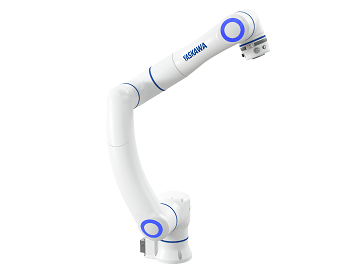
Yaskawa Electric announced the MOTOMAN-HC12 on Monday from its headquarters in Kitakyushu, Japan, a collaborative robot rated for a 12-kilogram payload and a 1,410-millimeter reach that the company built around a single design constraint: shrinking the arm's own footprint rather than chasing a bigger spec sheet. The HC12's forearm diameter drops to 170 millimeters, down from 275 millimeters on its predecessor the HC10DTP, and the unit is lighter overall, changes aimed squarely at the confined-cell and shared-workspace installations where a bulkier cobot simply does not fit between existing fixtures.
For an automation buyer comparing collaborative robots on a spreadsheet, payload and reach numbers dominate the conversation, but the HC12 launch is a reminder that arm geometry is frequently the real constraint in a retrofit. A plant that wants to add a cobot to an existing manual assembly line, welding cell, or packaging station is usually working within a footprint set years earlier by human ergonomics, not robot dimensions, and a wide-bodied arm can make an otherwise viable automation case physically impossible. Yaskawa's decision to cut the HC12's diameter by nearly 40 percent while holding payload steady at 12 kilograms is a direct answer to that constraint, and it targets exactly the palletizing, screwdriving, arc welding, and inspection tasks where cell space is tightest and cycle time still matters.
The HC12 also carries newly developed torque sensors that Yaskawa says improve collision detection without sacrificing productivity, a trade-off that has historically forced cobot buyers to choose between a highly sensitive safety threshold that trips on every minor contact and a looser one that risks a harder stop. Torque sensing distributed through the joints, rather than concentrated at the wrist or base, lets the controller distinguish between an intentional contact force during a task like screwdriving and an unplanned collision, which is the difference between a robot that pauses for a false alarm every few cycles and one that keeps a collaborative safety rating without throttling throughput.
The Cabling Detail That Actually Saves Integration Time
A specification easy to overlook in a press release, but not on a factory floor, is that the HC12 ships with application cabling, including Category 6A Ethernet, built into the arm as standard rather than routed externally. Integrators who have quoted collaborative robot cells before know that external cable management is not a cosmetic issue: exposed cabling near a human-shared workspace is a snag and pinch hazard that safety audits flag, and running clean internal wiring after the fact typically means an aftermarket kit or a custom harness that adds days to a deployment and a line item to the invoice. Building Cat6A Ethernet into the arm from the factory means a vision system or an industrial PC-based AI inference unit can be wired directly through the robot's own structure, which matters increasingly as cobots take on inspection tasks that depend on high-bandwidth camera data rather than simple digital I/O.
Yaskawa has not published a list price for the HC12, describing it instead as open-priced through its distributor network, which is standard practice for the company's Motoman line and means the real number a buyer sees will vary by region, integrator markup, and any bundled tooling. That pricing approach puts more weight on total installed cost during vendor evaluation, since two quotes carrying the same open-price designation can differ substantially once cabling, end-of-arm tooling, and safety-rated monitoring hardware are added. Buyers comparing the HC12 against Universal Robots' or Fanuc's collaborative lines should ask distributors for an all-in installed quote rather than a bare robot price, since the HC12's built-in cabling advantage only shows up in that comparison if the competing quote's external harness cost is priced in as well.
Why the Timing Fits Yaskawa's Broader Cobot Push
The HC12 lands inside a broader effort by Yaskawa to defend collaborative robot share against both Western incumbents and a wave of Chinese cobot exporters that have undercut legacy pricing over the past two years. Yaskawa's Motoman division has historically competed more on industrial-arm reliability and integration depth than on being first to a given payload class, and the HC12's engineering choices track that pattern: rather than leading with a novel sensor suite or an AI branding push the way some newer entrants have, Yaskawa is refining the mechanical fundamentals, arm diameter, weight, cabling, and collision response, that determine whether a cobot survives years of continuous duty in a welding or palletizing cell without unplanned downtime.
That is a deliberately narrower pitch than the "AI-ready platform" framing several competitors have adopted this year, and it is a defensible one for the buyers Yaskawa has built its industrial reputation on: manufacturers running high-mix, high-uptime lines where a robot's ability to fit a tight cell and survive a decade of duty cycles outweighs whether it ships with a large-language-model integration on day one. The HC12's target applications, palletizing, screwdriving, arc welding, and inspection, are also the tasks where collaborative robots have already proven return on investment, rather than the more speculative dexterous-manipulation use cases still working through pilot programs at humanoid and next-generation cobot startups.
The Buying Decision This Actually Changes
For a procurement team that shelved a cobot proposal in the past two years because the available arms would not physically clear an existing cell layout, the HC12's slimmer forearm is the detail worth re-opening that evaluation over, not the payload rating, which is unchanged from the outgoing HC10DTP class. The open question buyers should press distributors on before committing is availability lead time, since Yaskawa's announcement did not specify a shipping date, and a company weighing the HC12 against an in-stock competitor needs that number to model a realistic automation timeline rather than an aspirational one.
Screwdriving and inspection cells in electronics assembly, where multiple stations often sit within arm's length of each other on a single line, are the clearest early beneficiaries of the reduced 170-millimeter forearm diameter, since a wider arm in that setting frequently collides with neighboring fixtures long before it reaches its rated payload limit. Arc welding integrators, by contrast, will weigh the torque-sensing collision response more heavily than the slimmer profile, since welding cells already run with more clearance but depend on consistent contact-force detection to avoid weld-quality defects from an oversensitive or undersensitive safety threshold. On the mechanical case Yaskawa has made, thinner is the feature, and it is the kind of unglamorous engineering decision that rarely makes a keynote slide but routinely decides whether a cobot retrofit clears the tape measure on a real production floor.
Reading the HC12 Against the Price Pressure From Chinese Exporters
Yaskawa's open-price approach to the HC12 also has to be read against a collaborative robot market where Chinese manufacturers, several of them now shipping certified units into Europe and North America, have pushed list prices for comparable payload classes down by double-digit percentages over the past eighteen months. A Japanese incumbent competing on mechanical refinement rather than headline price has less room to simply match that pressure with discounting, since Yaskawa's cost base includes the kind of long-cycle reliability testing and torque-sensor development that a newer entrant optimizing purely for landed cost can skip. The HC12's pitch to a buyer weighing a lower-cost import against a Motoman unit is durability and integration depth over the equipment's working life, an argument that is harder to put on a comparison spreadsheet than a purchase price but shows up over several years in unplanned downtime and warranty claims.
That argument only holds if Yaskawa's distributor network prices the HC12 competitively enough that the total installed cost gap against a budget import stays within a range buyers are willing to pay for the reliability premium, which is precisely why the company has not published a fixed number and is instead routing pricing through regional distributors who can calibrate against local competition. For a buyer building a 2027 capital equipment budget, the practical step is requesting quotes from at least two Motoman distributors in different regions before assuming a single number represents Yaskawa's real market price, since open pricing on an industrial robot line typically carries more regional variance than a fixed-list competitor's catalog.
What Comes Next for the Motoman Line
Yaskawa has not signaled whether the HC12's slimmer-arm design philosophy will extend to the rest of the Motoman collaborative lineup or remain specific to this payload class, and that roadmap question matters for any buyer standardizing a multi-cell deployment on a single robot family. A plant planning to add cobots across several stations over the next two years will want continuity in cabling standards, safety certification, and controller software across whichever Motoman models it selects, and Yaskawa's next several product announcements will show whether the HC12's Cat6A-integrated cabling and reduced-diameter arm become the new baseline across the line or stay a one-off variant built for the tightest-clearance use cases. Until that pattern is clear, buyers evaluating the HC12 for a single cell are on solid ground, but those planning a multi-year, multi-cell Motoman rollout should ask Yaskawa directly whether the HC12's mechanical architecture is the template for what comes next.
This analysis draws on Yaskawa Electric's product announcement and public specifications for the MOTOMAN-HC12. It is for general information purposes only and does not constitute investment, financial, or legal advice.
Hero image credit: Yaskawa Electric Corporation.