RoboTechnik Targets US$800 Million in Hong Kong Listing
RoboTechnik, the world's top silicon-photonics manufacturing-equipment supplier, launched a Hong Kong secondary listing targeting US$800 million to fund AI-infrastructure and solar-equipment expansion.

RoboTechnik Intelligent Technology launched a Hong Kong share offering on Monday, September 21, seeking to raise approximately US$800 million in what would be one of the larger secondary listings by a Chinese automation-equipment maker this year. The Suzhou-headquartered company, already listed on the Shenzhen Stock Exchange's ChiNext board under ticker 300757 since January 2019, plans to price the Hong Kong tranche on September 24 and begin trading on September 29, with joint sponsors Huatai International, Citigroup, and Orient Securities International running the deal.
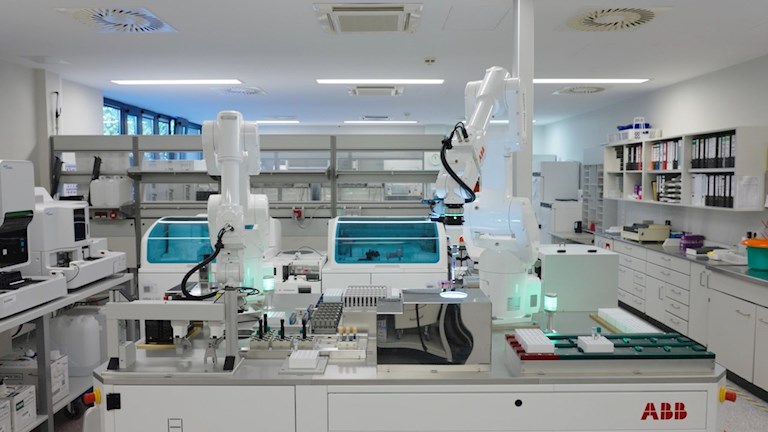
RoboTechnik makes two things that rarely appear in the same sentence but increasingly sit inside the same customer's capital budget: automated manufacturing equipment for photovoltaic solar cells, and precision assembly-and-test systems for silicon photonics devices, the optical chips that move data inside AI data centers. By Frost & Sullivan's 2025 revenue ranking, the company holds a 20.5 percent share of the global silicon-photonics intelligent-manufacturing-equipment market, the largest of any single supplier, while ranking fifth globally in photovoltaic-cell automation equipment with a 2.6 percent share. That silicon-photonics position traces to RoboTechnik's 2024 acquisition of ficonTEC, a German precision-photonics equipment maker whose systems handle the micro-assembly, coupling, and testing of silicon-photonic chips, optical transceivers, and laser components, work that has become a bottleneck point as hyperscale data-center operators race to build out AI infrastructure.
A Loss-Making Solar Supplier Turned Profitable by an AI Supply Chain Bet
The numbers behind RoboTechnik's Hong Kong listing tell a turnaround story more than a growth story. In the first half of 2026, the company posted net profit of RMB 6.6 million, approximately US$930,000, reversing a net loss of RMB 33.3 million (approximately US$4.7 million) in the same period a year earlier, while revenue surged 144.8 percent year over year to RMB 608.5 million, approximately US$85.6 million. That swing from loss to profit coincides almost exactly with the ficonTEC integration moving from acquisition to revenue contribution, evidence that the company's bet on silicon photonics has done more to fix its balance sheet in eighteen months than its long-running photovoltaic equipment business managed across the preceding several years of solar-sector overcapacity and pricing pressure. RoboTechnik's Shenzhen-listed shares have climbed 166 percent year-to-date, pushing its market capitalization to roughly US$15.5 billion, a valuation increasingly built on the silicon-photonics story rather than the solar-equipment business that originally took the company public.
That pivot matters to any buyer evaluating RoboTechnik as a long-term equipment supplier rather than a stock. A company whose core profitability now depends on a single, recently acquired business line carries concentration risk that a more diversified equipment maker does not, and the Hong Kong raise itself is partly an acknowledgment of that dependency: proceeds are earmarked for research and development, expanded factory capacity, global sales and service infrastructure, potential further acquisitions, and working capital, a use-of-proceeds list weighted toward scaling the newer, higher-margin photonics business rather than defending the legacy solar-equipment line.
Eight of the World's Ten Largest Solar Makers Are Still Customers
RoboTechnik's photovoltaic business, even as it cedes the growth narrative to silicon photonics, retains a customer list that gives the company negotiating leverage few equipment suppliers can match: by 2024 revenue, eight of the world's ten largest photovoltaic cell manufacturers bought RoboTechnik equipment, spanning automated production lines and the company's proprietary R2Fab manufacturing-execution-system software that coordinates equipment scheduling across a solar fab floor. That customer concentration at the top of the solar supply chain gives RoboTechnik a defensible base of recurring service and upgrade revenue even as the segment's growth slows, and it is the kind of embedded, multi-year customer relationship that a newer photonics-equipment entrant would need years to replicate.
The company's solar equipment spans PERC, TOPCon, and heterojunction cell production systems, covering the three dominant photovoltaic cell architectures currently in commercial production, which means RoboTechnik does not need a customer to commit to a single technology path before buying its equipment. For a solar manufacturer weighing capital expenditure amid the industry's ongoing consolidation, that technology-agnostic positioning reduces the risk of an equipment order becoming stranded capital if the buyer later shifts cell architecture.
Why a Second Listing Instead of a Straight Follow-On Offering
RoboTechnik's choice of a Hong Kong secondary listing, rather than raising additional capital through its existing Shenzhen shares, follows a route that has become standard for Chinese industrial-technology companies seeking capital for overseas expansion specifically. A Hong Kong listing gives the company a second pool of international institutional investors, a currency, effectively, denominated in a more globally tradable unit than Shenzhen-listed A-shares, and a public profile in the market where many of its silicon-photonics customers, global data-center operators and optical-component makers, already raise their own capital and evaluate suppliers. That structural logic has drawn a wave of Chinese robotics and automation names to Hong Kong over the past several months, and RoboTechnik's US$800 million target size would place it among the larger of those deals, reflecting both its existing US$15.5 billion market capitalization and the scale of overseas expansion, additional ficonTEC-style acquisitions, and manufacturing capacity the company says it intends to fund.
What a Silicon-Photonics Equipment Bottleneck Means for AI Infrastructure Buyers
Silicon photonics has become one of the least visible but most consequential constraints on how fast AI data centers can scale, because optical interconnects, rather than copper wiring, increasingly carry the data traffic between GPU clusters at the bandwidth AI training and inference workloads demand. Assembly and testing of those optical components requires sub-micron precision equipment that only a small number of suppliers worldwide can build, and RoboTechnik's position as the largest single supplier by market share puts it in a position closer to a chokepoint vendor than a commodity equipment maker. A hyperscale operator or optical-component manufacturer planning capacity expansion has a real, practical interest in RoboTechnik's ability to scale its own manufacturing fast enough to meet demand, which is precisely the capacity-expansion use of proceeds the company has cited for its Hong Kong raise.
A company that turned a photovoltaic-equipment loss into an AI-infrastructure profit inside eighteen months by buying its way into silicon photonics is not simply raising capital; it is trying to lock in a supply-chain position before better-capitalized competitors, Japanese and European precision-equipment makers among them, can close the gap. Whether RoboTechnik's Hong Kong debut prices at a valuation that reflects chokepoint-supplier scarcity or ordinary industrial-equipment multiples will be the clearest signal yet of how investors are pricing the physical infrastructure layer beneath the AI buildout, separate from the chips and data centers that usually dominate that conversation.
RoboTechnik Joins a Crowded Line of Chinese Equipment Makers Heading to Hong Kong
RoboTechnik's listing adds to a run of Chinese robotics and precision-equipment suppliers that have used Hong Kong secondary offerings this year specifically to fund overseas expansion rather than domestic growth, a pattern distinct from the humanoid-robot IPOs drawing most public attention. Cobot maker Rokae priced its own Hong Kong debut in July at HK$38 per share under the exchange's Chapter 18C technology-listing rules, while harmonic-reducer specialist Laifuharmonic became the first dedicated reducer stock to list in Hong Kong earlier the same month, and robot-brain software supplier Shenggong Intelligent debuted in late June. Each of those companies, like RoboTechnik, sells component-level or equipment-level technology into the broader robotics and automation supply chain rather than a finished consumer-facing robot, and each has framed its Hong Kong capital specifically around building manufacturing and service capacity in markets outside mainland China rather than defending domestic market share.
That distinction matters for how a buyer should read RoboTechnik's raise. Unlike a humanoid-robot developer whose Hong Kong listing signals a race for consumer or venture attention, RoboTechnik's equipment business sells almost entirely to other manufacturers and data-center operators who evaluate suppliers on delivery reliability, service-network coverage, and technical support response time rather than brand visibility. The company's stated plan to use Hong Kong proceeds for global sales and service infrastructure, not just factory capacity, reads as a direct response to that buyer expectation: a solar or photonics customer outside China needs confidence that an equipment failure will bring a technician within days, not weeks, and that kind of service footprint is exactly what a pre-IPO, domestically focused equipment maker typically lacks.
The RoboTechnik listing also tests investor appetite at a moment when Hong Kong's technology-listing pipeline has grown crowded enough that pricing discipline, not just deal volume, has become the market's real story. A US$800 million target size sits well above what Rokae, Laifuharmonic, or Shenggong Intelligent each raised individually, meaning underwriters Huatai International, Citigroup, and Orient Securities International are betting that RoboTechnik's dual identity, an established, profitable photovoltaic-equipment supplier layered with a newly dominant silicon-photonics franchise, can draw a broader mix of industrial and technology investors than a single-thesis robotics IPO typically attracts. If the September 24 pricing lands at the top of its range, it will be read across the sector as confirmation that AI-infrastructure exposure, even through an unglamorous equipment supplier rather than a chip or software name, now commands a premium in Hong Kong's technology-listing market.
This account synthesizes RoboTechnik's public listing disclosures, Shenzhen Stock Exchange filings, and reported deal terms for its September 2026 Hong Kong offering. It is for general information purposes only and does not constitute investment, financial, or legal advice.
Hero image credit: RoboTechnik Intelligent Technology / ficonTEC.