NVIDIA Isaac ROS 5.0 Ships Agent-Ready Skills to Fourteen Robotics Partners
NVIDIA released Isaac ROS 5.0 with a FoundationPose library it says tracks object pose 5.5 times faster, alongside day-one integrations from fourteen companies spanning RealSense, Intrinsic, Magna, Universal Robots and ROBOTIS.

NVIDIA released Isaac ROS 5.0 on Tuesday, September 22, and the number the company is leading with is 5.5, as in 5.5 times faster object pose tracking through a new FoundationPose inference library, one of a handful of GPU-accelerated additions built on top of the open-source Robot Operating System framework. The release matters less for that single speed figure than for what shipped alongside it: fourteen companies, spanning camera makers, industrial integrators, humanoid startups and machine-tool vendors, integrated their hardware or software with Isaac ROS 5.0 on day one, turning what has historically been a research toolkit into something closer to a shared operating layer for commercial robot perception.
Isaac ROS is NVIDIA's collection of hardware-accelerated packages that plug into ROS, the open-source middleware most robot manufacturers already use to move sensor data, motion commands and planning logic between software modules. Where ROS itself is vendor-neutral and runs on ordinary CPUs, Isaac ROS routes the compute-heavy parts, stereo depth estimation, object pose tracking, path planning, through NVIDIA's Jetson chips and CUDA software stack, so a developer keeps the open ecosystem of ROS while offloading the parts that would otherwise bottleneck on general-purpose processors. Version 5.0 adds support for ROS Lyrical and Ubuntu 24.04, which keeps the toolkit current with the community's own release cycle, but the more consequential changes are a set of what NVIDIA calls agent-ready skills, prepackaged capabilities for tasks like setup and manipulation that a developer can call directly rather than building from lower-level perception primitives.
The Perception Speedup Behind the Agentic Pitch
The headline technical addition is the FoundationPose inference library, which NVIDIA says lets robots perceive and track the position and orientation of objects up to 5.5 times faster than the prior implementation. Pose estimation, working out exactly where an object is and how it is oriented in three-dimensional space, sits underneath almost every pick, place and assembly task a robot performs, and it has historically been one of the more compute-expensive steps in that pipeline, particularly when the object is unfamiliar or partially occluded. A 5.5x speedup on that step changes what is achievable on embedded compute: tasks that previously needed a tethered workstation or a cloud round-trip become plausible on a Jetson module bolted to the robot itself, which is the difference between a lab demonstration and a machine that can operate on a factory floor with normal network conditions.
Isaac ROS 5.0 pairs that with a FoundationStereo fine-tuning capability, which lets developers adapt NVIDIA's stereo depth model to a specific camera's optical characteristics rather than relying on a generic calibration, and a standalone pick-and-place skill that packages perception, grasp planning and motion execution into a single agent-ready module. NVIDIA is explicit that the design intent behind all of this is agentic: rather than a developer wiring together perception, decision and control as three separate systems, Isaac ROS 5.0 treats a capability like pick-and-place as a unit an AI agent can invoke, inspect and compose with other skills. That framing puts Isaac ROS in more direct conversation with NVIDIA's own foundation-model line, Isaac GR00T, and with the broader shift toward vision-language-action models that reason about a task before executing it, rather than positioning the toolkit purely as a perception accelerator.
Fourteen Companies Betting on the Same Stack
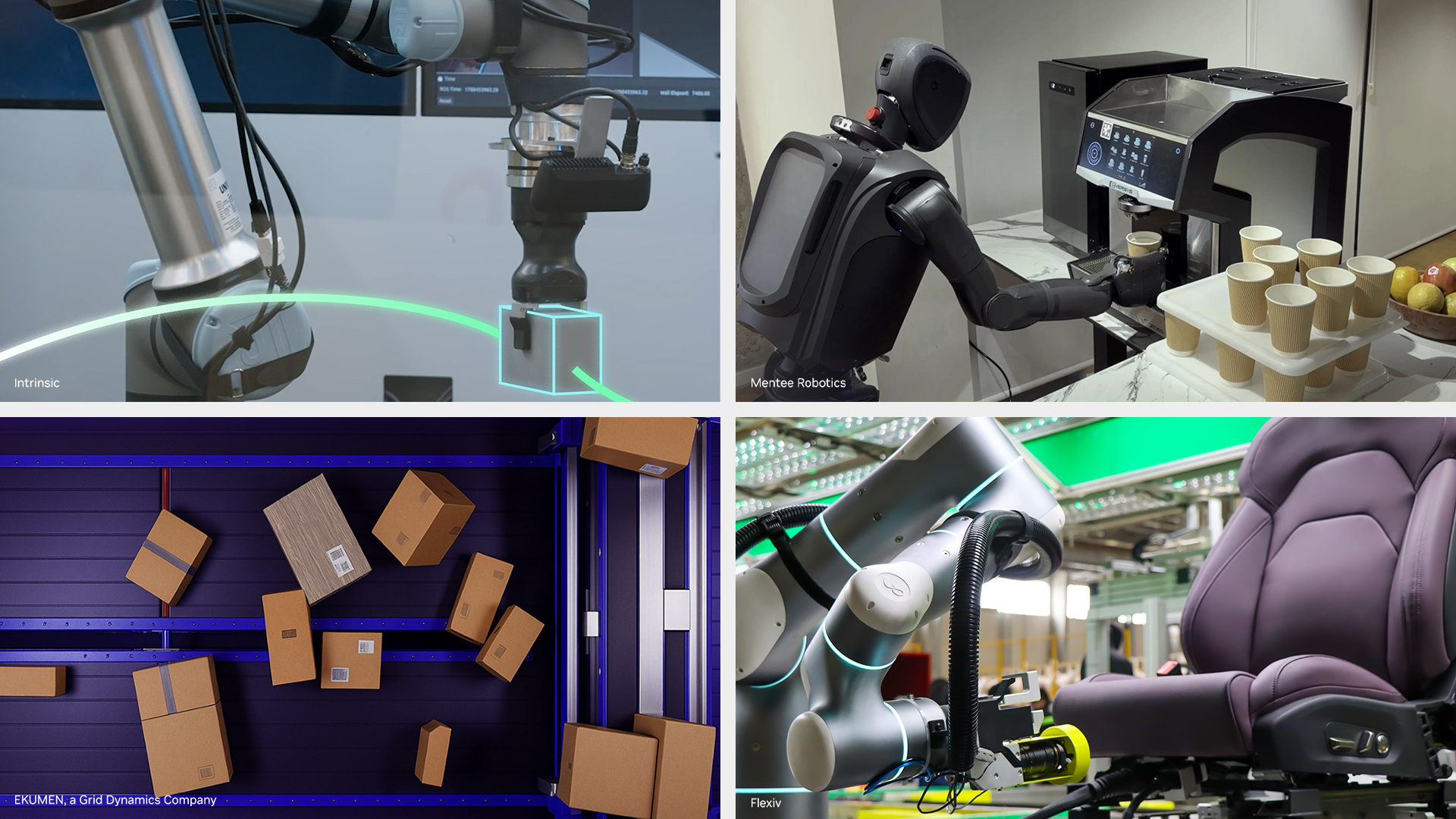
What separates this release from a routine version bump is the breadth of the partner list NVIDIA assembled around it. RealSense used the release to optimize its D585 Pro stereo depth cameras for NVIDIA's Jetson Thor compute module as part of a project it calls AgenticROS. Intrinsic, the robotics software company spun out of Alphabet, built an open machine-tending solution on top of FoundationPose for CNC operation and object registration, a task that has been a persistent bottleneck in small and mid-sized manufacturing because unfamiliar workpieces are hard for a fixed-program robot to register reliably. Magna, the automotive supplier, paired GPU-accelerated perception and synchronized data collection with GR00T model deployment and Isaac Sim hardware-in-the-loop testing, which lets it validate a robot's behavior in simulation before it ever touches a physical line.
The integration list also includes companies most procurement teams outside robotics circles will not recognize on sight. Ekumen, an Argentina-founded robotics software firm, built GPU-accelerated packages for precision docking and 3D obstacle detection that NVIDIA says can compute a collision-free path in roughly two to five milliseconds, fast enough to replan around a moving obstacle in something close to real time. Seeed Studio, a Shenzhen-based hardware company known for low-cost development boards, integrated its reBot Arm B601 with Isaac ROS on Jetson Thor, aimed at developers who want agentic robotics capability without an industrial-grade budget. Mentee Robotics, an Israeli humanoid startup, is running its MenteeBot's perception and AI backbone across both Jetson Orin and Jetson Thor platforms, while Noble Machines, a general-purpose industrial robot maker, is building its perception stack directly on Isaac ROS rather than developing a proprietary alternative. Universal Robots, the Teradyne-owned collaborative robot maker that dominates the cobot arm market, is offering the toolkit to integrators through an AI Accelerator SDK, and ROBOTIS is running Isaac ROS on its TurtleBot3 and AI Worker platforms for vision-guided manipulation. Flexiv paired its Rizon 4 adaptive robot arm with an Isaac Sim to physical-deployment pipeline, and FieldAI is running its robot foundation models directly on Jetson devices for on-device processing rather than a cloud dependency.
Where NVIDIA's Robotics Platform Strategy Is Headed
The partner roster is the real signal in this release, because it shows how deliberately NVIDIA is building Isaac ROS into a default rather than one option among several. A robotics buyer evaluating vendors increasingly has to ask not just whether a given robot can do the job, but what software stack it runs on and how much of that stack is locked to a single supplier. Isaac ROS's answer, an open-source layer that runs across products from at least fourteen independent companies spanning cameras, arms, humanoids and industrial integrators, reduces that lock-in risk relative to a closed perception stack, while still tying the performance advantage to NVIDIA silicon. That is a familiar platform play: give away the software, sell the compute it needs to run fast, and let a competitive ecosystem of hardware vendors do the work of proving the platform's value across use cases NVIDIA itself would never build directly.
It also clarifies the division of labor inside NVIDIA's own robotics portfolio. Isaac GR00T and the Cosmos world-model line, which NVIDIA showcased separately earlier this year, are aimed at the foundation-model layer, the part of the stack that reasons about a task and generates action sequences. Isaac ROS 5.0 sits underneath that, handling the perception and execution primitives a foundation model needs to actually see an object and move a manipulator toward it. Packaging those primitives as agent-ready skills is what lets a GR00T-style model call a pick-and-place routine as a single action rather than orchestrating each perception and control step itself, which is a meaningful engineering simplification for anyone building on top of both layers at once. The free and open-source licensing, with the full release published on GitHub, keeps the barrier to entry low enough that a small integrator like Seeed Studio and an automotive-scale supplier like Magna can build on the same foundation, which is precisely the kind of ecosystem breadth that determines whether a robotics software platform becomes an industry standard or stays a NVIDIA-only tool.
The Competitive Stakes of an Open Perception Layer
NVIDIA is not the only company chasing a shared robotics software layer. Google DeepMind has pushed its own Gemini Robotics models toward whole-body humanoid control, and Physical Intelligence has built a following around its pi-series foundation models, both competing for the same developer attention Isaac ROS is courting. The distinction is where each company plays in the stack. Gemini Robotics and the pi-series models compete at the reasoning layer, generating action sequences from a task description, while Isaac ROS 5.0 competes at the perception and execution layer underneath, the part that turns a camera feed into an accurate object pose and a planned, collision-free trajectory. A robot builder can in principle pair a rival foundation model with Isaac ROS for perception, which is part of why NVIDIA's open licensing matters commercially: the more of the stack that treats Isaac ROS as default plumbing regardless of which reasoning model sits on top, the harder it becomes for a competitor to displace it later, even one with a stronger foundation model.
The caveat a procurement team should weigh is that most of the reported gains, the 5.5x pose-tracking speedup and the two-to-five-millisecond path planning from Ekumen, are NVIDIA's or its partners' own figures rather than independently benchmarked comparisons, and they assume Jetson-class compute is already part of the target deployment. A team evaluating Isaac ROS against a simpler, CPU-only perception pipeline needs to weight the hardware cost of Jetson Orin or Jetson Thor modules against the throughput gain, rather than treating the speedup as free. For a buyer weighing whether to standardize a robotics program on Isaac ROS, the fourteen-company integration list at launch is a more useful signal than any individual benchmark number, because it demonstrates the toolkit already works across a wide span of hardware and use cases rather than existing as a single-vendor showcase.
This account synthesizes NVIDIA's public disclosures on the Isaac ROS 5.0 release published September 22, 2026. It is for general information purposes only and does not constitute investment, financial, or legal advice.
Hero image credit: NVIDIA.