KDDI and AVITA Debut Japan's First Gemini-Powered Emotion-Aware Android
KDDI and AVITA have unveiled Japan's first android powered by Google's Gemini 3.1 Flash Live Preview model at Google Cloud Next Tokyo. The system processes audio natively, allowing the android to respond to the emotional nuance and tone of a customer's voice without the lag of traditional speech-to-text pipelines. AVITA, an Osaka-based startup founded in June 2021 by robotics professor Hiroshi Ishiguro, specializes in remote human-plus-AI customer service platforms. The partnership aims to address Japan's severe service-sector labor shortage, with field trials planned for autumn 2026 in retail, healthcare, and entertainment venues.
Japan's service sector is caught in a demographic vise, squeezed between a rapidly shrinking working-age population and the cultural expectation of high-touch customer service. For over a decade, the proposed solution has been automation, yet the market is littered with the remnants of past attempts. The most prominent cautionary tale is SoftBank's Pepper, a wheeled humanoid launched in 2014 that saw production halted by 2020 after deploying roughly 27,000 units. Pepper's failure was not merely a technological shortcoming; it was a failure of utility and economics, struggling to provide value beyond novelty. Now, a new partnership is attempting to rewrite the script for service robots in Japan, shifting the focus from scripted interactions to genuine conversational intelligence. The challenge is immense, as the Japanese market demands a level of service that is notoriously difficult to automate. The stakes are high, with the viability of many service-oriented businesses hanging in the balance as the labor pool continues to contract. The industry is watching closely to see if this new approach can finally bridge the gap between technological promise and practical utility.
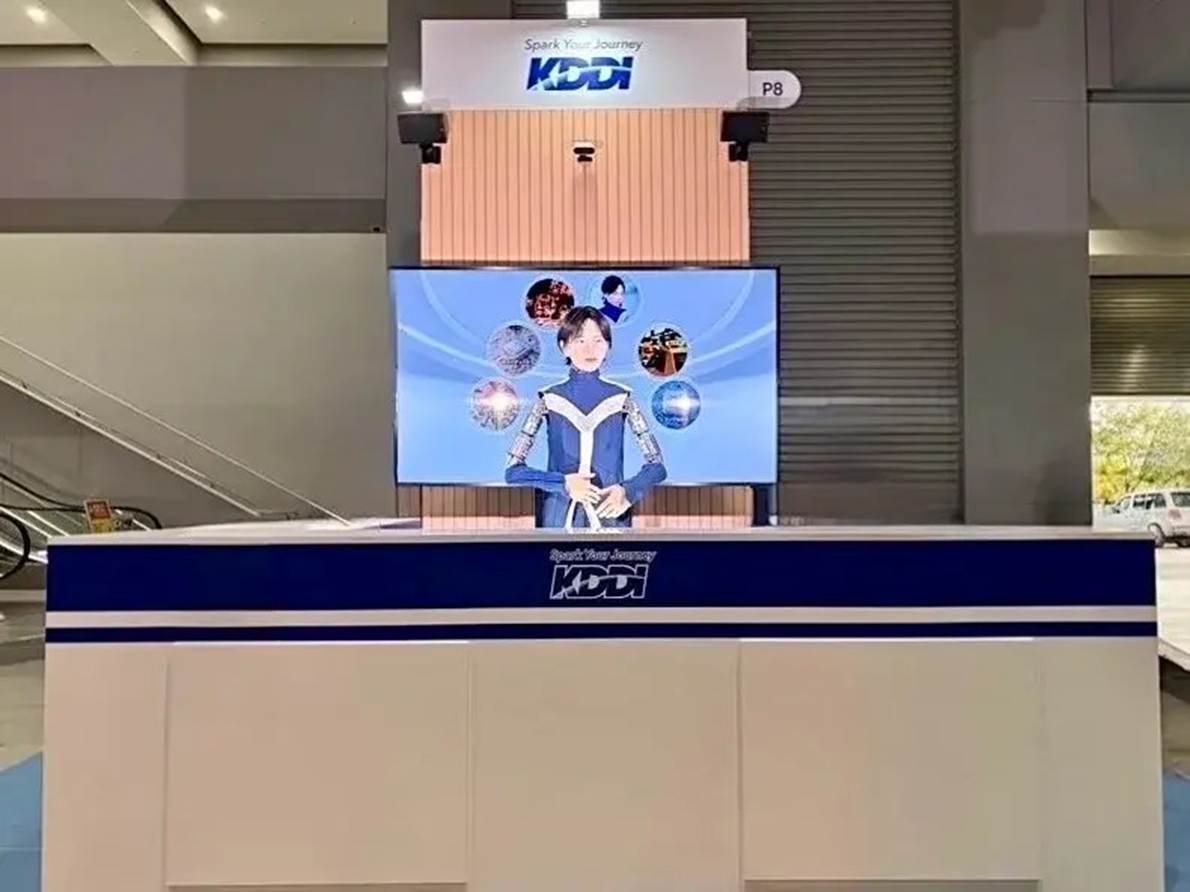
On July 30, 2026, KDDI, Japan's second-largest telecommunications carrier based in Tokyo, and AVITA demonstrated what they describe as the first robot in Japan running Google's Gemini 3.1 Flash Live Preview model. The demonstration took place at Google Cloud Next Tokyo, held at Tokyo Big Sight, specifically at KDDI booth P8 in the South Hall. This deployment represents a significant shift in how machines process human interaction, moving away from the rigid, lag-heavy systems of the past toward fluid, emotion-aware dialogue. AVITA, an Osaka-based startup founded in June 2021 by Hiroshi Ishiguro, the Osaka University professor renowned for his lifelike androids, brings its expertise in avatar and android customer service platforms to the partnership. Operating in the market niche of remote human-plus-AI customer service, AVITA provides the hardware and operational framework, while KDDI acts as the systems integrator, leveraging its massive network infrastructure. The collaboration between a telecommunications giant and a specialized robotics startup highlights the complex ecosystem required to bring advanced AI into the physical world. It is no longer sufficient to simply build a robot; one must also build the network, the software, and the operational model to support it.
The core technological advancement driving this new android is the integration of Google's Gemini 3.1 Flash Live Preview model, which launched in late March 2026. Unlike traditional systems that rely on a pipeline approach, converting speech to text, processing the text through a language model, and then synthesizing a spoken response, Gemini 3.1 Flash Live Preview processes audio natively end to end. This native audio-to-audio processing preserves the pitch, pace, and emotional nuance of the customer's voice. The android responds with an awareness of how something is said, not just what is said, enabling tone-aware customer service. This removes the several-second lag typical of pipeline systems, creating a conversational flow that mimics human interaction. The ability to process audio natively is a critical breakthrough, as it allows the AI to capture the subtle vocal cues that convey emotion and intent, which are often lost in text-based processing. This capability is essential for creating a natural and engaging customer experience, particularly in a culture that values subtle communication and high-touch service.
The Economics of Emotion-Aware Automation
The hardware itself reflects AVITA's design lineage from Ishiguro's extensive android research. The lifelike android features silicone skin, pneumatic actuators for subtle movements, and cameras embedded in the eyes for precise gaze tracking. However, the true innovation lies in the economic model underpinning the deployment. AVITA's existing AVACOM avatar platform has already established a track record of operational efficiency. Deployed at Lawson convenience stores since late 2022, the system utilizes about 70 operators covering 28 stores by early 2025. It is also utilized by Sumitomo Mitsui Banking Corporation (SMBC) and KDDI's own au Style shops. The AVACOM model proves that one remote human operator can effectively cover multiple physical locations. This proven operational model provides a solid foundation for the introduction of autonomous capabilities, reducing the risk associated with deploying unproven technology.
By adding a Gemini-driven autonomous layer to this proven operational model, KDDI and AVITA aim to significantly raise the operator-to-site ratio. The android can handle routine inquiries and emotionally nuanced interactions autonomously, escalating only the most complex or sensitive issues to a remote human operator. This hybrid approach addresses the labor shortage directly by multiplying the productivity of the existing workforce. The involvement of a major telecom carrier like KDDI as the systems integrator fundamentally changes the channel for service-robot procurement in Japan, providing the scale and reliability required for enterprise-wide deployments. The ability to seamlessly escalate interactions from an autonomous agent to a human operator is a critical feature, as it ensures that customers always receive the assistance they need, regardless of the complexity of their request. This hybrid model is likely to become the standard for service robot deployments in the future, as it combines the efficiency of automation with the empathy and problem-solving capabilities of human operators.
What exactly does native audio processing mean for the customer experience? It means the android can detect frustration in a customer's voice and respond with a soothing tone, or recognize urgency and accelerate its response pace, fundamentally altering the dynamic from a transactional exchange to an empathetic interaction. This capability bridges the gap between cold automation and the high-touch service expected in Japanese retail and hospitality. The ability to parse emotional subtext in real-time is a critical requirement for any machine expected to operate in a customer-facing role without constant human supervision. This level of emotional intelligence is what separates a truly useful service robot from a mere novelty, and it is what makes automation genuinely useful in the service sector.
Navigating the Graveyard of Service Robots
Despite the technological leap, the shadow of past failures looms large. The hard truth is that Pepper failed not primarily on speech quality, but on economics and usefulness. While emotion-aware dialogue removes one significant failure mode, frustrating, lag-filled conversations, it does not inherently answer the fundamental question of what task the android completes that a simple touchscreen kiosk or a human employee cannot. The upcoming field trials must demonstrate measurable service outcomes, such as increased transaction throughput, reduced customer wait times, or improved customer satisfaction scores, rather than relying solely on the novelty of the demonstration. The industry has seen too many promising technologies fail to deliver on their potential, and the burden of proof is on KDDI and AVITA to show that their approach is different. The success of this deployment will depend on their ability to identify and execute on specific use cases where the android can provide clear and measurable value.
The planned next step for the KDDI and AVITA partnership is a series of trials in real customer-facing settings scheduled for autumn 2026. These trials will target sectors acutely feeling the labor pinch, including retail, healthcare, and entertainment venues. The autumn 2026 field trials serve as the critical adoption checkpoint; success here could signal a broader rollout across KDDI's extensive enterprise customer base. The transition from a controlled demonstration environment to the unpredictable reality of a retail store or hospital waiting room will test the robustness of both the hardware and the Gemini 3.1 Flash Live Preview model. These trials will provide valuable data on how customers interact with the android in real-world settings, and will help to refine the technology and the operational model before a wider rollout. The results of these trials will be closely watched by the industry, as they will provide a strong indication of the viability of emotion-aware service robots in the Japanese market.
Interestingly, this deployment coincides with broader movements in the artificial intelligence space. On the same day as the KDDI demonstration, Google DeepMind launched Gemini Robotics 2, indicating a concerted push by Google to integrate its Gemini models into physical embodiments across both conversational and manipulation domains. This dual-pronged approach suggests that the era of isolated, single-function robots is giving way to versatile, multi-modal AI agents capable of operating in the physical world. The convergence of advanced language models with sophisticated robotics hardware is creating a new class of machines that can perceive, reason, and act in complex environments. This trend is likely to accelerate in the coming years, as the cost of hardware continues to decline and the capabilities of AI models continue to improve. The KDDI and AVITA deployment is just one example of this broader trend, and it provides a glimpse into the future of human-robot interaction.
Comparing Japan's Service Robot Initiatives
To understand the significance of the KDDI and AVITA deployment, it is essential to contextualize it within the record of Japan's service robot initiatives. The following table outlines key systems, their timelines, underlying intelligence, hardware configurations, and deployment scopes.
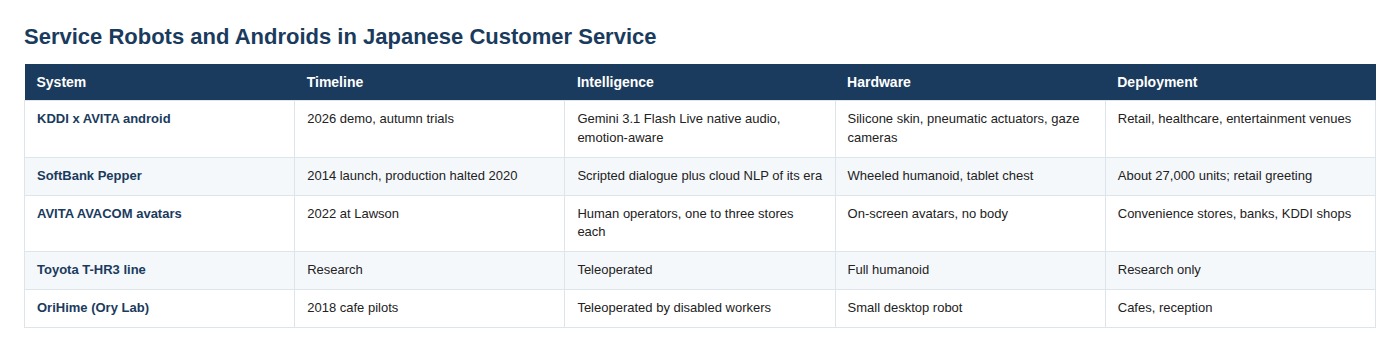
The transition from scripted dialogue to native, emotion-aware processing represents a paradigm shift in human-robot interaction. However, the ultimate success of the KDDI and AVITA android will depend not on its ability to mimic human emotion, but on its capacity to deliver tangible economic value in a labor-constrained market. The autumn trials will be the proving ground, determining whether this new generation of service robots can succeed where its predecessors faltered. The industry is at a critical juncture, and the outcome of these trials will have far-reaching implications for the future of automation in the service sector. If successful, this deployment could pave the way for a new era of intelligent, empathetic service robots that can seamlessly integrate into our daily lives.
The integration of advanced AI models like Gemini into physical embodiments marks a critical juncture in the evolution of service automation. As telecommunications giants like KDDI step into the role of systems integrators, the infrastructure required to support these complex deployments is falling into place. The focus must remain on measurable outcomes and operational efficiency, ensuring that the technology serves as a practical solution to demographic challenges rather than a fleeting technological showcase. The ability to seamlessly blend human oversight with autonomous capabilities will be the defining characteristic of successful service robot deployments in the coming decade. The future of service automation is not about replacing humans, but about augmenting their capabilities and enabling them to provide a higher level of service. The KDDI and AVITA deployment is a significant step in this direction, and it will be fascinating to see how it evolves in the coming years.
Disclaimer: This article is for informational purposes only and does not constitute investment advice, endorsement, or verification of any claims made by the companies mentioned.