
Japan PM Takaichi Vows Faster AI and Drone Adoption for Military
Prime Minister Sanae Takaichi told Japan's military leadership to accelerate AI and unmanned defense asset adoption, as the country's Defense Ministry requests a record $55 billion FY2027 budget for drones and AI-enabled command systems.

A country that has spent eight decades writing pacifism into its constitutional identity is now the one telling its own military to stop waiting for consensus before it fields drones. Prime Minister Sanae Takaichi told senior Self-Defense Forces commanders on Wednesday that Japan must accelerate the introduction of artificial intelligence and unmanned defense assets, framing the technologies as moving at "a completely different pace" than the equipment procurement cycles the country's defense bureaucracy was built around. "It goes without saying that we should introduce even more speedily," she said, a plain sentence that carries unusual weight coming from the first Japanese leader in over a decade to convene the country's defense leadership conference on an accelerated timeline of her own choosing.
The venue mattered as much as the words. The conference, held annually since 1964 with a pandemic-era gap in 2020, is where Japan's civilian and uniformed defense leadership set direction for the year, and Wednesday's session was the first under Takaichi's tenure since she took office in October 2025. She used it to announce that Japan will complete a year-end revision of three national security documents originally written in 2022 and designed to guide policy for a decade, compressing what was meant to be a ten-year framework into a review cycle of under four years. The revision is framed explicitly around the pace at which China and North Korea are fielding their own AI-enabled and unmanned systems, a framing that treats the current documents as already outdated rather than simply due for a routine update.
The Budget Behind the Speech
Words at a leadership conference translate into procurement only when a budget backs them, and Japan's Defense Ministry has already submitted one. The fiscal 2027 request stands at a record 8.89 trillion yen, roughly US$55 billion, the largest defense budget request in the country's postwar history and a figure that confirms Takaichi's Wednesday statement was a preview of spending decisions already in motion rather than an aspiration awaiting funding. The request includes development of low-cost attack drones and integration of AI systems into Self-Defense Forces command structures, the two capability areas Takaichi named specifically in her remarks to commanders.
That pairing, cheap drones and AI-assisted command and control, is not accidental. Japan has watched the same conflicts that reshaped Western defense thinking over the past several years, where inexpensive, mass-produced unmanned systems inflicted disproportionate damage against far more expensive conventional platforms, and where the side that could fuse sensor data into targeting decisions fastest held a persistent advantage regardless of hardware quality on either side. A defense ministry that spent decades optimizing for small numbers of exceptionally capable, exceptionally expensive systems is now explicitly budgeting for the opposite doctrine: large numbers of cheaper, AI-assisted systems that can be replaced faster than they can be attrited.
Where the Money Is Already Landing
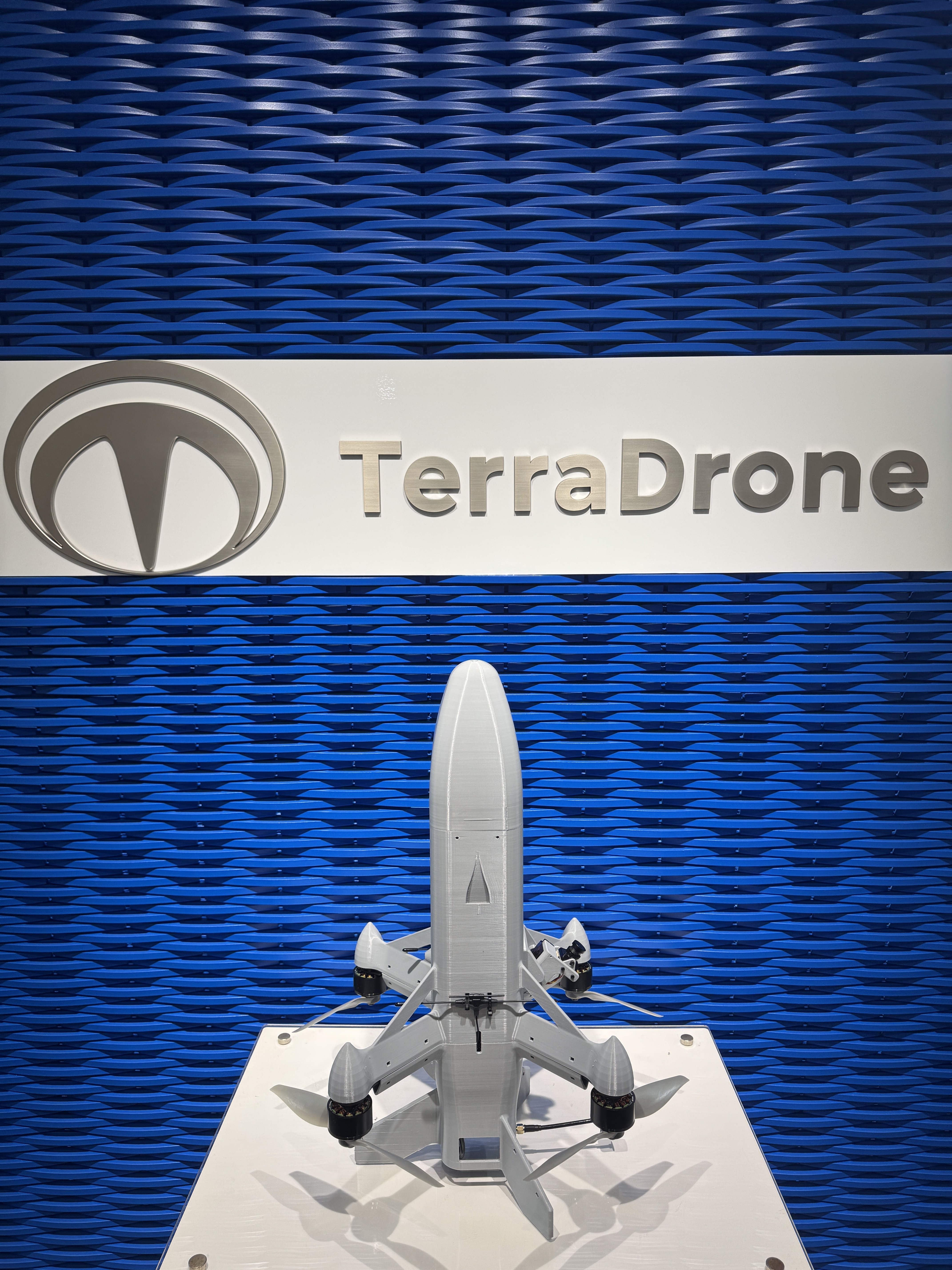
The policy shift is not purely rhetorical; Japan's domestic drone industry has an early production contract to point to. Japan's broader US$6.2 billion physical-AI investment push, aimed primarily at civilian robotics and manufacturing competitiveness against the United States and China, now has a defense-sector counterpart in the Acquisition, Technology and Logistics Agency's Interceptor Drone Early Acquisition Program. Terra Drone Corporation's domestically built Terra B1 interceptor passed the agency's fast-track evaluation on August 25 as the sole aircraft to advance to manufacturing, a design intended to counter long-range loitering munitions of the type Iran's Shahed series has made globally recognizable, with first deliveries to the Maritime Self-Defense Force expected this month.
Terra B1's path from prototype to procurement compresses into weeks a process that has historically taken Japan's defense acquisition system years, and it is the clearest evidence yet that Takaichi's "introduce even more speedily" instruction is already reshaping how ATLA runs competitions, not just how it writes requirements documents. A fast-track program that selects a winner, tests it, and schedules deliveries within a single fiscal quarter is a meaningfully different acquisition tempo than the multi-year development cycles that have defined most of Japan's post-2014 defense procurement, and it gives other domestic drone and AI-systems makers a template for how quickly a validated system can now move from demonstration to contract.
The Doctrine Japan Is Catching Up To
Japan's timing places it behind, not ahead of, the curve its own government now says it must close faster. The United States has spent the past several budget cycles pushing directed-energy and counter-drone production contracts of its own, and allies pursuing similar counter-drone manufacturing buildouts, including AeroVironment's recent production venture established in Greece, illustrate how quickly Western and NATO-aligned defense industries have moved to localize drone and counter-drone manufacturing rather than depend on a small number of prime contractors. Japan's constitutional and political constraints on offensive capability development have historically slowed its ability to match that pace, which is exactly the gap Takaichi's Wednesday remarks were aimed at closing, framed carefully around defensive unmanned systems and AI-assisted detection rather than offensive strike capability that would revive domestic political sensitivities Japan's postwar defense posture was built to avoid.
The revised national security documents due at year-end will be the real test of how far that acceleration goes. A revision that simply updates threat assessments while leaving procurement processes, budget authorization cycles, and interagency approval chains unchanged will do little to close the gap with China's and North Korea's fielding pace, regardless of how much money the fiscal 2027 budget allocates. A revision that restructures how quickly ATLA can move a validated system like Terra B1 from test to fleet, replicating that timeline across other unmanned and AI-enabled procurement lines rather than treating it as a one-off fast-track exception, would represent the structural change Takaichi's language on Wednesday was actually describing.
What Commanders Heard in the Room
Strip away the budget figures and the policy framing, and what happened Wednesday was simpler than either: a prime minister stood in front of the officers who will operate whatever gets fielded and told them the equipment they train on today will be outdated faster than any previous generation of Japanese hardware, and that the bureaucracy around them needs to move at the speed of the technology rather than the speed of its own procedures. For the commanders in that room, weighing how quickly an interceptor drone that passed testing three weeks ago becomes a unit they can actually deploy against a real incursion, that is the sentence the budget lines and document revisions now have to answer to.
A Regional Race Neither Side Wants to Lose
Japan is not making this pivot in isolation. South Korea unveiled its own national strategy for physical AI and robotics in June, setting an explicit target of a 20 percent global share in humanoid robotics, while Japan's parallel strategy names a target of roughly 30 percent share in AI robots more broadly, both frameworks announced within weeks of each other and both citing China's manufacturing scale and deployment pace as the benchmark neither government wants to fall further behind. Seoul's plan leans civilian and industrial, chasing manufacturing and export share; Tokyo's defense-side acceleration under Takaichi is the security complement to that same competitive anxiety, treating unmanned systems and AI-assisted command as capabilities Japan cannot afford to source primarily from allies if it wants genuine strategic autonomy in its own region.
That regional dynamic gives Takaichi's Wednesday remarks a second audience beyond the commanders in the room: defense planners in Seoul, Beijing, and Pyongyang who will read Japan's accelerated procurement timeline as a data point in their own budget planning. A revised set of national security documents that meaningfully compresses Japan's acquisition timeline for unmanned and AI-enabled systems changes the competitive calculus for every neighboring military weighing how quickly it needs to field comparable capability, which is precisely the kind of regional signaling effect that made the timing of Wednesday's conference, held earlier in the fiscal cycle than any of Takaichi's predecessors chose, a deliberate part of the message rather than a scheduling coincidence.
The Manufacturing Base That Still Has to Catch Up
None of the policy acceleration solves Japan's more basic constraint: a defense-industrial base that has spent decades building small production runs of exceptionally engineered systems rather than the high-volume manufacturing lines that cheap, attritable drones require. Terra Drone's compressed test-to-delivery timeline for the Terra B1 interceptor is encouraging precisely because it is still a small program, dozens of units rather than the thousands a genuinely attritable unmanned systems doctrine would eventually require. Scaling Japanese drone manufacturing to the volumes its own new doctrine implies will demand the kind of dedicated production investment that AeroVironment and other Western contractors have made in expanding their own factory capacity, a step Japan's domestic drone makers have only begun taking and one the fiscal 2027 budget request will need to fund explicitly if Takaichi's acceleration is going to survive contact with actual production constraints.
This analysis synthesizes public statements from Japan's Prime Minister's Office, Defense Ministry budget disclosures, and ATLA program announcements as of September 2, 2026.
Image: Terra Drone.
This article is provided for general information purposes only and does not constitute investment, procurement, legal, or engineering advice.













