Humanoid Robot Commercialization Is Turning into a Core-Components Integration Test
The World Artificial Intelligence Conference (WAIC) 2026 forum highlights how humanoid commercialization depends on integrating reducers, servo systems, dexterous hands, sensors, controllers, and connectors.

Which integration dependencies decide whether humanoid prototypes can scale?
On July 19, 2026, IMRobotic and the World Artificial Intelligence Conference (WAIC) Committee Office hosted the "Future of Embodied Humanoid Robots and the Intelligent Upgrade of Core Components" forum at the Thompson Shanghai Expo. The event established that scaling humanoid prototypes requires treating core components as a coordinated deployment stack.
A Forum Agenda Built Around Integration Risk
The robotics industry is undergoing a fundamental transition from building standalone prototypes toward the rigorous demands of mass production and real-world deployment. The WAIC 2026 forum provided a clear view of this evolving environment. The agenda treated reducers, servo systems, dexterous hands, sensors, controllers, and connectors as parts of a coordinated deployment stack. This approach highlights that the success of humanoid robots depends on the seamless integration of these diverse elements. The "White Paper on Global Technological Innovation and Applications of Embodied Intelligence" was officially released at the forum, emphasizing this shift.
During the scheduled sessions, ASD Robots, a subsidiary of the traditional cookware manufacturer ASD focusing on humanoid robots for industrial, consumer service, and kitchen scenarios, emphasized focusing solely on real-world commercial deployment. Infineon, a global semiconductor manufacturer providing solutions for humanoid robots including motor control and microcontrollers, presented on building the full stack for humanoid robots using semiconductor solutions. SLAMTEC also participated in the ecosystem collaboration. The forum framed the commercialization of humanoid robots not just as an artificial intelligence challenge, but as a profound hardware engineering and supply chain challenge.
Quotable insight: Scaling humanoid production is a systems-integration problem because component performance only becomes useful when interfaces, controls, power, sensing, and assembly work together.
This reality underscores the transition from demonstration to mass production.
The Foundation of Movement and Actuation
Joint modules and servo systems are the foundational elements of humanoid robot actuation and movement. They are responsible for translating control signals into physical motion, requiring a delicate balance of power, precision, and efficiency. The WAIC 2026 forum agenda highlights the critical role of these components in achieving reliable and dynamic movement. However, the path to commercialization is fraught with challenges. Reliability gaps and precision loss are significant failure modes that must be addressed. These issues can stem from mechanical wear, thermal management problems, or limitations in control algorithms.
The integration dependency of joint modules and servo systems is particularly high. They require tight integration with controllers and power systems to function effectively. The communication latency between the controller and the servo must be minimized to ensure responsive and stable movement. The power delivery system must be capable of handling the dynamic loads associated with demanding tasks. The adoption signal in this category is a clear push towards democratization and standardization. As the industry matures, there is a growing need for standardized interfaces and modular designs that can simplify integration and reduce costs. This trend is essential for enabling a broader ecosystem of component suppliers and accelerating the development of humanoid robots.
Bridging the Gap to Manipulation
Dexterous hands represent one of the most demanding and critical components of humanoid robots. They are essential for manipulation and interaction with the physical world, enabling robots to perform tasks that were previously the exclusive domain of humans. The WAIC 2026 forum agenda underscores the importance of dexterous hands in enabling new applications for humanoid robots. However, achieving human-like dexterity remains a formidable challenge. Lack of precision and durability issues are common failure modes. The intricate mechanical design and the sheer number of actuators required for a fully articulated hand make it susceptible to wear and tear.
The integration dependency of dexterous hands extends beyond mechanical and electrical connections. It depends heavily on data flywheels and multimodal perception. To manipulate objects effectively, the robot must be able to perceive its environment through vision, tactile sensing, and proprioception. This sensory data must be processed in real-time to adjust the grip and movement of the hand. The adoption signal in this area is the development of specific data collection solution matrices. Companies are increasingly focusing on gathering high-quality data to train the machine learning models that control dexterous manipulation. This data-driven approach is crucial for improving the robustness and adaptability of humanoid hands in unstructured environments.
The Brains of the Operation
Semiconductors and controllers form the processing and control backbone of humanoid robots. They are responsible for executing advanced algorithms, managing sensory input, and coordinating the movement of the entire system. The WAIC 2026 forum agenda highlights the foundational role of these components in the full-stack architecture of humanoid robots. As robots become more autonomous and capable, the demands on their processing capabilities increase exponentially. Processing bottlenecks and latency are critical failure modes that can compromise the performance and safety of the robot.
The integration dependency of semiconductors and controllers is absolute. They are foundational for the full-stack architecture, linking the high-level cognitive functions with the low-level motor control. The communication architecture must be designed to handle massive amounts of data with minimal latency. The adoption signal in this category is the emergence of dedicated full-stack solutions from major providers. Companies are developing specialized chips and computing platforms optimized for the unique requirements of embodied artificial intelligence. These integrated solutions aim to streamline development, improve performance, and reduce the overall cost of humanoid robot systems.
The Unsung Heroes of Reliability
Connectors are often overlooked in discussions about humanoid robots, yet they are critical for physical and electrical linkage. They ensure the reliable transmission of power and data between the various components of the system. The WAIC 2026 forum agenda identifies connectors as a specific enabler for scaling production. In a highly integrated system like a humanoid robot, a single faulty connector can lead to catastrophic failure. Structural failure and signal loss are the primary failure modes associated with connectors. These issues can be caused by vibration, mechanical stress, or environmental factors.
The integration dependency of connectors is critical for transitioning from prototype to mass production. The assembly process must be robust and repeatable, requiring connectors that are easy to install and highly reliable. The adoption signal is the recognition of connectors as a specific enabler for scaling. As manufacturers move towards higher production volumes, the demand for specialized connectors designed for the rigorous environment of humanoid robots will increase. This includes connectors that can withstand high currents, provide secure data transmission, and endure the physical stresses of dynamic movement.
Core Component Category Comparison
The following table provides a comparison of the core component categories discussed at the WAIC 2026 forum, detailing their function, failure modes, integration dependencies, and adoption signals.
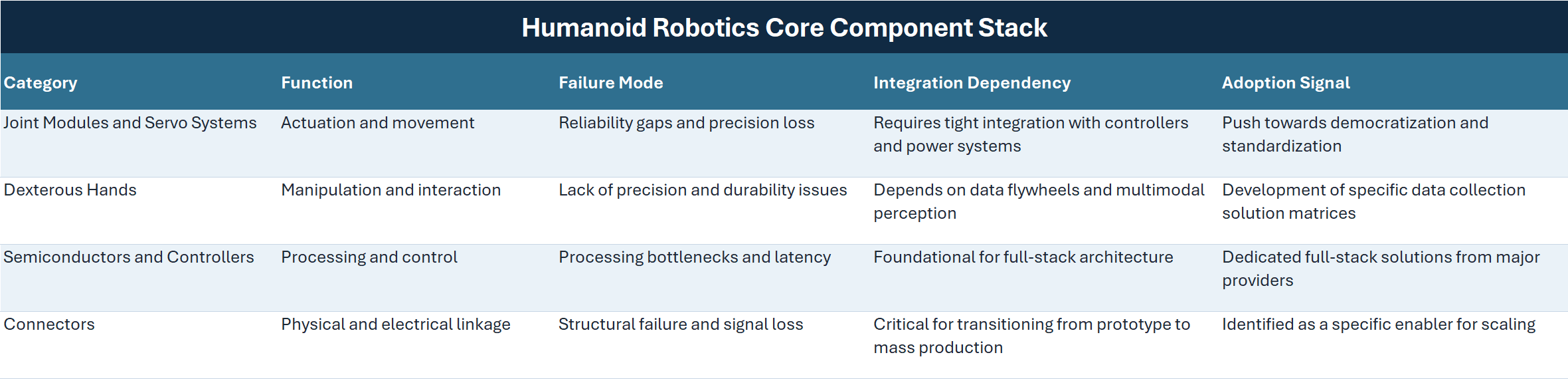
The table maps component functions and integration dependencies discussed in the official agenda. It does not report supplier rankings or production volumes.
The Path Forward for Humanoid Commercialization
The commercialization of humanoid robots is a multi-layered challenge that extends far beyond the development of advanced artificial intelligence models. It requires a deep understanding of hardware engineering, supply chain management, and system integration. The WAIC 2026 forum provides valuable insights into the current state of the industry and the critical role of core components. By treating reducers, servo systems, dexterous hands, sensors, controllers, and connectors as a coordinated deployment stack, the industry can begin to address the demanding challenges of mass production and real-world deployment.
The success of humanoid robots will depend on the ability of manufacturers to integrate these diverse components into reliable, efficient, and cost-effective systems. This requires a collaborative effort across the entire supply chain, from component suppliers to system integrators and end-users. As the industry continues to mature, we can expect to see further standardization, modularization, and innovation in core component technologies. These advancements will be essential for realizing the full potential of humanoid robots and driving the industry forward.
Expanding on the Integration Challenge
The integration of these core components is not merely a matter of plugging them together. It involves demanding engineering trade-offs and a deep understanding of system-level dynamics. For instance, the selection of a specific servo system will dictate the power requirements and thermal management strategies for the entire robot. Similarly, the choice of dexterous hands will influence the design of the perception system and the computational load on the main controller. These interdependencies require a systems engineering approach that considers the impact of each component on the overall performance and reliability of the robot.
The software architecture must be designed to accommodate the specific characteristics of the hardware components. The control algorithms must be tuned to the dynamics of the actuators, and the perception models must be calibrated to the sensors. This tight coupling between hardware and software is a defining characteristic of embodied artificial intelligence. It requires a multidisciplinary team of engineers with expertise in mechanical design, electrical engineering, control systems, and computer science. The WAIC 2026 forum agenda highlights the need for this collaborative approach, bringing together experts from across the robotics ecosystem to address the challenges of humanoid commercialization.
Addressing the Manufacturing Bottleneck
Scaling the production of humanoid robots is a significant bottleneck that must be addressed. The manufacturing process for these highly integrated systems is currently highly manual and time-consuming. To achieve mass production, manufacturers must develop automated assembly processes and establish robust supply chains for core components. The WAIC 2026 forum agenda highlights the importance of connectors and other components that enable efficient assembly and testing. The development of standardized interfaces and modular designs will also play a crucial role in streamlining the manufacturing process.
The quality control processes must be rigorous to ensure the reliability and safety of the deployed robots. This requires advanced testing and inspection techniques, as well as comprehensive traceability systems. The transition from prototype to mass production is a critical phase in the commercialization of humanoid robots, and it requires significant investment in manufacturing infrastructure and expertise. The insights shared at the WAIC 2026 forum provide a roadmap for navigating this demanding transition and building the foundation for a scalable and sustainable humanoid robotics industry.
This analysis synthesizes company statements and public market activity.
Image credit: IMRobotic and WAIC Committee Office
Disclaimer: This article is provided for informational purposes only and does not constitute investment, legal, technical, or business advice. It synthesizes verified primary-source materials available on July 19, 2026. Product specifications, event schedules, benchmarks, and performance claims remain subject to independent verification. Readers should conduct their own due diligence before making commercial or technical decisions.