China registers 116,000 new humanoid robot enterprises in early 2026
China’s market regulator logged 116,000 new humanoid robot enterprises in the first half of 2026 as funding surpassed the total for all of 2025. Shipments are projected to climb to 38,000 units this year, signaling a shift from research projects to the first wave of mass production.
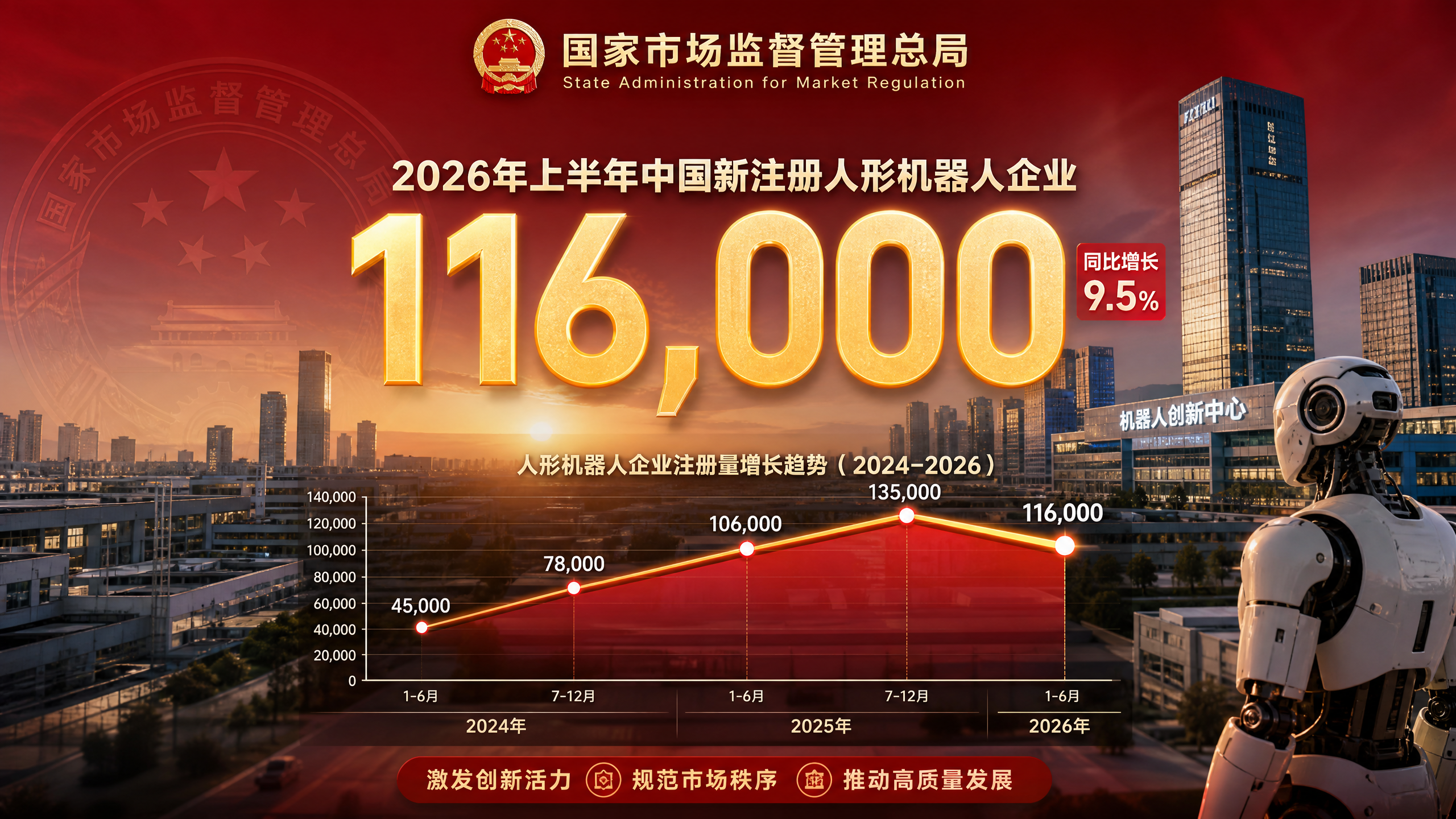
China's State Administration for Market Regulation reported 116,000 new enterprises registered in the humanoid robot sector in the first half of 2026.
The data, released in early August, came alongside funding tallies showing 125 deals totaling RMB 44.5 billion (approximately US$6.1 billion) and sharply rising shipment projections for 2026.
National Strategy in Execution
A national push is propelling humanoid robots into scaled production China is accelerating a strategic move to push humanoid robots from lab prototypes into factories and services at scale. The registration surge tracked by the State Administration for Market Regulation in Beijing captures a widening ecosystem that spans complete robot makers and the suppliers of actuators, harmonic reducers, roller screws, vision systems, and control software. It follows policy guidance from ministries that labeled humanoids as a frontier industry and encouraged scenario pilots and standards work.
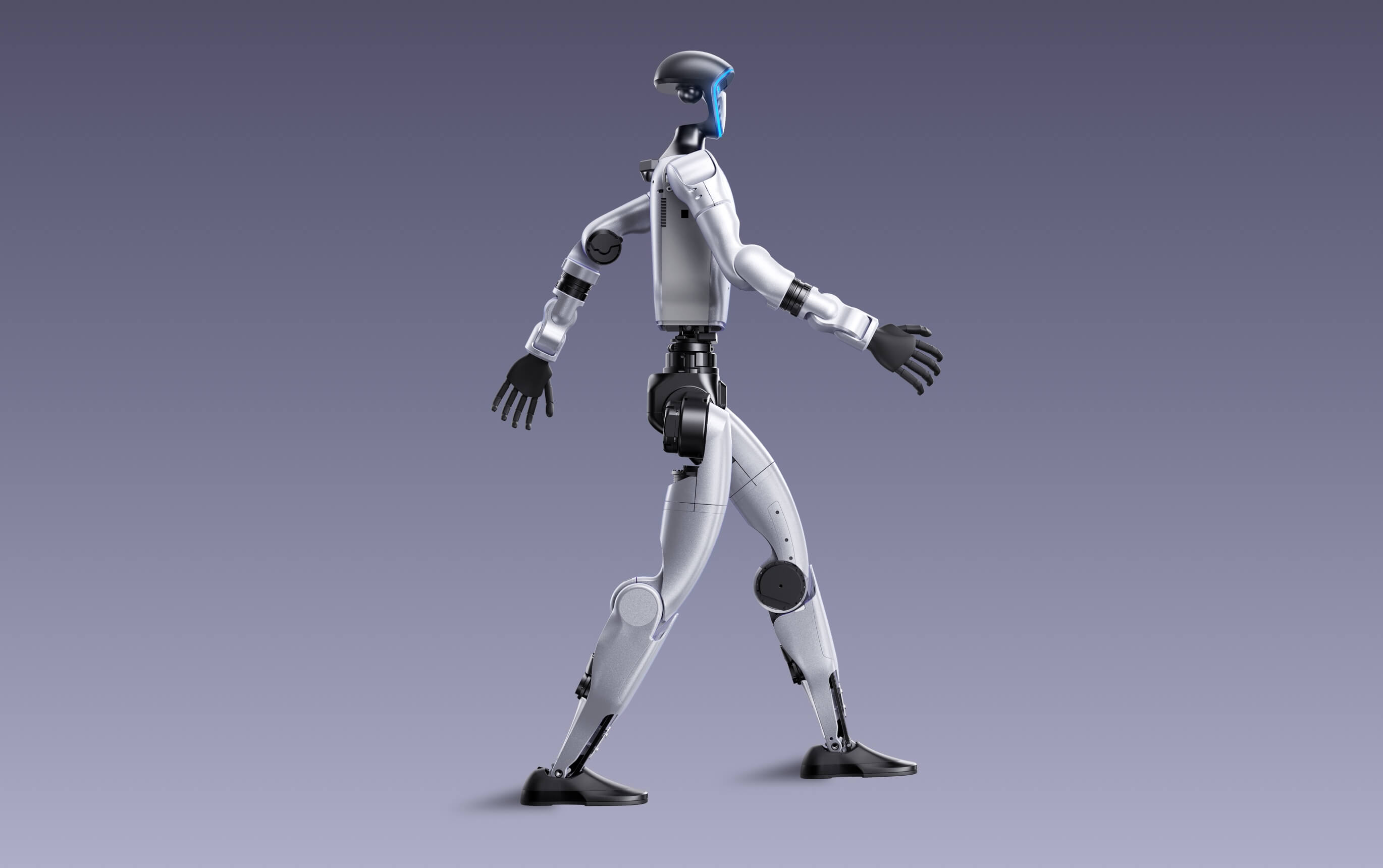
The core of this sector is anchored by firms such as Shenzhen based UBTech Robotics and Shanghai based Fourier Intelligence, which typify the emphasis on bipedal systems for logistics, manufacturing, and service tasks. UBTech has evolved from educational and service robots into industrial grade humanoids intended to operate in controlled environments. Fourier, known for rehabilitation robotics, has pivoted to general purpose humanoids with strong actuator design and torque control. Hangzhou based Unitree has brought cost down innovations from its quadrupeds into humanoids for industrial handling and research. These companies illustrate an emerging market niche that blends cutting edge mechatronics, real time AI control, and process integration for factories and warehouses.
Investments turned to Action
The investment wave points to a manufacturing breakout rather than a hype cycle as there are 125 funding events in the humanoid domain in the first half of 2026 with capital raised reaching RMB 44.5 billion. That amount exceeds the RMB 25.9 billion (approximately US$3.6 billion) raised during all of 2025 by a wide margin. The mix includes late stage financing for full stack robot makers, Series A and B rounds for component suppliers, and seed capital for software and integrators. The quantum and breadth suggest that investors are betting on near term unit sales rather than 5 year research timelines.
Chinese producers shipped 14,400 humanoid units in 2025, equal to 84.7 percent of the global total according to industry trackers. Projections for 2026 point to 38,000 units shipped, an advance that implies maturing production lines, rising orders from pilot customers, and more affordable bill of materials. The shift looks similar to the early smartphone era when upstream suppliers, contract assemblers, and brand owners ramped in concert. The analogy is not perfect because humanoids demand more safety and reliability than phones, yet the pattern of coordinated scaling applies.
A skeptical counterpoint is warranted. Registration numbers are a noisy proxy that can include shell firms and opportunistic rebrandings. Fundraising totals can mask concentration in a handful of national champions rather than broad based health. Early shipments can reflect demonstration placements with limited repeatability. The real test will be unit economics, uptime in production environments, and customer retention through replacement cycles.
Shift from Relying Foreign Suppliers to Domestic Supply Chain Buildout
Supply chain buildout is the decisive lever for cost and reliability Humanoid robots are defined by the quality of their joints, the precision of their transmission systems, and the acuity of their perception stacks. If we liken a humanoid to a high performance bicycle, the frame gets attention but the ride is made by the gears, bearings, and brakes. For robots, the equivalent parts are strain wave reducers, planetary and harmonic gear assemblies, torque dense motors, and high bandwidth force sensors.
Historically, Japanese companies dominated key components like harmonic reducers and roller screws, with brands such as Harmonic Drive and THK setting performance benchmarks. Chinese suppliers have worked for years to localize these components. Domestic providers of strain wave reducers and precision drives have improved efficiency, durability, and backlash metrics, though consistency remains a focus. Roller screws that convert rotary motion to linear force are seeing rising domestic output, cutting dependence on imports and reducing lead times. Camera and LiDAR providers have also scaled, supplying 3D vision with improved robustness for dusty and low light factory conditions.
Actuator integration is another battleground. Integrated joints that combine motor, reducer, encoder, and driver electronics in a sealed module are becoming standard for easing assembly and maintenance. The maturing of integrated drive units in China should lower costs and allow faster replacement, a key operational need for continuous duty cycles. Suppliers that offer both hardware and low level control firmware gain stickiness and higher margins.
Software and AI Compute being Localised
Software stacks and AI compute are being localized for resilience The software layer ties the hardware together and determines practical capability. Real time control loops, whole body dynamics, and safety envelopes must run predictably at millisecond scales. On top of that, perception, planning, and task sequencing now use transformer models and diffusion policies trained on motion datasets. The drive for local autonomy in compute is shaping architecture choices.
Export controls on advanced GPUs remain a pressure point. Many humanoids rely on edge inference with modest compute budgets relative to training clusters, but the favored modules from US vendors face restrictions. Chinese developers are adapting to domestic alternatives, including accelerators from Huawei and startups, along with x86 or ARM based industrial PCs paired with real time co processors. The policy environment has nudged the industry toward middleware and toolchains that do not depend on restricted software. ROS 2 variants with domestic forks, homegrown real time operating systems, and custom motion planning frameworks are gaining ground.
This software localization has two strategic benefits. It reduces supply risk amid geopolitical uncertainty, and it allows algorithmic tailoring to local factory processes and languages. Yet it introduces challenges as teams must optimize across heterogeneous hardware, sometimes at the cost of absolute peak performance. Stability, deterministic timing, and certification for functional safety will be ongoing hurdles.
Creating Local Demand
Local governments are underwriting infrastructure and scenario pilots Industrial policy is amplifying market forces. Municipalities and development zones have rolled out grants, tax incentives, and facility subsidies to attract humanoid robot companies and component makers. Several provinces have announced humanoid parks where assembly plants sit alongside motor winders, reducer makers, and test labs. These clusters mirror the electric vehicle supply chain template where colocation and shared services reduced costs and shortened learning cycles.
Local governments are also organizing scenario pilots with state owned manufacturers, logistics hubs, and public services to seed demand. Examples include automotive assembly tasks, electronics packaging, palletizing in bonded warehouses, and security patrols. Subsidies for the first two hundred units in a vertical can create proof points that lower the perceived risk for fast followers. This approach has a track record in industrial robots and new energy equipment.
A potential downside is excess capacity if investment outruns real adoption. Empty parks and underutilized lines would weigh on margins and trigger consolidation. The discipline of staged milestones tied to actual deployments will determine whether public funds catalyze durable ecosystems or just inflate registration statistics.
Compeitive Dynamics
Competitive dynamics favor firms with vertical integration and channel access The Chinese humanoid sector is crowded at the top and even more so in the middle. The leaders tend to share three traits. They own critical components such as actuators or drivers. They have deep relationships with system integrators that customize deployments for factories. They can access contract manufacturing to flex production volumes.
UBTech’s strength lies in its integration experience from earlier service robots and in relationships in southern China’s electronics belt. Fourier leverages actuator design and rehabilitation know how to produce precise motion control. Unitree brings cost innovation and agility from the consumer and research market. New entrants backed by internet platforms or industrial groups add marketing muscle and access to captive scenarios.
International competition is intensifying. US and European firms push distinct design philosophies and higher price points aimed at high mix automation in advanced economies. Chinese makers counter with fast iteration, local component sourcing, and lower system costs that appeal to value sensitive customers. The next two years may see co opetition, with Chinese suppliers selling components to foreign brands and vice versa, even as product lines compete in third markets.
Economies of Scale will Evolve
Unit economics improve as volumes rise and parts are standardized The central economic question is whether humanoids can pay for themselves in real workflows. The emerging answer is conditional. In repetitive tasks with light to moderate payloads and minimal fine dexterity, humanoids begin to show payback if unit cost and maintenance fall below specific thresholds. Those thresholds vary by region, wage rates, and process design.
As volumes increase to the projected 38,000 units in 2026, bill of materials should decline through scale effects. Standardized joint modules, reused electronics, and commodity vision sensors drive savings. Yield on critical reducers and motors improves with tighter process control. The share of hand assembly in actuator production falls as automation increases. Spare part ecosystems and refurbished component programs extend life and lower downtime.
Service models are evolving. Some vendors are experimenting with robot as a service contracts that bundle hardware, software updates, and on site support for a monthly fee. Others pursue traditional capex sales with optional extended warranties and training. Financing arms from banks and captive lenders may enter to smooth cash flows for buyers. All of these efforts echo the early days of industrial robotics, adapted to the specifics of bipedal machines.
Disclaimer: This article is for informational purposes only and does not constitute financial or investment advice.