Washington Just Locked Its Door to Chinese Humanoids, and Unitree Was Standing on the Porch
The FCC on July 28 barred new Chinese humanoid and quadruped robots and connected power inverters from the US equipment authorizations they need to be imported or sold, effective immediately upon publication. Already-authorized models stay legal for now. The move blocks Unitree's planned August North America launch and formalizes the robot trade's split into rival blocs.
The United States stopped waiting for legislation. On Tuesday afternoon, July 28, the Federal Communications Commission barred new Chinese humanoid and quadruped robots from the equipment authorizations they need to be imported, marketed, or sold in America. Connected power inverters got the same treatment. The measures took effect the moment they were published, Reuters reported in an exclusive. They apply to models not yet released. The FCC also kept the power to revoke authorizations it has already granted.
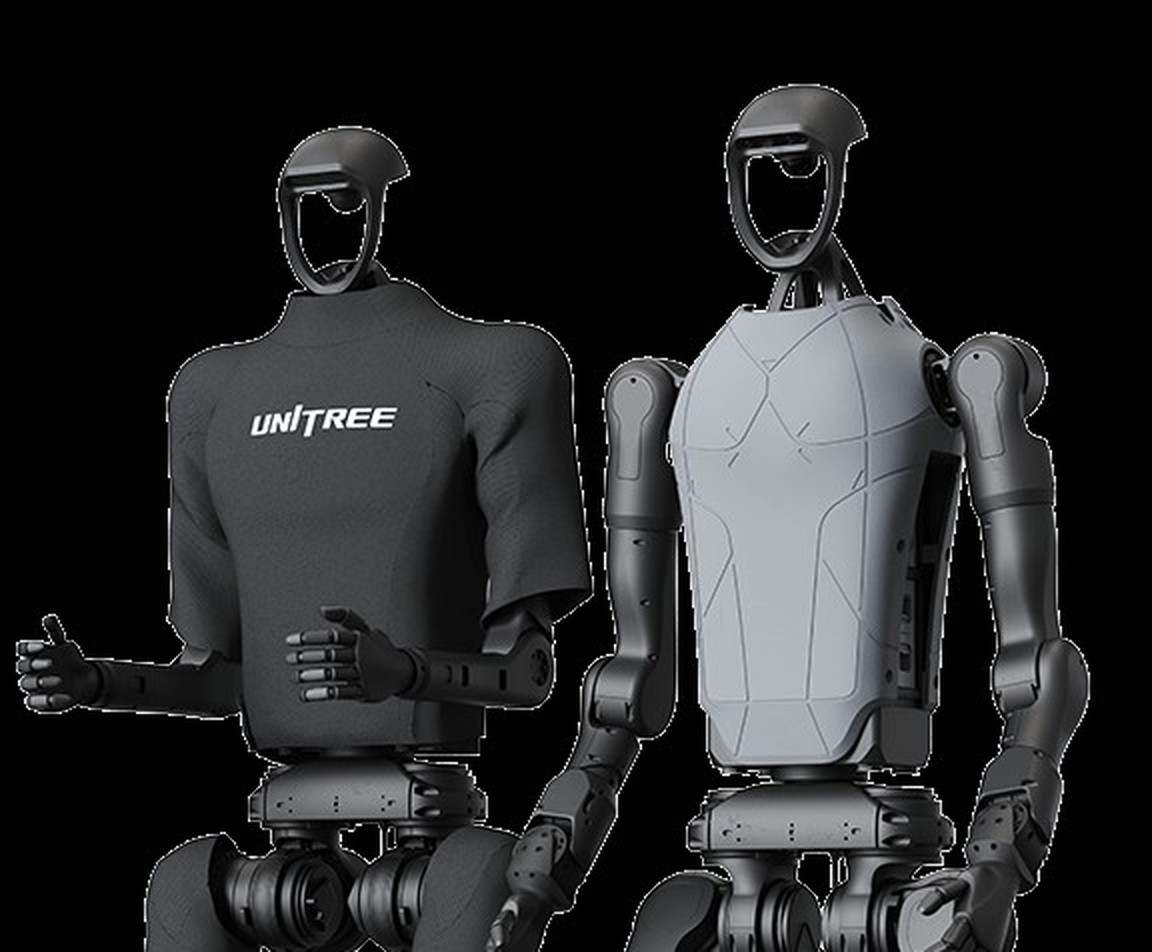
The FCC has placed them on its Covered List under the Secure and Trusted Communications Networks Act. Models already authorized remain legal for now. The ban lands hardest on Unitree Robotics. The company holds somewhere between a fifth and a third of the global humanoid market, depending on whose count you trust. It had been preparing a North American launch for around August 12.
The commission did not soften its language. The devices, the FCC said in its statement, "could create supply chain vulnerabilities that could disrupt U.S. economic and national security and could create a cybersecurity risk that threatened American critical infrastructure." Chairman Brendan Carr added that "the FCC will continue to do our part to secure America's critical supply chains." On the robots themselves, the agency warned they "collect data that could be leveraged by malign actors to surveil Americans, enhance the capabilities of foreign intelligence services, or to remotely commandeer the robots."
The Mechanism Is Quiet, Which Is Exactly Why It Works
There is a reason this arrived as an FCC order rather than a headline trade action. Adding a product category to the Covered List needs no tariff negotiation. No act of Congress. No notice-and-comment rulemaking. Any device with a radio needs an FCC equipment authorization before it can be imported or sold in the US and every modern robot has a radio. Deny the authorization and the product simply disappears from the market. No customs theater required.
Think of it as the difference between building a wall and changing the locks. Tariffs are a wall. Everyone sees them, fights them, prices them in. An authorization ban is a lock change. The door looks the same, but the key Chinese manufacturers have been using no longer turns. The FCC used the same lock on Huawei and ZTE telecom gear in 2021. Then on Hikvision cameras. Then on DJI drones in December 2025 and on Chinese consumer routers in March 2026. Robots are the newest entry on a list that only grows in one direction.
The order has two edges worth noting. It bans new models, not the installed base. The Unitree quadrupeds already walking around American university labs stay where they are. And the FCC signaled it expects to exempt many non-Chinese suppliers, as it did with the drone and router actions, according to four sources familiar with the measures. The target is national origin. Not the product category.
Unitree Had an August Date With America. It Is Now Cancelled
The timing borders on cinematic. Unitree opened commercial humanoid sales in Europe on July 22, becoming the first Chinese humanoid maker to enter Western commercial markets. A North American launch was lined up for around August 12. Six days after the European opening, the American door closed. Whatever new model Unitree meant to certify for US customers will not receive authorization.
The company was already on Washington's radar. In June it joined the Pentagon's 1260H list of alleged Chinese military-linked companies. Its IPO prospectus claims 32.4 percent of global humanoid unit shipments. Counterpoint Research credits it with just under one fifth of the market. Omdia hands the 2025 unit crown to AgiBot at 5,168 units. However the rankings shake out, Unitree shipped more than 5,500 humanoids in fiscal 2025. It booked roughly RMB 1.699 billion, about US$235 million, in revenue, up 335 percent year on year. And its largest customers have been US academic and research institutions. The FCC order now turns that irony into policy.
The security case against Unitree is not hypothetical, and honest coverage should say so. In March 2025, researchers disclosed CVE-2025-2894, a firmware backdoor in the Unitree Go1 quadruped tied to the CloudSail remote-access service. It started automatically on boot. It left roughly 2,000 robots reachable, including units at MIT, Princeton, and Carnegie Mellon. No firmware patch was ever confirmed. In September 2025, the UniPwn exploit showed root access over Bluetooth to the Go2, B2, G1 and H1, wormable from robot to robot. IEEE Spectrum called it the first major public exploit of a commercial humanoid. People argue about whether those flaws reflect malice or sloppiness. Nobody argues about whether they existed.
The skeptical counterpoint deserves equal weight. The FCC's legal theory rests on what Chinese law might compel companies to do, particularly Article 7 of the 2017 National Intelligence Law. Scholars genuinely disagree about how far that compulsion reaches in practice. Unitree partnered with Nvidia to run Blackwell chips as robot brains and Nvidia has said US customer data stays in the US. A ban on new models also does nothing about the thousands of Chinese robots already inside American institutions. That is where any real surveillance risk would live today. And the loudest voices calling for this action were American humanoid makers, who benefit directly from the removal of their cheapest competitor.
Congress Wanted This. The FCC Delivered It Faster
The political runway was long. In May 2025, all 24 members of the House Select Committee on China signed a letter urging the FCC to consider Covered List action on Chinese robotics. The letter noted that even the US Marines had used Unitree quadrupeds. In June 2026, the GUARD Act proposed mandatory security reviews of Chinese robots. The FCC's executive action delivers the bill's core outcome without waiting for a floor vote. John Moolenaar, who chairs the Select Committee, said the move "protects our country and strengthens our nation's robotics industry."
The inverter half of the order follows the same logic at a different layer of the stack. China is the world's largest maker of power inverters, the boxes that connect solar arrays and batteries to grids and data-center equipment. Sungrow Power Supply and Huawei lead that market. The Pentagon was already barred from buying solar cells and inverters from foreign entities of concern. The 2023 Volt Typhoon intrusions into US critical infrastructure sharpened official anxiety about grid-adjacent Chinese electronics. Pairing robots with inverters in one order tells you how Washington now sees humanoids. Not as consumer gadgets. As critical infrastructure endpoints.
What Changes for the Robot Trade
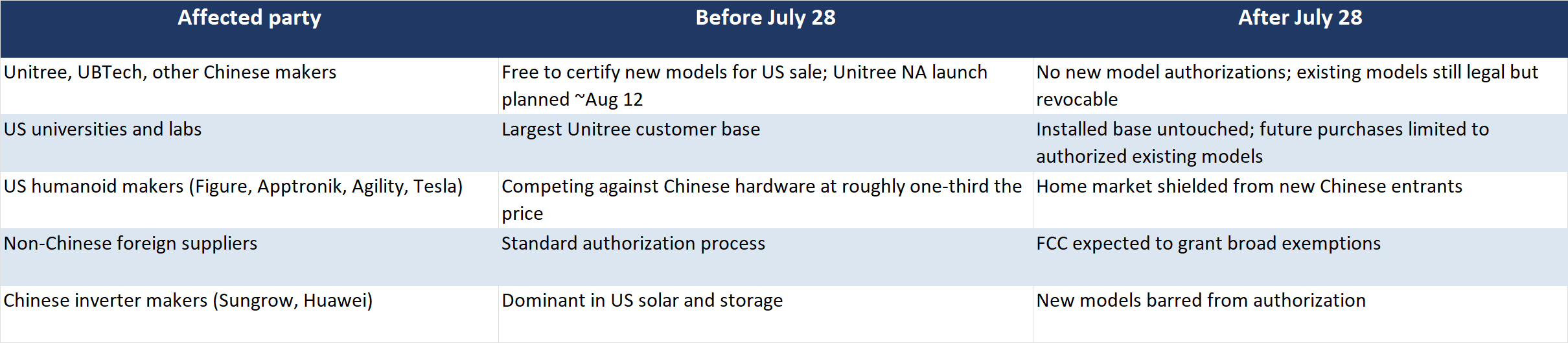
Nobody should mistake this for the end of the story. Treasury Secretary Scott Bessent warned the same day that Chinese AI firms could face sanctions over intellectual property theft. Beijing's responses to earlier Covered List actions suggest countermeasures will come. Rare-earth licensing is one option. Its own certification regimes are another. So is a faster de-Americanization of robot supply chains. The Chinese embassy did not respond to Reuters. Neither did Unitree, Sungrow, or Huawei.
One practical question hangs over every American robotics lab reading the order. What happens at renewal time? The FCC can revoke authorizations it has already granted, so the installed base lives on borrowed regulatory time. Any institution planning a multi-year research program around Chinese hardware now carries a policy risk it cannot hedge. Expect procurement officers to start asking that question this week.
The deeper shift is structural, and it echoes something we have tracked all month. China's robotics industry crossed its export milestone. Its champions began listing in Hong Kong. Unitree opened Europe. All of it happened while the US market drifted toward closure. As of July 28, the drift is official policy. The global humanoid market is no longer one market. It is two, with different products, different certifications, and different politics on each side of the lock. Buyers in the middle, from Berlin to Jakarta, should watch where Unitree redirects the shipping containers that were packed for California.
This article is for informational purposes only and does not constitute investment, legal, or professional advice. Figures are drawn from the cited sources and were accurate as of publication.