The Surgical Robotics Shakeout: A Bankruptcy, a Duopoly Test, and the Buyer's New Leverage
Surgical robotics just lost one of its most hyped startups to bankruptcy in the same week the premium market gained its first credible second supplier in a generation. This analysis maps the consolidation economics deciding who survives, China's parallel game, and a practical evaluation framework for hospitals entering the duopoly era.
What is the Surgical Robotics Shakeout?
Surgical robotics is consolidating into a contest of giants. In the same week of July 2026, Vicarious Surgical, a startup that raised roughly US$300 million, entered bankruptcy without ever clearing a product, while Johnson & Johnson's OTTAVA authorization gave the premium soft tissue market its first credible second supplier since 2000. The price of a seat at the table has become unpayable for almost everyone else.
One door opened at the top of the market while another closed at the bottom, and together the two events describe the industry's next five years better than any forecast. This analysis is less about any single machine than about the economics now sorting the field: who can afford to stay, how China is running a parallel contest, and what the arrival of genuine choice means for the hospital procurement committees who will cast the deciding votes.
The Quarter-Century Monopoly as the Baseline
To understand why this consolidation matters, start with the market structure it disrupts. Intuitive Surgical's da Vinci system, first cleared in 2000, built one of the most durable monopolies in medical technology: an installed base in the many thousands of systems, roughly 80 percent of the soft tissue robotic surgery market, and a razor-and-blades model in which instruments and accessories, not capital systems, generate the majority of revenue. Every da Vinci procedure consumes proprietary instruments with engineered lifespans, which converts each installed robot into an annuity. Around that annuity, Intuitive constructed moats that competitors found more forbidding than the hardware itself: tens of thousands of trained surgeons whose muscle memory lives on its console, a clinical literature of unmatched depth, and a global service network hospitals trust with their highest-margin procedures.
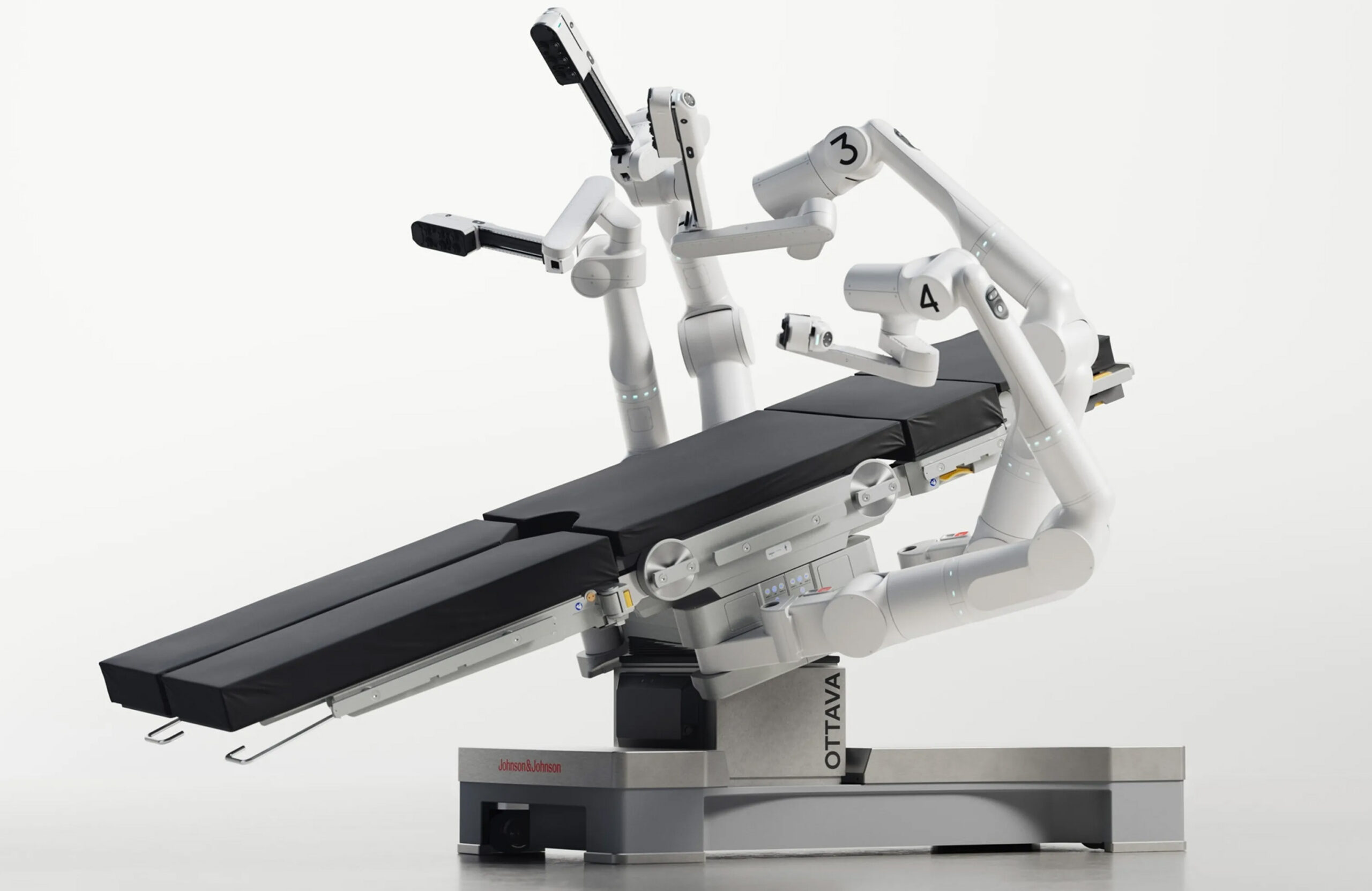
Challengers have chipped at the edges. Medtronic's Hugo won United States clearance for urologic procedures in 2025 and competes on modular carts and cost. Britain's CMR Surgical positioned Versius around portability, and Asensus pursued digital laparoscopy before its own financial struggles. None changed the fundamental market fact that a hospital wanting premium robotic general surgery had one realistic vendor. The FDA's July 22 De Novo authorization of OTTAVA, a table-integrated system covered in detail in our companion news report, changes that fact at the premium end. What matters for this analysis is not the machine's specification sheet but its strategic meaning: a US$400 billion conglomerate has paid the full decade-long, billion-dollar entry fee and arrived with a structurally different architecture and a data platform, which resets the competitive axes for everyone else.
The Corpse in the Room: What Vicarious Surgical's Collapse Teaches
The week's second event supplies the cautionary counterweight. Vicarious Surgical promised miniaturized instruments delivering robotic capability through a single small incision, raised approximately US300 million across venture rounds and a special purpose acquisition company merger that on valued it above USD1 billion, and attracted some of technology's most famous backers, including Bill Gates. It has now filed for bankruptcy protection without ever bringing a cleared product to the United States market. The proximate causes were familiar: development timelines that outran cash, and a post-2021 capital market that stopped refinancing pre-revenue hardware. The structural cause is the one that matters. Surgical robotics has the longest, most expensive proving path in all of robotics; a system must survive design freeze, verification, regulatory review, clinical evidence generation, surgeon training infrastructure, and hospital capital cycles before its first dollar of recurring revenue, a gauntlet that routinely consumes a decade and a billion United States dollars.
That arithmetic explains the field's new shape. The companies still standing in premium soft tissue robotics are a medical device conglomerate, a diversified giant in Medtronic, and an incumbent in Intuitive that generates billions in annual recurring revenue. The startups that remain viable are those attacking niches the giants ignore: orthopedic subspecialties, endoluminal platforms, or cost-engineered systems for markets the premium players do not price for. Investors should read Vicarious not as an isolated failure but as the template for what happens to every undercapitalized challenger whose burn rate meets this category's timelines.
China's Parallel Game
No analysis of surgical robotics in 2026 is complete without the parallel contest underway in China, where national policy treats surgical robots as a strategic import-substitution priority. Shanghai-based MicroPort MedBot has secured domestic approvals for its Toumai laparoscopic system and is pushing internationally, including telesurgery demonstrations across continental distances. Domestic procurement preferences, volume-based pricing, and a state-backed reimbursement push are building a protected home market in which Chinese systems can accumulate procedure volume, the currency that ultimately buys clinical credibility. The pattern mirrors what happened in orthopedic and imaging equipment: Western incumbents retain the premium global tier while Chinese systems win their home market first, then compete abroad on price. For the Western premium players, China is simultaneously a growth market and the origin of their next decade's cost competition. Buyers in Asia, the Middle East, and Latin America will increasingly face a three-way choice: the incumbent's evidence base, the challenger's architecture, or a Chinese system at a fraction of the capital cost.
The Contenders Compared
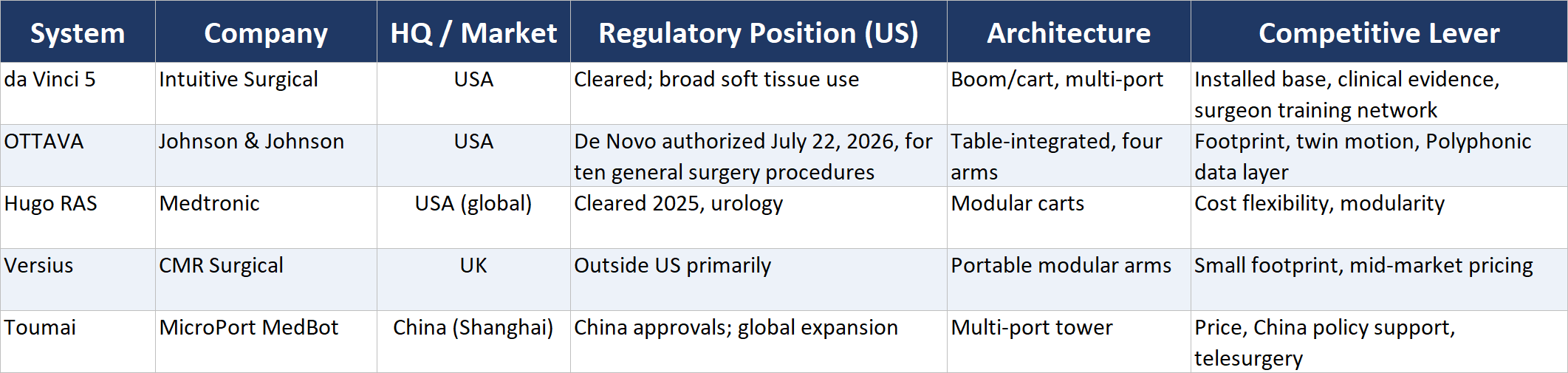
The table's message is that the competitive axes have multiplied. For twenty-five years the only axis that mattered was clinical evidence on the incumbent platform. Now footprint, data ecosystems, modularity, and sovereign industrial policy each define a lane, and no single vendor leads in all of them.
Think of it like a street that had one restaurant for a decade-plus. The food was excellent, the prices were the prices, and the queue for training was long. This month, a second restaurant with a genuinely different kitchen opened at the premium end of the street, a food truck with famous investors went out of business before serving a meal, and several inexpensive kitchens are being built at the far end by cooks with government backing. Diners will eat better and cheaper over time; but the new restaurant still has to prove its dishes, and the old one has twenty-five years of regulars.
The Slow Siege Ahead
A common misconception after weeks like this one is that hospitals win immediately as competition forces prices down. Robotic surgery pricing is defended by switching costs that authorization does not touch. A hospital that moves platforms writes off surgeon proficiency, retrains operating room teams, re-validates workflows, and accepts a temporary efficiency dip that shows up directly in surgical revenue, which is why incumbent displacement in medical capital equipment historically takes a decade even with superior challengers. Johnson & Johnson's own history counsels patience: OTTAVA arrives years behind its original schedule, after a full redesign, and its staged launch with select customers is an implicit admission that evidence, not architecture, closes hospital deals. Intuitive, meanwhile, is not standing still; it holds the pricing headroom, the data scale, and the balance sheet to respond aggressively.
The realistic scenario is not a price war in 2027 but a slow siege: the challenger winning greenfield programs and space-constrained facilities, the incumbent defending its base with bundling and next-generation instruments, Chinese systems annexing price-sensitive geographies, and every second-tier Western player facing Vicarious-style funding mathematics. Hospitals evaluating early adoption of any new platform should negotiate service guarantees carefully, and in the table-integrated case specifically around serviceability, because a fault that takes both robot and table offline idles the room entirely.
The Buyer's Framework for the Duopoly Era
Surgical robotics has moved from a monopoly defended by evidence to a duopoly that will be decided by economics, and the deciding votes belong to hospital procurement committees rather than surgeons alone. Three tests will separate wise adoption from expensive experimentation. First, the utilization test: model the robotic suite as real estate, and credit any footprint advantage only if the recovered space genuinely converts to revenue-producing use. Second, the evidence test: demand procedure-level outcome and efficiency data from early sites rather than accepting cross-platform extrapolation, and expect meaningful data no earlier than 2027. Third, the leverage test: whichever platform a hospital prefers, the mere existence of a credible alternative should be exercised in every incumbent contract renewal now, because vendor concessions are the one benefit of competition that requires no migration risk at all.
This development confirms that the operating theater's next era will not be won by the most elegant machine; it will be won by the vendor whose economics survive contact with a buyer who finally has a choice.
This analysis synthesizes company statements, regulatory records, and public market activity.
Disclaimer: This article is for informational purposes only and does not constitute investment, legal, safety, or procurement advice. Readers should independently verify specifications, certification scope, pricing, availability, regulatory obligations, and operational suitability with the relevant suppliers and authorities before making decisions.