The Robot Economy Stopped Asking Venture Capital for Permission
The last week of July 2026 marked physical AI's shift from venture funding to infrastructure capex. Nvidia's US$1.01 billion Naver stake, Brookfield's up-to-US$9 billion financing, Japan's PASTEC chip hub, and Korea's US$950 billion framework show states, asset managers, and chipmakers now fund the robot economy, changing what gets built and who captures the value.

For three years, the story of embodied AI has been told through venture rounds: who raised, at what valuation, on which demo video. That story quietly ended in the last week of July 2026. The new funders of the robot economy are a chipmaker taking direct equity stakes in national champions, the world's largest infrastructure asset manager writing nine-figure-to-ten-figure financing commitments, a Japanese property developer building semiconductor labs with a prefecture, and treasuries from Seoul to Sejong. Physical AI has entered its capex era and the balance sheets funding it no longer belong to Sand Hill Road.
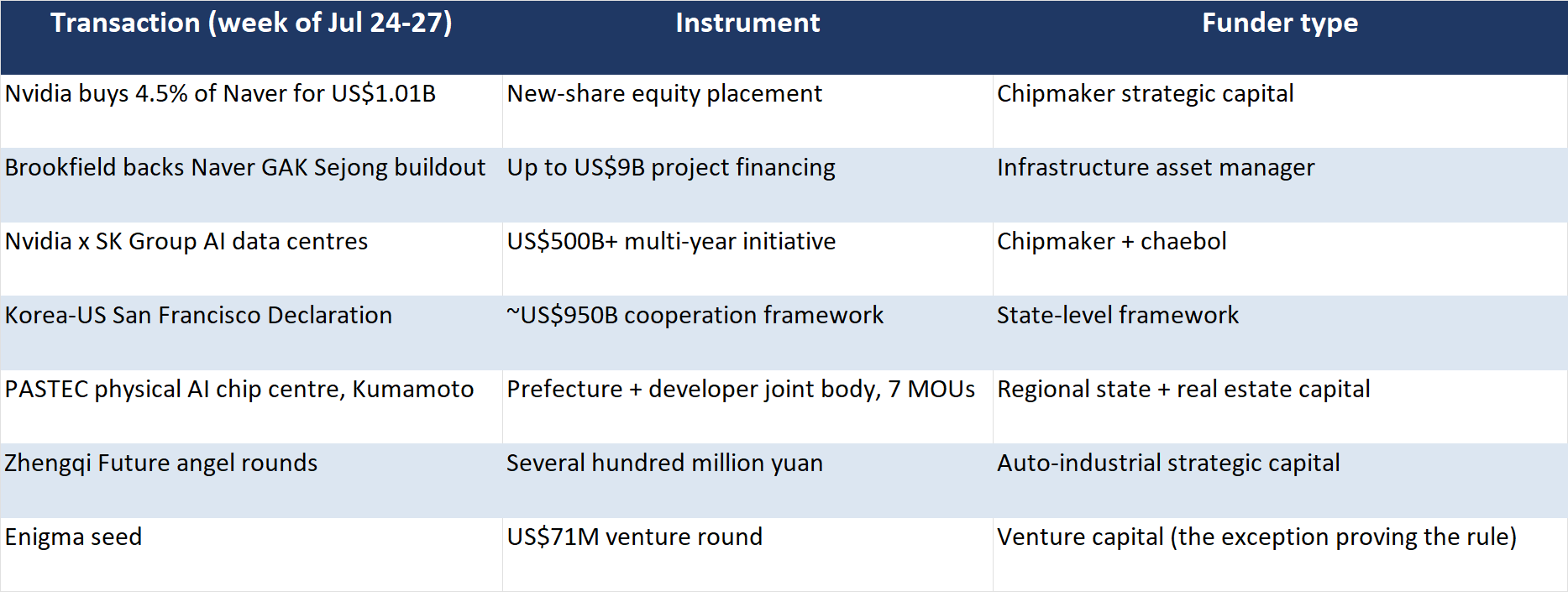
Consider what seven days produced. On July 24, Nvidia and SK Group unveiled a US$500 billion-plus AI data centre initiative while Nvidia, Naver, and Brookfield announced up to US$10 billion for expanding Naver's AI infrastructure. On July 26, South Korea's president flew his conglomerate chiefs to San Francisco and returned with a declaration framing roughly US$950 billion in Korea-US cooperation. On July 27, the details landed in regulatory filings: Nvidia will buy 7.2 million new Naver shares for US$1.01 billion, a 4.5 percent stake that makes the chipmaker one of the portal giant's largest shareholders behind the National Pension Service and BlackRock, while Brookfield confirmed up to US$9 billion as capital partner for a 200-megawatt buildout of Naver's GAK Sejong campus on Nvidia's Vera Rubin and Blackwell platforms. The same day, two time zones west, Mitsui Fudosan and Kumamoto Prefecture launched PASTEC, a physical AI semiconductor centre beside TSMC's Japanese fabs, with Taiwan's ITRI and the Hsinchu Science Park among seven founding partners.
None of these transactions is a venture round. They are equity placements, project financings, land developments and treaty-adjacent frameworks, the instruments of infrastructure, executed by the institutions that build power grids and ports. That is the tell. Industries graduate from venture funding to capex funding at exactly the moment their infrastructure requirements exceed what risk capital can carry and the robot economy crossed that line this month.
Why the Money Changed Shape
The arithmetic forced the transition. A frontier humanoid program burns perhaps US$500 million a year; the most aggressive venture financings in history can cover that. But the layer beneath the robots cannot be venture-funded: a single gigawatt-scale AI factory costs more than the entire global humanoid sector has raised since 2020 and Jensen Huang told Naver's leadership their company would be "10 times larger" once their jointly pursued gigawatt-scale vision was realised. One gigawatt is roughly four times the maximum capacity of GAK Sejong, Korea's largest hyperscale data centre. Multiply that ambition across Korea, Japan, the Gulf, and the American Midwest and the funding requirement lands in the trillions, a number that only three kinds of balance sheet can absorb: states, infrastructure asset managers and the chipmaker whose margins the buildout feeds.
Each of the three has a distinct motive and the week displayed all of them. For Nvidia, equity stakes in customers are vendor financing with upside: the US$1.01 billion in Naver joins the US$30 billion committed to OpenAI and US$10 billion to Anthropic in a widening circle of investments that guarantee demand for its platforms while the platforms guarantee the investments' value, a flywheel critics call circular and shareholders call genius. For Brookfield, AI factories are the new toll roads, long-duration assets with contracted cash flows and a sovereign policy tailwind; its Korea commitment follows the playbook it ran on renewables a decade ago, arriving early to a capex supercycle governments have decided must happen. And for states, the calculus is explicitly strategic. Korea's declaration, Japan's physical AI industrial strategy and China's provincial embodied-intelligence funds are all wagers that robot-economy infrastructure is what electrification was in the twentieth century: the layer that determines which nations capture the productivity dividend.
The pattern has a Chinese mirror, with different actors playing the same roles. Where the American-led bloc deploys Nvidia equity and Brookfield project finance, China deploys state-owned capital through provincial funds and its industrial giants invest directly: this week alone, SAIC, CATL, and BYD-affiliated funds seeded an autonomous-driving veteran's mobility-robot startup, while a state-backed Shanghai institute open-sourced a frontier robot foundation model trained on a data corpus no venture-funded Western lab can match. The instruments differ; the migration from risk capital to strategic capital is identical.
What Gets Funded Changes What Gets Built
The change in funders is not merely financial plumbing; it reorders what the industry optimises for. Venture capital funds legible milestones on three-to-five-year horizons, which is why the venture era produced demo videos, valuation ladders and humanoid launch dates slipped annually. Infrastructure capital funds utilisation on twenty-year horizons supports the capex to produce something less cinematic and more consequential: megawatts energised, wafer-level packaging lines commissioned, robots-per-shift deployed under service contracts. When your funder is Brookfield, the KPI is uptime.
The week's transactions, laid side by side, make the funder migration visible at a glance.
This is, historically, how general-purpose technologies actually arrive. Railways, electrification, and telecommunications all began with speculative capital funding wild experiments, then crossed into a phase where states and insurance-scale capital built the boring substrate, tracks, grids, exchanges, on which the famous applications later ran. The dot-com era's fibre glut, laid by infrastructure capital and mocked as overbuild, became the physical precondition for everything from streaming to cloud computing. If the analogy holds, today's AI factories and packaging labs are the fibre of the robot economy: some will be white elephants, and the aggregate will be the reason the applications of 2032 seem to appear from nowhere.
The skeptics deserve their full hearing, because the capex era has a failure mode the venture era did not. Venture bubbles destroy limited partners' money; infrastructure bubbles destroy public money and utility ratepayers' patience, and they take longer to admit failure. The circularity critique of Nvidia's investment web is not frivolous: when the chip vendor funds the customer who buys the chips, reported demand and real demand become harder to distinguish, and Korea's US$950 billion declaration, like most summit arithmetic, aggregates existing plans, private intention and political aspiration into a number no auditor will ever reconcile. A 200-megawatt data centre is verifiable; a national robot economy is a press release until the robots clock in. The week's most honest data point may have been the smallest: Tesla, the company with the loudest humanoid ambitions, bought exactly one teleoperation treadmill.
Yet the direction survives the discount. Strip away every aspirational number and the verifiable residue of one week still includes a US$1.01 billion equity placement filed with regulators, up to US$9 billion in committed project financing from the world's most disciplined infrastructure investor, a semiconductor research centre with seven signed institutional partners and a 4.5 percent stake registered on a shareholder ledger. Capex, unlike vision, leaves receipts.
The Investor's Map for What Comes Next
Three layers look structurally advantaged. The first is the picks-and-shovels layer beneath the picks and shovels: advanced packaging, power equipment, cooling and the mature-node semiconductors that PASTEC exists to integrate, categories where demand is now underwritten by state-adjacent capital rather than startup burn rates. The second is the deployment layer, the integrators and service operators who convert energised megawatts and delivered robots into contracted utilisation; infrastructure owners always pay for uptime. The third is the data layer, where this week's Chinese announcements, a 40,000-hour robot-data corpus, a hospital digitisation pact, showed that proprietary vertical data is becoming the scarcest input precisely because the generic layers are being commoditised by open source and overbuilt by capex.
What loses relative ground is the pure story stock: the humanoid maker whose moat is a launch date, the model lab whose differentiation is a benchmark, any company whose primary asset is a valuation set in the venture era's currency. As the funders shift from betting on futures to financing throughput, the market will reprice accordingly, and the repricing has already begun in Seoul, where a hydraulic-hand component maker hit its daily limit on a verifiable engineering claim while grander robot visions traded flat.
The robot economy's first act was written by founders and their believers. The second act belongs to the institutions that measure in decades and gigawatts, and it started, with regulatory filings rather than fireworks, in the last week of July. The machines have not changed. The money behind them has, and in industrial history, that is usually the moment things stop being a story and start being a sector.
This article is for informational purposes only and does not constitute investment advice. Readers should conduct their own research before making investment decisions.