Pricing Watch: Supply Chain Security Collides With Cost Reduction in Robotics
The economics of the Automation, Robotics, and Physical Intelligence (ARPI) sector are currently being shaped by two opposing forces. On one side, geopolitical friction is introducing upstream cost risks, highlighted by China's June 2026 export controls targeting major US rare earth firms. On the other side, domestic Chinese humanoid robot prices are in freefall, dropping 72% year-over-year, driven by aggressive substitution of legacy components with Commercial-Off-The-Shelf (COTS) hybrid architectures and the onset of mass production scale.
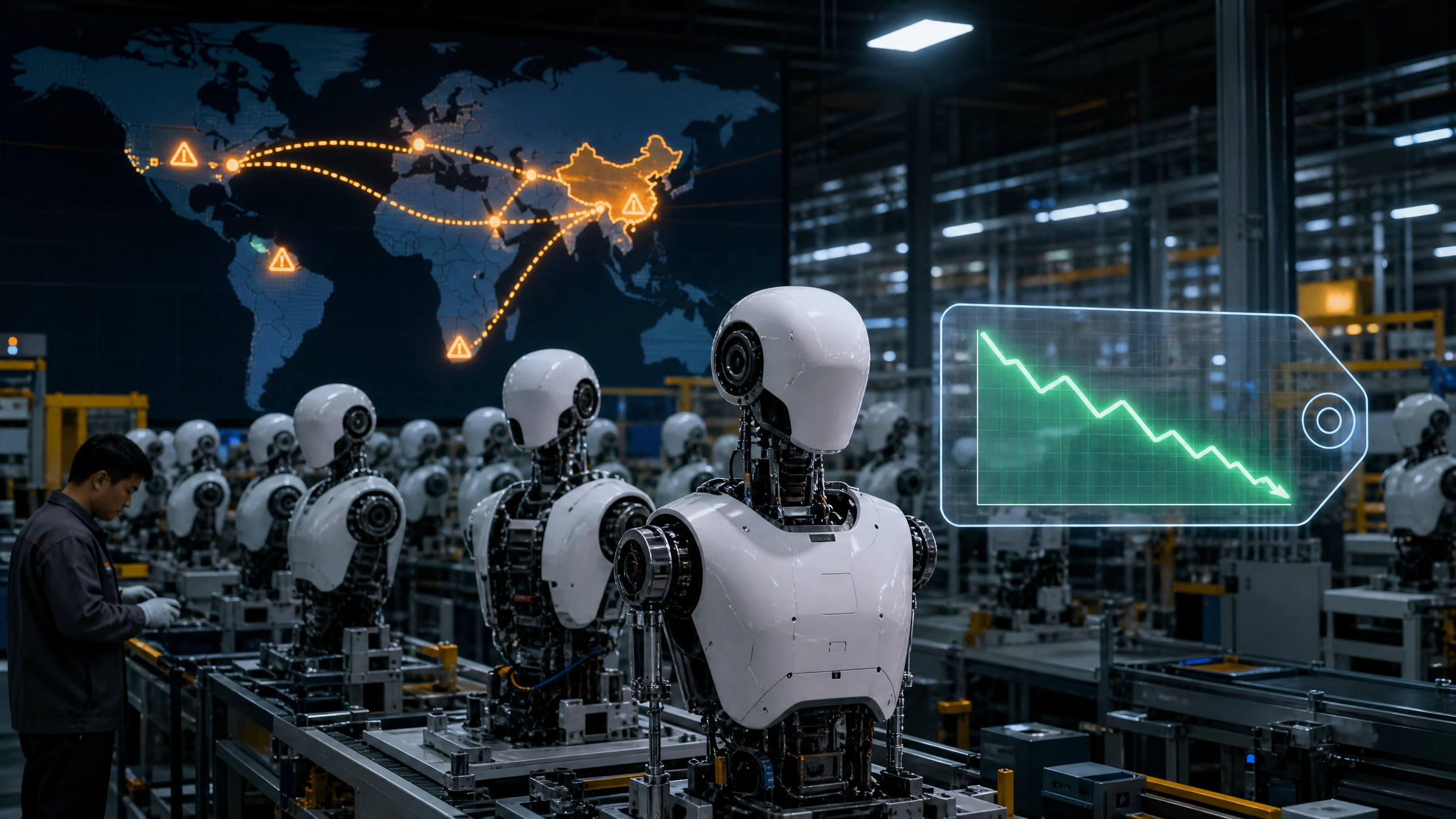
The Geopolitical Risk: Rare Earth Export Controls
On June 22, 2026, China's Ministry of Commerce expanded its export control list to include MP Materials and USA Rare Earth, alongside other US entities. [1] This move tightens Beijing's grip on the critical minerals supply chain, specifically targeting the processing technology and export of heavy rare earths and neodymium magnets. [1]
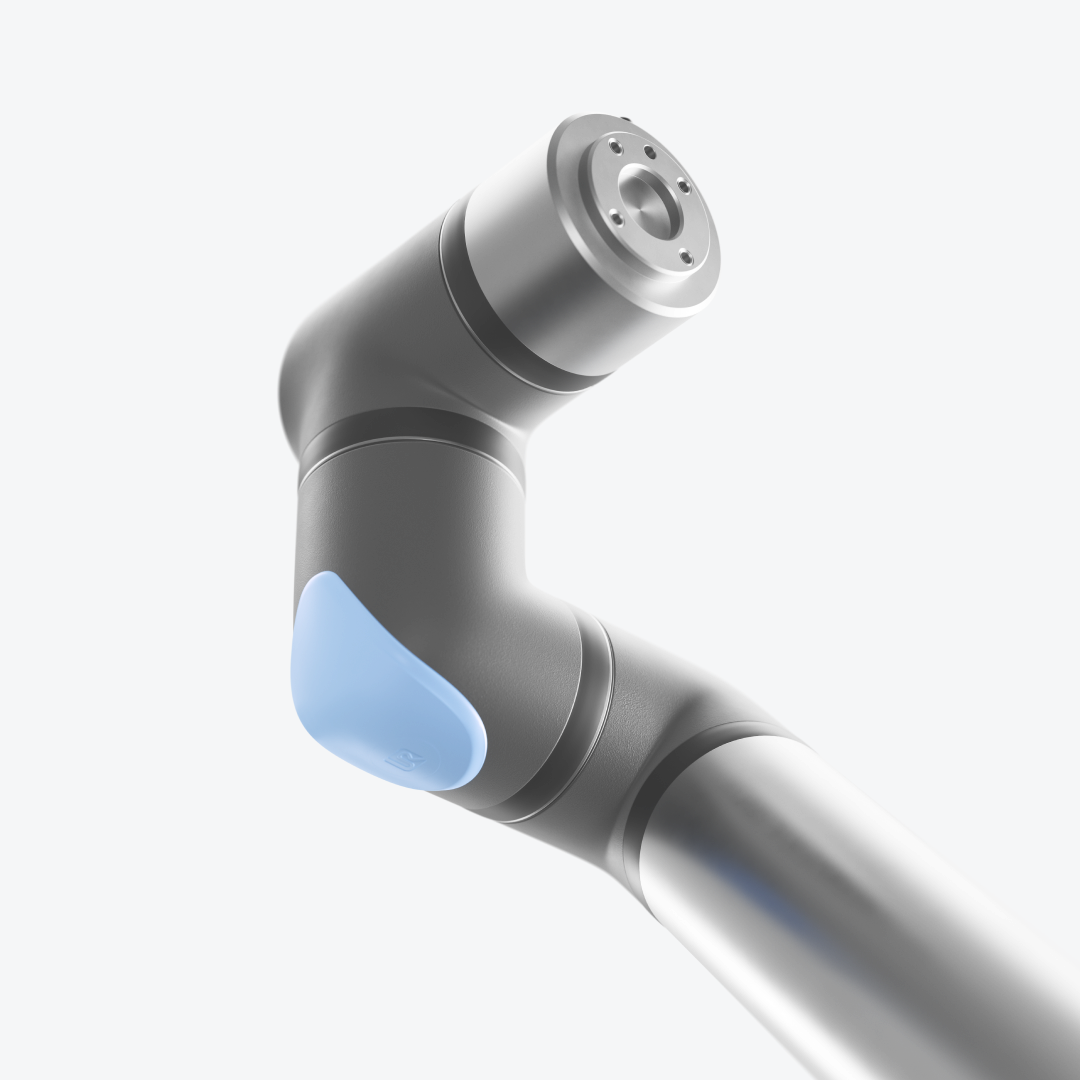
For the robotics industry, this is a significant vulnerability. High-performance permanent magnet synchronous motors (PMSMs), which are the backbone of modern robotic actuation, rely heavily on neodymium-iron-boron (NdFeB) magnets to achieve the torque density required for dynamic movement. [2] While the electric vehicle (EV) industry is also affected, the humanoid robotics sector is particularly sensitive because actuators account for 40% to 60% of a robot's total Bill of Materials (BOM). [2]
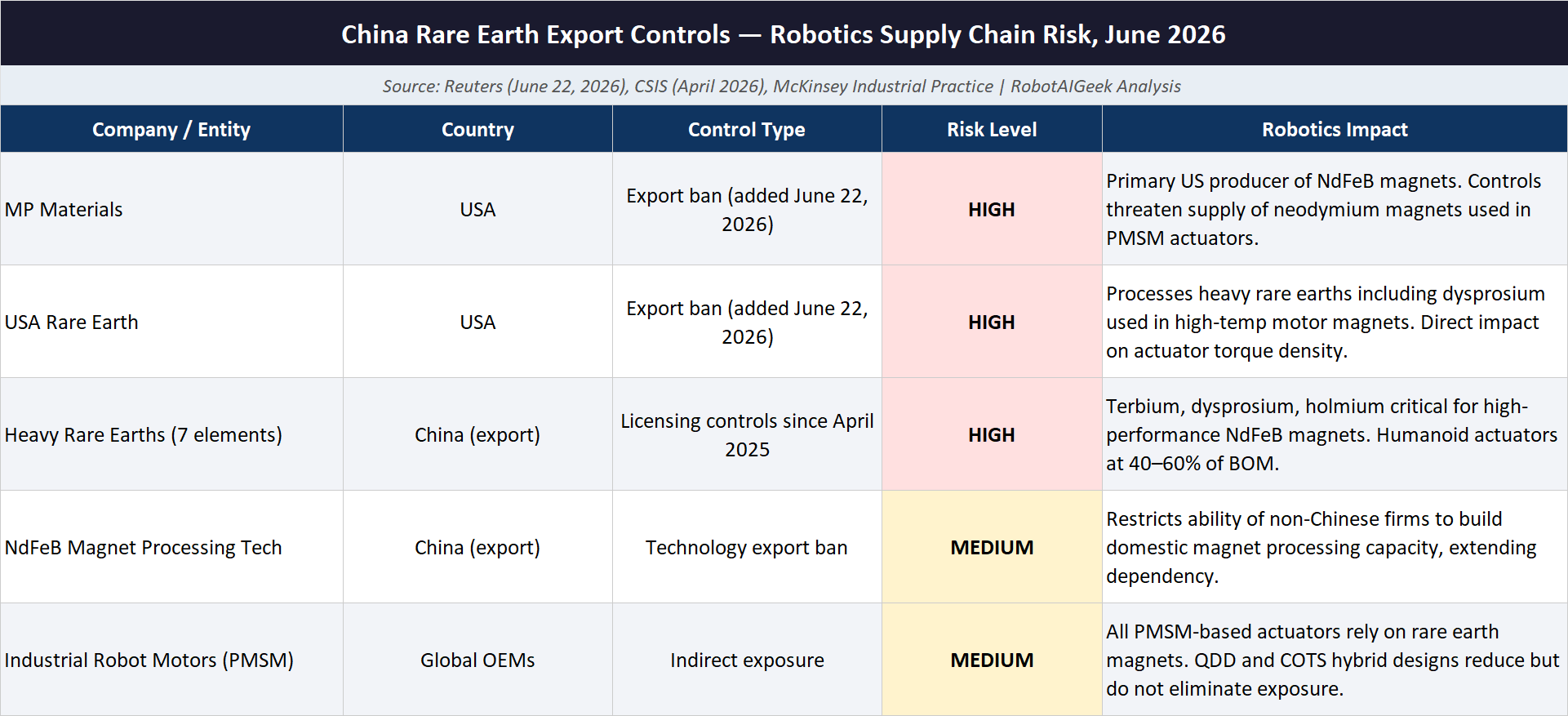
Any sustained disruption or price spike in the rare earth magnet supply chain will directly impact the BOM floor for humanoid robots, potentially delaying the industry's march toward the sub-$20,000 consumer price threshold. [3]
The Domestic Price Plunge: Unitree and the COTS Revolution
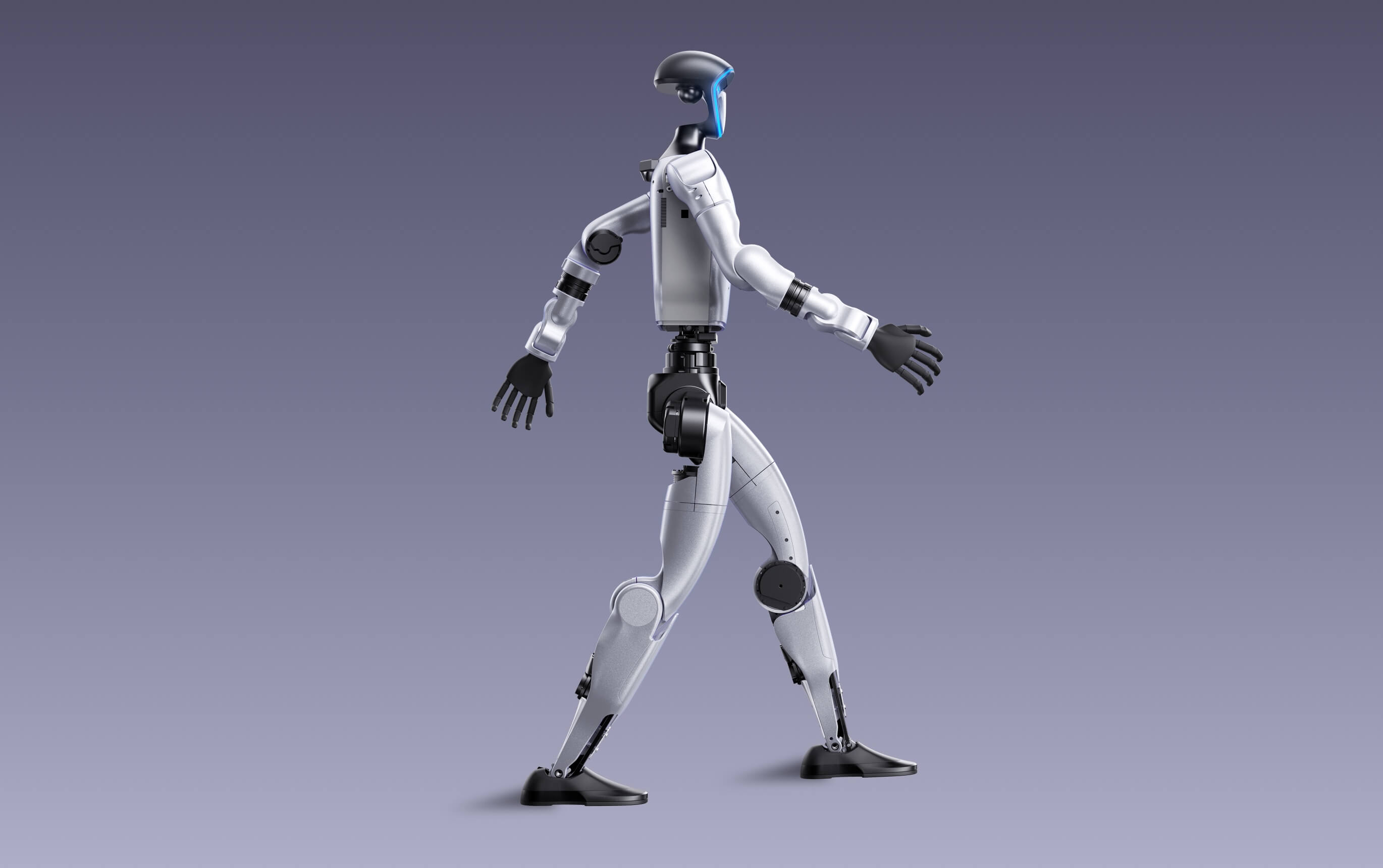
In stark contrast to the upstream supply chain risks, the retail pricing of humanoid robots in China is experiencing a dramatic downward trajectory. According to Unitree's recent IPO filing, the average unit price of its humanoid robots plunged 72%, from approximately 593,400 yuan ($82,600) in 2023 to 166,400 yuan ($23,200) in 2025. [4]
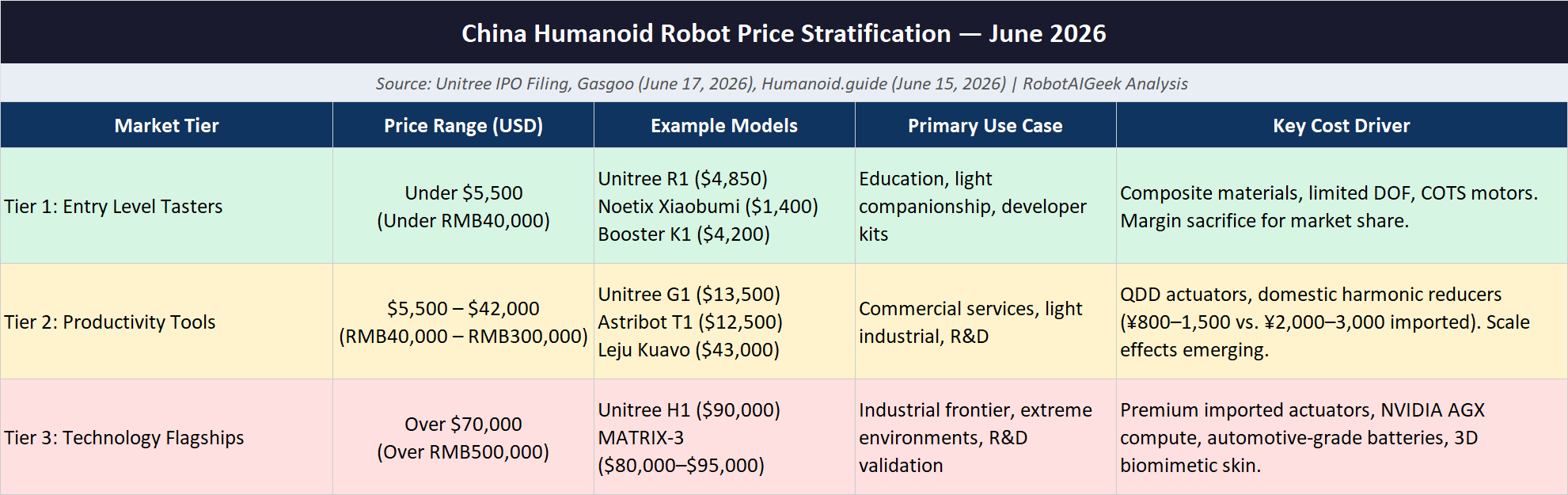
This price compression is most evident in the newly stratified market landscape. At the entry level, Unitree's R1 model recently saw a price cut to 29,900 yuan (approximately $4,850), while Noetix Robotics' Xiaobumi is selling for under 10,000 yuan ($1,400). These models target education and light companionship, utilizing composite materials to slash costs. [4] [5] At the productivity tier, models like the Unitree G1 and Stardust Intelligence Astribot T1, starting at 89,900 yuan, represent the core commercial battleground. [5]
The rapid cost reduction is not merely a margin-sacrificing price war; it is a structural shift in how robots are built. The market has bifurcated away from expensive, legacy harmonic drives toward Quasi-Direct-Drive (QDD) and custom hybrid actuators leveraging COTS components. By leaning on the mature supply chains of the EV and drone industries, companies are driving the BOM floor down to the $13,000 to $18,000 range for 30-plus Degree of Freedom (DOF) systems. [3] Furthermore, as leading Chinese firms cross the 10,000-unit annual production threshold, economies of scale are rapidly amortizing research and development and manufacturing overhead. [5]
BOM Cost Breakdown and Actuator Trajectories
To understand the path to commercial viability, it is crucial to analyze the humanoid robot BOM. The table below summarizes the key cost categories and their supply chain maturity, derived from McKinsey Industrial Practice analysis. [2]
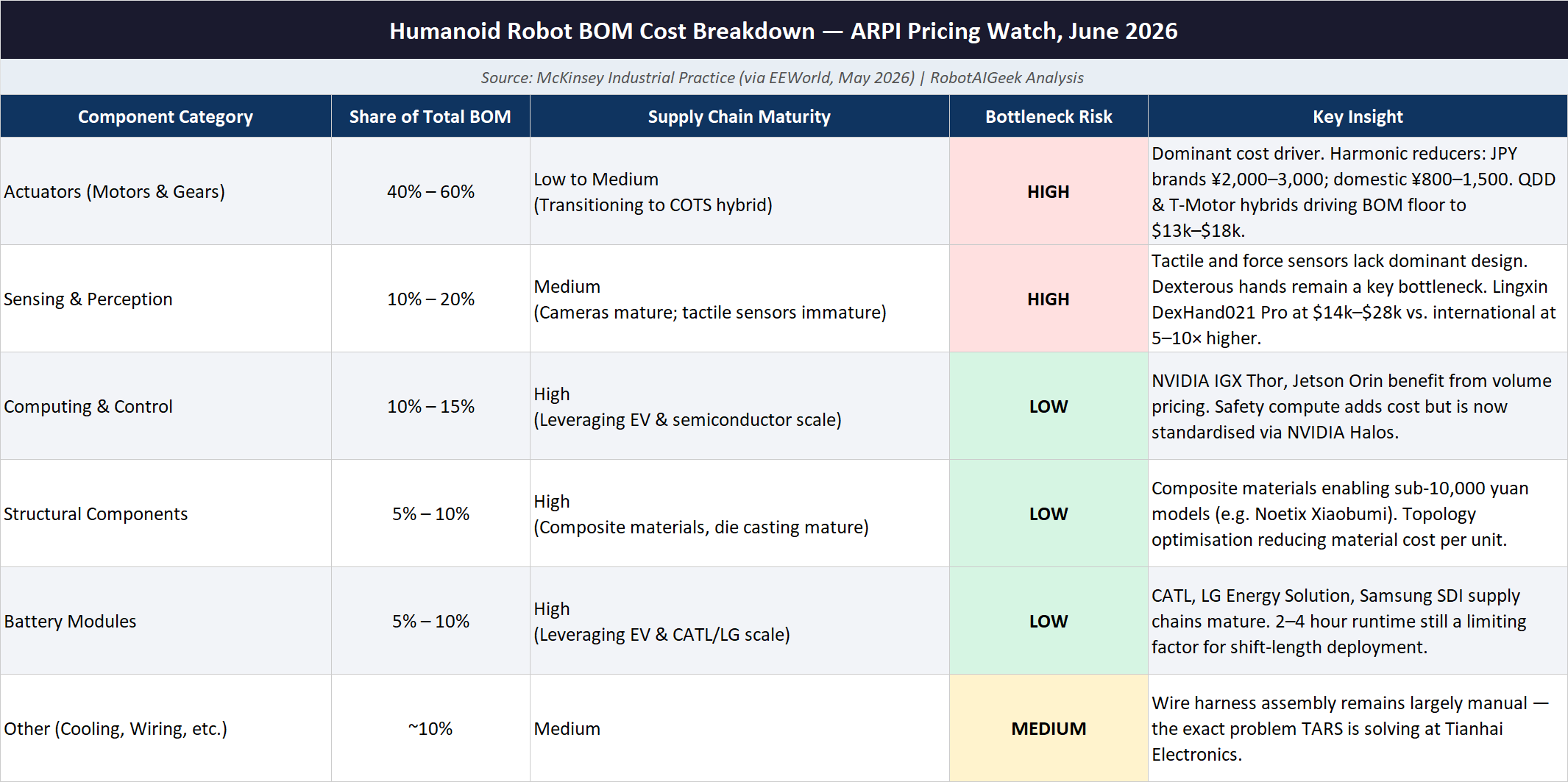
Risk Legend: HIGH = supply chain bottleneck likely to constrain scaling | MEDIUM = watch closely | LOW = well-supplied from adjacent industries
Disclaimer: For informational purposes only. Not financial or investment advice. RobotAIGeek, June 28, 2026.
The actuator remains the dominant cost lever. While harmonic reducers from international brands traditionally cost 2,000 to 3,000 yuan, domestic Chinese alternatives have compressed this to 800 to 1,500 yuan. [5] Bank of America estimates that the built-in China humanoid BOM cost, which sat at $35,000 in 2025, will be roughly cut in half by the end of the decade. [6]
Disclaimer: For informational purposes only. Not financial or investment advice. RobotAIGeek, June 28, 2026.
RobotAIGeek's Read
The ARPI sector is racing toward a critical inflection point. The aggressive cost engineering and COTS adoption led by Chinese manufacturers prove that the $20,000 humanoid robot is technically achievable today. However, the looming shadow of rare earth export controls serves as a stark reminder that this pricing miracle rests on a fragile, geopolitically sensitive supply chain. Companies and investors that fail to account for this upstream risk in their cost models are building on an unstable foundation.
Primary Sources
1. China targets US rare earth and other firms with export controls. Reuters. June 22, 2026.
2. Disassembly and analysis of the Bill of Materials (BOM) of humanoid robots. McKinsey Industrial Practice via EEWorld. May 13, 2026.
3. Actuator Cost Trajectories in Humanoid Robotics. SoulDriver. May 2, 2026.
4. China humanoid prices plunge as Unitree cites 72% drop. Humanoid.guide. June 15, 2026.
5. Humanoid Robots: Have Prices Really Crashed? Gasgoo. June 17, 2026.
6. Physical AI, part 2: Humanoid robots. Bank of America Institute. March 12, 2026.
Disclaimer:The information provided in this article is for informational purposes only and does not constitute financial or investment advice. The robotics and AI sectors are highly volatile, and market conditions can change rapidly. RobotAIGeek is not responsible for any investment decisions made based on this content.