Navigating the Different Classes of Humanoid Robots
Humanoid robots are not one procurement category. This guide separates stationary upper-body systems, wheeled hybrids, bipedal industrial humanoids, and frontier whole-body platforms by mobility, manipulation, facility redesign, safety, integration, and buyer diligence.

A buyer should not begin by asking which model looks most human. The better question is which physical class carries the least operational complexity for the job. A robot that walks through an existing warehouse, a torso that rides on a wheeled base, and a stationary upper-body system may all be described as humanoid, but they expose the buyer to very different integration, safety, uptime, and maintenance problems.
The official record does not yet provide a comparable price series or market-size dataset for humanoid robot classes. Buyers therefore need a classification method built from observable operating requirements rather than borrowed estimates.
Overview of Variants
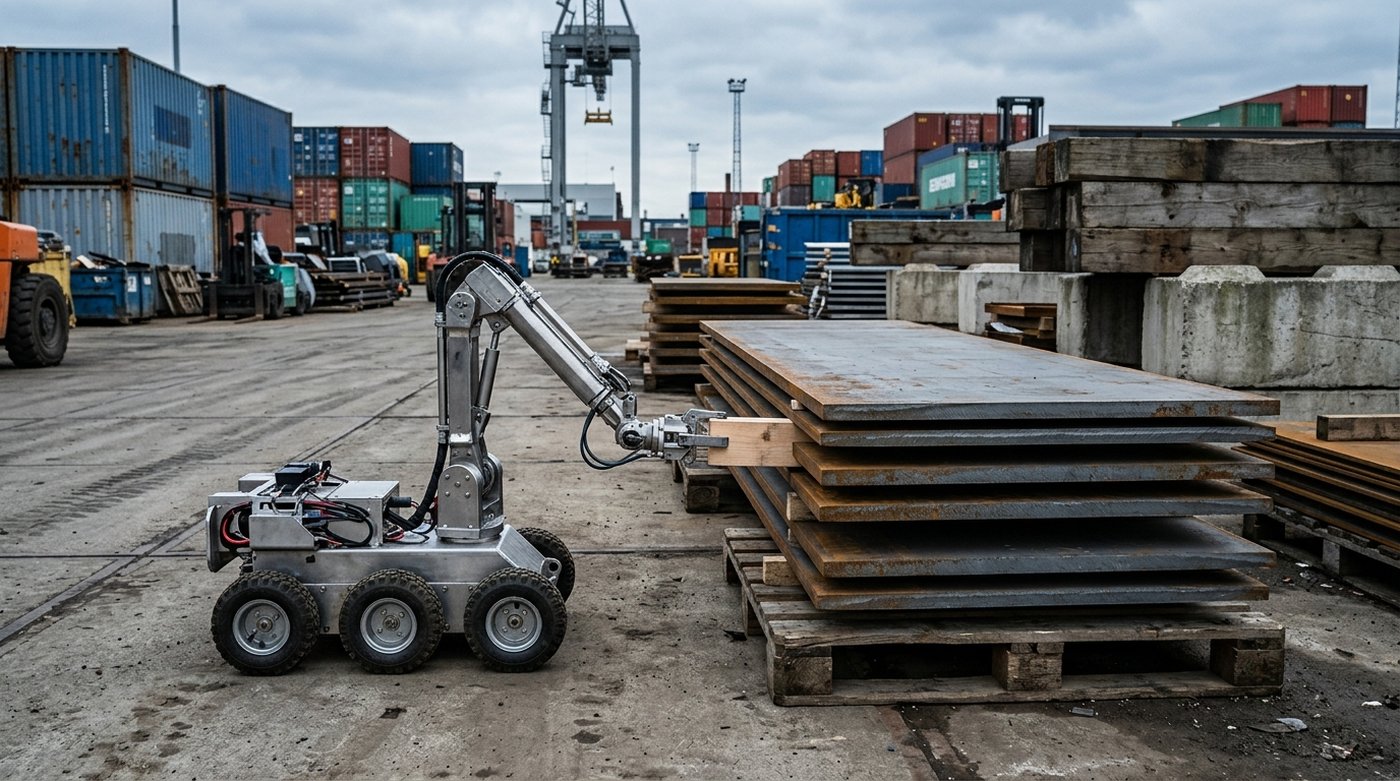
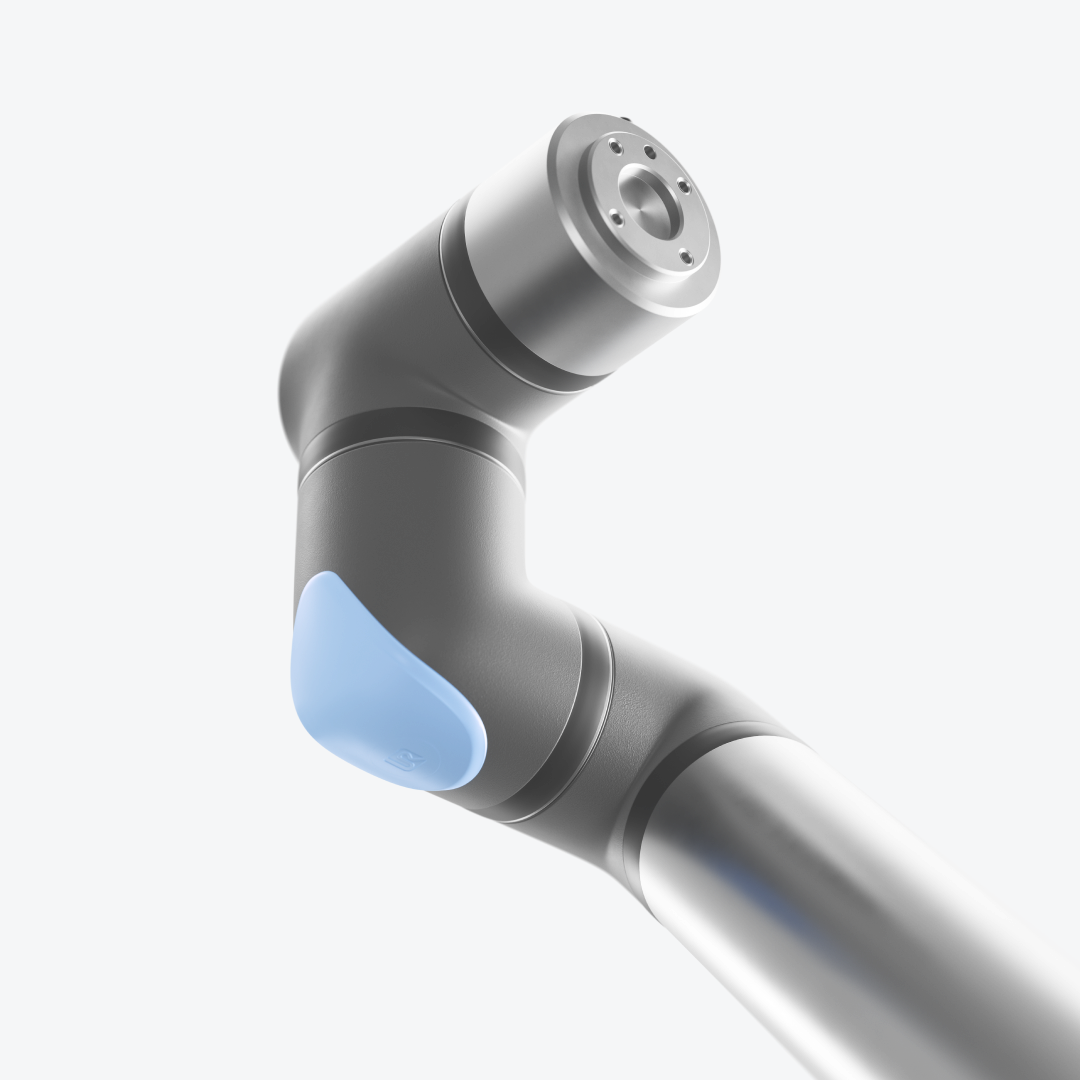
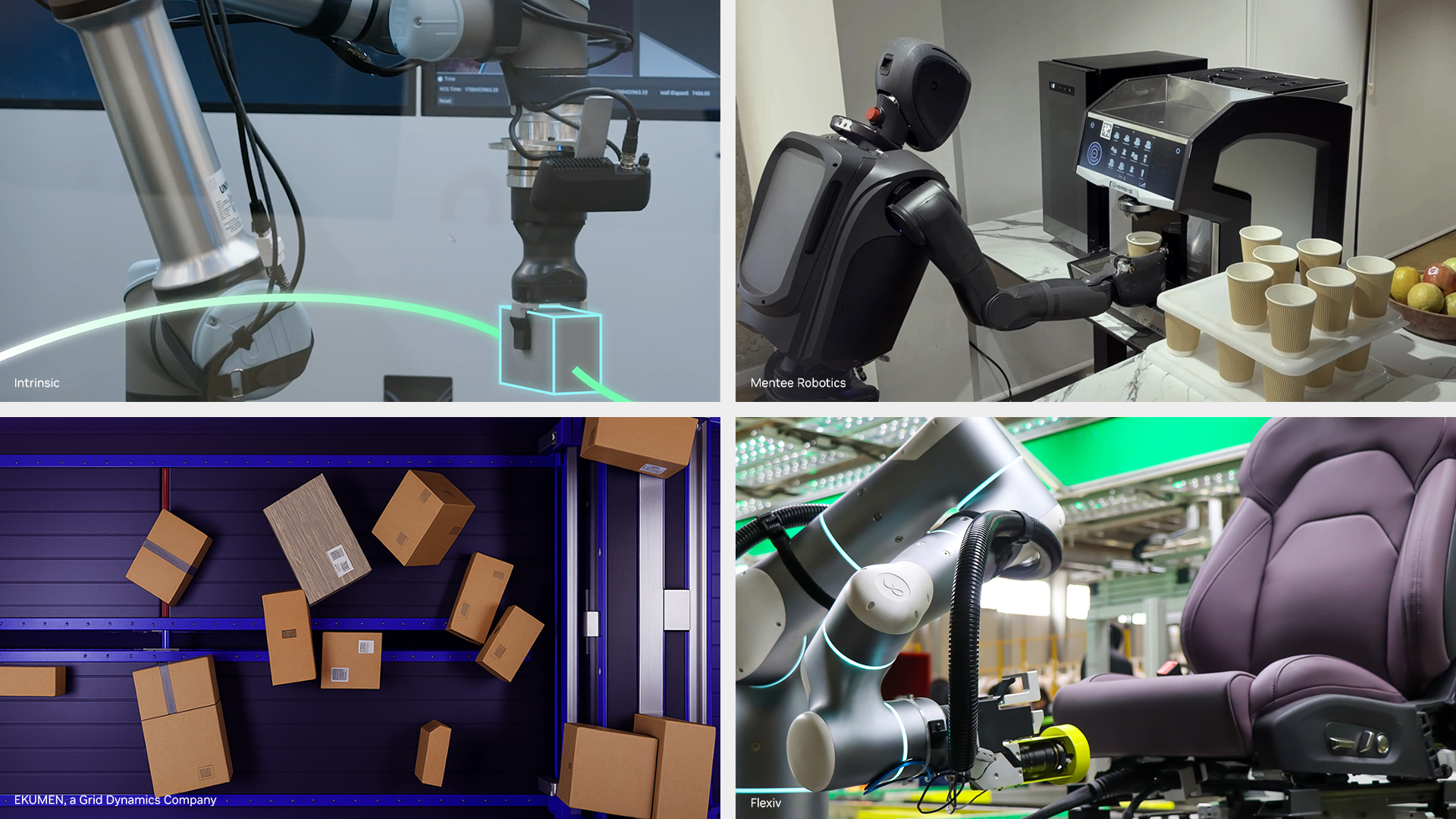
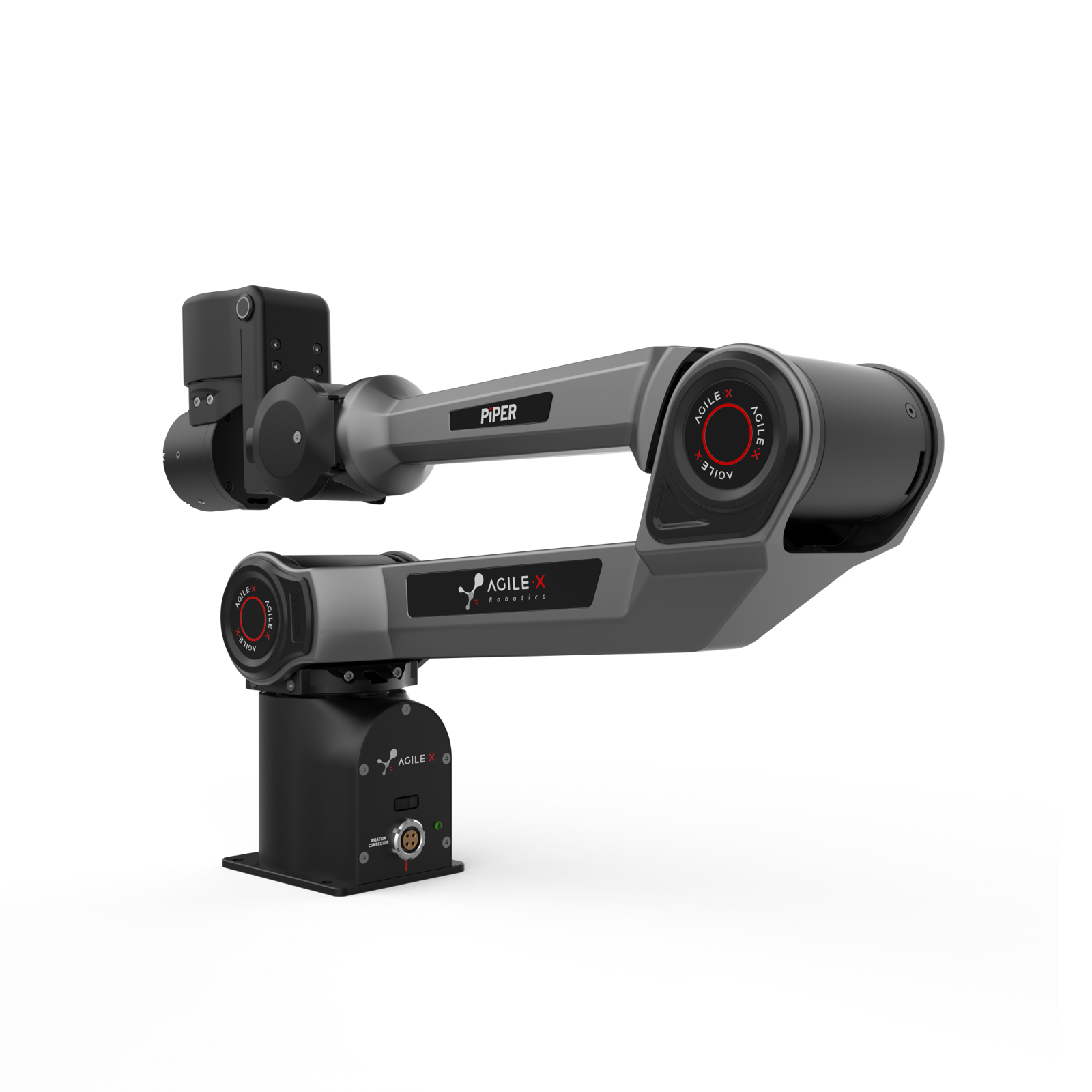
The first class is the stationary upper-body humanoid. It has a human-like torso, arms, hands, and sensing stack, but it remains fixed to a workcell, pedestal, or other controlled position. Its advantage is that it concentrates engineering effort on manipulation and perception while removing the hardest locomotion problem: moving a tall, heavy machine safely through a shared environment. This class fits repetitive handling, inspection, training, or research tasks where the work can be brought to the robot. It is a poor fit when the robot must cover several stations without a designed transfer system.
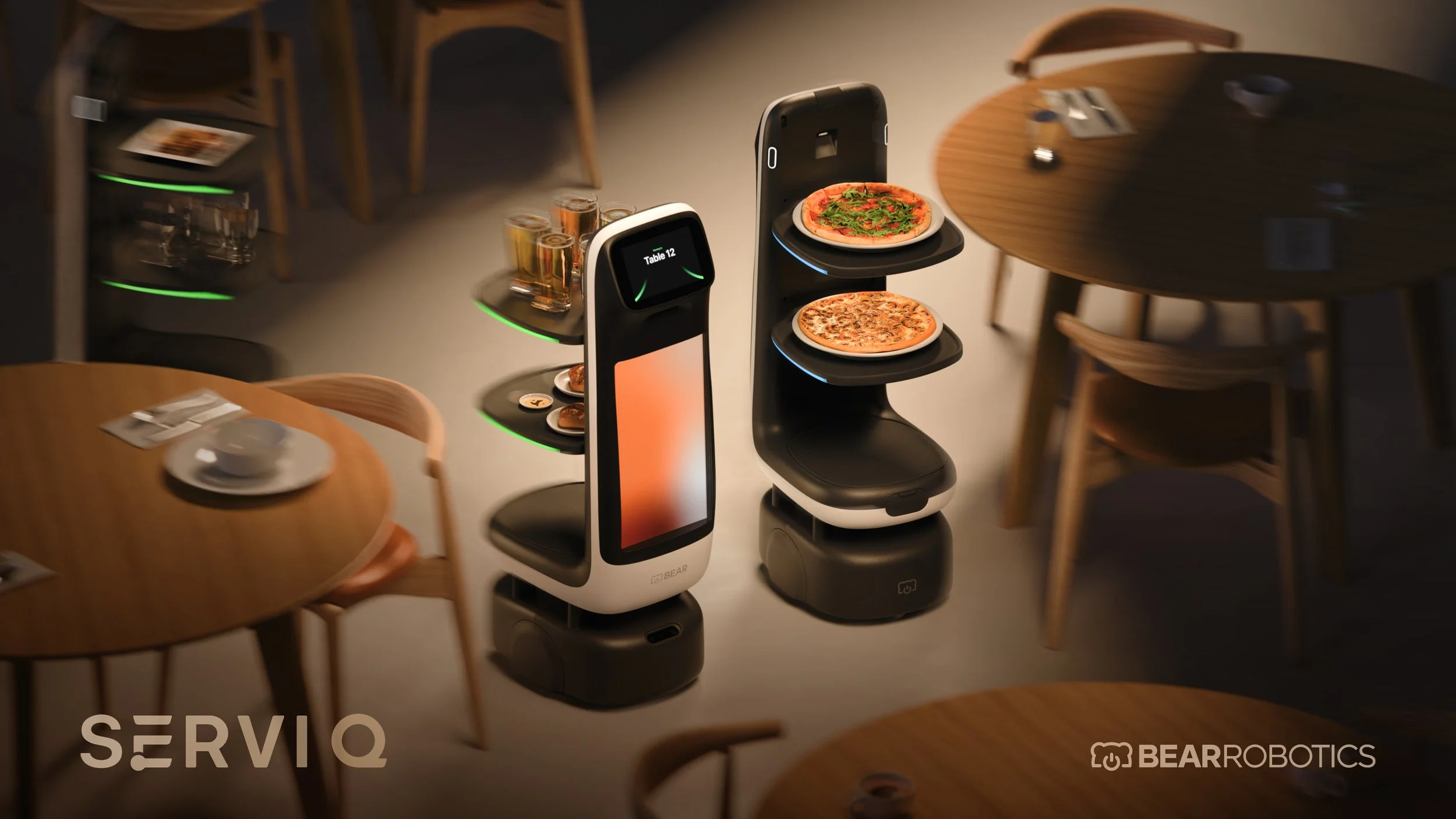
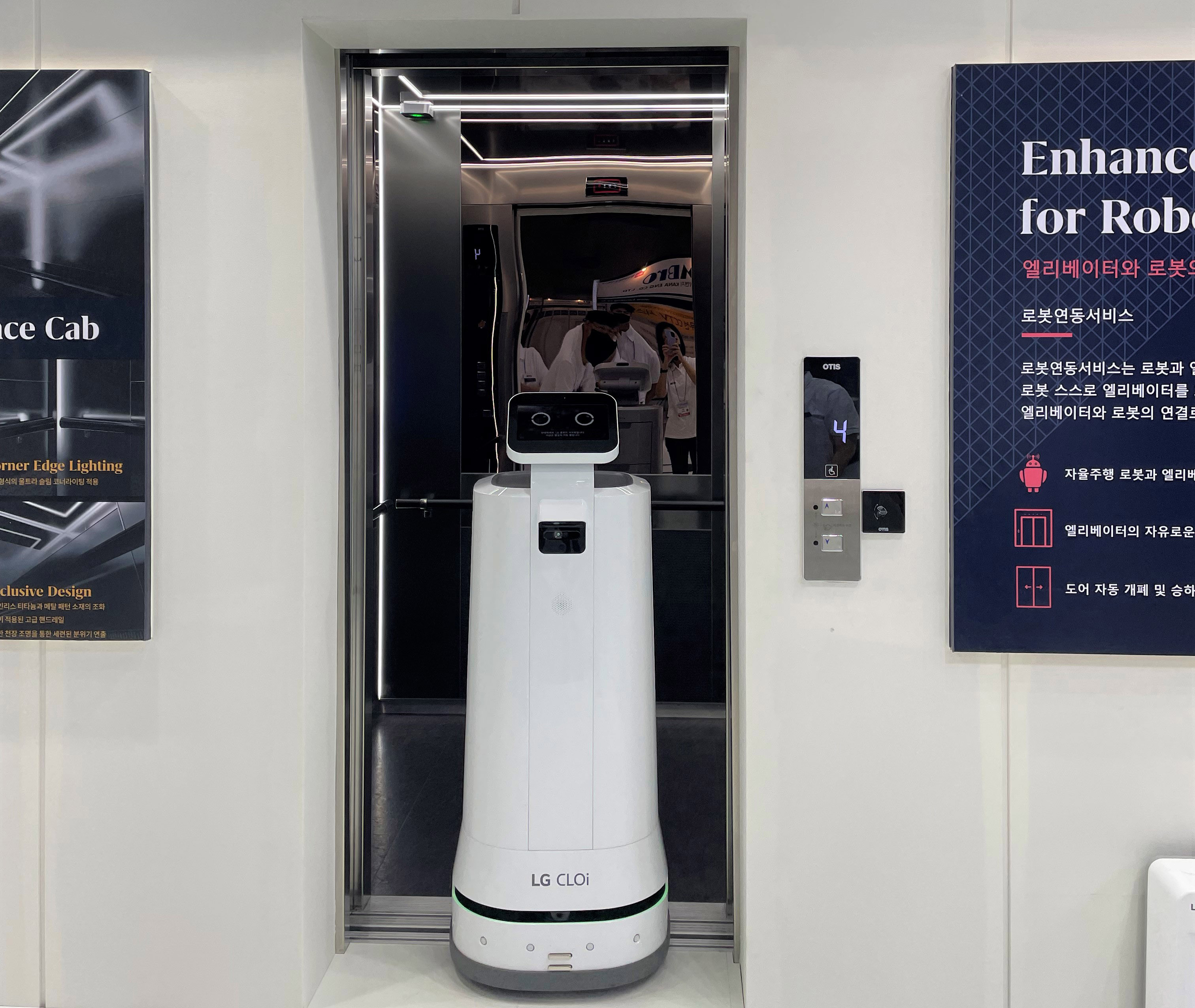
The second class is the wheeled upper-body hybrid. The upper body retains human-oriented reach and tool interaction, while a wheeled base supplies mobility on a prepared floor. Apptronik’s Apollo is an important official example of the design logic. The company states that Apollo can be configured as a bipedal walking humanoid, a torso operating on wheels, or a torso mounted in a stationary location. That modularity makes the robot a useful reference point for buyers who want to test manipulation first and add locomotion only where the facility justifies it.
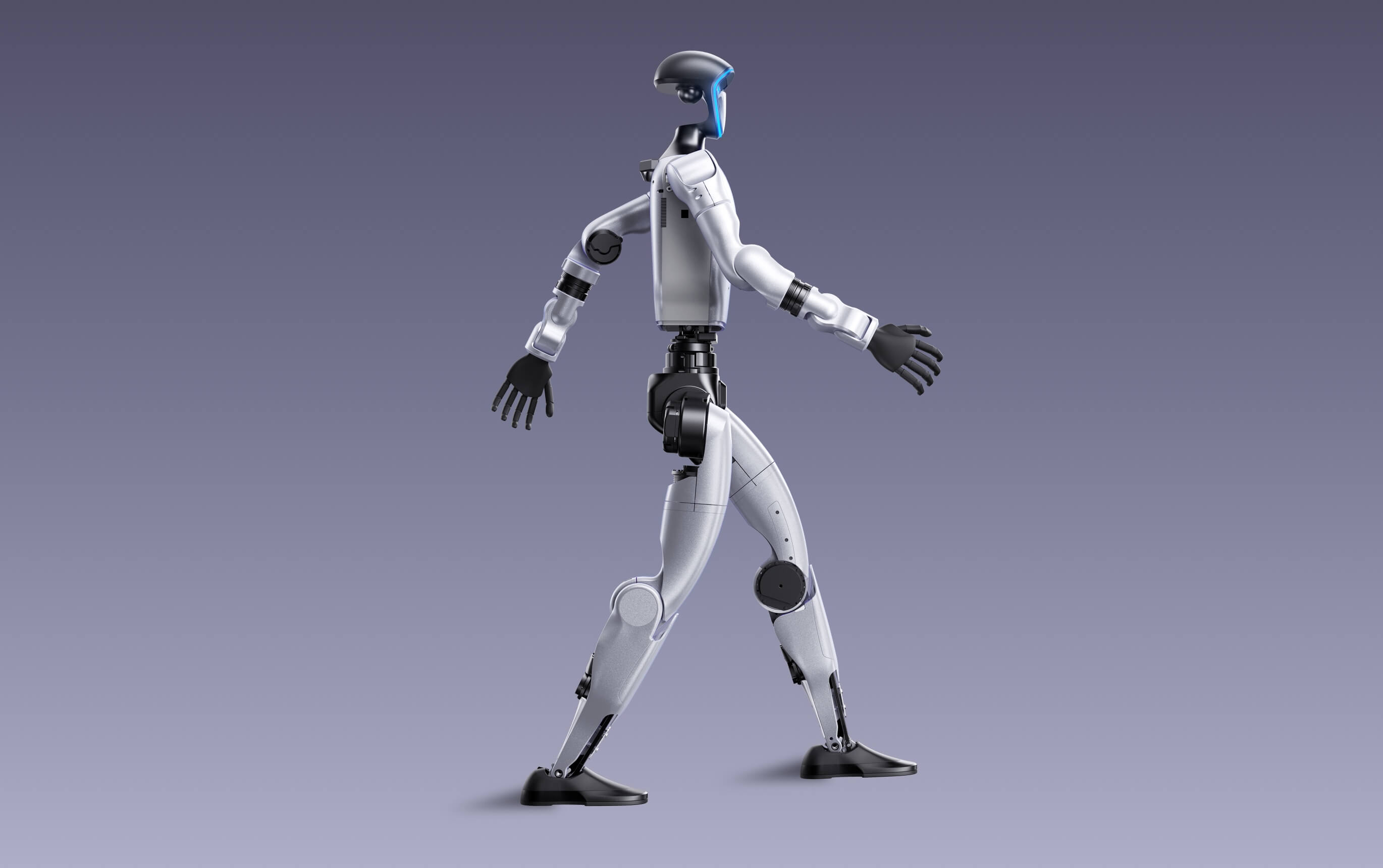
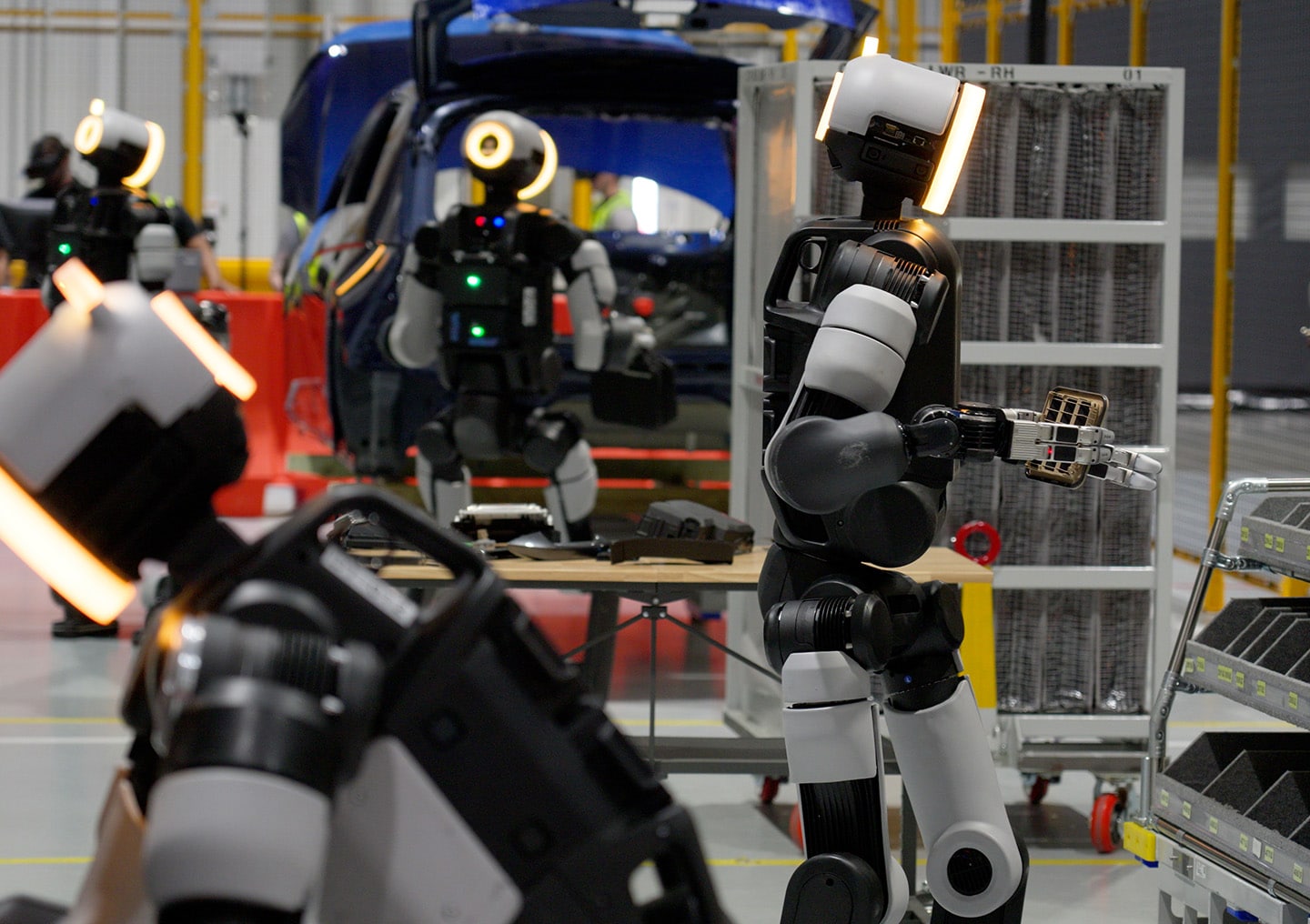
The third class is the bipedal industrial humanoid. Its defining feature is not appearance but the ability to move through spaces built around human workers while carrying out a limited set of material-handling or logistics tasks. Agility Robotics describes Digit as a bipedal humanoid intended for places where people already work, with a vendor-stated carrying capacity of 35 pounds, four-hour battery life, and integration through the Arc cloud platform. Boston Dynamics positions Atlas for enterprise material handling and states that its robot has a 1.9-metre height, 56 degrees of freedom, a 50-kilogram instant capacity, and a 30-kilogram sustained capacity. These are company disclosures, not independent benchmarks.
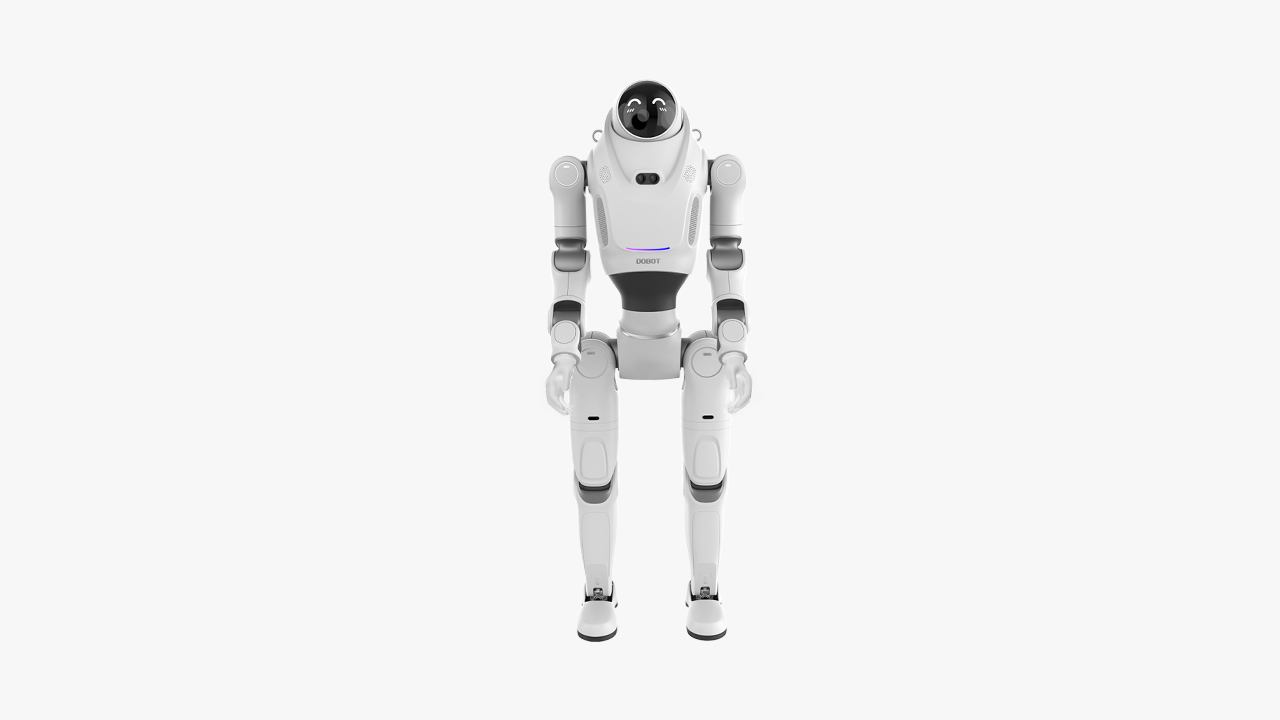
The fourth class is the frontier whole-body humanoid. This class emphasises dynamic balance, a broad range of motion, dexterous manipulation, and learning across tasks. It may be valuable as a research platform or as a future general-purpose system, but its procurement case is more difficult because the buyer must validate behaviour across many edge cases rather than one repeatable workflow. A high degree-of-freedom count is an indicator of mechanical scope, not proof of commercial readiness; it must be matched with safety controls, serviceability, software integration, and task evidence.
These four classes are a buyer taxonomy, not an official industry standard. The International Federation of Robotics uses International Organization for Standardization definitions to distinguish industrial robots, which are automatically controlled, reprogrammable, multipurpose manipulators programmable in three or more axes, from service robots that perform useful tasks for people or equipment. That distinction is more useful to a procurement team than the word humanoid alone because it forces the evaluation back toward the task and operating context.
How Each Variant Differs
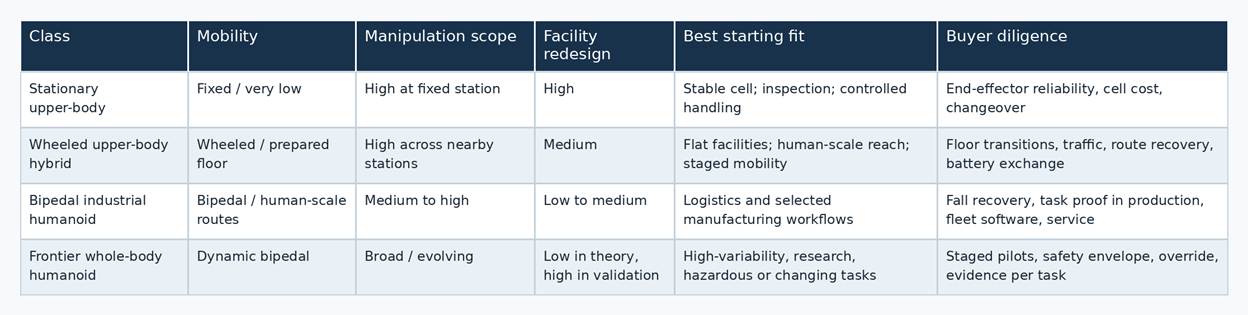
The main differentiator is locomotion risk. Stationary systems have the narrowest movement envelope and the simplest physical exclusion zone. Wheeled hybrids can cover more ground, but they depend on floor quality, turning space, ramps, thresholds, and traffic rules. Bipedal systems can use human-scale paths and stations, but they add balance, fall, recovery, and shared-space questions. Whole-body systems expand the possible task envelope further, yet they also create more coupled failure modes because movement, reach, contact, and perception interact.
The second differentiator is the amount of facility redesign the buyer will fund. A stationary system usually needs a designed cell; a wheeled hybrid needs navigable routes and consistent work-surface access. A bipedal system is attractive when human-scale workstations, carts, shelves, and tools cannot be economically rebuilt. Even then, “fits the existing environment” does not mean “requires no integration.” Digit’s Arc platform and Atlas’s stated connections to manufacturing and warehouse systems show that the software layer remains part of the purchase decision.
The third differentiator is payload and endurance. Buyers should separate instant capacity from sustained capacity vs carrying capacity from useful manipulation at the end of an arm. Boston Dynamics publishes both instant and sustained figures for Atlas. Agility publishes a carrying capacity and battery duration for Digit. Apptronik publishes Apollo’s stated lift capability and a swappable-battery approach. These are useful inputs for a shortlist, but they should not be combined into a league table because the companies describe different test conditions and disclosure scopes.
The fourth differentiator is safety architecture. A humanoid that works near people needs more than a claim of artificial intelligence. It needs a defined operating envelope, sensing, safe stopping behaviour, recovery procedures, training, and evidence that the proposed workflow has been assessed. Apptronik describes Apollo’s force-control architecture as supporting operation around people. The European Union’s Machinery Regulation provides a broader reminder: machinery placed on the European market must meet essential health and safety requirements, with the regulation explicitly addressing autonomous mobile machinery, connected equipment, and artificial intelligence using learning techniques for safety functions. It applies from 20 January 2027.
When to Use Each Variant
Choose a stationary upper-body system when the task is valuable but the work location is stable. Examples include inspection, controlled pick-and-place, fixed assembly assistance, or a research environment where repeatability is more important than roaming. The buyer should spend its diligence budget on end-effector reliability, perception under the actual lighting conditions, changeover time, and the cost of designing the cell.
Choose a wheeled hybrid when the facility is mostly flat and the work requires human-like reach at several nearby stations. This class can be a sensible bridge between fixed automation and full bipedal mobility. The buyer should test doorways, floor transitions, traffic interactions, battery exchange, and recovery from blocked routes. A wheeled base may reduce fall risk, but it does not remove the need for safety zoning and workflow integration.
Choose a bipedal industrial humanoid when the value proposition depends on entering spaces that already work for people. Logistics, distribution and selected manufacturing tasks are the clearest starting points because the operating goal can be bounded around repetitive handling. The buyer should require a task-level demonstration under production conditions, not a general demonstration in an empty room. It should also ask whether the supplier is offering a robot, a managed fleet, or a complete workflow with service and software.
Choose a frontier whole-body system when the organisation has a research, hazardous-environment, or high-variability requirement that justifies technical uncertainty. This class can make sense where the cost of redesigning the environment is unusually high or where the task envelope is still being discovered. It is not the rational default for a stable, high-volume process that a dedicated machine can already perform. The procurement case should include a staged pilot, clear stop criteria, human override procedures, and an evidence plan for every new task.
Geography can change the class decision before the robot reaches the facility. On 28 July 2026, the United States Federal Communications Commission added foreign-produced advanced robotic devices to its Covered List through an official regulatory action. The notice is not a product ranking, but it is a direct reminder that connected mobile robots may face market-access and equipment-authorization constraints that differ by country. Buyers should therefore screen origin, radio equipment, network architecture, software updates, and import requirements alongside payload and mobility.
Emerging Subcategories
The first emerging subcategory is the modular humanoid. Apollo’s stated ability to move between bipedal, wheeled, and stationary configurations illustrates a procurement path in which the buyer can start with the simplest useful architecture and add mobility as evidence accumulates. The commercial advantage is not that one robot automatically does everything. It is that the buyer can test the value of human-like manipulation without committing immediately to the full risk of bipedal operation.
The second is the fleet-integrated industrial humanoid. Digit is presented with Arc, while Atlas is presented with Orbit and connections to manufacturing and warehouse systems. This points to a class boundary that is increasingly defined by the operating system around the robot. A buyer should compare task assignment, monitoring, data ownership, cybersecurity, remote support, battery management, and software update policy as carefully as the mechanical platform.
The third is the compliance-defined humanoid. The European Union machinery framework and the United States FCC action show that market access is becoming part of technical classification. A robot’s class is no longer only about legs, wheels, hands, and payload. It also includes the jurisdictional conditions under which the machine can be connected, authorised, supervised, and maintained.
Start with the least mobile class that can reach the required work, then move upward only when avoided facility redesign or labour exposure justifies the added locomotion and safety burden. For most buyers, the winning humanoid will not be the most general robot in a demonstration. It will be the class whose physical form, software integration, evidence package, and regulatory path align with one repeatable operating problem. That is the right foundation for the deployment, pricing, and supplier comparisons that follow in this series.
Disclaimer
This article is published by RobotAIGeek for informational and educational purposes only. It does not constitute procurement advice, engineering advice, safety advice, legal advice, investment advice, or a recommendation to buy, specify, or deploy any product, system, or security. References to international standards, including their titles, edition numbers, development stages, publication dates, and scope statements, are provided for general orientation only, are stated as current at the information cut-off date, are subject to change as standards progress through their development stages, and do not substitute for reading the standard itself or for conformity assessment by a competent body. The absence of a published standard covering a function is not a statement that any machine is unsafe, and the presence of a published standard is not a statement that any machine conforms to it. This article deliberately asserts no market size, no unit forecast, no market share, and no price for this asset class, because no official source publishes one, and readers should treat any single such figure encountered elsewhere with corresponding caution. Financial figures are drawn from one issuer's own regulatory filing, are stated in the currency, periods, and reporting scope used in that filing, are not converted between currencies, have not been independently audited by RobotAIGeek, and are official with respect to that issuer alone rather than to any other company or to the asset class. A securities offering referred to in that filing had not been completed as at the information cut-off date and nothing here should be read as a characterisation of its outcome or as an offer, solicitation, or recommendation in relation to any security. Characterisations of competitors appearing in that filing are the issuer's own statements and not the disclosure of the companies described. The analytical frameworks presented here are judgements about the availability of assurance evidence rather than statistical tests, safety assessments, product evaluations, or predictions of future performance. Readers should conduct their own due diligence and obtain independent professional advice before making any procurement decision. Information cut-off: 10 August 2026.