Marc Raibert's Next Robot Company Isn't Boston Dynamics
Boston Dynamics licensed a category to two of its own alumni and let founder Marc Raibert write a personal angel check. NEURA Robotics bought a rival outright. Palladyne AI and FANUC America partnered as equals. A column on the three structures physical-AI companies used this week to grow into capabilities they lacked, and what each one means for a buyer's due diligence.


Marc Raibert built Boston Dynamics into the company every other robotics founder still measures itself against, then stepped back from running it, then watched Hyundai spend the past five years absorbing it piece by piece into a Korean conglomerate's balance sheet. On September 8, less than two months after Hyundai announced it would buy out the last outside shareholder in that company, Raibert put his own name down as an angel investor in a robotics startup he does not control, staffed by his own former Chief Strategy Officer, built to compete in a market Boston Dynamics itself has never entered.
On its own, that is not much of a story. Founders angel-invest in ex-employees' startups constantly. What makes this one worth a second look is what a different physical-AI company did the same week, from the opposite side of the same kind of decision, with a completely different tool.
Three physical-AI companies answered the same strategic question this week, and no two of them the same way: how do you get a capability you do not have, without betting your own balance sheet on someone else's technology?
The insider who left with a license, not equity
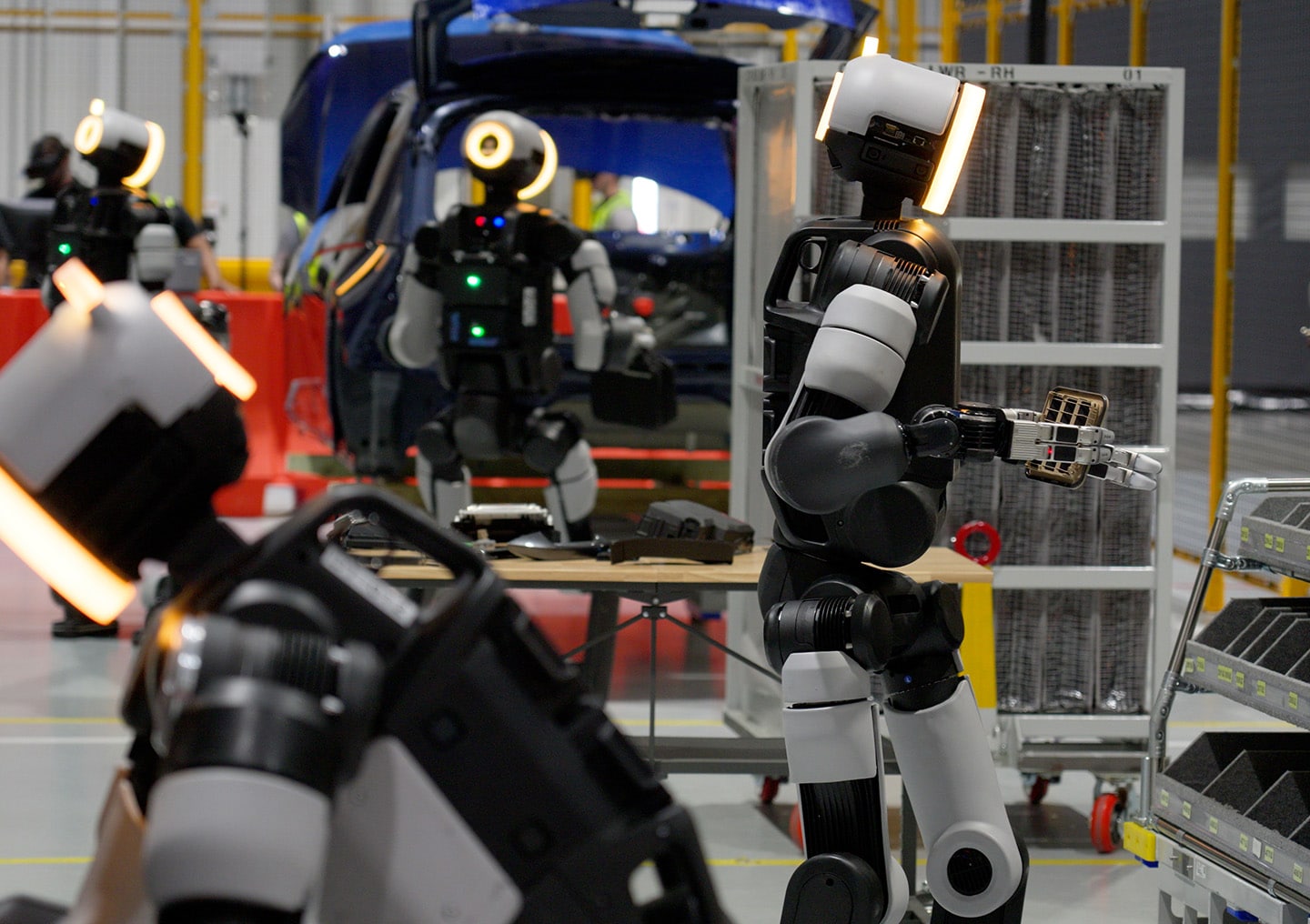
Dynamic Creatures emerged from stealth this week as, in its own words, Boston Dynamics' "official entertainment and hospitality partner." Its founders are Marc Theermann, Boston Dynamics' former Chief Strategy Officer and a Google veteran, and Farbod Farshidian, a former research leader at the Robotics and AI Institute, the nonprofit lab Raibert now leads as founder and executive director. The company builds mobile character robots for theme parks, hotels, casinos, and cruise ships, some built on Boston Dynamics' existing hardware and some fully original, animated by an operating layer it calls SnowJay.
Boston Dynamics did not spin up this business unit itself, and it did not buy Dynamic Creatures either. It licensed a category, entertainment and hospitality robotics, to two of its own alumni, granted them an official-partner label, and let outside venture funds, Eniac Ventures, Kindred Ventures, Heliad, Sunshine Lake, and BlueGrass Ventures among them, write the checks. Raibert wrote one too, as an individual, alongside a second named angel, Lukas Ziegler.
Here is the detail that makes the timing worth sitting with rather than shrugging off. Hyundai Motor Group announced on July 16 that it would acquire SoftBank's entire remaining stake in Boston Dynamics, a stake SoftBank had held since the 2021 deal that first handed Hyundai control, this time triggered by a put option written into that original agreement. That announcement, folding the last outside shareholder out of Boston Dynamics, landed seven weeks before Dynamic Creatures emerged from stealth. Its founder's newest robotics bet is not Boston Dynamics stock, because Boston Dynamics is no longer available to bet on in pieces. It is a personal check into a company he does not control, built on a hardware platform now several ownership changes removed from the person who invented it.
Whether Raibert planned the sequence this way is not something an outside observer can verify, and the two events may share no formal connection beyond landing in the same year. What is verifiable is the shape of the choice now in front of him: whatever upside exists in a category Boston Dynamics is not pursuing itself runs through an outside cap table, not an internal one.
The company that just bought its way in
Set that against NEURA Robotics, a German physical-AI company that announced on August 24 it was acquiring 100 percent of ADLATUS Robotics, a maker of autonomous industrial cleaning robots. NEURA's chief executive, David Reger, put the logic plainly: "We're not buying ADLATUS just to add another cleaning robot to our portfolio. We want to give machines like this a new brain."
NEURA owns ADLATUS outright now. There is no separate cap table, no departing executive walking off with a partner logo and someone else's venture money. NEURA absorbed a hardware line it lacked, in full, and immediately pointed its own sensor and AI stack at it.
Reger also said something that complicates any tidy story about buying versus building: "Physical AI will only truly scale if it becomes an ecosystem." That is the language of a platform strategy, spoken by a company doing the structural opposite of what Boston Dynamics just did. Owning something outright and calling it an ecosystem is not automatically a contradiction. It is a reminder that the word gets used by companies consolidating control just as often as by companies giving it away.
The two companies that chose neither
A third structure sits between the other two. Palladyne AI, a Nasdaq-listed physical-AI software company spun out of Sarcos with a revenue base built partly on US defense autonomy contracts, announced a strategic collaboration with FANUC America on September 8 to run its Palladyne IQ software on FANUC's industrial robot arms. Neither company bought the other. Neither licensed a category to a departing executive. Two independently owned businesses, one public and one a subsidiary of a much larger Japanese manufacturer, agreed to integrate products and validate use cases together, and left their ownership structures exactly where they were before the announcement.
That is the least dramatic of the three, and probably the one industrial robotics will actually run on the most over the next several years, because it is the only structure of the three that asks neither party to give up governance over anything.
- Buy: NEURA and ADLATUS. Full control, full liability, day one.
- Partner: Palladyne AI and FANUC America. Reversible, low-commitment, easy to quietly wind down.
- License and seed: Boston Dynamics and Dynamic Creatures. Cheapest for the platform owner, riskiest for the company built on top of it.
What a buyer should actually watch
None of these three approaches is free, and none is wrong. Buying outright gives NEURA immediate control, but it also inherits ADLATUS's existing customers, contracts, and technical debt on day one, whether or not any of it fits NEURA's own roadmap. Partnering as equals is reversible and low-risk for both FANUC and Palladyne, which is exactly why it commits either side to so little: one party can quietly deprioritize the collaboration eighteen months from now with no announcement required. Licensing a category to an insider spinout is the cheapest option on Boston Dynamics' own books and the most exposed one for Dynamic Creatures, whose commercial future depends on continued access to a hardware platform it does not own, sitting under a parent company that just changed hands.
A procurement team evaluating vendors built on any of these three structures is really running three different kinds of due diligence, and treating them the same way is the mistake worth avoiding. A subsidiary's roadmap answers to its new owner's capital priorities first. A partnership's roadmap answers to whichever side has less to lose if the deal quietly lapses. A licensed spinout's roadmap answers, in the end, to whoever owns the platform underneath it, and that owner's name on the org chart can change within the same fiscal year the license was granted.
None of these three structures is the actual news. The news is that all three happened in the same industry in the same week, which means build-partner-license is no longer a slide in a strategy deck. It is the live operating question every physical-AI company with a hardware advantage is answering in public, one deal at a time.
I read announcements like these from the Philippines, a market where none of these three companies sells anything yet, so the question I ask of a vendor is not which structure looks strongest in a press release. It is which one still answers a support ticket the same way three years from now. A wholly owned subsidiary answers to one balance sheet. A partnership answers to whichever side needed the deal less. A licensed spinout answers, eventually, to whoever owns the platform underneath it, and that ownership, as this week showed, is not something a founder can assume will stay put.
Disclaimer: This column reflects the author's own analysis and is provided for general information purposes only. It does not constitute investment, financial, legal, or procurement advice. Readers should verify details with primary sources before making business decisions. Hero image: David Reger (NEURA Robotics) and Adlatus/NEURA Mobile Robots leadership at the announcement of NEURA's acquisition of ADLATUS Robotics, official NEURA Robotics press photography.