Drones Are Not Waiting on Batteries. They Are Waiting on Permission
Congress set a legal deadline of January 2026 for the FAA to finalise its drone rule. An executive order titled Unleashing American Drone Dominance set another for February. Both passed. As of late August 2026 the rule was still a proposal, and the industry had flown 65 million times without it. The constraint on drones was never the battery.

Congress set a legal deadline of 16 January 2026 for the FAA to finalise the rule that would allow routine drone flight beyond an operator's line of sight. An executive order titled Unleashing American Drone Dominance, signed 6 June 2025, set a second deadline of 1 February 2026. Both passed.
Understanding drone use cases starts there rather than with any specification sheet. As of 29 August 2026, Part 108 remained a notice of proposed rulemaking, having sat with the Office of Information and Regulatory Affairs since 10 July 2026 — while the industry logged more than 65 million flights without it, per AirData's operational count. Some trade coverage has reported the rule as finalised; the Federal Register docket, checked in late August 2026, says otherwise.
Everything else about this industry follows from that one unresolved permission.
What Counts as a Drone in 2026?
Drones range from sub-250 gram consumer camera aircraft to heavy-lift platforms carrying 30 kilograms. Consumer models fly under visual line of sight rules. Commercial delivery and inspection at scale requires beyond-visual-line-of-sight authorisation, which in the United States remains a proposed rule rather than a granted permission as of 2026.
A drone is an uncrewed aircraft flown by a remote operator or by onboard automation. It matters now because the category has split into legal tiers that share almost no operational reality, and buyers routinely compare aircraft across tiers that cannot legally do the same work. For anyone assessing the sector, the useful question is not what an aircraft can do but what its operator is permitted to do with it.
The Rule That Gates the Whole Industry
Radio transmitters existed long before broadcasting licences. What decided who built a business was not the engineering but the allocation of spectrum. Airspace is the drone industry's spectrum, and beyond-visual-line-of-sight authorisation is the licence.
What is BVLOS and why does it matter for drones?
BVLOS stands for beyond visual line of sight — flying a drone further than the operator can see it. It matters because every commercial application that scales, including package delivery, pipeline inspection, and large-area agriculture, requires it. In the United States, BVLOS currently needs case-by-case waivers under Part 107. The proposed Part 108 rule would replace that with a standing framework covering operations up to 1,320 pounds, but as of 29 August 2026 it remained a notice of proposed rulemaking rather than a final rule.
Part 108 would cover operations up to 1,320 pounds under a standing framework, and the four-tier ladder in Figure 1 shows how narrow the legally permitted band is beneath it.
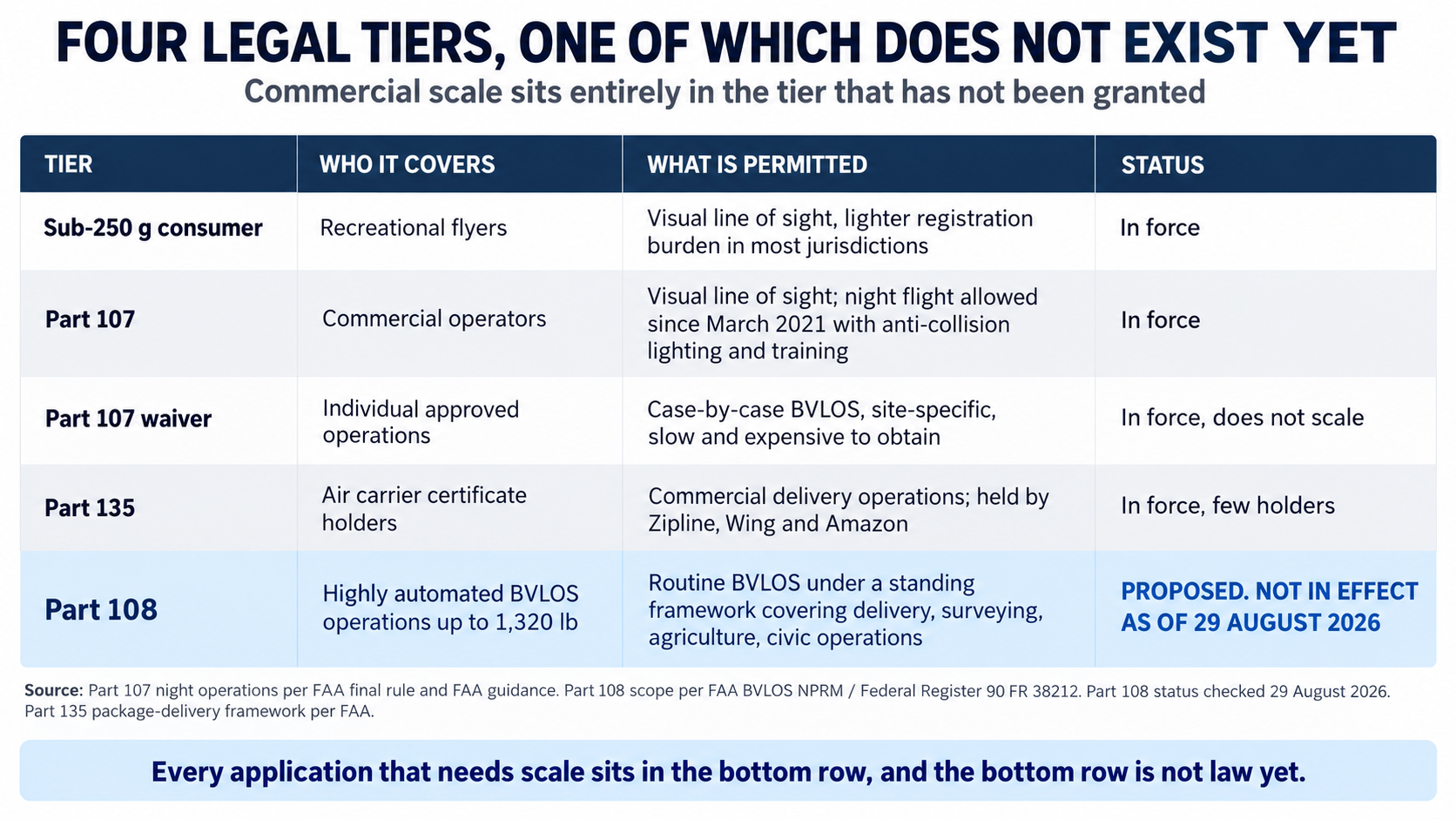
An executive order titled "Unleashing American Drone Dominance" set a deadline of 1 February 2026 for the rule that would unleash it. Seven months later the rule was still a proposal.
The constraint is permission, not propulsion.
Where Drones Already Earn Their Keep
Zipline services 84% of Rwandan hospitals and Wing completes over 1,000 deliveries a day in select regions, and the seven applications in Figure 2 show how unevenly that evidence is distributed across the sector.
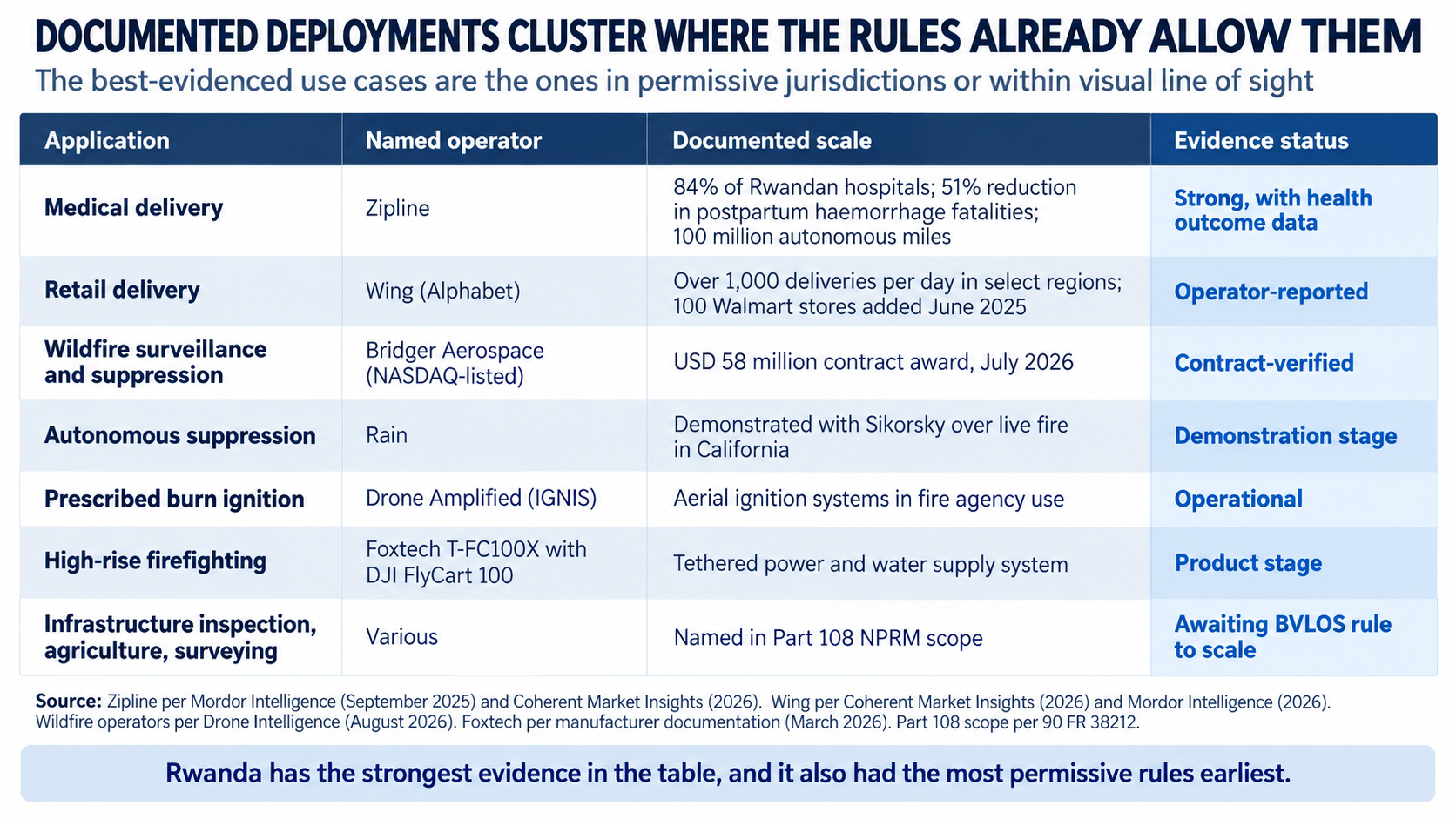
Wildfire is instructive for a different reason. Drone Intelligence noted in August 2026 that no analyst firm publishes a settled market size for wildfire drones as a standalone category, because the segment is bought through fire-agency service contracts, defence-adjacent autonomy programmes, and land-management budgets. The money is real and it does not appear in any single number.
Why the Best Firefighting Drones Stay on a Cable
Industrial drones typically fly 30 to 60 minutes while tethered systems run continuously, and the trade set out in Figure 3 shows what that endurance costs and what it buys.
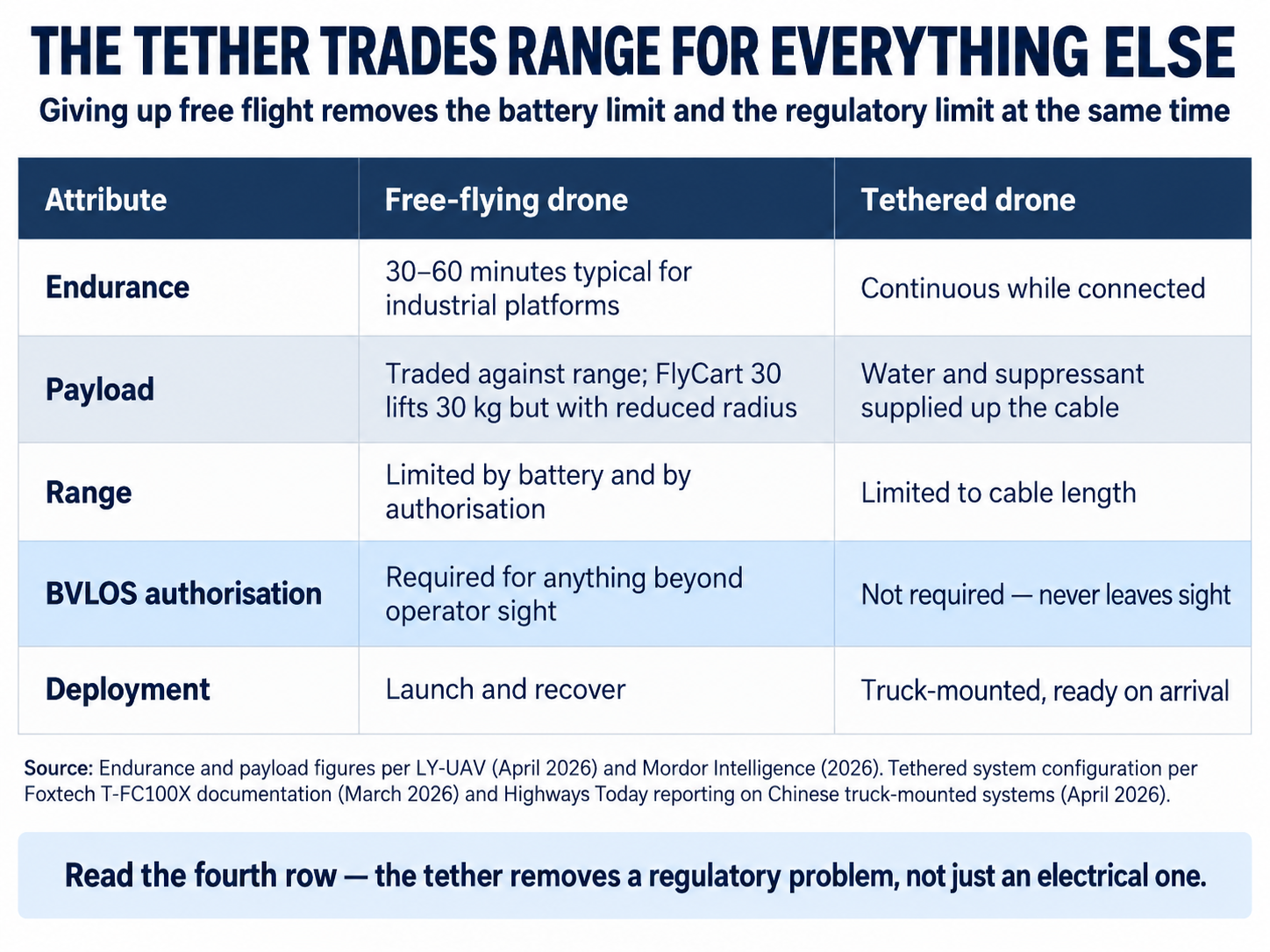
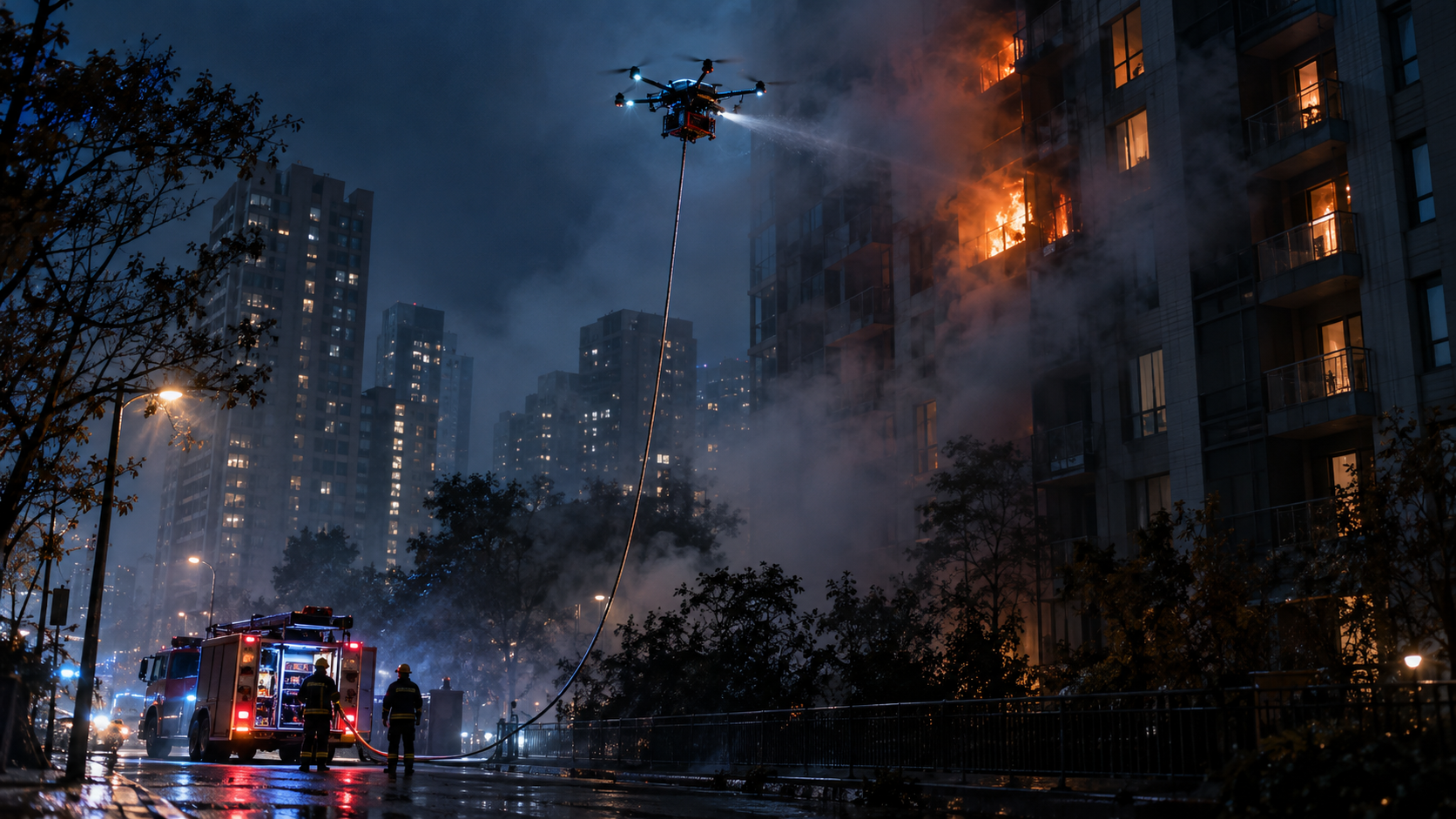
The engineering follows. Foxtech's T-FC100X combines tethered power with a high-capacity water supply and integrates with DJI's FlyCart 100 heavy-lift platform, per the manufacturer's March 2026 documentation. Chinese engineers have gone further in the same direction: Highways Today reported in April 2026 that truck-mounted systems combining autonomous UAVs with tethered aerial platforms are being deployed with endurance, control, and immediate readiness prioritised over range and autonomy.
The application driving it is high-rise fire. Ladder trucks struggle to reach upper floors in dense urban environments, and cities keep building upward. A tethered platform ascends in minutes and stays.
What the Small Drones Are Actually Shaped By
Consumer drones look like a pure product category, and the specification that defines the top end gives that away. DJI's Mini 5 Pro, launched September 2025, was the first mini camera drone with a 1-inch CMOS sensor delivering 50-megapixel stills and 4K/60fps HDR video — engineered into a sub-250 gram body, per Fortune Business Insights (August 2026). Fitting a sensor of that size under a specific weight is a regulatory target, not an optical one.
Market concentration is extreme and measured on several different bases. Counter-drone firm Dedrone recorded DJI at 83.48% of all global drone detections in 2025, with DIY and FPV builds second at 9.82% — a 4.3-fold increase from 2024 — and Autel at 1.40%. The FAA's own ASSURE A83 study in March 2026 put DJI platforms at approximately 96% of detected US drone activity via Remote ID sensors across 64 locations. Compiled industry data places DJI at roughly 80% of the US consumer market and 70% of the global civilian market.
Those figures are why the FCC's 22 December 2025 ban on new foreign-manufactured drone models matters commercially rather than symbolically, and why it sits alongside the broader question of who supplies national robotics capability. A rule affecting one manufacturer touches most of the installed base.
What Changes When the Rule Lands
The applications waiting on Part 108 are named in the NPRM itself: delivery, surveying, agriculture, and civic-interest operations. Each shares the same property — the value comes from covering distance, and distance is what visual line of sight forbids.
Pipeline and powerline inspection is the clearest case. An inspection that requires an operator to relocate every few hundred metres is a different economic proposition from one flown continuously along a corridor. Large-area agriculture is the same argument at field scale.
The international clock is running visibly. India's Civil Aviation Minister Rammohan Naidu announced that the country would deliver BVLOS certification by the end of 2026, and the FAA opened the second phase of its BEYOND programme on 29 August 2026 to add up to eight government drone-testing partners. There is no published forecast of how quickly volumes shift after a final rule takes effect, and any confident number would be guesswork — the transition period alone is expected to run six to twelve months after publication.
Permission or Physics
The operators: the ceiling is legal
Commercial operators describe a consistent investor conversation — sound unit economics, real demand, and a regulatory ceiling capping growth, as one BVLOS analysis put it in July 2026. Part 135 air carrier certification functions as a moat, restricting large-scale delivery to compliant operators, per Coherent Market Insights (2026), and only Zipline, Wing and Amazon hold one.
The Rwandan evidence supports the reading directly. Zipline reached 84% hospital coverage under a permissive regime while its US footprint advanced waiver by waiver, and the same aircraft flew both.
Mordor Intelligence: the ceiling is physical
The counter-position is stated plainly in Mordor's 2026 delivery analysis: without breakthroughs in battery density or hybrid propulsion, revenue per sortie stays capped. DJI's FlyCart 30 lifts 30 kg but sacrifices endurance and therefore radius. The Wingcopter 198 pairs a 6 kg payload with 75 km of range and remains a niche healthcare solution.
No authorisation extends the distance an aircraft can physically reach, and the payload-versus-range trade holds on every battery-electric platform in the market.
Both ceilings are real and they bind at different scales — physics decides what one flight is worth, regulation decides how many flights an operator may run and over what territory. Which explains why the systems working best in fire response today are not competing in either race: a truck-mounted tethered platform draws its power from the ground, never leaves the operator's sight, and is therefore the only class of drone in this article whose growth does not depend on a docket number.
This development reinforces:
- Where Robots Are Used: The pillar covering deployment contexts, including why the constraint that decides adoption is rarely the one on the specification sheet.
- Sports Robots Are Three Different Machines Wearing One Name: The same category error appears there — one label spanning machines that share nothing but a marketing word.
- AI and Robotics in China: How Beijing Is Turning Automation Into National Power: DJI's share of detected US drone activity, at roughly 96% per the FAA's own March 2026 study, is what makes the December 2025 FCC ban a supply-chain event rather than a procurement note.
Sixty-five million flights have been logged while the rule that would let those flights go somewhere sat in a review queue. The aircraft were never the bottleneck: DJI put a 1-inch sensor into a 250-gram airframe, Zipline flew 100 million autonomous miles, and Foxtech built a system that hangs a water cannon outside a tenth-floor window. What none of them could build was the permission. The tethered firefighting rigs are the tell — the one class of drone that scaled without waiting, because a cable running down to a truck is a way of saying the aircraft will never go anywhere, and going somewhere is the part that needs signing off.
Frequently asked questions
1. What does BVLOS mean for drones?
BVLOS means beyond visual line of sight — flying a drone further than the operator can see it. It is the requirement behind every scaled commercial application, including package delivery, pipeline inspection, and large-area agriculture. In the United States, BVLOS currently requires case-by-case waivers under Part 107, which are slow and expensive to obtain and do not support expansion across multiple sites.
2. Is FAA Part 108 in effect yet?
No. As of 29 August 2026, Part 108 remained a notice of proposed rulemaking, per the Federal Register docket, with no operator able to claim Part 108 authority. The rule was published as an NPRM on 7 August 2025 and has been under review at the Office of Information and Regulatory Affairs since 10 July 2026. Some published coverage has reported the rule as final; the docket record does not support that.
3. How do firefighting drones actually work?
Firefighting drones split into three roles: surveillance and suppression, autonomous suppression, and aerial ignition for prescribed burns. The systems used for high-rise fires are typically tethered, drawing power and water up a cable from a truck below — which gives them continuous endurance instead of the 30 to 60 minutes typical of free-flying industrial platforms. Foxtech's T-FC100X pairs tethered power with a high-capacity water supply on a DJI FlyCart 100 airframe.
4. What are drones actually delivering today?
Medical supplies and retail packages, mostly in geographically limited operations. Zipline services 84% of Rwandan hospitals and has flown 100 million autonomous miles, associated with a 51% reduction in postpartum haemorrhage fatalities through on-demand blood delivery per Mordor Intelligence (September 2025). Wing completes over 1,000 deliveries per day in select regions and added 100 Walmart stores in June 2025.
5. Why are so many consumer drones just under 250 grams?
Because the weight sits below a registration threshold in most jurisdictions, making the aircraft simpler to own and fly. DJI's Mini 5 Pro, launched September 2025, fitted a 1-inch CMOS sensor with 50-megapixel imaging into a sub-250 gram body — an engineering effort aimed at a regulatory number rather than an optical one, per Fortune Business Insights (August 2026).
6. What does the FCC ban on foreign drones mean for buyers?
The FCC banned new foreign-manufactured drone models on 22 December 2025, which matters because of how concentrated the installed base is. The FAA's ASSURE A83 study in March 2026 found DJI platforms accounted for approximately 96% of detected US drone activity via Remote ID sensors across 64 locations, and Dedrone recorded DJI at 83.48% of global drone detections in 2025. Existing aircraft are not affected in the same way as new model approvals.
7. Which drone use cases come next?
Infrastructure inspection, large-area agriculture, and surveying are the applications named in the Part 108 NPRM and waiting on it, because each earns its value by covering distance that visual line of sight forbids. The international timing is competitive — India's Civil Aviation Minister announced BVLOS certification by end-2026, and the FAA opened BEYOND Phase 2 on 29 August 2026 to add up to eight government testing partners.