China's Humanoid Robot Capital Cycle: Record IPOs Meet Fresh Angel Money
China's humanoid robot sector reached a capital markets turning point in July 2026. Unitree's record-speed IPO registration leads more than 20 companies toward listings while new angel rounds, including Guangxiang Tech's several-hundred-million-yuan raise, show institutional money entering at both ends of the pipeline.
What is happening in China's humanoid robot capital markets in July 2026?
On July 2, 2026, China's securities regulator approved Unitree Robotics' IPO registration for the Shanghai STAR Market in a record 104 days, clearing the way for the A-share market's first pure-play humanoid stock. More than 20 robotics companies are now moving toward listings in Shanghai, Shenzhen, and Hong Kong, while fresh angel capital keeps entering the sector.
What Happened
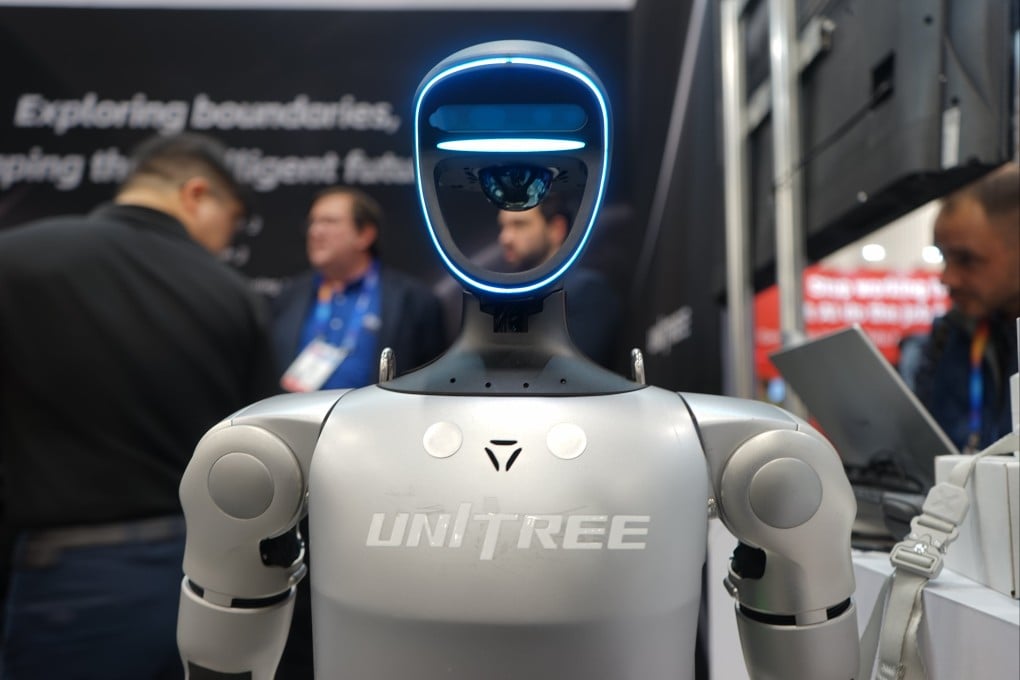
The clearest signal came on July 2, when the China Securities Regulatory Commission approved Unitree Robotics' registration for an initial public offering on the Shanghai STAR Market. The approval took just 104 days from acceptance, a new speed record for the hard-tech board. Unitree plans to raise 4.202 billion yuan at an issue valuation of approximately 42 billion yuan, with the listing expected in the third quarter. With 5,500 humanoid units shipped in 2025, the company enters the public market as the sector's undisputed bellwether.
Unitree's milestone is not an isolated event. According to market data compiled by 163.com and Sina Finance, more than 20 core robotics companies are in various stages of IPO coaching, filing, hearing, or issuance as of July 2026. And on July 4, the other end of the capital pipeline made its own statement. Guangxiang Tech, an embodied AI startup co-incubated by Tsinghua University's School of Vehicle and Mobility and School of AI, announced it has completed a cumulative several-hundred-million-yuan angel round, drawing in eight new institutional and strategic investors while the most mature players in the sector prepare to exit into public markets.
Why is the IPO wave happening now?
Four forces have converged to open the window. First, listing standards have expanded on both the STAR Market and the Hong Kong Stock Exchange, whose Chapter 18C rules for specialist technology companies were written for exactly this kind of pre-profit hardware firm. Second, the state-mandated deployment push gives the sector a demand floor: the MIIT and SASAC action plan calls for more than 10,000 humanoid robots working in real commercial scenarios this year. Third, venture funds from the 2022 and 2023 vintages are approaching the end of their investment cycles and need exits. Fourth, global valuation resonance from massive private rounds, such as Figure AI's multibillion-dollar raises in the United States, has reset what public investors will pay for humanoid exposure.
The result is a queue that spans every board and every layer of the supply chain, from whole-machine makers to the harmonic reducers inside their joints.
The Leading Contenders
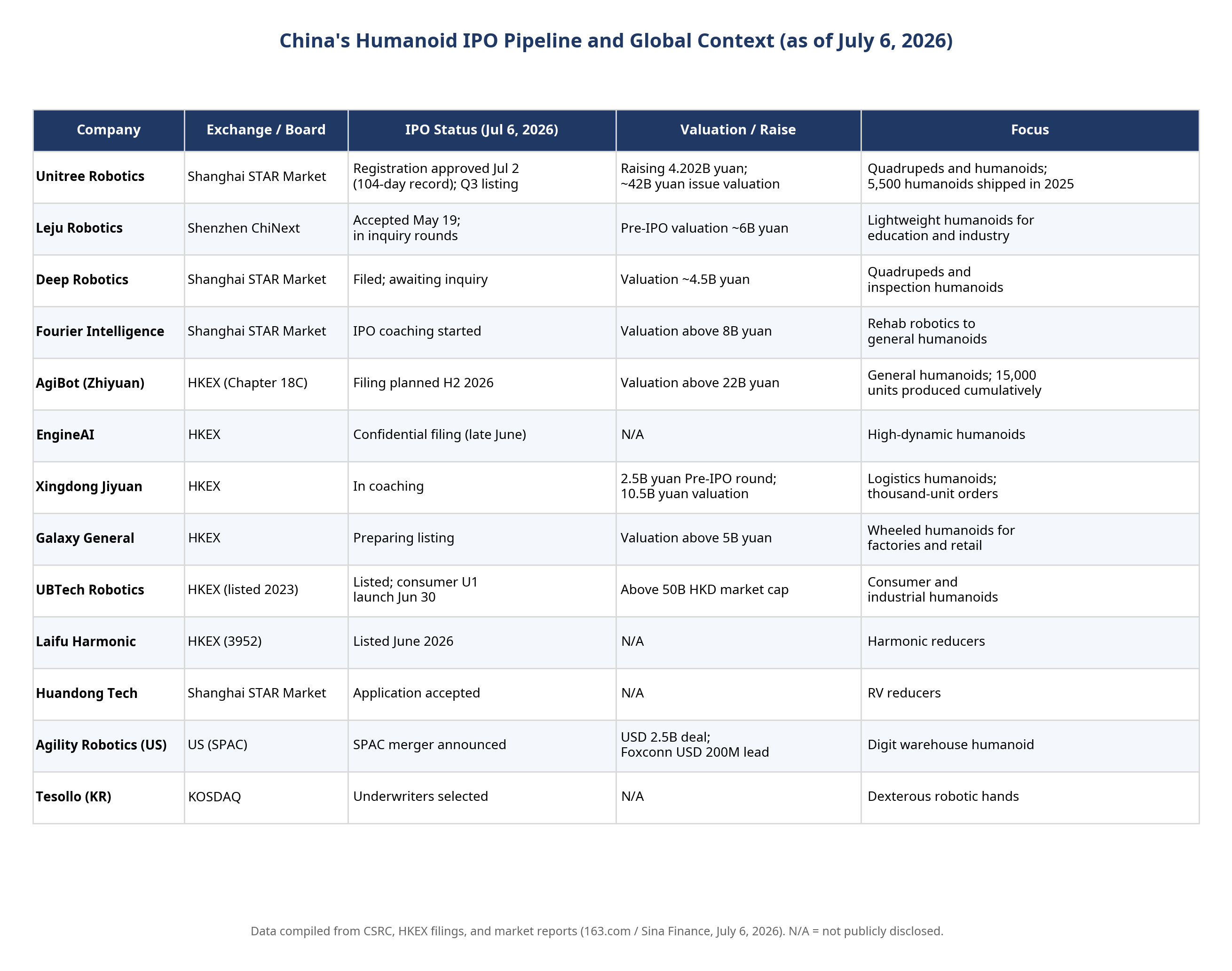
Unitree stands alone as the first pure-play humanoid stock heading for the A-share market, but the field behind it is crowded. Leju Robotics, known for lightweight humanoids used in education and industrial settings, had its ChiNext application accepted on May 19 under the board's fourth listing standard and is now in the inquiry phase at a pre-IPO valuation of roughly 6 billion yuan. Deep Robotics, a leader in quadruped and inspection robots, has filed for the STAR Market and awaits inquiry at a valuation near 4.5 billion yuan. Fourier Intelligence has started IPO coaching for the same board, bringing its transition from rehabilitation devices to general humanoids to public markets at a valuation exceeding 8 billion yuan.
Hong Kong is capturing a significant share of the overflow. AgiBot plans to file in the second half of 2026 with a track record of 15,000 cumulative units produced and a valuation topping 22 billion yuan. EngineAI recently made a confidential filing. Logistics-focused Xingdong Jiyuan is in coaching after a 2.5 billion yuan pre-IPO round valued the company at 10.5 billion yuan, and Galaxy General is preparing a listing at a valuation above 5 billion yuan.
The Component Wave
The capitalization push extends deep into the upstream supply chain. More than 30 robotics-related companies are preparing Hong Kong filings, and several component makers have already moved. Laifu Harmonic listed on the HKEX in June as the market's first dedicated harmonic reducer stock. Huandong Tech, an RV reducer manufacturer, has had its STAR Market application accepted. Joint module maker Weita Dongli is in coaching, and electronic skin developer Boshi Zhidong is preparing a Chapter 18C filing. Listed beneficiaries are feeling the pull too: Zhongdali De reportedly secured a 110,000-unit reducer order from Unitree, a single purchase order that illustrates how one flagship IPO can cascade demand through the component base.
Fresh Angel Money Is Still Entering the Pipeline
A capital cycle needs an entry point as much as an exit, and the Guangxiang Tech round shows the entry end running at full pressure. The startup's cumulative angel financing brought in Zhuhai Technology Industry Group, XingZheng Capital, Songhe Capital, Shunxi Fund, Muhua Sci-Tech, See Fund, Yichen Capital, and the listed company Xingyun Tech as a strategic investor, with existing backers 01VC and L2F participating again. That a public company took a strategic position at angel stage says as much about the sector's perceived time horizon as any IPO filing does.
Guangxiang is also a bet on a distinct technical route. Founded by CEO Zhang Tao and Tsinghua Professor Li Shengbo, the company is building what it calls a physical-native foundation model, grounded in reinforcement learning and high-fidelity physics data rather than the internet-scale text and video that vision-language-action models depend on. Its Phi-Bot X1 industrial robot, whose zero-error 21.5-hour automotive welding run was covered here previously, is the first commercial vehicle for that approach, and the new capital is earmarked to push deployments from automotive manufacturing into the 3C electronics sector. In effect, public markets are about to price the VLA and hardware-led routes through Unitree and its peers, while angel investors are still placing side bets on alternative architectures that could leapfrog them.
Global Context and Market Risks
China's IPO wave is happening against a backdrop of global consolidation. In the United States, Agility Robotics announced a 2.5 billion dollar SPAC merger backed by Foxconn, which is contributing 200 million dollars to scale the Digit warehouse humanoid. South Korea's Tesollo has selected underwriters for a KOSDAQ listing built around dexterous robotic hands. The listing race is now genuinely international, but no other market comes close to China's queue depth.
For investors evaluating the Chinese cohort, the projections are large. Market forecasts cited in the 163.com analysis point to a 400 billion yuan global market by 2035, with 2026 China humanoid shipments expected to exceed 100,000 units, roughly ten times the 2025 volume. The risks are equally pronounced. Most of the queue is loss-making, the winning technical route remains unsettled, bill-of-materials costs are falling more slowly than list prices, and several late-stage startups carry valuations that their order books do not yet support.
The Bigger Signal
The deeper story is that China's humanoid sector now has a complete, functioning capital cycle for the first time. Angel money enters at one end, as Guangxiang's round shows. Growth capital carries companies through pre-IPO rounds, as Xingdong Jiyuan's 2.5 billion yuan raise did. Public markets provide the exit, as Unitree's 104-day sprint to registration now proves. Each stage de-risks the one before it, which is why a record-speed IPO approval and a crowded angel round can land in the same week without contradiction. A quotable way to put it: China no longer funds humanoid robotics as a science project, it finances the sector as an industry, with an assembly line for capital that runs parallel to the assembly lines for robots.
Strategic Implications
For procurement and strategy teams, the listing wave changes counterparty risk in both directions. Publicly listed suppliers will carry audited financials, disclosed capacity numbers, and quarterly scrutiny, which makes multi-year deployment contracts easier to underwrite. At the same time, IPO proceeds will fund aggressive capacity expansion and likely price competition, so buyers who lock long-term unit pricing before the listings complete may leave money on the table.
Watch the third quarter closely. Unitree's debut will set the public reference multiple for every company behind it in the queue, and a strong first print will accelerate the filings of AgiBot, EngineAI, and the component makers, while a weak one would test how much of the current valuation stack is self-referential.
The Simple Version
Think of it like a farm system in sports. For years, Chinese robot companies played only in the minor leagues of private funding. Now the best team, Unitree, has been called up to the major leagues of the stock market in record time, twenty more teams are warming up behind it, and scouts are still signing brand-new players like Guangxiang in the hope they become the next call-up.
The Hard Truth
Most coverage of the IPO queue treats regulatory approval as validation of the underlying businesses. It is not. Approval validates disclosure, not demand. Outside Unitree's 5,500 shipped units and a handful of verified factory deployments, much of the queue is selling capacity that does not exist yet to customers who have not signed yet. The 100,000-unit shipment forecast for 2026 requires a tenfold volume jump in a single year, and no industrial hardware category has ever done that without a painful correction along the way. The companies that survive the eventual sorting will be the ones whose robots are earning revenue per hour on real production lines, not the ones with the fastest filings.
2026 Humanoid and Component IPO Pipeline
Sources
163.com / Sina Finance, July 6, 2026: 2026 Humanoid Robot IPO Wave Analysis. https://www.163.com/dy/article/L14AVO7U05568W0A.html
NBD, July 3, 2026: Humanoid leader IPO registration approved. https://www.nbd.com.cn/articles/2026-07-03/4447216.html
QbitAI, July 4, 2026: Guangxiang Tech completes cumulative several-hundred-million-yuan angel round. https://www.qbitai.com/2026/07/442958.html
Related coverage: Just One Year After Founding, Tsinghua-Backed Phi-Bot Secures Car Factory Orders. https://www.robotaigeek.com/news/tsinghua-phi-bot-car-factory-orders-embodied-ai-production-line