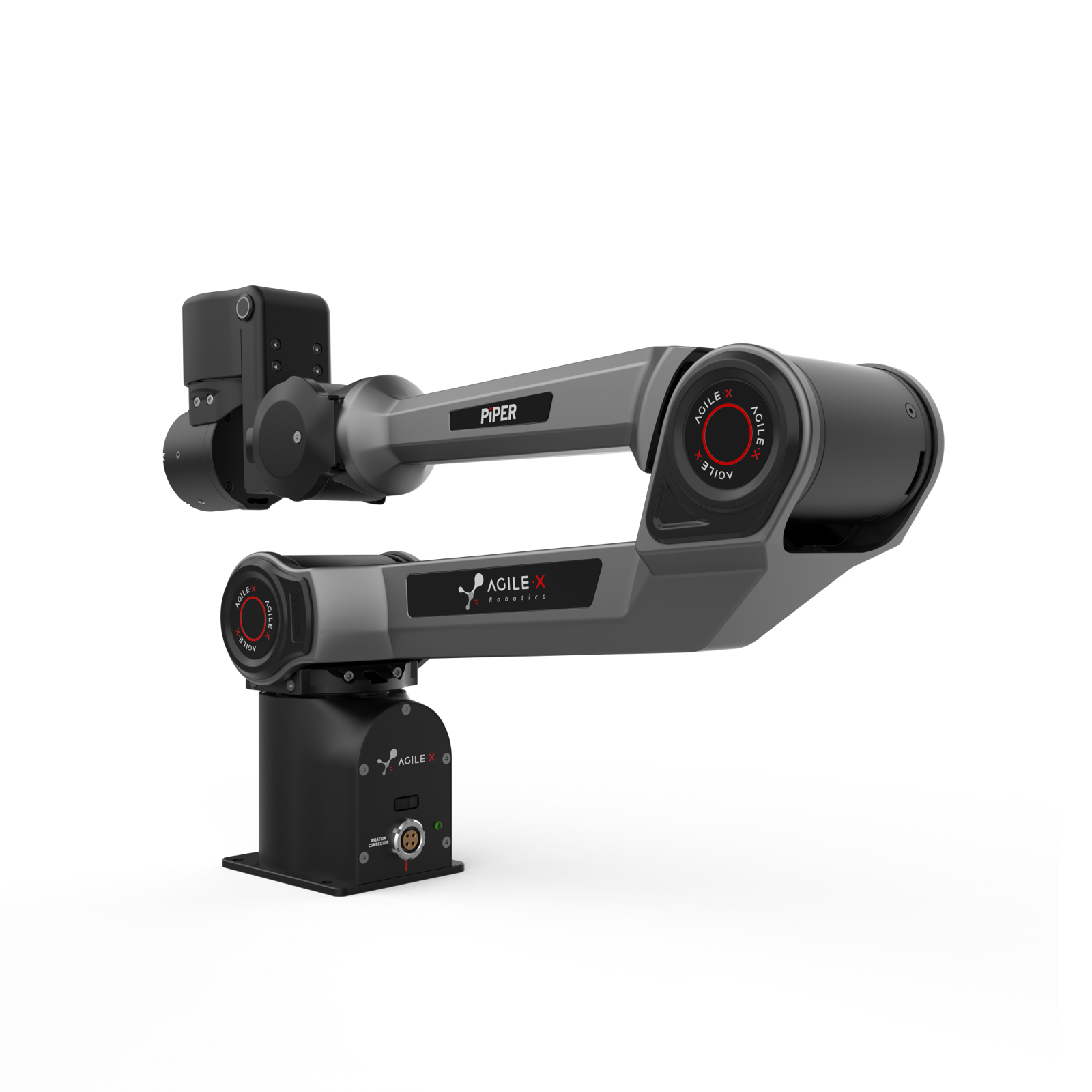
Beyond the Invoice: Calculating the True Cost of a Humanoid Robot
A buyer-focused guide to the hidden costs of humanoid robots, from integration and training to maintenance, downtime, compliance, and upgrades, with a quote-normalised five-year TCO worksheet.
A humanoid robot can look affordable when a buyer compares only the invoice. The harder question is what the system costs after it reaches the site, learns the work, needs service, loses productive hours, and eventually requires an upgrade. Public procurement records show why a single “market price” is unsafe: one Chinese award lists a Unitree G1eduU2 at CNY 226,000 for a science-outreach purchase, another lists a training humanoid configuration at CNY 394,730, while a university award lists a configured CASBOT 02 with a CASBOT Handle-L1 at CNY 1,085,000. These are real public awards, but they describe different configurations and missions, not a universal price curve.
The practical answer is a quote-normalised total cost of ownership (TCO) model. A buyer should separate the robot, the workcell, the people, the operating risk, and the compliance path. That separation is more useful than a borrowed maintenance percentage because official sources do not yet provide a comparable humanoid-robot series for five-year ownership cost, mean time between failures, resale value, or average lead time.
Installation and Integration Costs
The invoice rarely describes the whole installation. Before comparing suppliers, split the proposal into five layers: the robot platform, task tooling, site preparation, software integration, and commissioning. Task tooling can include grippers, fixtures, charging equipment, protective devices, and the interfaces needed to work with an existing line or warehouse process. Site preparation can include electrical capacity, network coverage, floor changes, safety zoning, and access for maintenance. Software work can include the connection to a warehouse-management system, manufacturing controls, digital work instructions, or a remote-support platform.
The distinction matters because a robot-level quotation is not the same thing as a ready-to-run application. The International Organization for Standardization (ISO) describes ISO 10218-1:2025 as covering safety requirements for industrial robots treated as partly completed machinery. It identifies robot-level design, risk reduction, and information for use, while the application and integration layer is addressed separately in ISO 10218-2. A buyer should therefore ask for a responsibility matrix that says which party pays for the risk assessment, guarding, validation, site acceptance test, and changes after the first task trial.
The European Union (EU) Machinery Regulation 2023/1230 adds another reason to price the compliance path early. It addresses risks arising from machinery function and machinery placed on the EU market or put into service. The regulation is not a humanoid price list, but it makes documentation, conformity work, instructions, and change control part of the ownership conversation. A low invoice can become an expensive project if the supplier has not defined who produces the technical file, conformity evidence, and operating instructions for the final application.
Training and Onboarding
Training is not one line item. Separate the first operator course, maintenance training, task-teaching time, safety instruction, and the labour required to build a reliable exception process. Ask the supplier to state the number of people, training days, location, language, materials, travel, refreshers, and the level of access provided to the customer’s own engineers.
The peer-reviewed industrial-robot TCO method by Steffen Landscheidt and Mirka Kans identifies operator wages among the most influential cost factors and notes that companies often struggle to retrieve the expenditure generated by automation equipment. That mechanism is directly relevant to humanoid pilots: a robot that needs a skilled employee beside it for every exception has a different business case from one that can be supervised across several stations.
Use a simple onboarding test. Record the hours required for an operator to run the standard task, recover from a safe stop, change a tool, and diagnose a failed attempt. Then record the hours required for a maintenance technician to isolate a fault and return the robot to service. These are buyer measurements, not universal benchmarks. They should be converted into local labour cost using the buyer’s own payroll data, not a generic industry assumption.
Maintenance and Spare Parts
A humanoid system has more maintenance questions than a static machine because it combines actuators, batteries, sensors, computing, communications, software, and task-specific tooling. The proposal should identify preventive-maintenance intervals, battery replacement conditions, actuator inspection, sensor calibration, lubrication or consumables, spare-part prices, software support, remote diagnostics, and the expected response time for a critical failure.
The public record does not support a reliable annual maintenance percentage for humanoid robots. That gap is important. A percentage borrowed from another robot class could understate the cost of batteries, high-cycle joints, unfamiliar failure modes, or software support. The buyer should instead request a five-year parts-and-service schedule with separate prices for planned service, emergency labour, travel, replacement modules, software updates, and cybersecurity remediation.
The same discipline applies to energy. The TCO research identifies energy consumption as a major cost factor, but a humanoid’s power profile depends on payload, walking, manipulation, idle time, charging strategy, and the site’s electricity tariff. Require measured or contractually defined energy data for the buyer’s task. If the supplier offers only a laboratory figure, keep it separate from the production estimate.
Downtime and Productivity Risk
Downtime is the cost most likely to disappear from a glossy proposal. Build a task-level model around productive hours rather than around a headline autonomy claim. The buyer needs the planned operating window, charging time, task cycle time, supervised hours, safe-stop recovery time, remote-support response, and fallback labour when the robot is unavailable.
Suppliers should provide mean time between failures and mean time to repair where those figures exist, but the buyer should not assume that a prototype demonstration has a production reliability history. A useful pilot contract defines what counts as an unavailable hour, how availability is measured, who supplies replacement hardware, and whether the customer receives service credits or an extension when the system misses the agreed operating window.
Run at least three sensitivities in the approval model. The first assumes the robot meets its planned productive hours. The second removes a modest block of hours for additional supervision and recovery. The third assumes a major component failure that requires a replacement module and specialist travel. The purpose is not to predict failure. It is to show decision-makers how quickly the payback case changes when the robot performs below the plan.
Market access can create a separate schedule risk. In its 28 July 2026 frequently asked questions (FAQ), the Federal Communications Commission (FCC) says that new foreign-produced advanced robotic devices generally cannot receive FCC authorization for import, marketing, or sale in the United States unless an applicable exemption or Conditional Approval exists. The FCC definition includes qualifying humanoid robots. A U.S. buyer should therefore verify authorization status, country-of-production evidence, testing-only exemptions, and the supplier’s responsibility for any approval delay before counting a robot as an available asset.
End of Life and Upgrade Costs
A five-year plan should not assume that the hardware remains valuable simply because it still moves. Ask how long the supplier will support software, safety fixes, batteries, actuators, sensors, and task models. Ask whether an upgrade changes the validated safety case, the technical file, the network architecture, or the operator training requirement. Ask whether customer data and task models can be exported if the supplier changes its platform or commercial terms.
Resale value is not an official market series for humanoids, so it should be treated as zero in the conservative case unless a buyer has a contractual buyback or a documented secondary-market transaction. The same principle applies to depreciation. A finance model can include a residual-value scenario, but it must show how the result changes when residual value is removed.
The buyer should also price the cost of replacement learning. If the next generation changes the arm geometry, battery, software interface, or safety architecture, the task may need to be retaught and revalidated. That is an ownership cost even when the supplier describes the change as a free upgrade.
TCO Summary
The table below is an illustrative worksheet, not a market forecast. It begins with a public award reference, adds explicitly labelled assumptions, and shows how the invoice can understate the five-year commitment. Replace every assumption with a supplier quote or the buyer’s own operating data before approval.
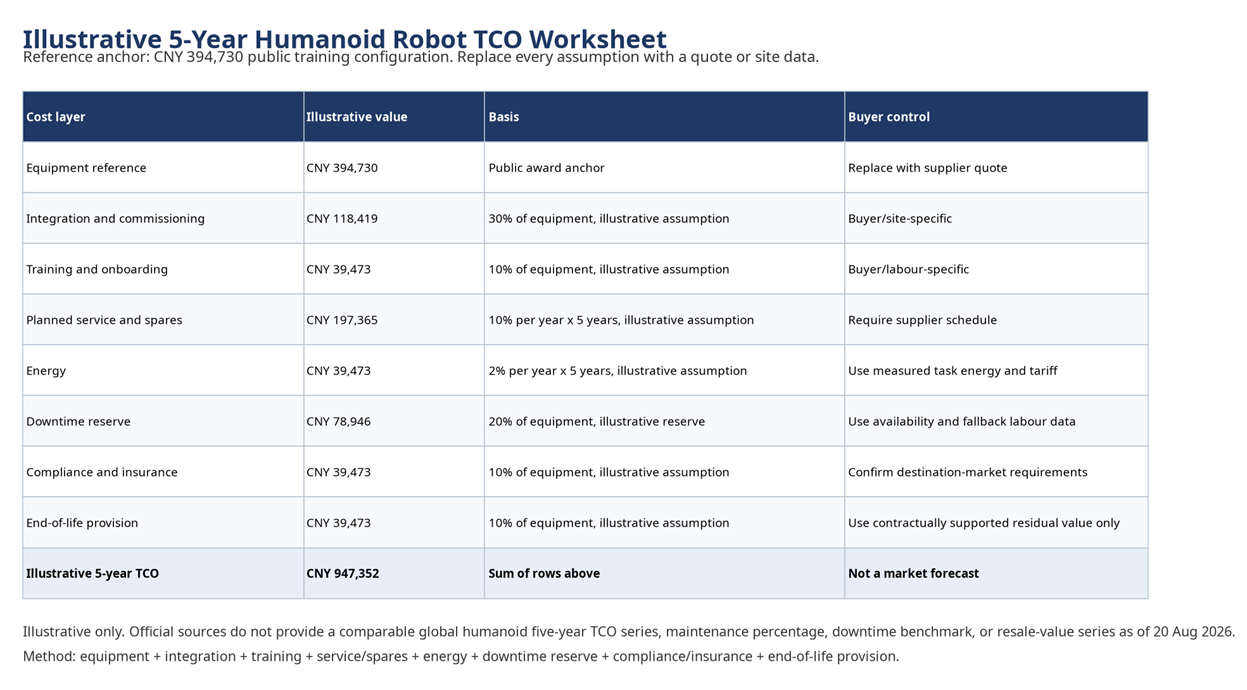
The calculation uses a simple structure: five-year TCO equals the reference equipment cost, integration and commissioning, training, planned maintenance, energy, downtime reserve, compliance work, and end-of-life provision, less any contractually secured residual value. For a serious investment case, discount future cash flows using the buyer’s approved rate. The peer-reviewed TCO method supports net-present-value treatment, but it does not supply humanoid-specific inputs.
The three public Chinese awards are useful anchors because they expose the importance of configuration and mission. The CNY 226,000 Unitree award is not interchangeable with the CNY 394,730 training configuration, and neither is interchangeable with the CNY 1,085,000 configured research package. The European procurement record titled “Humanoid Robot” is even more instructive: its EUR 243,192.39 final value describes a bimanual mobile manipulator for geriatrics tasks, so it should not be treated as a clean humanoid unit price.
The right procurement question is therefore not “What does a humanoid robot cost?” It is “What task, service level, compliance path, and five-year risk envelope does this quotation buy?” Buyers who force suppliers to answer that complete question will compare systems more honestly and will be better positioned to approve a pilot that can survive contact with production.
This analysis synthesizes company statements, exchange filings, and public market activity; figures reflect disclosures available as of the information cut-off of August 20, 2026.
Disclaimer: This article is for general information purposes only and does not constitute investment, legal, or procurement advice. Readers should verify details with primary sources before making business decisions.