Why Investors Are Betting Big on the Collaborative Robot Sector
Capital is flowing into collaborative robotics faster than the sector's modest revenue base would seem to justify. A private Chinese cobot maker just raised RMB 600 million (about USD 84 million), the listed pure play grew revenue 31.7 percent in 2025 yet still runs at a loss, and Western incumbent demand remains cyclical. In the closing analysis of our ten-part cobot series, we examine the verified market data behind the enthusiasm, map where the money moved in the first half of 2026, weigh the risks from tariffs to price erosion, and score the three ways investors can actually get exposure, so procurement leaders understand why their supplier market is crowded, subsidised, and unusually favourable to buyers.

In March 2026, a collaborative robot manufacturer that most procurement managers outside Asia have never evaluated closed a RMB 600 million financing round, roughly USD 84 million, at a reported post-money valuation near RMB 6 billion, about USD 840 million. In the same month, the sector's most closely watched listed pure play reported that revenue grew 31.7 percent in 2025 while its research budget jumped almost 60 percent. Capital is moving into collaborative robotics faster than the sector's modest revenue base would seem to justify, and that gap is precisely the story. Investors are not paying for what cobots sell today. They are paying for a structural position in the automation layer closest to the world's labour shortage, and this closing analysis of our ten-part cobot series examines whether that bet is rational, who is making it, and what must happen for it to pay off.
Market Size and Growth Rate
The honest starting point is that the collaborative robot market is small. According to the market intelligence firm Interact Analysis, global cobot revenue passed USD 1.2 billion in 2025, growing 10.5 percent on shipments of roughly 57,000 units, up 14.5 percent. The same firm forecasts shipments to grow at an average annual rate of 17.3 percent between 2025 and 2030, nearly doubling to about 129,000 units, with revenue reaching approximately USD 2.3 billion by 2030. Readers comparing these figures with the multibillion-dollar market sizes circulated in promotional research should note that inflated estimates bundle software, grippers, integration services, and adjacent robot categories into the headline. This series relies on the narrower, unit-anchored estimate because it reconciles with what manufacturers actually disclose.
Two features of this growth profile matter more to investors than the headline size. First, units are growing faster than revenue, which means average selling prices are still falling, a pattern documented in the audited numbers of Shenzhen Dobot, whose six-axis cobot average selling price declined from RMB 65,900 in 2021 to RMB 47,100, roughly USD 6,600, by the first half of 2024 according to its Hong Kong listing prospectus. Second, volume is concentrating in China, which took 54.7 percent of global cobot shipments in 2025 and is projected by Interact Analysis to reach 61.4 percent by 2030. For wider context, the International Federation of Robotics counted 542,000 industrial robot installations in 2024 and expects more than 700,000 annually by 2028, with cobots holding about a tenth of installations when the IFR last broke out the category. The investment case therefore rests not on the size of today's market but on cobots' claim to the fastest-growing slice of a very large automation build-out.
Key Demand Drivers
Four structural forces explain why buyers keep arriving faster than prices fall. The first is labour arithmetic: manufacturing economies from Germany to Guangdong face shrinking working-age populations and persistent vacancies in machine tending, assembly, and inspection, and a cobot that deploys in days rather than months is the automation format best matched to firms that cannot staff those roles. The second is accessibility economics. A six-axis arm that averaged roughly USD 6,600 at factory level in China, per Dobot's prospectus disclosures, sits within the capital budget of small and medium manufacturers that could never justify a fenced industrial cell, and our total cost of ownership analysis published earlier this week showed that even at two to five times sticker price over five years, well-utilised cobot cells undercut fully loaded labour cost in high-wage markets.
The third driver is payload creep. Interact Analysis documents the market shifting into 16 to 20 kilogram and heavier classes, with JAKA marketing a 40 kilogram model and ABB designing its PoWa line for the Chinese market, meaning cobots now compete for tasks that once belonged exclusively to conventional industrial robots. The fourth is the embodied intelligence convergence. Dobot's annual report shows 39.3 percent of its 2025 research spending, RMB 45.1 million of RMB 115 million, directed at embodied intelligence, and its new humanoid and wheeled platforms reuse the joints, controllers, and force-control software developed for cobots. Investors read this as optionality: a cobot maker's component and control stack is a call option on the far larger embodied robotics market, whether or not humanoids arrive on schedule.
Recent Notable Investments
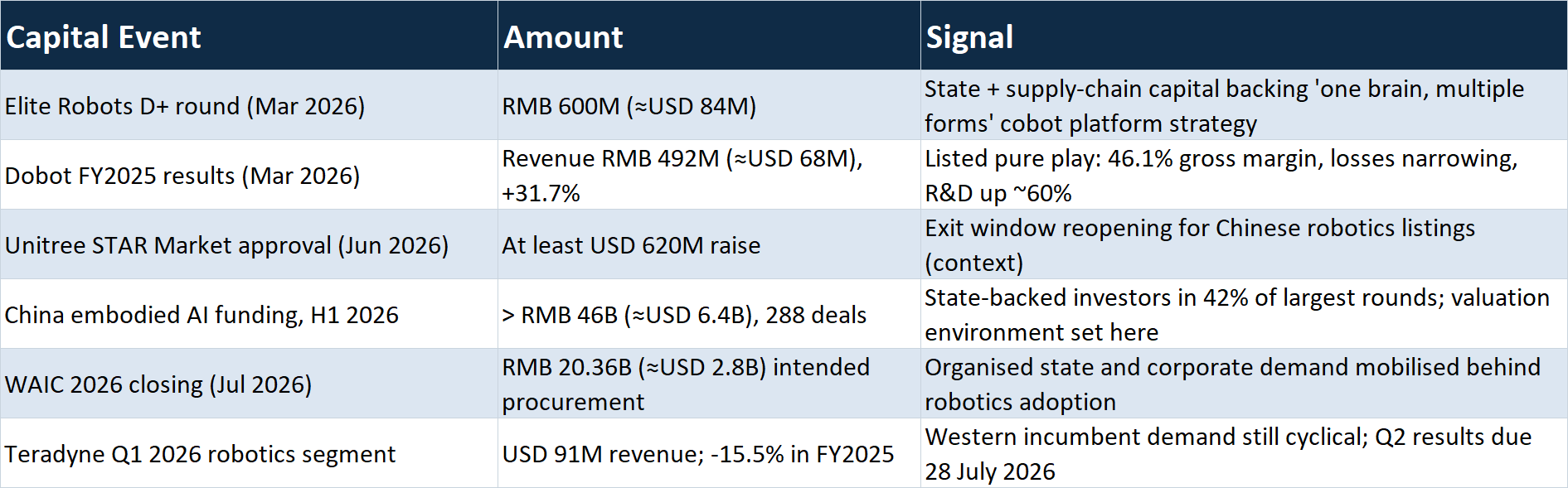
Three capital events in the first half of 2026 illustrate where conviction is forming. The first is Elite Robots' RMB 600 million, approximately USD 84 million, D+ round closed in March 2026, backed by Lavender Hill Capital Partners, Fortune Capital, Oriza Holdings, Harvest Capital, corporate venture funds along the AI data centre supply chain, and the Zhengzhou Embodied Intelligence Industrial Fund. The investor list is more informative than the amount: state-affiliated platforms from two Chinese cities and supply-chain corporates bought into a cobot maker pitching a "one brain, multiple forms" strategy that spans collaborative arms, composite mobile manipulators, and humanoid-adjacent machines.
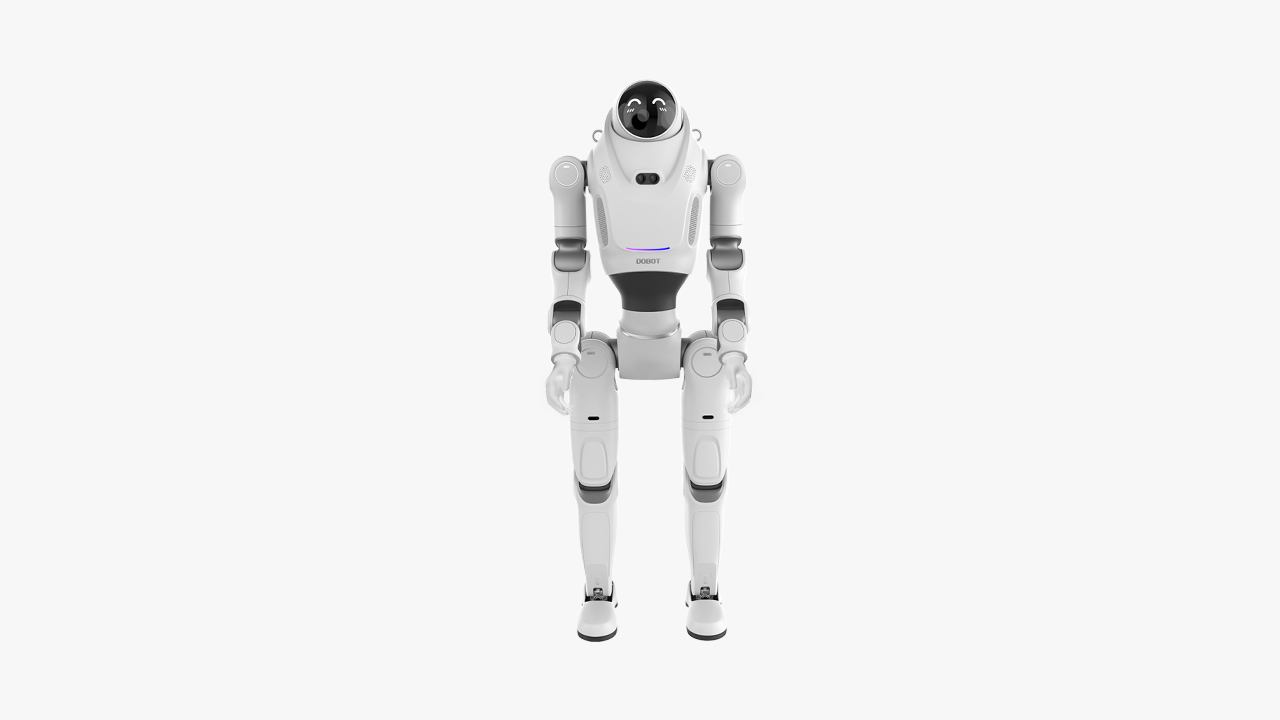
The second is the report card from the sector's listed pure play. Dobot's results for 2025, released through the Hong Kong exchange in March 2026, showed revenue of RMB 492 million, about USD 68 million, up 31.7 percent, a gross margin of 46.1 percent, cumulative shipments passing 100,000 units, and a net loss that narrowed 11.9 percent to RMB 85 million, roughly USD 12 million. A public cobot company growing above 30 percent with software-like gross margins while still loss-making is the single most useful valuation reference the sector offers.
The third event is the reopening of the exit window. The Shanghai STAR Market approved Unitree Robotics to raise at least USD 620 million in June 2026 according to Reuters Breakingviews, and data provider ITjuzi counted more than RMB 46 billion, roughly USD 6.4 billion, of disclosed embodied intelligence and robotics financing across 288 deals in China in the first half of 2026, with state-backed institutions participating in over 40 percent of the largest rounds. Cobot-specific deals are a modest share of that flood, but the flood sets valuations, and the World AI Conference in Shanghai closed this month with organisers reporting RMB 20.36 billion, about USD 2.8 billion, in intended robotics and AI procurement, a demand signal that state and corporate buyers are being mobilised behind the same thesis.
Key Risks
The risks are as structural as the drivers. Price compression is the most visible: the same falling average selling prices that widen the addressable market also erode revenue per unit, and although Interact Analysis observed China's cobot price decline slowing to 0.35 percent in 2025 after a 7.9 percent drop in 2024, a renewed price war would push profitability further out for every participant. Profitability itself remains unproven at scale, since the sector's benchmark listed pure play still loses money at a 46 percent gross margin, and Teradyne's robotics segment, which houses Universal Robots and MiR, saw revenue fall 15.5 percent in 2025 and posted USD 91 million in the first quarter of 2026 after two restructuring rounds, evidence that even the historical market leader is not immune to demand cyclicality.
Geopolitics compounds the concentration risk. The United States opened a Section 232 national security investigation into imports of robotics and industrial machinery in September 2025, and no determination had been published as of this article's cut-off, leaving open the possibility of tariffs on precisely the Chinese-made arms that dominate global volume. China's export controls on rare earth materials and magnets, essential to the servo motors inside every cobot joint, cut the other way and expose non-Chinese manufacturers to input bottlenecks. Finally, investors should price disclosure risk: much of the sector's claimed momentum rests on private-company announcements and mixed-scope segment reporting, and valuation multiples in the current Chinese listing environment, where STAR Market constituents trade near 93 times earnings on average according to Reuters, assume flawless execution.
What Smart Money is Watching
Sophisticated investors have largely stopped asking whether cobot shipments will grow and instead tracking a short list of quality signals. The first is average selling price stabilisation, because a durable floor under prices converts unit growth into revenue growth; the 2025 slowdown in price decline is the first supportive datapoint in years. The second is gross margin trajectory and the mix shift toward software, vision, and embodied intelligence revenue, where Dobot's 4.1 percent embodied revenue share, small but growing severalfold in a year, is the metric to watch on each successive filing. The third is the cross-over between cobot economics and buyer payback, which our total cost of ownership model quantified at roughly two to five times sticker price over five years; anything that compresses integration cost, the largest controllable line, accelerates adoption faster than any price cut.
The near-term calendar offers concrete markers: Teradyne reports second-quarter results on 28 July 2026, the next credible read on Western cobot demand; the Section 232 determination will define landed costs in the world's second-largest robot market; and the pipeline of Chinese robotics listings will test whether public investors accept private-round valuations. Our conviction scorecard below assembles these signals into a single view across the three disclosure classes available to investors.
The Conviction Scorecard
To move beyond anecdote, we scored the three investable exposure types on the five theses that recur in every cobot investment memo: volume scale, margin quality, revenue mix optionality, policy support, and exit visibility. Each thesis is scored from one to five strictly on disclosed, verifiable evidence, with five requiring audited or regulatory disclosure, three a named primary announcement, and one indicating reliance on unverifiable claims. A listed pure play such as Dobot scores highest on evidence quality because audited figures exist for every thesis, even where those figures reveal weakness such as continuing losses. A private champion such as Elite Robots scores well on policy support, where fund participation is documented, but low on margin quality, where nothing is disclosed. Incumbent segment exposure through Teradyne offers the cleanest exit visibility and the weakest near-term growth evidence. The method's limitation is deliberate: it rewards disclosure, not performance, and it cannot rank companies against each other on commercial success because, as this series has repeatedly noted, disclosure scopes differ too much for that comparison to be honest.
Table 1: Conviction Scorecard - Cobot Investment Exposure Types
Evidence-based scoring of the 5 recurring investment theses across the 3 disclosure classes as of July 2026
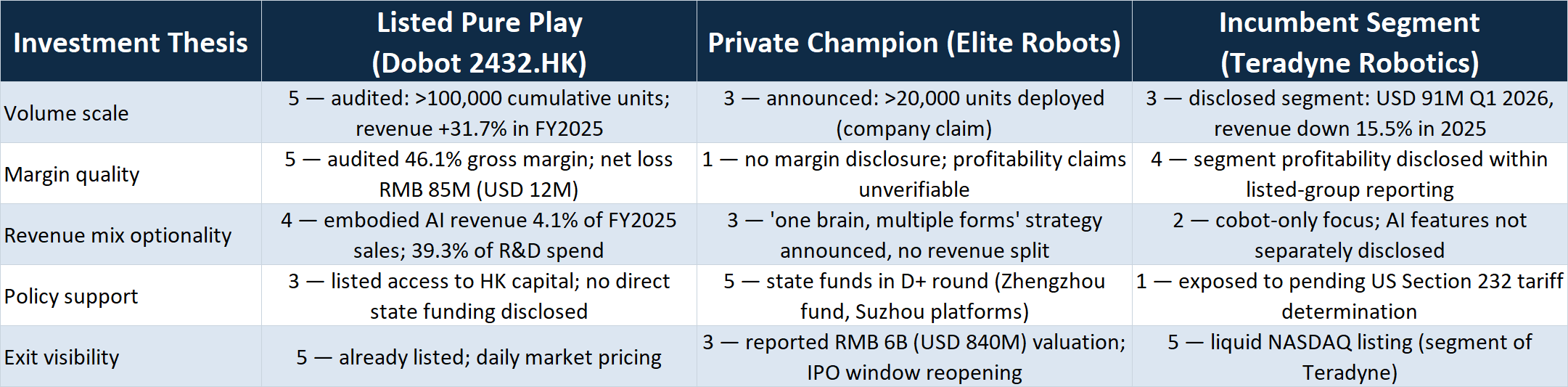
Scoring: 5 = audited/regulatory disclosure; 3 = named primary announcement; 1 = unverifiable claims. Rewards evidence quality, not performance.
Table 2: The 2026 Cobot Capital Map - Where the Money Moved
Verified capital events shaping collaborative robot sector conviction in the 1st half of 2026.
The collaborative robot sector enters the second half of 2026 with more committed capital than at any point in its history and a revenue base that has yet to validate it. That tension will resolve in one of two ways: either average selling prices hold while unit volumes double as forecast, converting today's valuations into tomorrow's earnings, or price competition resumes and the sector consolidates around the two or three manufacturers whose balance sheets outlast the squeeze. For the ARPI thesis, the direction is unambiguous even if individual winners are not. Every scenario, including the harshest, ends with more collaborative robots deployed at lower cost per task, which is why patient capital keeps arriving, and why procurement teams should treat today's crowded, subsidised, fiercely competitive supplier market as the most favourable buying window this asset class has yet offered.
Disclaimer: This article is for general information only and does not constitute investment advice or a recommendation to buy or sell any security. Figures are drawn from company filings, regulatory notices, and named industry sources; original currencies are stated with approximate US dollar equivalents at indicative exchange rates (RMB 7.15 per USD). Market forecasts are third-party estimates and are subject to revision. Information cut-off: 23 July 2026.