Top 5 Collaborative Robot Manufacturers in 2026: Who Dominates and Who Is Gaining
The 2026 collaborative robot market does not have one undisputed leader because manufacturers disclose their performance on different bases. Some report cobot revenue, while larger automation groups combine collaborative and conventional robots. A credible ranking must therefore consider ecosystem strength, product breadth, service reach, geographic momentum, commercial scale, and disclosure quality, rather than comparing headline revenue alone.
At a Glance
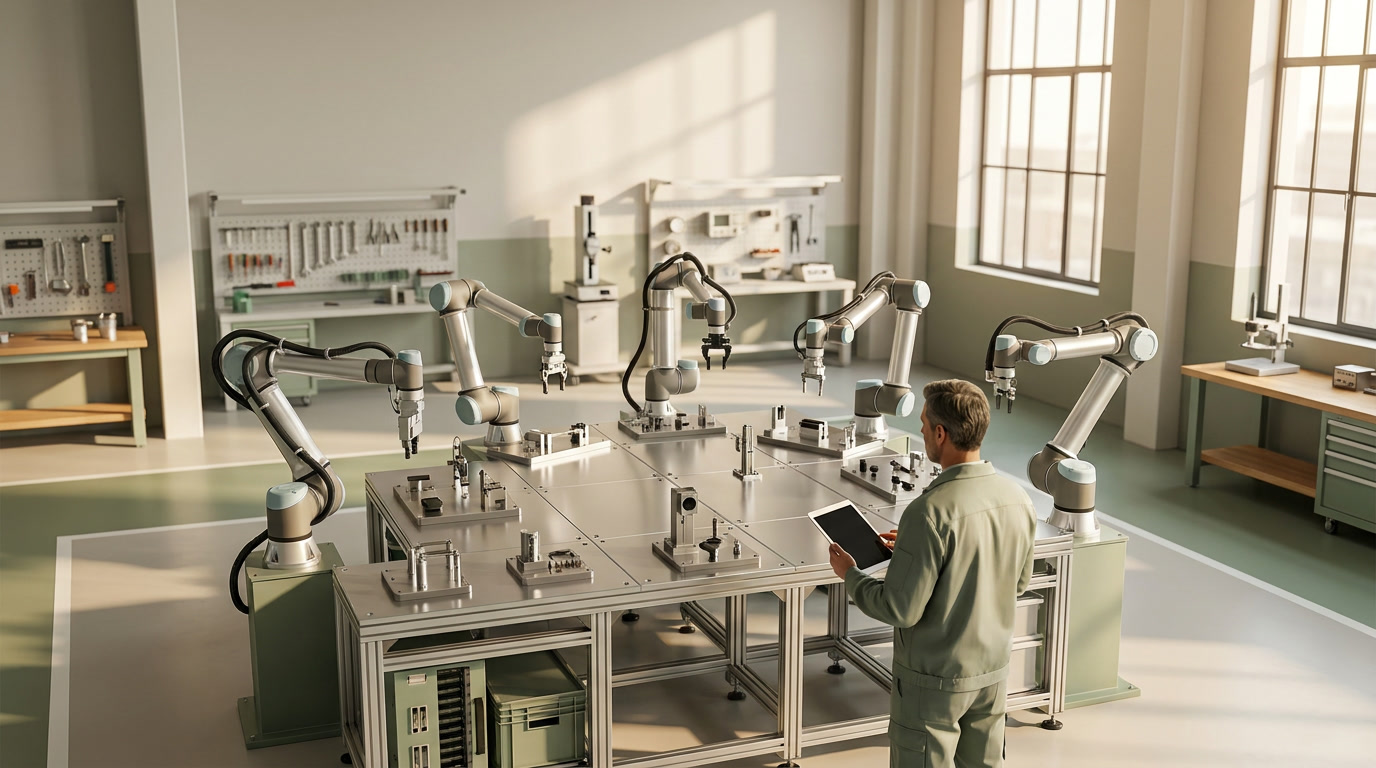
Collaborative robots are no longer a niche experiment. They represented 10.5 percent of the 541,302 industrial robots installed worldwide in 2023, according to the International Federation of Robotics.1 Yet identifying the market leader is harder than counting installations. Some manufacturers disclose cobot revenue, while diversified automation groups report all robot sales together. This ranking therefore compares strategic position, product influence, commercial scale, geographic reach, and the quality of public disclosure.
Selection Criteria
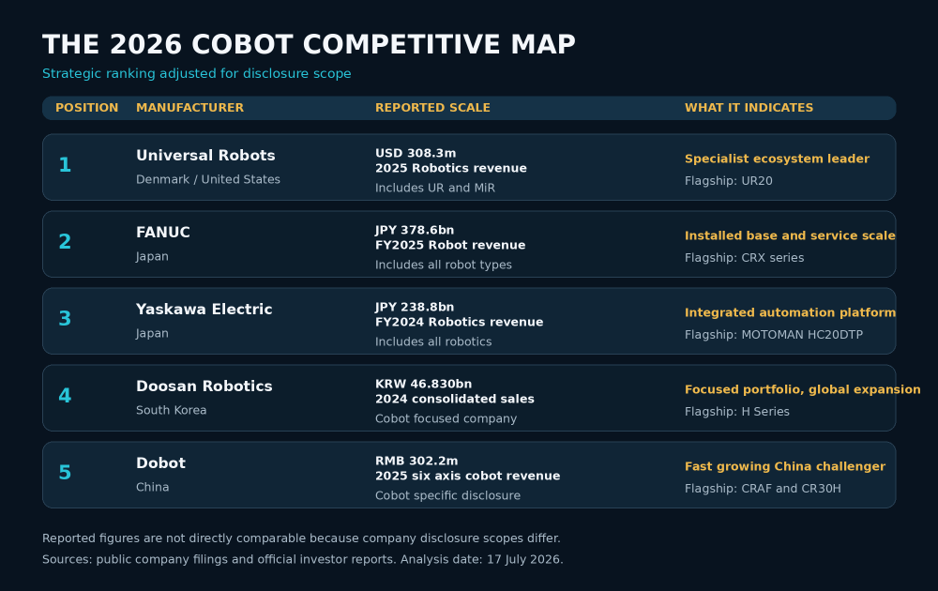
The five manufacturers were selected through a disclosure adjusted method. First, the company must have a meaningful collaborative robot portfolio and international commercial relevance. Second, it must disclose enough current information through an audited filing or official investor report to establish scale. Third, the assessment considers product breadth, service reach, channel strength, and influence on buyer expectations.
This approach produces a competitive map rather than a claimed global market share table. Teradyne combines Universal Robots with mobile robot maker MiR. FANUC and Yaskawa report conventional and collaborative robots in the same segment. Doosan is more cobot focused. Dobot provides the cleanest current six axis cobot revenue disclosure. Treating those figures as equivalent would create false precision.
Player Profiles

1. Universal Robots
Universal Robots remains the category reference point because it combines cobot specialization with a mature partner ecosystem. Parent company Teradyne reported Robotics revenue of USD308.3 million in 2025, down 15.5 percent from 2024. The figure includes both Universal Robots and MiR, so it is not a pure cobot number. The fourth quarter marked the third consecutive quarter of sequential Robotics revenue growth as Teradyne focused on original equipment manufacturers, systems integrators, and large enterprise accounts.2
The UR20 is the flagship reference for buyers seeking a proven general purpose platform. Universal Robots ranks first here because ecosystem influence can matter more than headline payload. Integrator familiarity, application packages, and deployment support reduce execution risk.
2. FANUC
FANUC brings a different form of dominance. Its advantage is the service infrastructure and automation installed base built around a much broader robot business. Summing the four quarterly disclosures in its latest results gives fiscal 2025 Robot division revenue of JPY378.6 billion. Fourth quarter Robot revenue reached JPY109.4 billion, 25.5 percent above the prior year period.3
The CRX series is FANUC's collaborative reference, including a 40 kilogram capable model and the portable CRX 3iA welding system highlighted in its latest investor presentation.3 FANUC is particularly strong where a buyer wants cobots to fit into an established factory automation standard rather than operate as a separate island.
3. Yaskawa Electric
Yaskawa combines robotics with motion control and systems engineering. Its 2025 annual report states that fiscal 2024 Robotics revenue was JPY238.8 billion and represented 44 percent of group revenue.4 That segment includes conventional industrial robots, so the number indicates organizational scale, not cobot sales alone.
The MOTOMAN HC20DTP is the flagship collaborative reference. Yaskawa's distinguishing strength is integration across robot arms, drives, controllers, and production engineering. It suits manufacturers that value a unified automation architecture and established process knowledge, especially in welding, handling, and machine tending.
4. Doosan Robotics
Doosan Robotics reported 2024 consolidated sales of KRW46.830 billion. Total revenue declined 11.7 percent, but North American revenue increased 41.8 percent and represented 39 percent of the total.5 This divergence matters because it shows commercial traction in a large overseas automation market despite a difficult company wide year.
The H Series led the product mix at 28 percent of revenue, ahead of the M Series at 23 percent.5 Doosan stands out for a broad payload portfolio and a focused cobot identity. Its fourth position reflects credible international expansion, balanced against a smaller disclosed revenue base than the diversified Japanese groups.
5. Dobot
Dobot is the Chinese entrant in the top five and the most transparent current cobot growth case. Its 2025 HKEX annual report shows group revenue of RMB492.2 million, up 31.7 percent. Six axis cobot revenue rose 44.7 percent to RMB302.2 million.6
The company introduced the CRAF intelligent force controlled cobot and the CR30H high speed heavy payload model.6 Dobot's distinction is not simply lower cost. It is building breadth across industrial, education, healthcare, and commercial applications while giving investors a cleaner view of cobot revenue than most rivals provide.
The Chinese Contender
Dobot's inclusion changes the ranking logic. Chinese manufacturers should not be treated as a single price tier. Dobot's disclosed growth suggests that the competitive question is moving from whether Chinese cobots can win orders to which suppliers can sustain channels, application support, and premium product development.
The buyer implication is clear. A global incumbent may still offer the lowest integration risk, but a Chinese supplier can now present credible product depth and faster disclosed growth. Procurement teams should therefore compare local service response, certified application packages, spare parts availability, and integrator competence alongside arm price.
Ones to Watch
ROKAE Robotics is the fastest rising disclosed challenger. Its final HKEX prospectus shows 2025 revenue of RMB521.7 million, up 60.4 percent. Collaborative robot revenue increased 46.0 percent to RMB138.2 million, while unit sales rose 75.4 percent to 3,633. ROKAE ranked fourth in China by collaborative robot sales volume with an 8.1 percent share, according to the prospectus.7 The same filing says it was the only top six provider producing more than 1,000 flexible collaborative robots annually.
ABB also remains strategically important because it pairs the GoFa collaborative range with a global automation portfolio. It sits outside this top five because comparable cobot specific revenue is not publicly isolated. That disclosure gap does not reduce its buyer relevance, but it prevents a clean evidence based placement above companies with clearer current figures.
What the Ranking Means for Buyers
The original analytical result is that there is no single form of dominance. Universal Robots leads in specialist ecosystem influence. FANUC leads in industrial service scale. Yaskawa leads through integrated automation architecture. Doosan offers focused portfolio breadth with overseas momentum. Dobot represents the strongest disclosure led China growth case.
A buyer should therefore start with the operating model, not the logo. Choose the ecosystem leader when application support is scarce, the diversified incumbent when the plant already runs its controls, and the challenger when local integration capability makes faster product evolution economically useful. In 2026, the winning cobot is less likely to be the arm with the best isolated specification than the platform with the lowest deployment risk for the intended task.
Disclaimer: This article is provided for informational purposes only and does not constitute investment, financial, legal, procurement, or other professional advice. Readers should verify specifications, pricing, availability, regulatory requirements, and commercial terms directly with the relevant company or authority before making decisions.