The Top 5 Global Players in the Industrial 6-Axis Arm Market
A competitive landscape analysis of the five most influential manufacturers in the global industrial 6-axis arm market, ranked by market share and strategic influence. Covers selection criteria, individual player profiles, the Chinese contender, and two companies gaining ground rapidly.
The global industrial robot market has been shaped for decades by a small group of manufacturers whose names appear on production lines from Stuttgart to Shanghai. Yet the competitive landscape in 2026 is more contested than at any point in the industry's history. Chinese manufacturers are scaling rapidly, software is becoming a primary differentiator, and the traditional dominance of Japanese and European brands is being tested from multiple directions. For procurement teams, system integrators, and investors, understanding who leads this market and why is foundational intelligence. This analysis profiles the five most influential players in the global industrial 6-axis arm segment, with a clear view of the challengers closing the gap.
Selection Criteria
The five companies profiled below were selected on the basis of three primary metrics: 2023 global revenue share as reported by Statista's Giants of Industrial Robotics dataset [1], unit shipment volume as tracked by the International Federation of Robotics [2], and strategic influence, defined as the degree to which a manufacturer's technology choices, pricing decisions, or ecosystem partnerships shape the direction of the broader market. Where revenue share and unit share diverge, both figures are noted, because the gap between them is itself analytically meaningful. Collaborative robots and humanoid robots are excluded from this analysis; the focus is strictly on industrial 6-axis articulated arms operating in traditional fenced or semi-fenced production environments.
Player Profiles
1. FANUC (Japan)
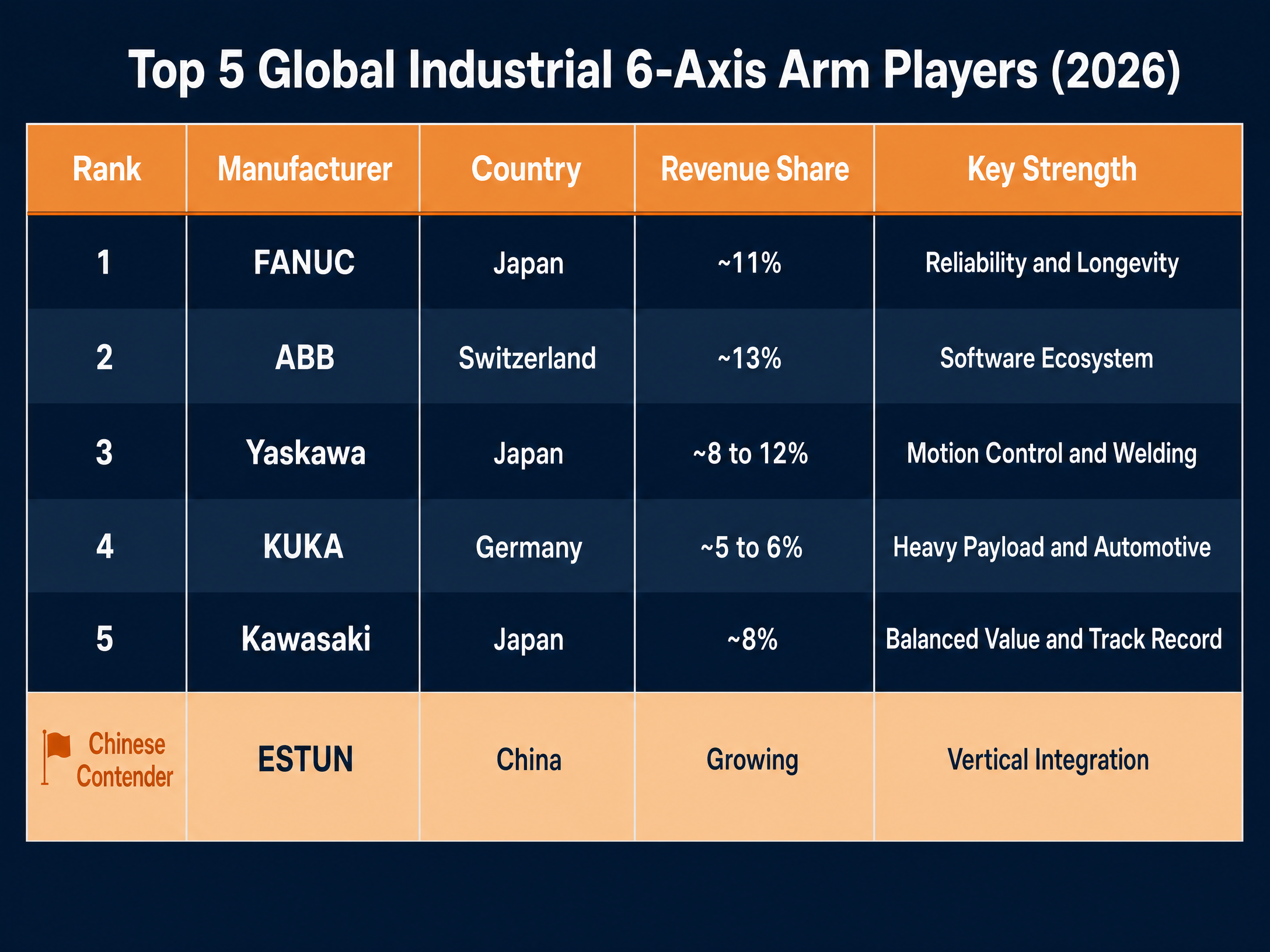
FANUC is, by most measures, the single most important company in industrial robotics. Spun out of Fujitsu's numerical control division in 1956, it has spent seven decades refining a very specific proposition: machines that are extraordinarily reliable, precise, and long lived. Its instantly recognisable yellow arms are deployed across more than 200 models, covering payloads from under one kilogram to over 2,300 kilograms. By units shipped, FANUC consistently ranks first globally, and its approximately 11 percent revenue share [1] understates its influence because many of its machines are sold at lower average selling prices than premium European competitors.
What distinguishes FANUC most sharply from its peers is its commitment to longevity. The company maintains spare parts and service support for robots manufactured decades ago, a policy that matters enormously to automotive and aerospace plants that amortise production lines over 15 to 20 years. Its ROBOGUIDE offline simulation software and the iRVision integrated vision system are deeply embedded in the workflows of thousands of integrators worldwide. For buyers who prioritise uptime certainty and long term support over cutting edge features, FANUC remains the default choice.
2. ABB (Switzerland)
ABB commands approximately 13 percent of global industrial robot revenue [1], making it the top ranked manufacturer by that metric. Its portfolio spans the widest payload range in the industry, from the compact IRB 120 at 3 kilograms to heavy duty models exceeding 800 kilograms, and its product lines serve automotive, electronics, food and beverage, and process industries with equal depth. ABB's genuine differentiator is its software ecosystem. RobotStudio, its offline programming and simulation platform, allows integrators to design, test, and commission an entire robot cell virtually before a single piece of hardware is installed on the factory floor. This capability compresses project timelines and reduces commissioning risk in ways that are difficult to quantify on a specification sheet but are immediately apparent to anyone who has managed a large automation project.
ABB has also invested heavily in AI-enabled motion control through its OmniCore controller platform, which uses machine learning to optimise path accuracy and energy consumption in real time. For buyers managing complex, multi-robot installations where synchronisation and throughput are critical, ABB's ecosystem maturity is a compelling argument that goes well beyond the hardware specification of any individual arm.
3. Yaskawa (Japan)
Yaskawa launched the Motoman robot in 1977, one of the first all-electric industrial arms, and its roots in servo motor and motion control engineering still define its competitive identity. The company holds approximately 8 to 12 percent of global market share depending on the metric used [1] [3], and its installed base is particularly deep in arc welding, spot welding, and semiconductor handling, applications where smooth, fast, and repeatable motion is the primary requirement.
Yaskawa's smart teach pendant interface has historically lowered the programming skill barrier for plant operators, which matters in manufacturing environments that cannot staff a dedicated robotics engineer. Its DX200 and YRC1000 controller families are well regarded for their multi-robot coordination capabilities, allowing a single controller to manage up to eight arms simultaneously. For buyers in automotive tier one and tier two supply chains, Yaskawa's combination of motion control heritage, welding application depth, and competitive pricing makes it a consistently strong shortlist candidate.
4. KUKA (Germany)
Founded in 1898 and now owned by China's Midea Group, KUKA occupies a distinctive position in the global market: German engineering heritage combined with Chinese manufacturing scale and capital. Its KR QUANTEC and KR AGILUS series are deeply embedded in European automotive body-in-white manufacturing, where heavy payload handling and structural welding demand the kind of mechanical robustness that KUKA has built its reputation on over more than a century of industrial engineering. The company holds approximately 5 to 6 percent of global revenue share [1] [3].
The Midea acquisition, completed in 2016, initially raised concerns among European customers about technology transfer and supply chain continuity. In practice, KUKA has maintained its German engineering standards and European service infrastructure while gaining access to Midea's manufacturing network and the Chinese domestic market. For buyers in Europe who need heavy payload capability with a well-established local service network, KUKA remains a credible and often preferred option. Its KUKA.Sim simulation software is competitive with ABB's RobotStudio and provides a familiar environment for integrators already working within the KUKA ecosystem.
5. Kawasaki (Japan)
Kawasaki Heavy Industries built Japan's first industrial robot in 1969, giving it one of the longest operational track records in the entire field. It holds approximately 8 percent of global market share [1] and is known for producing balanced, cost-effective machines across handling, welding, and assembly applications rather than leading in any single headline specification. This pragmatic positioning makes Kawasaki a strong choice for procurement teams that want proven, dependable performance without paying a premium for a marquee brand name.
Kawasaki's duAro dual-arm collaborative robot, designed to operate within the footprint of a single human workstation, has attracted attention as a practical bridge between traditional industrial automation and the more flexible collaborative paradigm. The company's deep roots in heavy industry, including aerospace, shipbuilding, and energy, also give it credibility in high-consequence manufacturing environments where reliability over decades is non-negotiable.
The Chinese Contender
No analysis of the global industrial 6-axis arm market in 2026 is complete without a serious treatment of ESTUN Robotics. Founded in Nanjing in 1993 and listed on the Shenzhen Stock Exchange, ESTUN is China's second largest industrial robot manufacturer by domestic market share, holding approximately 9.5 percent of the Chinese market in 2024 [4]. Globally, its revenue share remains well below the top five, but the trajectory is what matters.
ESTUN's competitive advantage is vertical integration. The company manufactures its own servo motors, controllers, and motion control systems, which reduces its dependency on imported components and gives it a cost structure that Western competitors cannot easily replicate. Its 2019 acquisition of German welding automation specialist Cloos gave it access to advanced welding technology and a European distribution network, a strategic move that signals ambition well beyond the domestic market.
In 2026, ESTUN has defined its strategic focus around AI integration, embodied intelligence, and global market expansion [5]. Chinese robot exports grew 28 percent year over year in 2025, and ESTUN is among the brands leading that push. For international buyers who are open to Chinese suppliers and willing to evaluate total cost of ownership rather than brand familiarity, ESTUN represents the most credible domestic alternative to the established global leaders.
Ones to Watch
Two companies outside the current top five are gaining ground in ways that procurement teams and investors should monitor closely.
Universal Robots (Denmark) commands over 15 percent of the collaborative robot market globally [3] and is increasingly relevant to buyers who are reconsidering whether a traditional industrial 6-axis arm is the right tool for their application. As the boundary between cobots and light industrial arms continues to blur, Universal Robots' ecosystem of over 300 certified hardware and software partners gives it a platform reach that rivals the established industrial giants in specific application categories.
EFORT Intelligent Equipment (China) is the most export-oriented of the major Chinese industrial robot manufacturers, with 44 percent of its 2024 revenue derived from international sales [4]. Its acquisition of Italian controller specialist Robox has strengthened its software capabilities, and its payload range from 6 kilograms to 500 kilograms covers the full spectrum of general manufacturing applications. EFORT is the Chinese manufacturer most likely to appear on a competitive shortlist alongside FANUC or ABB in a European or Southeast Asian procurement process within the next three years.
The competitive map of the industrial 6-axis arm market is being redrawn. The established leaders retain formidable advantages in software ecosystems, global service networks, and decades of application-specific engineering knowledge. But the cost and capability gap that once made Chinese alternatives a secondary consideration is narrowing faster than many buyers appreciate. The procurement decisions made today will reflect not just where the market stands in 2026, but where it is heading by 2030.
References
[1] EVS Robotics. (2026). "Top 10 Industrial Robot Manufacturers by Market Share 2026". https://www.evsint.com/top-industrial-robot-manufacturers/
[2] International Federation of Robotics. (2026). "Top 5 Global Robotics Trends 2026". https://ifr.org/ifr-press-releases/news/top-5-global-robotics-trends-2026
[3] Progressive Robotics. (2025). "Beyond the Big 4: The Complete 2025 Robot Manufacturer Guide for Smart Integrators". https://progressiverobotics.ai/beyond-the-big-4-abb-fanuc-kuka-yaskawa-the-complete-2025-robot-manufacturer-guide-for-smart-integrators/
[4] EVS Robotics. (2026). "Top 10 Industrial Robot Manufacturers in China (2026): Complete Buyer's Guide". https://www.evsint.com/top-10-industrial-robot-manufacturers-china-2026/
[5] ESTUN Robotics. (2026). "Unite for Leap, Jointly Scale New Heights: 2026 ESTUN China Strategy". https://en.estun.com/?list_53/2300.html