The Hidden Costs of Industrial 6-Axis Arms: What the Sticker Price Misses
A comprehensive guide to the Total Cost of Ownership (TCO) for industrial 6-axis robot arms. Discover why the purchase price is only a fraction of the real investment, covering integration, training, maintenance, and downtime costs.
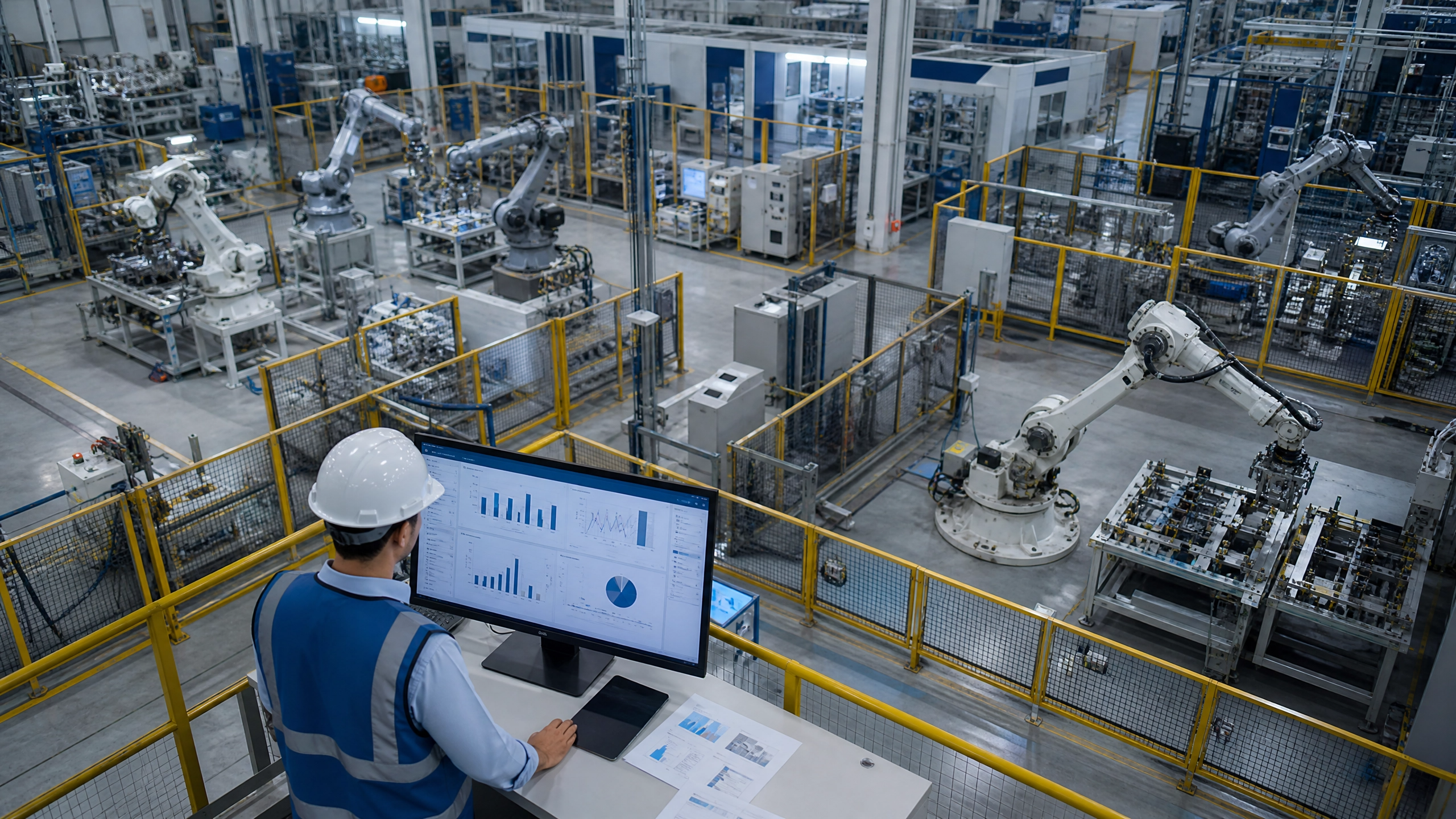
When procurement teams evaluate industrial 6-axis robot arms, the hardware quote tends to anchor the entire budget conversation. A standard 6-axis manipulator lists anywhere from $25,000 to $150,000 depending on payload, reach, and brand tier [1]. It is tempting to treat that figure as the cost of automation. In practice, the bare arm represents only 30 to 50 percent of the capital required to deploy a functioning production cell [1] [2]. The remaining investment, spread across integration, training, maintenance, downtime risk, and eventual decommissioning, is what separates a well-planned automation project from one that quietly underperforms its business case.
Total Cost of Ownership captures every financial outlay across the full lifecycle of the robotic system. For operations leaders and procurement managers, building this complete picture is not optional. It is the foundation of a credible return on investment calculation.
Integration and Installation: Where Budgets Are Most Frequently Tested
Transforming a bare robot arm into a productive manufacturing cell requires substantial engineering effort. The cell must be mechanically laid out, electrically wired, safety-certified, and programmed to handle specific parts within precise cycle times. End of arm tooling, which can range from $5,000 to $50,000 depending on complexity, must be designed and fabricated [3]. Safety systems including light curtains, safety-rated programmable logic controllers, and physical fencing are mandatory in virtually every jurisdiction [3].
Integration and programming alone typically account for 20 to 40 percent of the total project cost [2]. Process equipment such as welding power sources or vision guidance systems can add a further 5 to 20 percent [2]. A $40,000 robot arm routinely becomes a $100,000 to $150,000 investment once it is fully integrated and commissioned. In high-complexity applications such as precision assembly or multi-robot welding cells, total deployment costs can reach two to three times the arm price [4].
Training and Onboarding
A sophisticated robotic cell requires a skilled workforce to operate and maintain it. Professional robotics training programs average around $1,500 per day [5]. For a standard three to five day maintenance course, the direct cost per technician can exceed $4,500 before travel expenses. Manufacturers must budget for both initial commissioning support and ongoing advanced training to reduce long-term dependence on expensive external integrators. The indirect cost of lost productivity while staff attend training is a further charge that rarely appears in the initial project budget.
Maintenance, Spare Parts, and Downtime
Industrial 6-axis arms are highly reliable machines, with mean times between failures ranging from 40,000 to 100,000 hours depending on the manufacturer and duty cycle [6] [7]. However, they are not maintenance free. Annual maintenance costs typically range between 5 and 12 percent of the original purchase price, representing 20 percent of total lifetime TCO across a robot's service life [8]. For a $100,000 robotic cell, this translates to $5,000 to $12,000 every year in planned upkeep.
Unplanned failures are harder to budget but inevitable. A servo drive failure can cost between $2,000 and $8,000 per axis for parts alone, while reducer replacements on high-duty joints can reach $15,000 [3]. The most severe financial consequence of a failure is not the repair bill but the production stoppage. In large manufacturing environments, unplanned downtime can cost upwards of $260,000 per hour [8]. Even in mid-sized facilities, the lost throughput, idle downstream operators, and potential delivery penalties from a single day of stoppage can easily exceed the annual maintenance budget for the entire cell.
End of Life and Upgrade Costs
Most procurement models focus heavily on acquisition and operational phases, leaving decommissioning costs unaddressed. Industrial robots typically carry a useful life of 10 to 15 years [7]. Controllers and software platforms face obsolescence after approximately 10 years, at which point securing replacement parts becomes increasingly difficult [7]. Mid-life retrofits, such as upgrading a controller while retaining the mechanical arm, can extend the system's life but require significant engineering adaptation and path-file reconversion. Physical removal, disposal, and the transition downtime between old system decommissioning and new system qualification represent a final tranche of cost that belongs in any honest TCO model.
What the Sticker Price Misses: A Country-by-Country Perspective
This is where the standard TCO discussion ends and where most published analyses fall short. The hidden costs of industrial 6-axis arm deployment are not uniform globally. They vary substantially by country, driven by local labour rates for integration and maintenance, import duty regimes, integrator market density, and government subsidy availability. The table below synthesises these variables across the six most significant markets for industrial robot adoption.
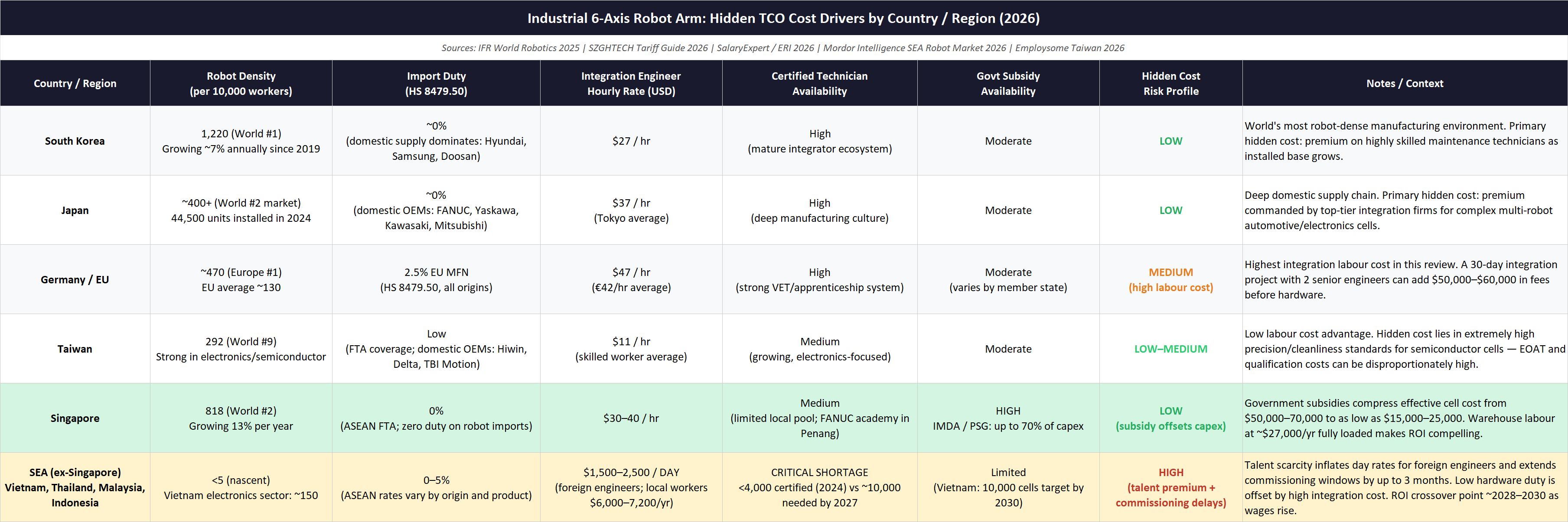
Note: Integration engineer rates reflect local market averages for automation/robotics engineers. SEA foreign engineer day rates apply where local certified technicians are unavailable. Import duty rates are MFN base rates for HS 8479.50 (industrial robot arms) as of 2026; actual landed cost depends on origin country and applicable trade agreements.
South Korea operates the world's most robot-dense manufacturing environment at 1,220 robots per 10,000 employees, growing at approximately 7 percent annually [9]. Domestic manufacturers including Hyundai Robotics, Samsung Techwin, and Doosan Robotics supply a mature local integrator ecosystem, which keeps integration engineering costs competitive. Robotics engineers earn approximately $27 per hour on average [10], and import duties on robot arms are effectively zero for domestically produced systems. The result is one of the lowest total integration cost environments globally, with the primary hidden cost being the premium on highly skilled maintenance technicians as the installed base continues to grow.
Japan is the world's second-largest robot market by installation volume, with 44,500 units installed in 2024 [9]. Domestic giants FANUC, Yaskawa, Mitsubishi, and Kawasaki dominate the supply chain, meaning import duties are largely irrelevant. Automation engineers in Tokyo earn approximately $37 per hour [11], and the country's deep manufacturing culture means in-house maintenance capability is generally strong. The primary hidden cost in Japan is the premium commanded by the most experienced integration firms, particularly for complex multi-robot cells in automotive and electronics applications.
Germany leads Europe in robot density at approximately 470 robots per 10,000 employees [9]. Automation engineers earn an average of €42 per hour ($47 USD) [12], making it the highest-cost integration and maintenance labour market among the countries reviewed here. Import duties on robot arms from non-EU origins are modest at 2.5 percent under the EU MFN rate [13], meaning hardware costs are broadly competitive. The significant hidden cost in Germany is labour: a 30-day integration project involving two senior automation engineers can add $50,000 to $60,000 in engineering fees alone, before any hardware or safety system costs are counted.
Taiwan ranks 9th globally in robot density at 292 robots per 10,000 employees [9], with a strong domestic precision machinery ecosystem anchored by companies such as Hiwin, TBI Motion, and Delta Electronics. Skilled manufacturing worker wages average approximately $11 per hour [14], making integration and maintenance labour substantially cheaper than in Germany or Japan. Taiwan's hidden cost lies in a different dimension: the island's electronics and semiconductor manufacturing base demands extremely high precision and cleanliness standards, meaning end of arm tooling and cell qualification costs for semiconductor applications can be disproportionately high relative to the arm price itself.
Southeast Asia presents the most complex and rapidly evolving TCO picture. Robot density across the region's labour-intensive manufacturing clusters sits below 5 units per 10,000 workers [15], reflecting the current economics where a Vietnamese manufacturing worker earns $6,000 to $7,200 per year and the ROI case for automation at current robot prices remains marginal for general assembly [15]. However, the hidden cost structure here is uniquely driven by talent scarcity. Thailand, Malaysia, and Vietnam together graduated fewer than 4,000 certified robot technicians in 2024 against an estimated demand of nearly 10,000 by 2027 [16]. This shortage inflates day rates for foreign robot engineers to $1,500 to $2,500 per day [16] and extends commissioning windows by up to three months, eroding a significant portion of the productivity gains that automation is intended to deliver. Singapore stands apart within the region: robot density of 818 per 10,000 employees [9], government subsidies covering up to 70 percent of qualified automation capital expenditure [16], and a warehouse labour cost of over $27,000 per year fully loaded make it the most economically compelling automation market in Southeast Asia today.
The European Union beyond Germany broadly mirrors the 2.5 percent import duty environment and benefits from a relatively mature integrator ecosystem in countries such as the Netherlands, Sweden, and the Czech Republic. Labour costs vary considerably across member states, from approximately $45 per hour for automation engineers in Scandinavia to $15 to $20 per hour in Central and Eastern Europe. For manufacturers deploying robot cells across multiple EU facilities, this labour cost differential within a single regulatory zone creates a genuine optimisation opportunity that is rarely captured in standard TCO models.
Building a Realistic TCO Model
The invoice price of an industrial 6-axis arm is the entry fee into robotic automation, not the total cost. A realistic five-year TCO model for a $100,000 initial cell will typically reach $140,000 to $160,000 in mature markets such as Germany, Japan, and South Korea, and can climb significantly higher in talent-scarce environments such as Southeast Asia where commissioning delays and premium foreign engineer rates compound the base costs [2] [3] [8].
Understanding these hidden costs by geography is the foundation for the broader investment case. The true value of industrial robotics lies not in the cheapest hardware but in a well-integrated, reliably maintained system that consistently drives productivity within the specific cost environment where it operates.
Sources:
[1] EVS International, "How Much Does an Industrial Robot Cost? Pricing Guide 2026," May 2026.
[2] AMD Machines, "Robot Total Cost of Ownership: Beyond the Purchase Price," June 2025.
[3] Mecademic, "Total Cost of Ownership (TCO) for Robots."
[4] PatSnap Eureka, "Industrial Robot Deployment: Cost vs. Efficiency Analysis," April 2026.
[5] EVS Robot, "Industrial Robot Price 2026: Cost Breakdown, ROI and Quote Guide," May 2026.
[6] Motion Controls Robotics, "Robot Life Cycle FAQs."
[7] Southwest Research Institute, "Extending the Industrial Robot Life Cycle," April 2021.
[8] PatentPC, "Robotics Maintenance Costs: Operating Efficiency Data," June 2026.
[10] ERI, "Automation Engineer Salary in South Korea (2026)."
[11] SalaryExpert, "Automation Engineer Salary in Tokyo, Japan (2026)."
[12] SalaryExpert, "Automation Engineer Salary in Germany (2026)."
[13] SZGHTECH, "China Robot Import Tariffs and HS Codes 2026," May 2026.
[14] Employsome, "Average Salary in Taiwan 2026: By Sector, City and Cost Guide," April 2026.
Note: Currency is based on USD.