The Global Battle for Collaborative Robot Market Share: China vs the West
An analytical review of China's rise in collaborative robotics, exploring how domestic supply chains, policy drivers, and scale are reshaping global procurement options and the competitive balance between Chinese, European, and Japanese manufacturers.

The transition of collaborative robots from niche laboratory novelties to scalable industrial assets has fundamentally altered the geographic balance of robotics manufacturing. Procurement leaders evaluating cobot deployments are no longer simply choosing between established European and Japanese incumbents. They must now navigate a bifurcated market where Chinese manufacturers offer compelling scale and cost advantages, while traditional leaders defend their positions through advanced software ecosystems and proven reliability. Understanding this geopolitical and competitive manufacturing landscape is essential for operations teams seeking to balance capital expenditure against long term integration risk.
China's Market Share
While pure cobot market share data remains closely guarded by private manufacturers, the broader industrial robotics ecosystem provides a clear proxy for manufacturing scale. The International Federation of Robotics (IFR) reports that 542,076 industrial robots were installed globally in 2024 [1]. China accounted for 295,045 of these installations, representing 54 percent of global demand [1]. Within this massive domestic market, Chinese manufacturers have achieved a structural inversion. Local suppliers captured 57 percent of all industrial robot installations in China across industries in 2024, up from 47 percent in 2023 [2].
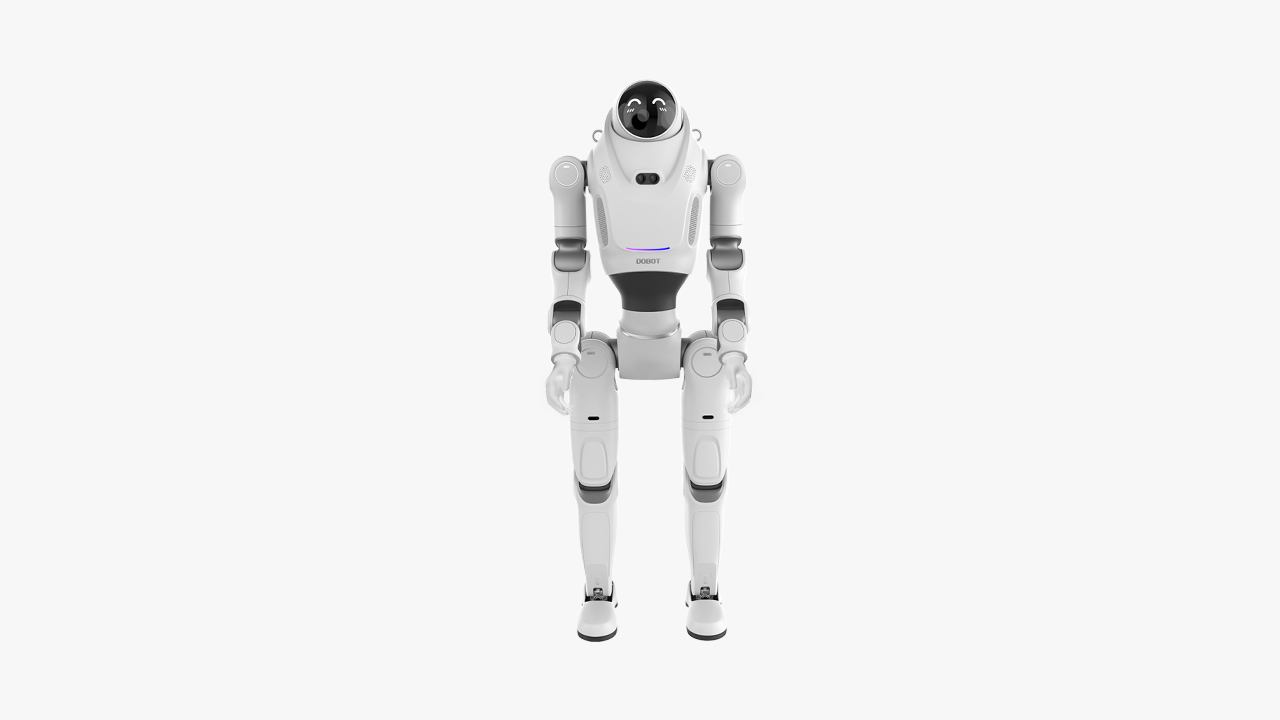
This domestic scale directly subsidises export competitiveness. In the cobot segment, which the IFR noted represented 10.5 percent of global industrial robot installations in 2023 [3], the financial footprint of leading players illustrates the market's scale. Teradyne, the parent company of Universal Robots and Mobile Industrial Robots, reported 2025 Robotics segment revenue of USD 308.3 million [4]. Conversely, Shenzhen Dobot Corporation, a leading Chinese manufacturer whose revenue is driven heavily by six axis cobots, reported 2025 revenue of RMB 492.2 million [5].
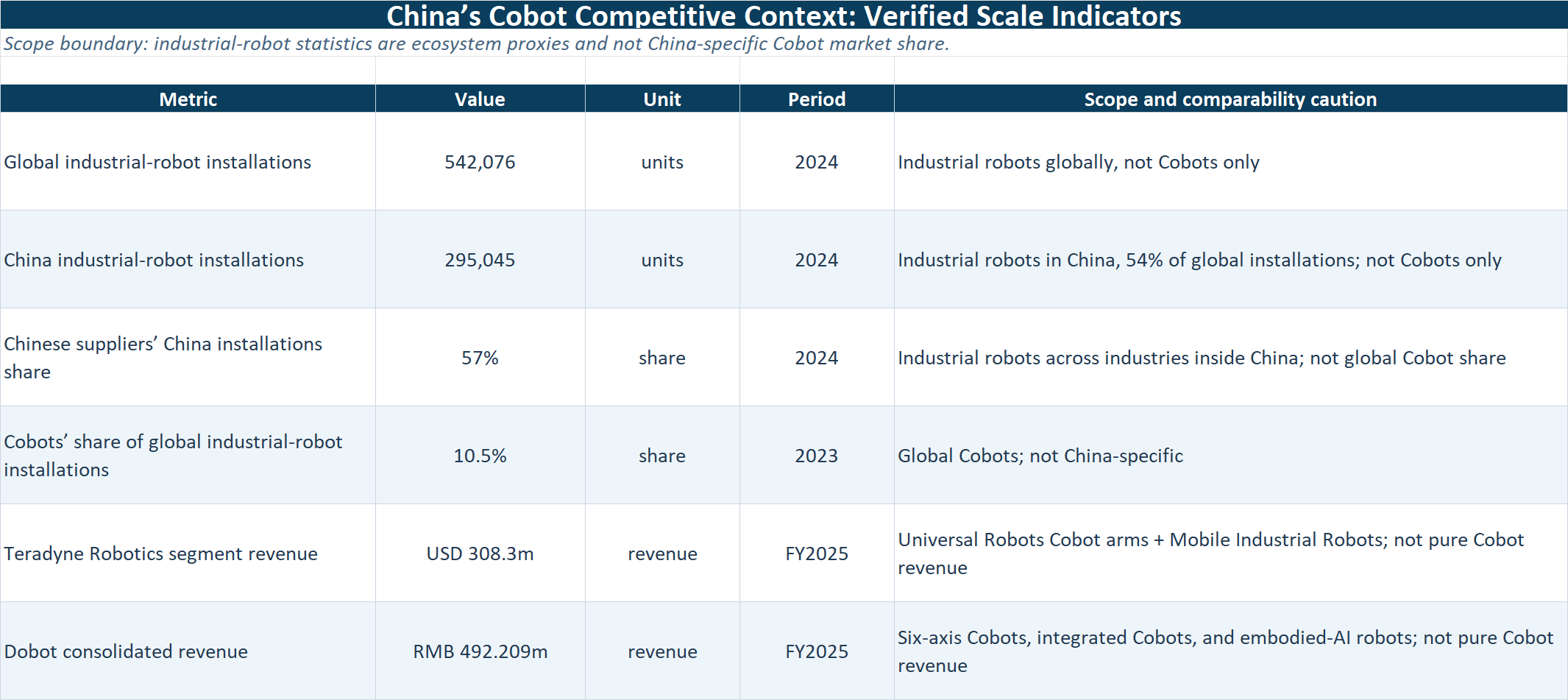
Sources: IFR World Robotics 2025; IFR China release; IFR collaborative-robots release; SEC Teradyne Form 10-K; HKEX Dobot annual results.
How China Got Here
The rapid maturation of China's robotics sector is not solely the result of organic market forces. It is the product of coordinated, sustained industrial policy designed to secure supply chain independence. The 14th Five-Year Plan for the Robotics Industry Development, issued jointly by the Ministry of Industry and Information Technology and fourteen other government departments in late 2021, established a national architecture for technological breakthrough and supply chain consolidation [6].
This policy framework triggered the development of dense industrial clusters in Shenzhen, Shanghai, and the Yangtze River Delta. These clusters allow Chinese cobot manufacturers to source critical components, such as harmonic drives, frameless motors, and absolute encoders, from proximate domestic suppliers at significantly reduced costs. The resulting scale economies allow Chinese firms to price their cobots aggressively, accelerating adoption in cost sensitive sectors like commercial retail, education, and light manufacturing, which in turn generates the field data necessary to iterate hardware designs rapidly.
Where Western and Japanese Players Still Lead
Despite China's aggressive capacity expansion, Western and Japanese manufacturers retain formidable advantages that dictate their continued dominance in high value applications. European pioneers like Universal Robots have cultivated extensive, open developer ecosystems. These platforms allow third party integrators to build certified end effectors, vision systems, and software plugins that reduce deployment friction. For many buyers, the value of a cobot lies not in the arm itself, but in the ease with which it can be integrated into an existing production line.
Japanese manufacturers, drawing on decades of leadership in traditional industrial robotics, excel in precision engineering and reliability. Their cobots often feature superior repeatability, thermal management, and mean time between failures. Furthermore, Western and Japanese firms possess mature global support networks, ensuring rapid parts availability and on site engineering assistance across the Americas and Europe. This service infrastructure remains a significant barrier to entry for emerging Chinese brands attempting to secure enterprise contracts outside their domestic market.
The Technology Gap
The technology gap between Chinese manufacturers and traditional leaders has narrowed from a chasm to a seam, but critical distinctions remain. Chinese hardware has largely achieved parity in basic kinematic performance, payload capacity, and reach. However, the software layer remains a differentiator. Western cobots generally offer superior path planning algorithms, more intuitive user interfaces, and advanced safety controller integration.
Original Analysis: Manufacturer Disclosure and Revenue Quality
When evaluating the competitive landscape, buyers must apply a rigorous analytical layer to manufacturer claims. A direct comparison of revenue figures often obscures underlying market realities due to differing disclosure scopes.
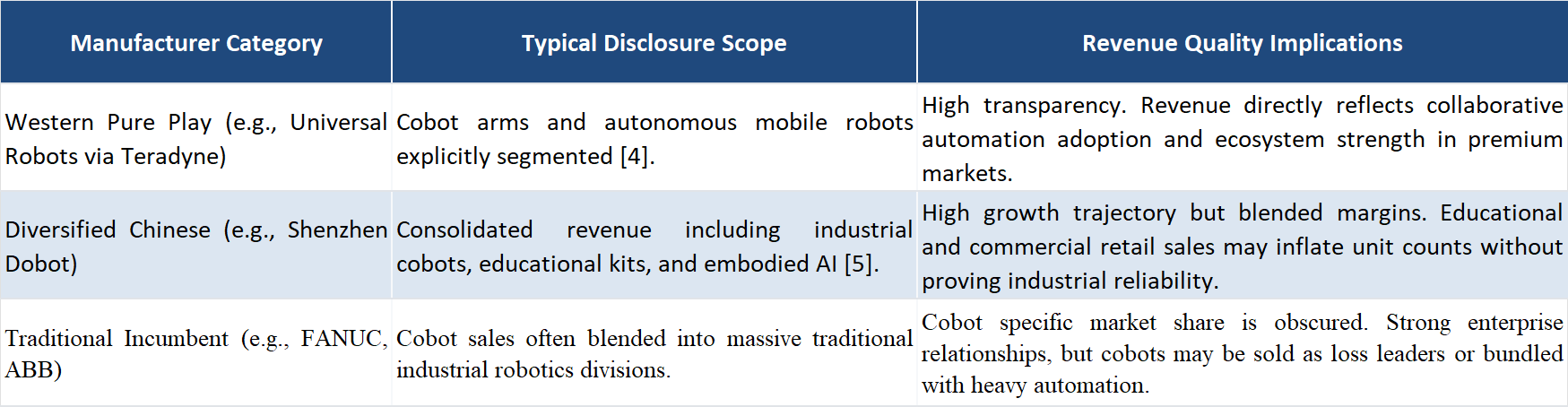
Note: This matrix illustrates the limitation of comparing consolidated corporate revenues to gauge pure cobot market leadership. Buyers must evaluate the specific industrial installed base rather than aggregate corporate scale.
What This Means for Buyers
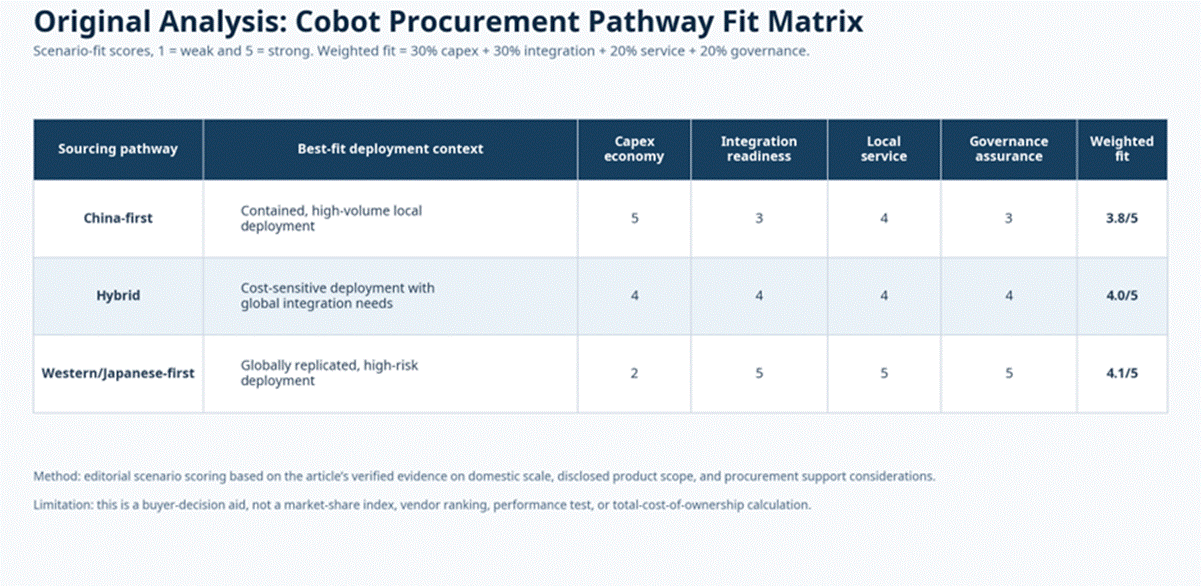
For global procurement teams, the bifurcation of the cobot market requires a segmented sourcing strategy. Chinese manufacturers offer an undeniable cost advantage, making them highly attractive for simple, repetitive tasks, educational deployments, or facilities where capital constraints are severe. However, buyers must account for potential hidden costs in integration, software development, and localized support.
Conversely, Western and Japanese cobots remain the prudent choice for complex deployments requiring advanced vision integration, stringent safety certifications, or deployment across multiple international facilities. The premium paid for these systems is often offset by reduced engineering time, higher uptime, and the security of a mature global service network. Procurement leaders must move beyond simple unit cost comparisons and model the total cost of deployment, balancing the aggressive hardware pricing of the East against the software and ecosystem maturity of the West.
References
[1] IFR Statistical Department, VDMA Services GmbH. (2025). World Robotics 2025: IndustrialRobots.