Procuring an AMR and AGV: Key Specs and Supplier Questions
There is a specification error sitting in live tender documents that no commercial review will catch, because it looks like diligence: a requirement to conform to ISO 3691-4:2020, an edition the international standards body records as withdrawn. Post 8 of our AMR and AGV series introduces the ARPI Specification Verifiability Test, which scores each specification line on four binary attributes before it is allowed into a comparison matrix, and finds that navigation accuracy, interoperability support and certification claims are routinely non-comparable as published. It pairs that with the Obligation Allocation Matrix, which maps every compliance obligation to the party that carries it and identifies the most consequential procurement development of 2026: the completion of the three-part American national standard series, whose Part 3 places a conformity obligation on the operating company. The article also documents why the primary vehicle safety standard excludes power sources entirely, and why trade measures now make landed cost contingent rather than fixed.

There is a specification error sitting in live tender documents right now that will not be caught by any commercial review, because it looks like diligence. A buyer writes that the vehicle shall conform to ISO 3691-4:2020, the international safety standard for driverless industrial trucks. A vendor confirms that it does. Both parties are satisfied. The problem is that the 2020 edition was withdrawn, and the international standards body records it as such. The current edition is ISO 3691-4:2023. A conformity claim against a withdrawn edition is not a conformity claim, and the tender has just made it contractually acceptable to deliver against a superseded standard.
That error is small, specific, and easy to fix in an afternoon. It is worth opening with because of what it reveals about how autonomous mobile robots, or AMRs, and automated guided vehicles, or AGVs, are actually bought. The comparison table gets built with real care. The specification lines inside it are rarely interrogated at all. Buyers scrutinise which number is larger and almost never ask whether the two numbers measure the same quantity, whether the conditions under which each was obtained are stated, or whether the figure could be reproduced at acceptance if the vehicle underperformed. This article is about closing that gap, because in this asset class the difference between a good purchase and an expensive one is rarely the vehicle. It is the specification.
Key Specifications to Evaluate
Begin with a correction that matters more than it appears to. Generic procurement guidance for robotics was written for stationary industrial arms, and it recommends comparing reach and repeatability. Neither is a meaningful specification for a mobile robot. Reach describes the working envelope of a manipulator and has no analogue in a vehicle that moves itself to the work. Repeatability, in the arm sense, describes how closely a tool centre point returns to a taught position, which is a question about a kinematic chain bolted to a floor. Carrying those lines into a mobile robot tender produces a comparison matrix populated with quantities that either do not exist or do not mean what the buyer thinks.
The specification lines that decide outcomes in this asset class are payload under stated conditions, navigation positioning accuracy separated from docking repeatability, runtime expressed against a duty cycle, gradeability with load, ingress protection across the whole assembly including charging contacts and sensor apertures, safety function performance levels, and the fleet interoperability version. Each of those is comparable only if the vendor states what was measured and under what conditions, which is precisely what datasheets in this market usually omit.
The scale of the omission is easy to underestimate. Positioning figures published for mobile robots and their components differ by three orders of magnitude, not because the products differ by that much, but because the figures describe different things. A two-dimensional time-of-flight navigation sensor is specified at plus or minus twenty millimetres of repeatability across a two hundred and eighty degree field of view. An industrial arm is specified at plus or minus three hundredths of a millimetre of positional repeatability. A mobile manipulator marketing sheet quotes both a hundredth-of-a-millimetre repeatability figure and a plus or minus ten millimetre positioning figure for the same machine, which is internally consistent only because the two numbers refer to different points in the kinematic chain under different reference frames. A buyer who tabulates any two of those against each other has constructed a comparison that carries no information.
The instrument that prevents this is a test applied to each specification line before it is allowed into the comparison matrix. ARPI calls it the Specification Verifiability Test, and it asks four binary questions of every figure a vendor supplies.
The first is whether the line is defined. Does the vendor state which quantity is measured and under what method or standard? A bare millimetre figure without a stated reference frame fails immediately. The second is whether it is conditioned. Are the load, speed, floor surface, temperature and charge-state conditions stated alongside the number? An unconditioned figure holds only in the best case the vendor happened to test, and the buyer has no way of knowing what that case was. The third is whether it is contestable. Could the buyer reproduce the measurement, or require it be reproduced, at acceptance? A figure that cannot be reproduced cannot be enforced, whatever the contract says. The fourth is whether it is bounded. Is the number a guaranteed minimum or a typical value, and is the tolerance stated? Without that, there is no threshold at which underperformance becomes breach.
A line satisfying all four is contractable and can go directly into acceptance criteria. A line satisfying three is conditionable, meaning it becomes contractable once the missing attribute is obtained in writing, which is usually a short email rather than a negotiation. A line satisfying two is indicative only, useful for shortlisting and inadmissible in acceptance criteria. A line satisfying one or none is non-comparable and should be struck from the matrix entirely, because leaving it in manufactures confidence that the underlying evidence does not support.
Applied to real datasheets, the results are uncomfortable and useful. Payload as a single kilogram figure is conditionable, and becomes contractable once stated at a given gradient, speed and load centre of gravity offset. Runtime in hours is merely indicative, because the figure a buyer actually needs is throughput per shift including opportunity-charge dwell time. Maximum speed is indicative, because the speed that governs throughput is the one sustained under the safety-rated monitored-speed condition that applies at the buyer's site rather than the unrestricted maximum. An ingress protection rating is usually contractable as stated, which makes it one of the few lines that can be relied on without further work. A claim of support for the fleet interoperability specification is non-comparable unless the major and minor version are named, and version three of that specification is current, with major version increments carrying breaking changes. A claim that the vehicle is certified, or bears a conformity mark, is non-comparable in its unqualified form, for reasons that require their own section below.
Table 1: The Specification Verifiability Test
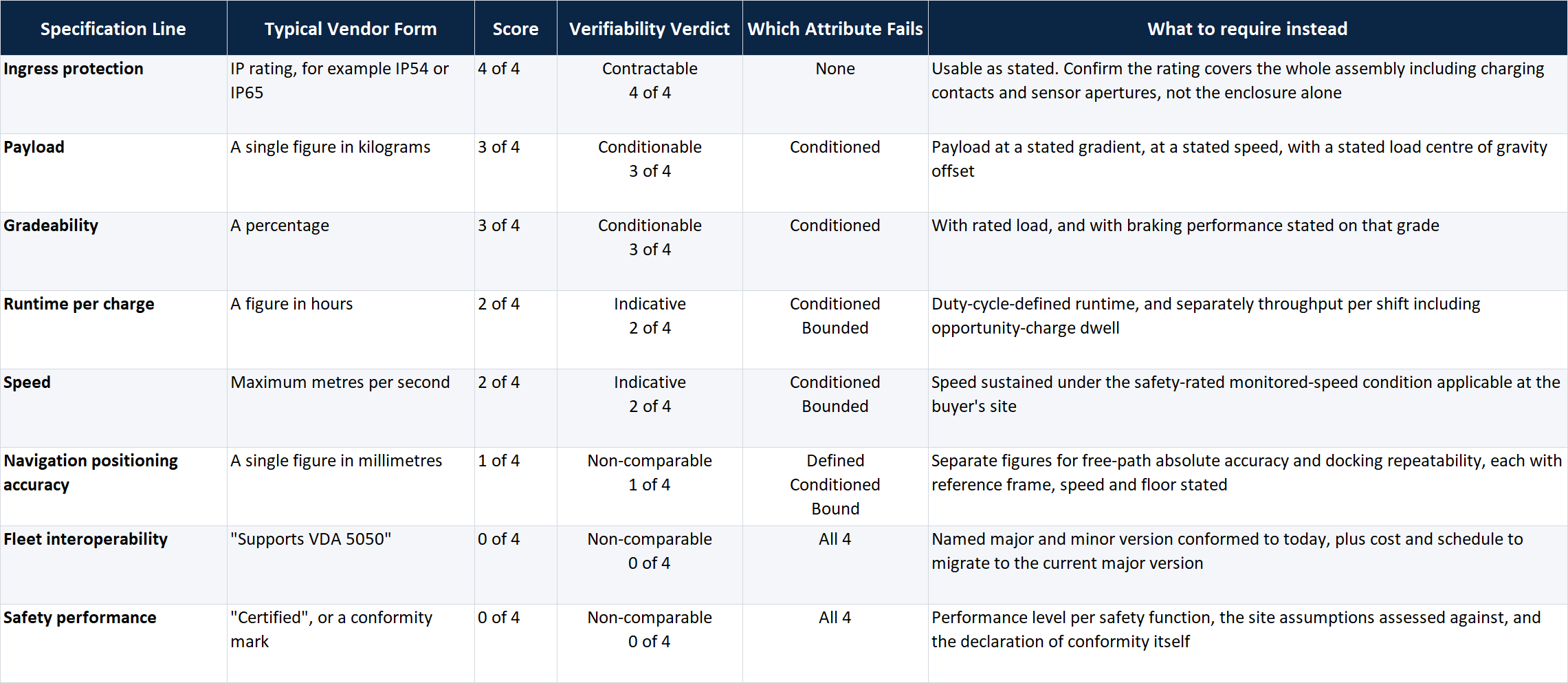
Method: each specification line is scored on four binary attributes before it is admitted to a comparison matrix. Defined, does the vendor state which quantity is measured and under what method. Conditioned, are load, speed, floor, temperature and charge state stated alongside the figure. Contestable, can the buyer require the measurement be reproduced at acceptance. Bounded, is the figure a guaranteed minimum or a typical value, with tolerance stated. Four of four is contractable and may enter acceptance criteria as written. Three of four is conditionable and becomes contractable once the missing attribute is obtained in writing. Two of four is indicative, for shortlisting only. One or none is non-comparable and should be struck from the matrix, because leaving it in manufactures confidence the evidence does not support. Limitations: this is a reasoning instrument, not a measurement standard, and no certification body issues verifiability scores. The scoring is ordinal rather than quantitative, so two competent engineers may score a borderline line differently. Verdicts describe the typical vendor form encountered in this market, not any specific manufacturer, and a vendor who states conditions fully will score higher than shown here. The test does not determine which specifications matter most for a given operation, which remains an application question. Assessment as at 5 August 2026.
The test has limits worth stating plainly. It is a reasoning instrument, not a measurement standard. Its four attributes derive from the structural finding that conformity in this asset class is partly site-dependent and that published accuracy figures are inconsistently defined, so the scoring is ordinal rather than quantitative and two competent engineers may score a borderline line differently. It also does not tell a buyer which specifications matter most for their operation, which remains an application question that no framework can answer from outside. What it does is prevent a decision from resting on a line that cannot bear the weight.
Questions to Ask Suppliers
The questions below are deliberately narrow. They interrogate the specification and commercial terms of a machine available for purchase today. An earlier article in this series set out a separate set of questions for interrogating forward-looking roadmap claims, and the two sets are complementary rather than overlapping. These are the questions that decide whether the machine on the quotation is the machine that arrives.
· For each performance figure on your datasheet, what quantity is being measured, under what method, and at what load, speed and floor condition? Which figures are guaranteed minima and which are typical values?
· Which of those figures will you reproduce on our site at acceptance, and what happens commercially if a figure is not met?
· Which edition of the governing safety standard does the declaration of conformity name, and can you supply the declaration rather than a summary of it?
· For each safety function, what performance level has been achieved, and what site assumptions were those levels assessed against? What in our facility would invalidate them?
· Which certification covers the energy system, including battery management and fire containment, given that the primary vehicle safety standard excludes power sources from its scope?
· Which major and minor version of the fleet interoperability specification does the vehicle conform to today, and what is the cost and schedule to migrate to the current major version?
· If a software update changes vehicle behaviour after acceptance, who is responsible for re-validation and who pays for it?
Every one of those questions has a correct answer that a competent vendor can give in writing. The diagnostic value is less in the answers than in which questions produce a pause.
Lead Times and Supply Chain Considerations
Two things about timing in this asset class are routinely misjudged. The first is that the vehicle is rarely the long pole. The second is that the schedule risks that matter most in 2026 are not manufacturing risks at all.
On duration, the most instructive evidence comes from how a listed operator of large integrated warehouse automation programmes reports its own progress. Symbotic, in its results for the quarter ended 28 March 2026, reported revenue of six hundred and seventy-six million United States dollars, up twenty-three percent year on year, and its chief financial officer described the total number of systems in deployment rising to seventy. The phrase deserves attention. A system is reported as being in deployment, as a standing population, rather than as a completed installation, because at this scale deployment spans multiple reporting quarters. That is a structural feature of integrated automation programmes rather than a company-specific one. It is worth being precise about what this evidences: Symbotic supplies high-density automated storage and retrieval systems rather than standalone mobile robot fleets, and this scope guard matters: its cadence describes the upper bound of programme complexity, not a delivery lead time for vehicles. What transfers is the shape of the problem. Where a purchase involves fleet management software, warehouse management system integration and site preparation, the procurement timeline is governed by integration and commissioning, not by build slots.
The genuinely underpriced risk is trade policy, and it is underpriced because it does not appear as a robot-specific measure. As at the editorial date, no tariff line targets mobile robots. Exposure arrives indirectly, through inputs, and the indirect route is where the exposure is largest.
A twenty-five percent tariff on certain semiconductors took effect on 15 January 2026 under the United States national security trade authority, and the operative detail for a buyer is not the rate. It is that duty drawback is not permitted on that measure. On most measures an importer who re-exports can recover duty; here it cannot. For a machine that is fundamentally a computer with wheels, motor controllers and perception sensors, semiconductor content is not incidental. From 6 April 2026, steel, aluminium and copper derivatives carry a twenty-five percent tariff, with fifty percent on certain goods within the relevant tariff chapters, and the tariff applies to the full value of the good rather than to its metal content. Relief exists where the applicable metal is under fifteen percent of the article's weight, which for a machine with a steel chassis and copper motor windings is a live question whose answer determines whether duty attaches to the whole vehicle. Above all of that sits a global ten percent import surcharge, in effect since 24 February 2026, which stacks with other measures.
Then there is the fact that will not appear in any vendor's quotation. On 7 May 2026 the United States Court of International Trade declared the proclamation imposing that global surcharge invalid as contrary to law. The court did not enjoin collection and did not order refunds, and the government has appealed. The duty is therefore still being collected under an instrument a federal court has already found unlawful, with the appeal unresolved. The commercial consequence is that landed cost is contingent, and a contract that does not allocate retrospective duty adjustment leaves unanswered the question of who receives a refund if one is eventually ordered. That allocation clause costs nothing to insert before signature and is unobtainable afterwards.
Component supply carries a dated risk of the same kind. Chinese export controls on seven categories of medium and heavy rare earth items, including samarium, gadolinium, dysprosium and yttrium, together with controls on certain foreign-produced items incorporating Chinese rare earth material, are recorded as suspended until 10 November 2026. Rare earth elements are permanent magnet inputs and permanent magnets sit in every drive motor in this asset class. A suspension with a stated expiry is a scheduled risk event, and any order placed now with a lead time beyond three months has that date inside its delivery window. There is also a broader trade investigation open into structural excess capacity in named sectors including electronic equipment and machinery, which is a threatened rather than implemented measure and must be treated as such, but whose sector coverage would plainly reach this asset class if action followed.
Practical planning follows from this. Fix the specification before the schedule, because respecification after award is the most common cause of slippage. Establish which duty measures apply to the specific tariff classification of the machine and its major assemblies rather than to robots generically. Ask whether quoted prices are duty-inclusive and which party bears a change in duty between order and clearance. And where a component with concentrated supply sits on the critical path, ask what the second-source plan is and what it costs, rather than whether one exists.
Certification and Compliance Standards
This is where the most consequential 2026 development in mobile robot procurement sits, and it has had almost no buyer-facing attention.
Start with the international regime, because its scope statement is unusually informative. ISO 3691-4 governs driverless industrial trucks, and it settles a terminological argument that wastes a great deal of tender-drafting time: the standard's own scope names automated guided vehicles, autonomous mobile robots, bots, automated guided carts and tunnel tuggers as examples of the same regulated machine category. Marketing distinctions between AMR and AGV do not create separate safety regimes. What the standard does not cover is more useful still. Requirements for power sources are outside its scope entirely. So are operation in freezer applications and extreme climates, potentially explosive environments, towed trailers, and public zones. It is also not applicable to trucks manufactured before its publication date. Freezer operation and towed trailers are commercially ordinary configurations, so for many buyers these are not theoretical gaps.
Two further features of the standard determine how much a certificate is worth. Its Clause 4 requires that the truck be designed according to the principles of the general machinery risk assessment standard for relevant hazards the document does not deal with, which is an explicit statement that the standard defines a baseline rather than an exhaustive solution. And its Annex A places obligations on preparation of the operating zone, which means conformity is partly a site obligation rather than solely a vehicle property. Its Table 3 identifies typical safety functions with minimum required performance levels under the functional safety standard for safety-related control systems, current edition 2023, and those required levels move with application conditions. Site congestion, variable floor gradients, low-friction surfaces, complex load geometries and multi-vehicle interactions can each raise the required performance level, because a longer stopping distance on a gradient demands more of the speed-monitoring or braking function. The consequence is worth stating directly: two buyers purchasing an identical vehicle can hold different compliance obligations, and a vehicle adequate at one site can be non-compliant at another.
An accredited certification body puts the resulting trap plainly, and it is the single most useful sentence a buyer can read on this subject.
One of the most significant risks is the confusion between component certification and system compliance. Even where subsystems carry strong safety integrity level or performance level claims, machinery compliance ultimately depends on the verified performance of the integrated automated guided vehicle within its real operating environment.
Now the development. The American national standard series for industrial mobile robots is, as of this year, complete in three parts, and the three parts bind three different parties. Part 1 covers the industrial mobile robot itself and binds the manufacturer, and it now carries a reaffirmation designation, meaning a buyer specifying it should cite the reaffirmed 2026 designation rather than the bare 2020 reference, and the designation itself is given in the accompanying table. Part 2, published in 2023, covers systems and applications and binds the integrator. Part 3, published in 2026, covers the use of industrial mobile robot applications, and it binds the operating company. That is the buyer.
Until Part 3 existed, a buyer could plausibly treat safety as a thing purchased from a vendor. It is now written into an American national standard that a material portion of the obligation was never the vendor's to discharge, and it has become considerably harder to argue that a purchase order transferred it. Read alongside the site-dependence of required performance levels and the operating-zone obligations in the international standard, a coherent picture emerges that most tender documents do not reflect.
The remaining piece is the one buyers miss most often, and it follows directly from the scope exclusion noted above. Because the primary vehicle safety standard excludes power sources, the energy system is covered by a separate standards family. The North American standard for automated mobile platforms addresses hazard and injury prevention, object detection and avoidance, risk assessment, functional safety, robotic payloads and product integration, and critically it addresses what the international vehicle standard does not: requirements to reduce fire risk, including containing a fire that occurs inside the product until it can be extinguished, and requirements for batteries and battery management systems to mitigate thermal runaway, with the relevant battery standards addressing the management system where it forms part of a pack. Charging is treated on both sides, with the international standard requiring shock-hazard protection for automatic charging connections rated above sixty volts direct current or twenty-five volts alternating current, and requiring that reachable charging contacts be energised only when the truck is connected.
The commercial reading of that is stark. The energy system is the most common source of both unplanned downtime and catastrophic facility risk in a mobile robot fleet, and it sits in the gap of the primary vehicle safety standard. A buyer who has verified conformity to the vehicle standard alone has verified nothing whatsoever about the battery.
Two other corrections belong here. The standard most frequently cited in error is the industrial robot safety standard, whose parts were both revised in 2025. It governs stationary manipulators and their integration, not driverless trucks. It becomes relevant only where a manipulator is mounted on a mobile base, in which case both regimes apply to their respective parts of the machine, and a buyer procuring a mobile manipulator needs to say so explicitly rather than assume one certificate covers both. And a conformity mark is a declaration by the manufacturer that applicable directives have been met, not an independent verification of a performance figure. Asking for the declaration of conformity itself, and reading which standards and editions it names, takes a few minutes and is the highest-yield document request in this entire process.
Assembling these findings produces the second instrument in this article, an allocation of obligations across the parties that carry them. Vehicle machine safety design sits with the manufacturer under the international vehicle standard and Part 1 of the American series. Safety function performance levels sit with the manufacturer but are assessed against the buyer's site conditions. Hazards outside the type-C scope sit with whoever holds the risk assessment, under the general machinery standard invoked by Clause 4. System and application integration sits with the integrator under Part 2, discharged by system-level validation evidence rather than component certificates. Use of the application sits with the buyer under Part 3. Operating zone preparation sits with the site owner under Annex A. Electrical, fire and battery safety sits with the manufacturer but under an entirely separate standards family. Charging electrical safety above the stated thresholds sits with the manufacturer under the referenced electrical standard.
Table 2: The Obligation Allocation Matrix
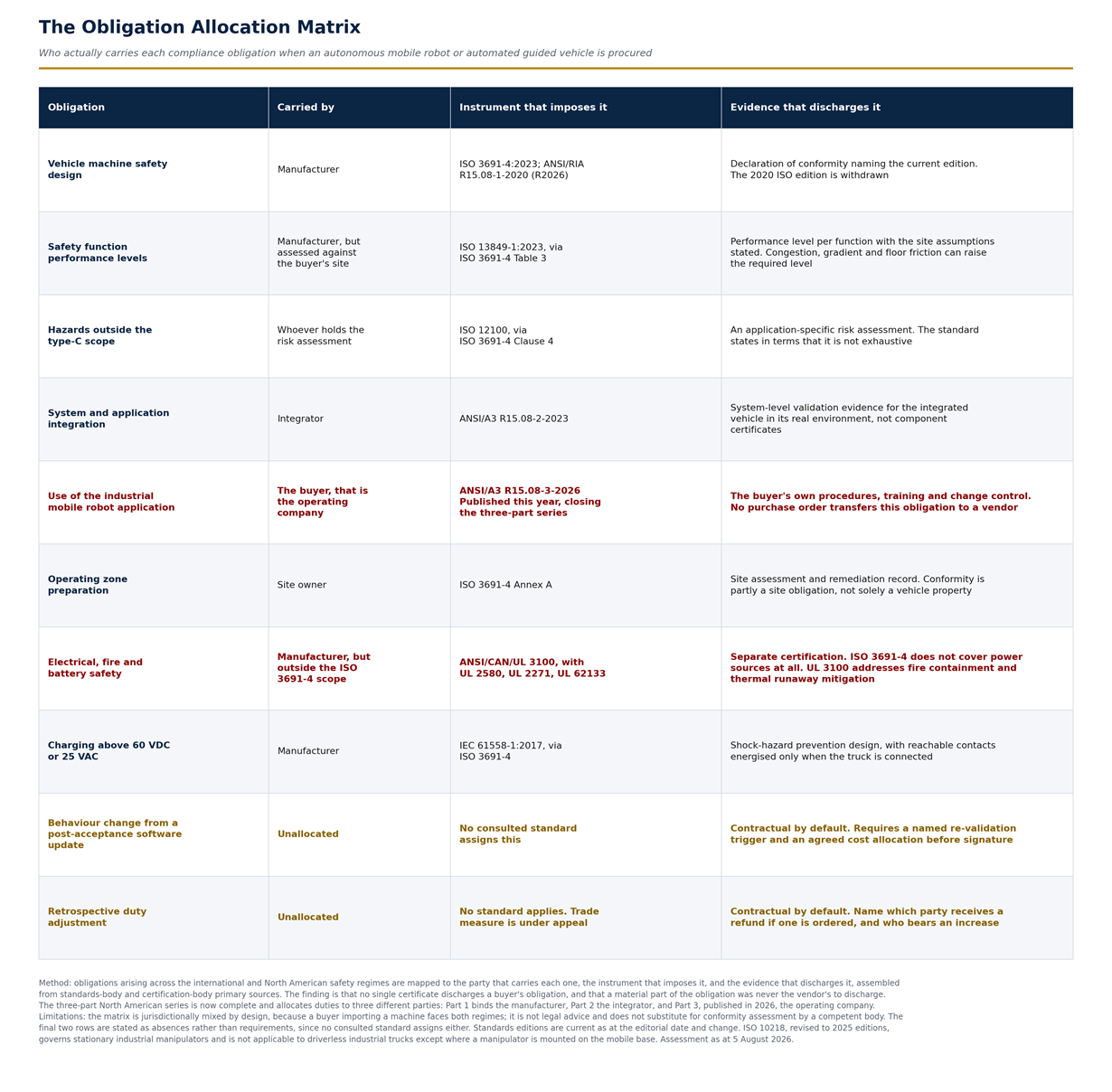
Two cells in that allocation have no owner. No consulted standard assigns responsibility for behaviour change introduced by a software update after acceptance, and none allocates retrospective duty adjustment. Both are therefore contractual questions by default, and default in practice means whoever drafted the terms. That absence is stated here as an absence rather than dressed up as a requirement, which is also the honest limit of this matrix: it is jurisdictionally mixed by design, because a buyer importing a machine faces both regimes, it is not legal advice, it does not substitute for conformity assessment by a competent body, and standards editions are current as at the editorial date and will change.
Total Cost of Ownership Preview
Everything above concerns whether the machine that arrives is the machine that was specified. It says almost nothing about what the machine costs, which is a separate question and the subject of the next article in this series.
Two findings from this analysis preview why the invoice is a poor guide. The battery is a consumable with a replacement cycle rather than a capital item with a life, and its replacement cost varies sharply by region. Blended lithium-ion pack prices average around one hundred and eight United States dollars per kilowatt hour globally, with lithium iron phosphate packs near eighty-one dollars, but North American pack prices run approximately forty-four percent above Chinese levels and European prices approximately fifty-six percent above. A replacement priced at acquisition-market rates and incurred years later in a different market is a variance that no purchase price captures. Second, the duty exposure described above is contingent rather than fixed, because it rests partly on an instrument under appeal. A cost that may be refunded, to a party the contract does not identify, is not a cost that belongs in a single purchase-price line.
Neither of those appears on a quotation. Both are large enough to change a comparison between two vendors whose quoted prices are close. The next article takes up the full picture.
The ARPI Procurement Position
The reason procurement goes wrong in this asset class is not that buyers fail to compare vendors carefully. It is that they compare them on lines that cannot bear the comparison, and then verify compliance with a document that was never designed to discharge their own obligation.
The corrective is unglamorous and cheap. Strike from the comparison matrix every specification line that fails to state what was measured and under what conditions, because a line that cannot be reproduced at acceptance is decoration. Require the declaration of conformity rather than a summary, and read which editions it names, because a withdrawn edition is not a standard. Ask which certificate covers the energy system, since the primary vehicle standard does not. Name the interoperability version, including the minor version. And treat the newly complete three-part obligation structure as what it is: written confirmation that the buyer holds a share of the compliance burden which no purchase order will transfer, and which is far cheaper to discharge before commissioning than after an incident.
A buyer who does those five things will not have bought a better robot. They will have bought the robot they specified, on terms that survive contact with their own building, which in this market is the harder and more valuable achievement.
Disclaimer
This article is published by RobotAIGeek for informational and educational purposes only. It does not constitute investment advice, procurement advice, legal advice, or a recommendation to buy, sell, or specify any product, service, or security. References to safety standards, certification schemes, and conformity obligations are provided for general orientation and do not substitute for conformity assessment by a competent body or for independent legal counsel. Standards editions and trade measures are stated as current at the information cut-off date and are subject to change, including through judicial proceedings that remain unresolved. Figures are stated as published by the cited sources, in the currencies and units those sources use, and have not been independently audited. Readers should conduct their own due diligence and obtain independent professional advice before making procurement or investment decisions. Information cut-off: 5 August 2026.