How Much Does an Industrial 6-Axis Arm Cost? A 2026 Pricing Guide
A comprehensive guide to the 2026 pricing landscape for industrial 6-axis robot arms. Covers price ranges by payload tier, the cost gap between Chinese and Western manufacturers, key price drivers, the current market trend, and an ARPI benchmark reference for procurement teams.
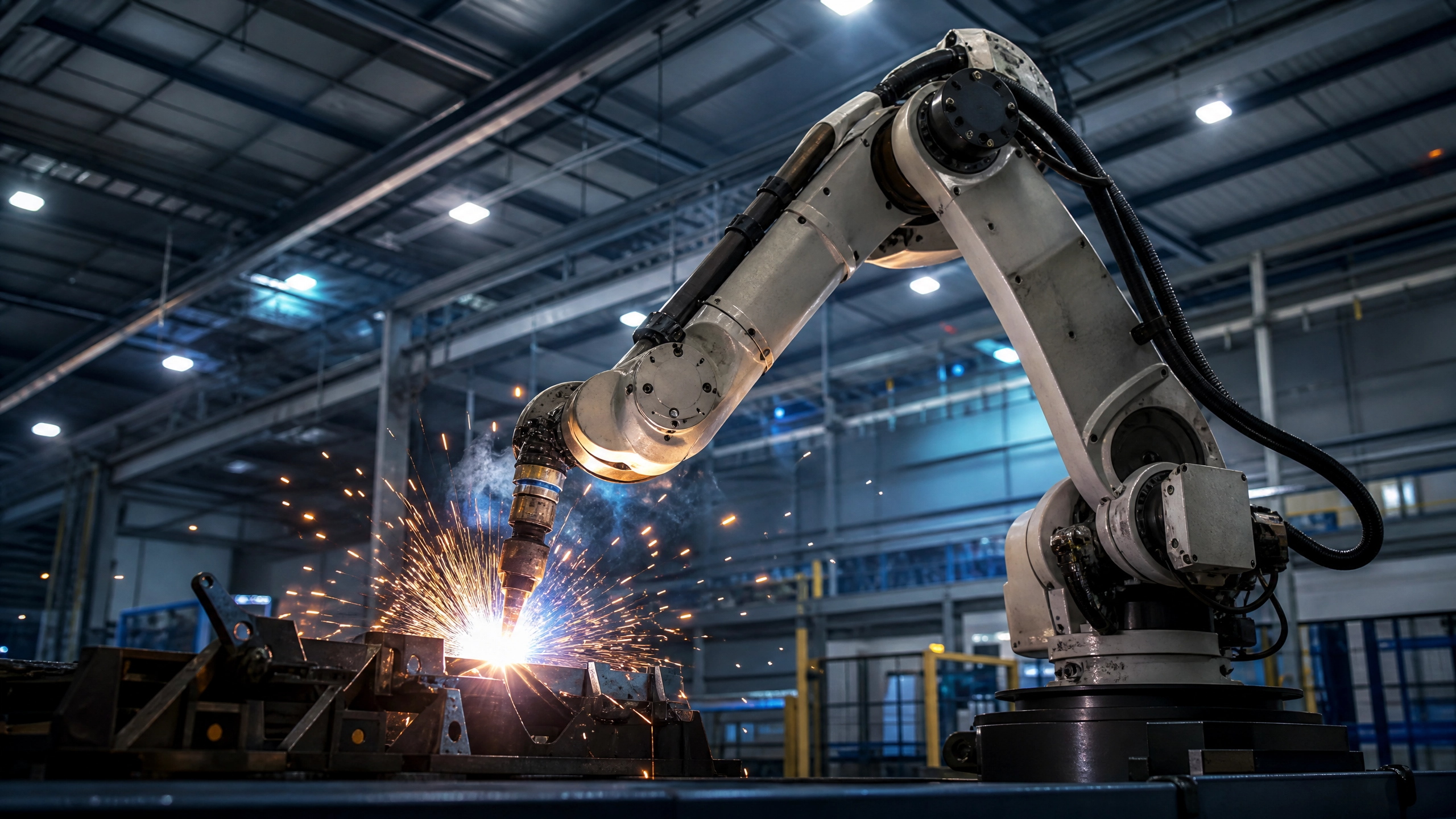
The financial calculus of automation is shifting rapidly in 2026. For decades, the high capital expenditure required for industrial robotics restricted their deployment to major automotive and electronics conglomerates. Today, plunging component costs and aggressive global competition have democratised access to this technology. However, navigating the pricing landscape remains complex. A buyer entering the market will find a vast spectrum of sticker prices, heavily influenced by payload capacity, precision requirements, and geographic origin. Understanding these pricing tiers is the first critical step in building a viable return on investment model for factory automation.
Price Range by Subcategory
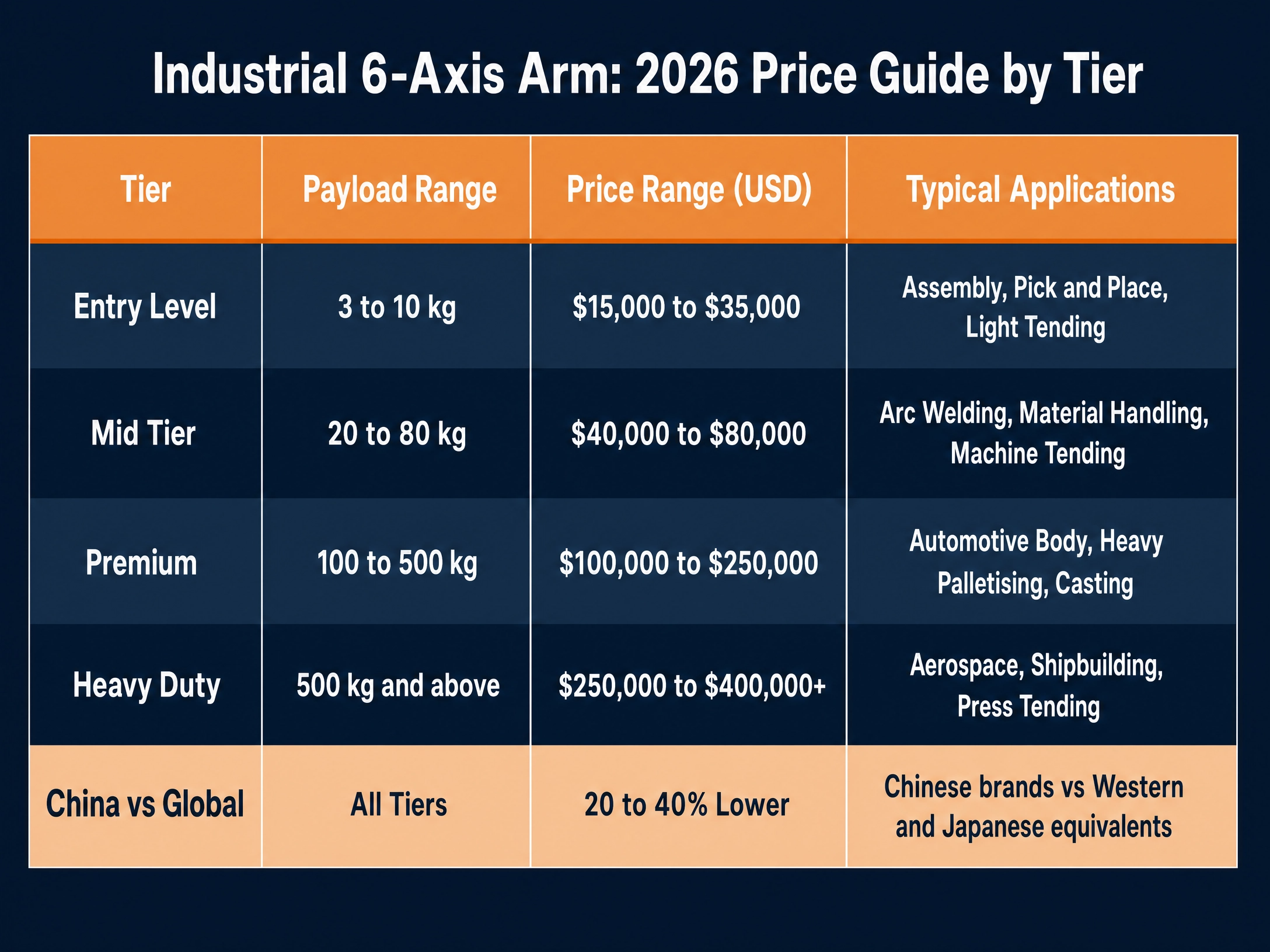
The cost of an industrial 6-axis arm is primarily dictated by its payload capacity and reach. In 2026, the market is broadly segmented into three main pricing tiers, with a fourth ultra heavy duty category reserved for specialised industrial applications.
Entry level models, typically handling payloads between 3 kilograms and 10 kilograms, are designed for lightweight assembly, pick and place operations, basic inspection, and light machine tending. These systems generally range from $15,000 to $35,000 USD [1] [2]. This tier has seen the most aggressive price compression in recent years, largely driven by Chinese domestic manufacturers scaling their production of standard servo motors and harmonic reducers. For small and medium enterprises considering their first automation investment, this price band now represents a genuinely accessible entry point, with payback periods that can fall inside 18 months under favourable production conditions.
Mid tier industrial arms form the backbone of general manufacturing. With payload capacities ranging from 20 kilograms to 80 kilograms, these robots are deployed for arc welding, material handling, press tending, and heavier machine tending. Buyers can expect to pay between $40,000 and $80,000 USD for these versatile workhorses [1]. This is the most competitive segment of the market, where the largest number of global manufacturers compete directly on price, cycle time performance, and software ecosystem quality. For most procurement teams evaluating their first large scale automation project, the mid tier is where the most meaningful trade offs between cost and capability are made.
Premium and heavy duty models are engineered for extreme tasks. These robots manage payloads from 100 kilograms up to 500 kilograms and beyond, frequently utilised in automotive chassis manipulation, heavy palletising, die casting extraction, and aerospace component manufacturing. Prices in this upper echelon start around $100,000 USD and scale well past $400,000 USD for highly specialised, long reach configurations designed for shipbuilding or large press tending [1]. At this level, the purchase price of the arm itself is often a smaller proportion of the total project cost than the integration, tooling, and safety infrastructure surrounding it.
China vs Global Price Gap
One of the most defining characteristics of the 2026 robotics market is the substantial and widening price differential between Chinese domestic manufacturers and the established Western and Japanese incumbents. This gap is not simply a reflection of lower labour costs in China. It is the result of a decade of deliberate industrial policy, aggressive domestic supply chain development, and the rapid scaling of component manufacturers that now supply the global market.
Currently, Chinese industrial robots are typically priced 20 to 40 percent lower than equivalent European or Japanese models offering comparable payload and reach specifications [3]. For example, while a standard 20 kilogram payload welding robot from a top tier Japanese manufacturer might command $55,000 USD, a structurally similar unit from a leading Chinese brand can often be procured for under $35,000 USD. This pricing advantage is most pronounced in the entry level and mid tier segments, where Chinese brands have achieved the greatest manufacturing scale. In the heavy duty segment, the gap narrows somewhat, as the precision requirements for high payload joints still favour the accumulated engineering expertise of established Japanese and German manufacturers.
It is important for procurement teams to understand what this price gap does and does not represent. Chinese manufacturers have made substantial gains in reliability and software capability over the past five years. Several leading brands now hold CE certification and supply tier one automotive manufacturers globally. However, differences in after sales support infrastructure, spare parts availability outside of Asia, and long term software update commitments remain genuine considerations for buyers operating in Western markets. The price advantage is real, but it must be evaluated within the full context of total cost of ownership rather than purchase price alone.
What Drives the Price
Beyond payload and brand origin, several underlying factors dictate the final sticker price of an industrial 6-axis arm. Understanding these drivers allows buyers to make more informed decisions about where to invest and where to accept trade offs.
The most significant hardware cost driver is the precision reduction gearing. High grade harmonic reducers, used in smaller and mid range robots, and RV reducers, used in larger heavy duty configurations, are among the most technically demanding components in the entire system. They govern the robot's positional accuracy and repeatability, and they are expensive to manufacture to the tolerances required for industrial use. Harmonic reducer pricing has fallen significantly as Chinese manufacturers like Laifuhe and Leaderdrive have scaled domestic production, but the component still accounts for a substantial portion of the bill of materials for any 6-axis arm.
Advanced servo motors and absolute encoders represent the second major hardware cost driver. Robots requiring sub millimeter repeatability demand higher grade encoders and tighter motor manufacturing tolerances. A robot rated to plus or minus 0.02 millimeters will cost meaningfully more than one rated to plus or minus 0.05 millimeters, even if the physical form factor appears identical.
Software licensing and controller capabilities also heavily influence the purchase price. Basic kinematic control is standard across the market, but advanced features such as integrated 3D vision processing, force torque feedback algorithms, proprietary welding process libraries, and collision avoidance software often require premium software packages that are licensed separately or bundled into higher tier models. For buyers who intend to deploy the robot in complex, variable environments, the software capability of the controller can be as important as the mechanical specification of the arm.
Finally, brand premium plays an undeniable role. Established manufacturers charge higher prices based on decades of proven reliability, extensive global support networks, guaranteed long term spare parts availability, and the reputational assurance that comes with deploying a system from a name that has been in the industry for 30 or 40 years. For risk averse procurement teams in regulated industries, this premium is often considered money well spent.
Price Trend
The macroeconomic trajectory for industrial 6-axis arm pricing continues to point downward in 2026. Over the past three years, average selling prices have declined steadily, driven by the scaling of Chinese component manufacturing, intensifying competition across all market tiers, and the broader commoditisation of standard robotic hardware. The global robotic arm market was valued at approximately $17.12 billion in 2025 and is projected to reach $36.20 billion by 2035 [4], and this growth is being fuelled in part by falling unit prices that are expanding the addressable buyer base.
This deflationary trend is particularly evident in the sub 20 kilogram payload category, where intense competition among dozens of manufacturers has compressed margins significantly. Entry level 6-axis arms that cost $50,000 USD five years ago can now be sourced for under $20,000 USD from competitive Chinese suppliers. While the cost of raw materials like steel and copper occasionally creates short term price friction, and while geopolitical factors such as tariffs and export controls introduce periodic volatility, the underlying structural trend remains one of falling hardware costs.
For buyers, this trend has a practical implication: waiting for prices to fall further is a strategy that carries its own cost. Every quarter of delayed automation is a quarter of foregone productivity gains, and in a competitive manufacturing environment, the compounding advantage of early adopters is significant.
ARPI Benchmark Reference
When evaluating procurement options, it is crucial to rely on verified market data rather than list prices, which rarely reflect actual transaction values. Manufacturers routinely offer volume discounts, regional pricing adjustments, and promotional bundles that can move the effective price well below the published figure.
According to directional ARPI estimates, the median global transaction price for a standard 50 kilogram payload industrial 6-axis arm currently sits at approximately $52,000 USD, representing a modest but steady year over year decrease [directional estimate — verify against latest ARPI index before publication]. For entry level arms in the 6 kilogram payload class, the median transaction price is estimated at approximately $22,000 USD when sourced from a Chinese manufacturer, compared to approximately $32,000 USD for an equivalent unit from a European or Japanese brand.
Buyers are advised to use these benchmarks as a baseline during vendor negotiations. A quote that comes in significantly above the ARPI median for a given payload class warrants scrutiny, while a quote that comes in dramatically below it warrants equally careful investigation into the reasons for that discount. The benchmark is a navigation tool, not an absolute ceiling or floor.
Looking ahead, the falling cost of industrial 6-axis arms is reshaping capital allocation strategies across the manufacturing sector. As the hardware becomes more affordable, the financial focus is shifting toward integration, software, and the transformative potential of embodied AI. The arm itself is increasingly becoming a commodity. What differentiates a successful automation investment from a costly one is the intelligence layered on top of it, and that is where the next generation of pricing complexity will emerge.
References
[1] EVS Robotics. (2025). "How Much Does a Robotic Arm Cost? (2025 Price Guide)". https://www.evsint.com/how-much-does-a-robotic-arm-cost/
[2] Standard Bots. (2026). "How much does a robotic arm cost in 2026?". https://standardbots.com/blog/how-much-does-a-robot-arm-cost
[3] EVS Robotics. (2026). "Top 10 Industrial Robot Manufacturers in China (2026): Complete Buyer's Guide". https://www.evsint.com/top-10-industrial-robot-manufacturers-china-2026/
[4] SZGHTECH. (2026). "Industrial Robot Arms in 2026: The Complete Buyer's Guide for Manufacturers". https://www.szghtech.com/industrial-robot-arm-complete-buyers-guide-2026