China vs the World: Who Leads Industrial 6-Axis Arm Manufacturing?
An analytical breakdown of China's rise in industrial robotics, comparing domestic manufacturers against global incumbents in market share, technology gaps, and procurement implications.
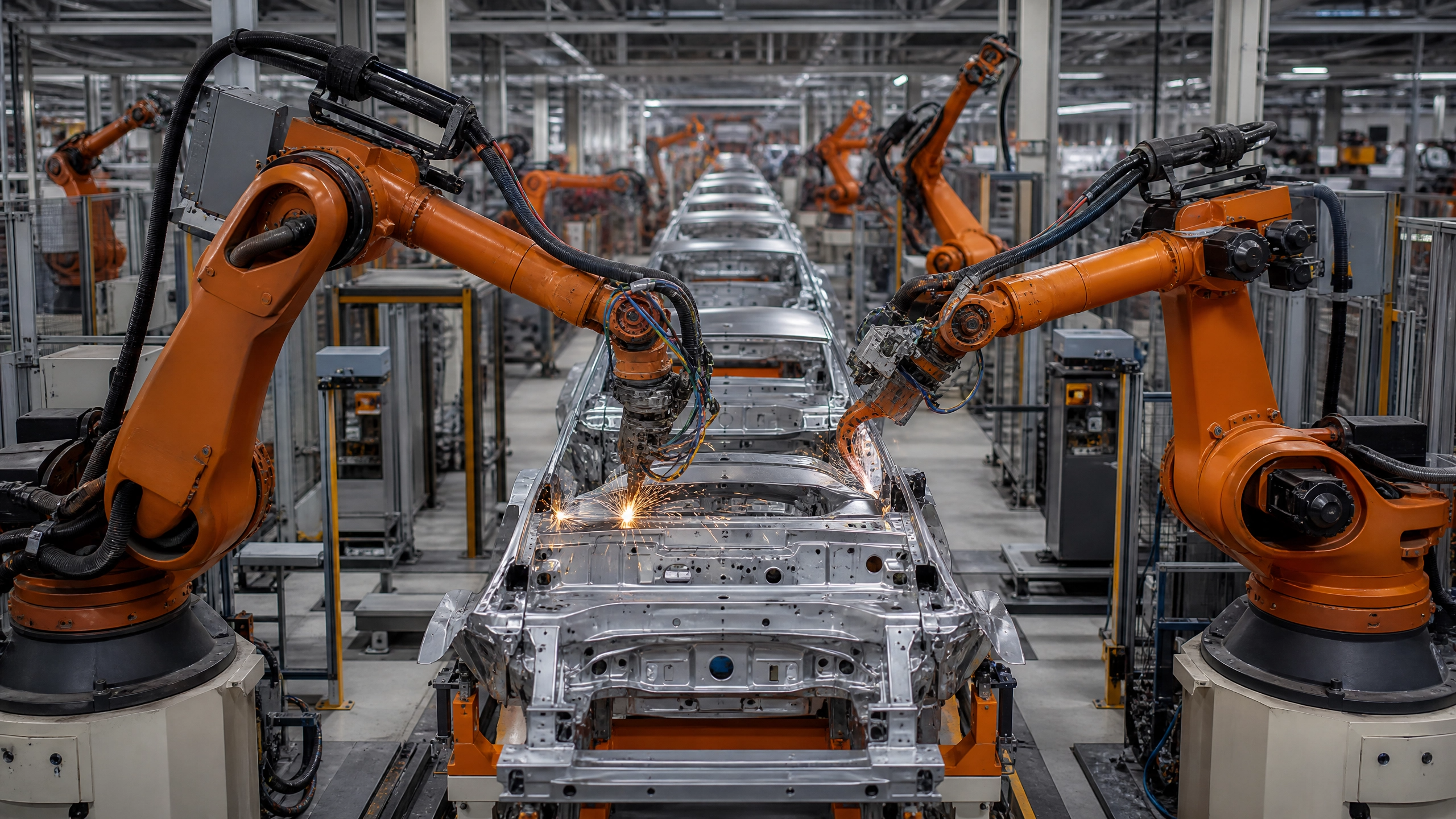
China's Market Share
The global industrial robotics landscape has experienced a profound geographic shift over the past decade. According to the International Federation of Robotics, China accounted for fifty four percent of all global industrial robot installations in 2024, deploying nearly three hundred thousand units in a single year [1]. This massive domestic demand has served as the foundation for China's manufacturing base.
More telling than installation volume is the origin of these machines. A decade ago, Chinese factories relied almost entirely on imported robots. Today, domestic manufacturers supply over fifty percent of the industrial robots sold within China [2]. This domestic dominance is unevenly distributed across sectors. In industries requiring standard handling and basic assembly, such as food and beverage or textiles, Chinese manufacturers capture between eighty and one hundred percent of the market [3]. However, in high precision sectors like automotive and electronics manufacturing, foreign brands still maintain a significant lead.
The most notable development in recent years is China's transition from a net importer to a net exporter of industrial robots. In the first half of 2025 alone, China exported over ninety four thousand industrial robots, representing a nearly sixty percent year over year increase [4]. This export momentum continued into 2026, with Chinese products reaching over one hundred and fifty countries [5]. Chinese manufacturers are leveraging their massive production scale to compete aggressively in emerging markets, Eastern Europe, and increasingly within the European Union.
How China Got Here
China's rapid ascent in industrial robot manufacturing is the result of deliberate policy execution and structural advantages. The Made in China 2025 initiative, launched in 2015, explicitly targeted robotics as a strategic sector, aiming for a seventy percent domestic market share [6]. This top down mandate mobilized significant capital, resulting in subsidies, tax incentives, and government backed financing for domestic robotics firms.
Beyond policy support, China benefits from an unparalleled industrial ecosystem. The country has cultivated dense supply chain clusters where motor manufacturers, precision reducer suppliers, and electronics fabricators operate in close proximity. This geographic concentration allows Chinese robot makers to iterate designs rapidly and reduce logistics costs. Leading domestic firms like Estun, Siasun, and Efort have capitalized on this ecosystem to achieve high levels of vertical integration, producing many critical components in house.
The sheer scale of China's domestic market provides another critical advantage. By deploying hundreds of thousands of robots annually, Chinese manufacturers accumulate operational data and field experience at an accelerated rate. This rapid feedback loop enables them to refine their products and drive down costs faster than competitors operating in smaller markets. Consequently, Chinese industrial robots are often priced twenty to forty percent lower than comparable Western or Japanese models [7].
Where Western and Japanese Players Still Lead
Despite China's impressive gains in volume and market share, established global leaders retain significant advantages in the premium segment. The big four manufacturers — ABB from Switzerland, alongside Japan's FANUC and Yaskawa, and Germany's KUKA — continue to dominate applications demanding ultra high precision, extreme reliability, and complex software integration [6].
In sectors like semiconductor manufacturing, optics assembly, and medical device production, where tolerances are measured in hundredths of a millimeter, foreign brands remain the default choice. Similarly, in the heavy duty segment involving payloads exceeding two hundred kilograms, the established players hold a commanding lead. Chinese manufacturers have struggled to break past a thirty percent market share in heavy duty applications over the last eight years, as the mechanical engineering required for reliable heavy lifting remains a significant barrier [6].
Furthermore, Western and Japanese manufacturers possess superior software ecosystems. Companies like ABB and KUKA offer extensive libraries of application specific software packages, offline programming tools, and advanced simulation environments. These proprietary ecosystems, refined over decades, provide integrators with robust tools for complex deployments. Global brands also maintain extensive international service networks, guaranteeing rapid on site support that emerging Chinese exporters cannot yet match globally.
The Technology Gap
An objective assessment reveals that the technology gap between Chinese and global manufacturers is narrowing, but it has not closed. For mid range applications such as material handling, palletizing, and standard arc welding, modern Chinese six axis arms offer repeatability and performance that are entirely sufficient for most industrial users [8].
The remaining gap lies in the invisible elements of robotics: advanced control algorithms, trajectory planning, and long term mechanical durability under continuous stress. Foreign robots generally exhibit superior point accuracy and trajectory accuracy, allowing them to maintain precise paths at high speeds without vibration [6]. This performance relies on deeply integrated control electronics and sophisticated mathematical models that are difficult to replicate quickly.
There is also a growing concern within the Chinese industry regarding involution, a term describing intense, self perpetuating price competition that squeezes margins and stifles genuine innovation [6]. While aggressive pricing has secured market share, it risks trapping domestic manufacturers in a low margin cycle, limiting their ability to invest in the fundamental research and development required to challenge the global leaders in the highest performance tiers.
What This Means for Buyers
For procurement teams and engineering leaders, the evolving landscape requires a nuanced sourcing strategy. The decision between a Chinese manufacturer and a global incumbent is no longer a simple binary of quality versus cost.
When evaluating an industrial six axis arm for standard applications like machine tending, packaging, or basic welding, Chinese manufacturers present a compelling value proposition.
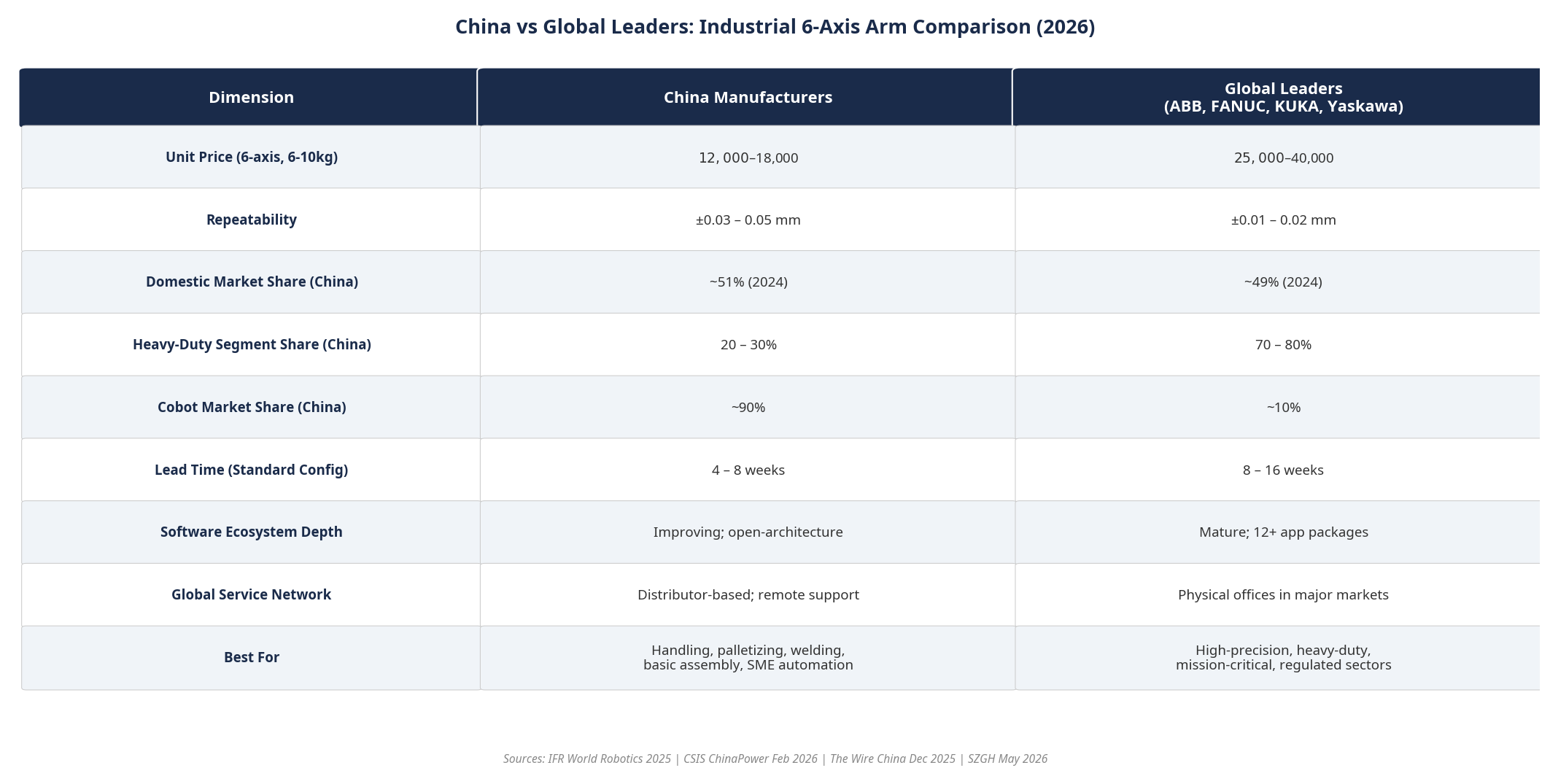
The twenty to forty percent reduction in capital expenditure can significantly improve return on investment timelines, particularly for small and medium enterprises automating for the first time. Additionally, Chinese suppliers currently offer substantially shorter lead times, often delivering within four to eight weeks compared to the eight to sixteen weeks typical of global brands [7].
However, for mission critical operations where unplanned downtime results in severe financial losses, or for applications requiring extreme precision and complex multi robot coordination, the premium commanded by ABB, FANUC, or Yaskawa remains justified. Buyers must carefully assess their specific performance requirements, the availability of local integration support, and the total cost of ownership over a five to ten year lifecycle. A hybrid approach is increasingly common, deploying cost effective Chinese robots for standardized tasks while reserving premium global brands for the most demanding operations on the factory floor.
Ultimately, the rise of Chinese industrial robot manufacturing provides buyers with unprecedented leverage and choice, fundamentally altering the economics of global automation.
References
[1] International Federation of Robotics. "Global robot demand in factories doubles over 10 years." September 2025.
[2] RobotAuto. "China's Industrial Robotics Landscape: Key Players, Market Trends and Global Influence." August 2025.
[3] Center for Strategic and International Studies (CSIS). "Is China Leading the Robotics Revolution?" February 2026.
[4] People's Daily. "China's robotics industry saw accelerated overseas market expansion in Q1 2026." June 2026.
[5] Global Times. "China's robot exports near 20 billion yuan in Jan-May as overseas push quickens." July 2026.
[6] The Wire China. "China Is Falling Behind at the Sharp End of the Global Robot Race." December 2025.
[7] SZGH Tech. "China Robot Manufacturer vs ABB, FANUC & KUKA: An Honest Comparison for 2026 Buyers." May 2026.
[8] Robot Magazine. "Chinese Robot Manufacturers: Industrial Capacity, Cost & Performance." 2026.