The Week in AI Robotics: Billion-Dollar Valuations, IPO Waves, and the Shift to Physical AI
The week of June 15–20, 2026, marked a decisive acceleration in the capital markets for physical artificial intelligence. Across funding rounds, venture capital fund formations, and public market filings, the narrative shifted from software-based generative AI to embodied intelligent machines that can move and work in the physical world. From the trade floors of Automate 2026 in Chicago to the stages of VivaTech in Paris and the regulatory halls of Shanghai, the message from investors was clear: the hardware is ready, the models are scaling, and the race for market share has begun. Here is the complete sum-up of the week's major financing events, market impacts, and the sectors poised to win and lose as Q2 2026 draws to a close.
1. The Capital Scorecard: Funding Rounds and IPOs (June 15–20)
This week saw an extraordinary concentration of capital deployment, highlighted by record-breaking late-stage rounds and a wave of Chinese IPO filing.
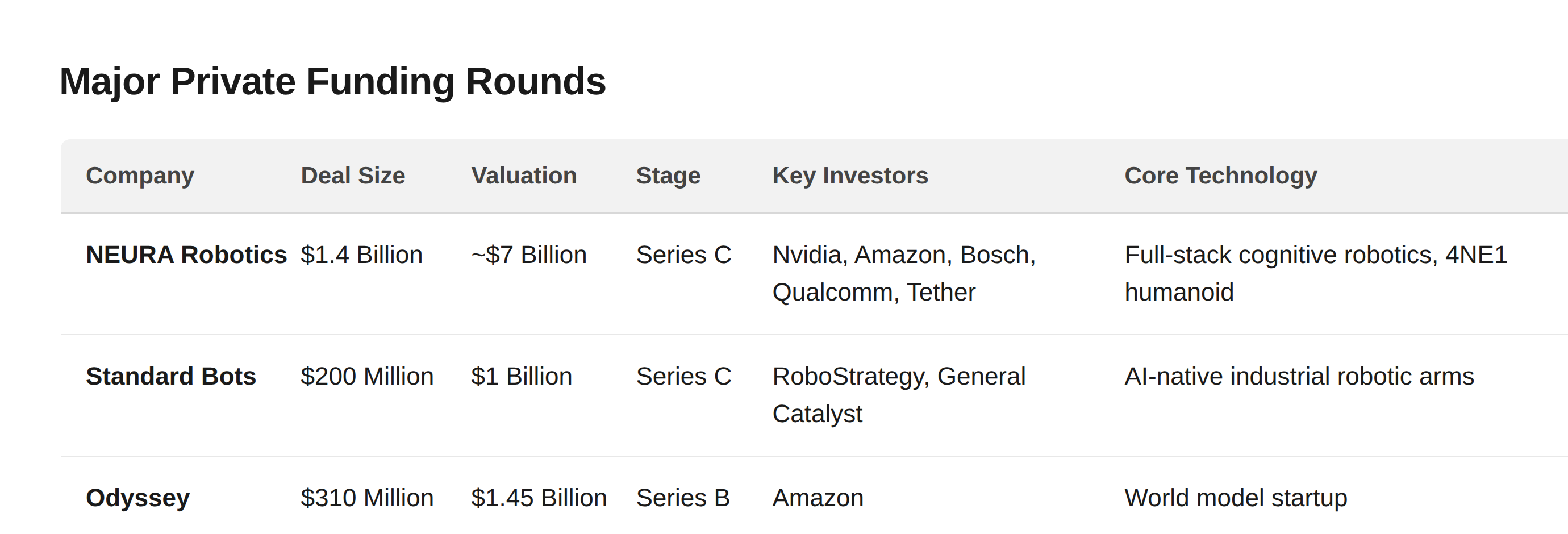
The standout event was Germany-based NEURA Robotics closing up to $1.4 billion in Series C financing, the largest ever raised by a full-stack robotics company. Backed by heavyweights including Nvidia, Amazon, and Bosch, the capital will fund the scale-up of its cognitive robots and its "Neuraverse" shared intelligence database, targeting multi-million unit production by 2030.
In the US, Standard Bots hit unicorn status with a $200 million Series C. The company, which builds AI-native robotic arms that learn through demonstration, announced aggressive plans to capture 10% of all new US industrial robot deployments by next year and bring all manufacturing back to the US by 2027.
On the fund side, Eclipse Ventures announced a new $1.3 billion fund specifically dedicated to building physical AI and autonomous systems startups from scratch, signaling deep institutional commitment to the sector.
The Chinese IPO Wave
While Western companies raised private capital, Chinese robotics firms rushed the public markets, aided by new regulatory rules. On June 17, the China Securities Regulatory Commission (CSRC) and the Shanghai Stock Exchange formally expanded the STAR Market's "fifth listing standard" to include AI large-model developers and robotics companies. This allows pre-profit companies to list domestically if their core technology is approved by the state and their valuation exceeds roughly $591 million (4 billion RMB).
The pipelines are packed:
• Unitree Robotics: Cleared its listing committee review on June 1 and is currently in the registration and pricing phase for a Shanghai STAR Market IPO targeting up to $7 billion.
• EngineAI: Filed confidentially for a Hong Kong IPO on June 12, just three years after its founding, following a $200 million April round that valued it above $1.5 billion.
• Linkerbot: Closed a Series B+ round at a $3 billion valuation and is already targeting $6 billion for its next round.
2. Market Impacts: The "Android of Robotics" Race
The influx of capital this week solidifies a structural shift in the robotics market: the decoupling of the "brain" from the "body."
Historically, robotics companies built closed, proprietary systems. The investments in NEURA Robotics and the public filings of companies like Unitree reveal a market bifurcating into two layers:
(1) Foundation Model Providers: Companies building the generalized intelligence layer (the "brain"). Nvidia's pervasive presence as an investor (NEURA) and partner (ABB Robotics, Doosan) highlights its ambition to be the operating system for physical AI.
(2) Hardware Integrators: Companies building the physical chassis and actuators (the "body"). The massive manufacturing scale-up in China where EngineAI claims it can build a humanoid robot every 15 minutes suggests hardware is rapidly commoditizing.
The market impact is a race to become the "Android of robotics." Investors are placing billion-dollar bets on companies they believe can establish the dominant foundation model that other hardware manufacturers will license.
3. Sector Beneficiaries: Who Wins from the Funding Pour?
The capital deployed this week is highly targeted. The primary beneficiaries over the next 12–18 months will be:
(1) Advanced Manufacturing & Automotive Standard Bots' $200M raise and NEURA's partnership with Bosch point directly to the factory floor. Automotive assembly, precision welding, and quality inspection will see the first wave of these newly funded AI robots, as they can now be trained via demonstration rather than complex hard-coding.
(2) Logistics and Supply Chain With Amazon backing NEURA Robotics and Agility Robotics already piloting in Amazon warehouses, logistics remains the clearest near-term ROI for embodied AI. The focus is shifting from simple autonomous mobile robots (AMRs) to versatile humanoids capable of depalletizing and trailer unloading.
(3) Component Suppliers (Actuators, Sensors, and Compute) The true winners of the humanoid boom are the "pick and shovel" providers. Companies manufacturing high-torque actuators, dexterous end-effectors (like Linkerbot), and edge-compute modules (like Nvidia's Jetson Thor) will see massive revenue growth as companies like Unitree and NEURA scale production to the tens of thousands.
4. The Losers: Job Displacement and Legacy Incumbents
The flip side of the physical AI boom is the acceleration of labor displacement and the threat to legacy robotics manufacturers.
The Labor Impact While robotics companies pitch their products as solutions to labor shortages, the reality of job displacement is already visible. In May 2026, US employers announced over 97,000 job cuts, the highest May level since 2020 with tech and AI-driven restructuring cited as a primary driver. As AI-native robots like those from Standard Bots (which require zero lines of code to set up) enter factories, the demand for mid-skill manual labor and traditional robot programmers will contract sharply.
Legacy Industrial Robotics Traditional robotics giants that rely on proprietary programming languages, expensive integration consultants, and rigid, single-task robotic arms are facing an existential threat. The $1.4 billion invested in NEURA and the $200 million into Standard Bots represent a direct assault on the business models of legacy incumbents. If a factory manager can teach a robot a new task in 10 minutes by simply guiding its arm, the traditional multi-week integration process becomes obsolete.
5. What to Watch as Q2 2026 Ends
As the second quarter closes, the physical AI market is transitioning from prototype demonstrations to commercial deployment. Here are the key indicators to watch:
• Pricing of the Unitree IPO: Unitree's debut on the STAR Market will be the ultimate stress test for humanoid robot valuations. If the market supports its $7 billion target, expect the remaining 150+ Chinese robotics startups to accelerate their own listing plans, flooding the market with capital.
• Commercial Conversion Rates: At VivaTech 2026, humanoid robots were the star attraction, but the critical metric is no longer the demo, it is the pilot conversion rate. Watch for announcements of multi-hundred unit fleet deployments rather than single-unit R&D purchases.
• U.S.-China Tech Rivalry in Robotics: China's expansion of the STAR Market rules to explicitly fund AI and robotics is a direct industrial policy response to US export controls. Watch for how US policymakers and capital markets respond to China's attempt to dominate the physical manufacturing of AI systems.
The week of June 15–20 proved that the capital is ready. The second half of 2026 will prove whether the robots are.
Sources:
1. NEURA Robotics press release, June 19, 2026
2. Standard Bots press release, June 18, 2026
3. Reuters, June 17, 2026
4. China Securities Regulatory Commission (CSRC), June 17, 2026
5. Bloomberg, June 12, 2026
6. Challenger, Gray & Christmas, May 2026 Job Cuts Report
7. Robot-Magazine.fr, VivaTech 2026 coverage
Disclaimer: All editorial content is independently written by RobotAIGeek based on publicly available Chinese and English-language sources. Quoted material is attributed to its original publisher.