The Macro View: The Investment Thesis Behind AMR and AGVs
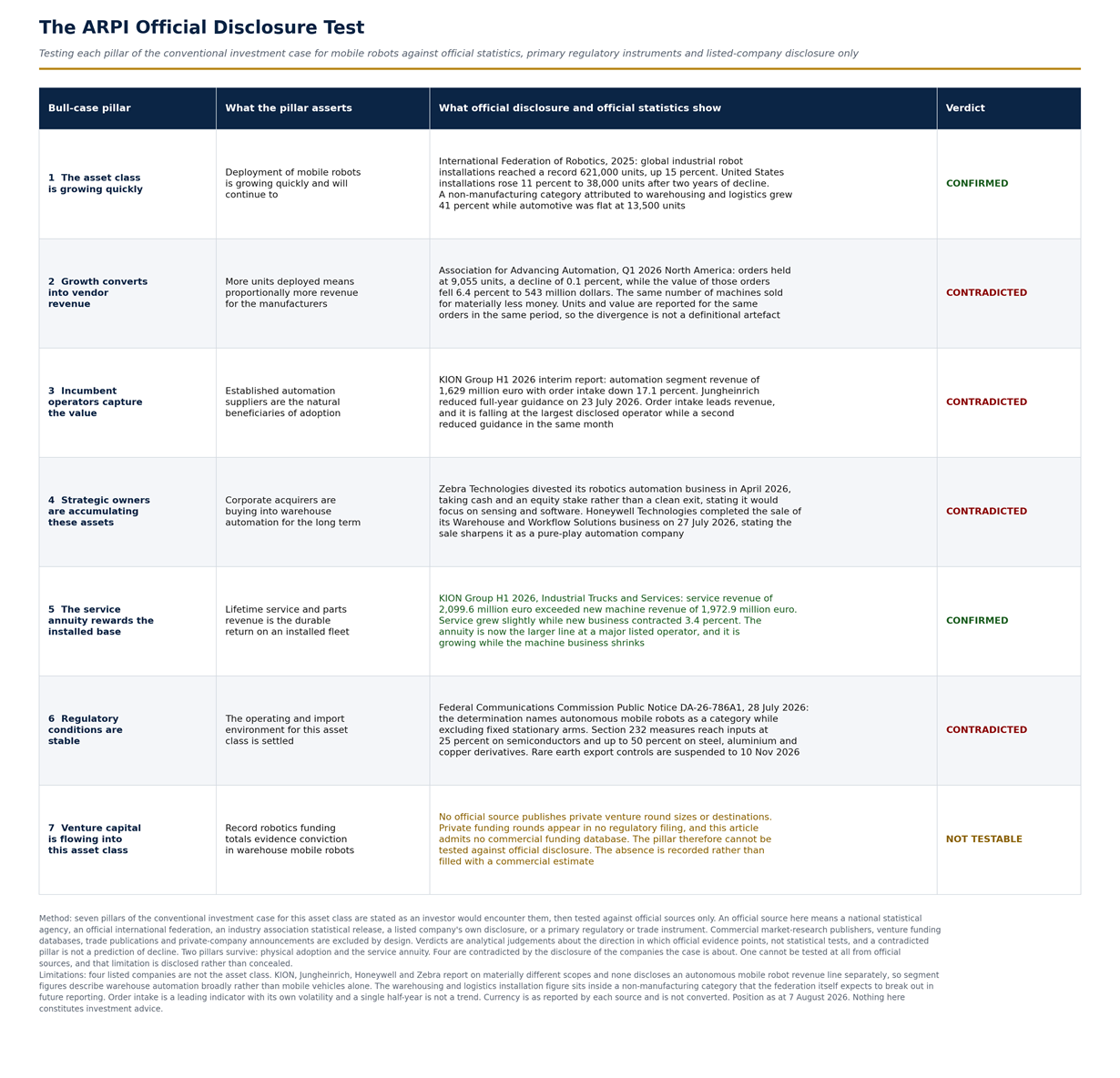
Zebra Technologies divested its robotics automation business in April 2026 for cash and an equity stake. Honeywell Technologies completed the all-cash sale of its warehouse automation business on 27 July, stating in its own release that the sale sharpens it as a pure-play automation company. A major industrial concluded that warehouse automation does not belong inside a pure-play automation portfolio. Post 10 of our AMR and AGV series tests seven pillars of the conventional investment case against official sources only, meaning national statistical agencies, official federations, industry association releases, listed-company disclosure and primary regulatory instruments. Two pillars hold: physical adoption, with a warehousing and logistics installation category up 41 percent, and the service annuity, now larger than new machine revenue at KION. Four are contradicted, including growth that is not converting into vendor revenue, where North American orders held flat in units while order value fell 6.4 percent. One cannot be tested from official sources at all, and the article says so rather than substituting a commercial estimate. The article deliberately asserts no market size, because no official source publishes one.

Two listed industrial companies made capital allocation decisions about warehouse robotics in the four months to August 2026, and both decided to reduce exposure. Zebra Technologies sold its robotics automation business in April, taking cash and an equity stake in the buyer rather than a clean exit. Honeywell Technologies completed the sale of its Warehouse and Workflow Solutions business, which trades under the Intelligrated and Transnorm brands, in an all-cash transaction on 27 July. Its chairman and chief executive said the completion further sharpens the company as a pure-play automation business, positioning it to lead the industrial sector's transition from automation to autonomy.
Read that reasoning twice. A major industrial concluded that warehouse automation does not belong inside a pure-play automation portfolio and said so while completing the sale.
That is the uncomfortable starting point for any investment case in autonomous mobile robots (AMR) and automated guided vehicles (AGV). The physical evidence of adoption is strong and improving. The commercial evidence disclosed by the companies that sell the equipment points the other way. A thesis worth holding has to account for both, and the gap between them is where the analysis lives.
Market Size and Growth Rate
This article asserts no market size and no compound annual growth rate, because the official record supports neither. Commercial research publishers offer figures for substantially the same asset class in the same year that differ by more than a factor of two, and at least one contradicts itself across two of its own pages. Where dispersion among estimates exceeds the growth being forecast, the figures cannot carry a capital decision. That absence is a finding, not a gap in the research.
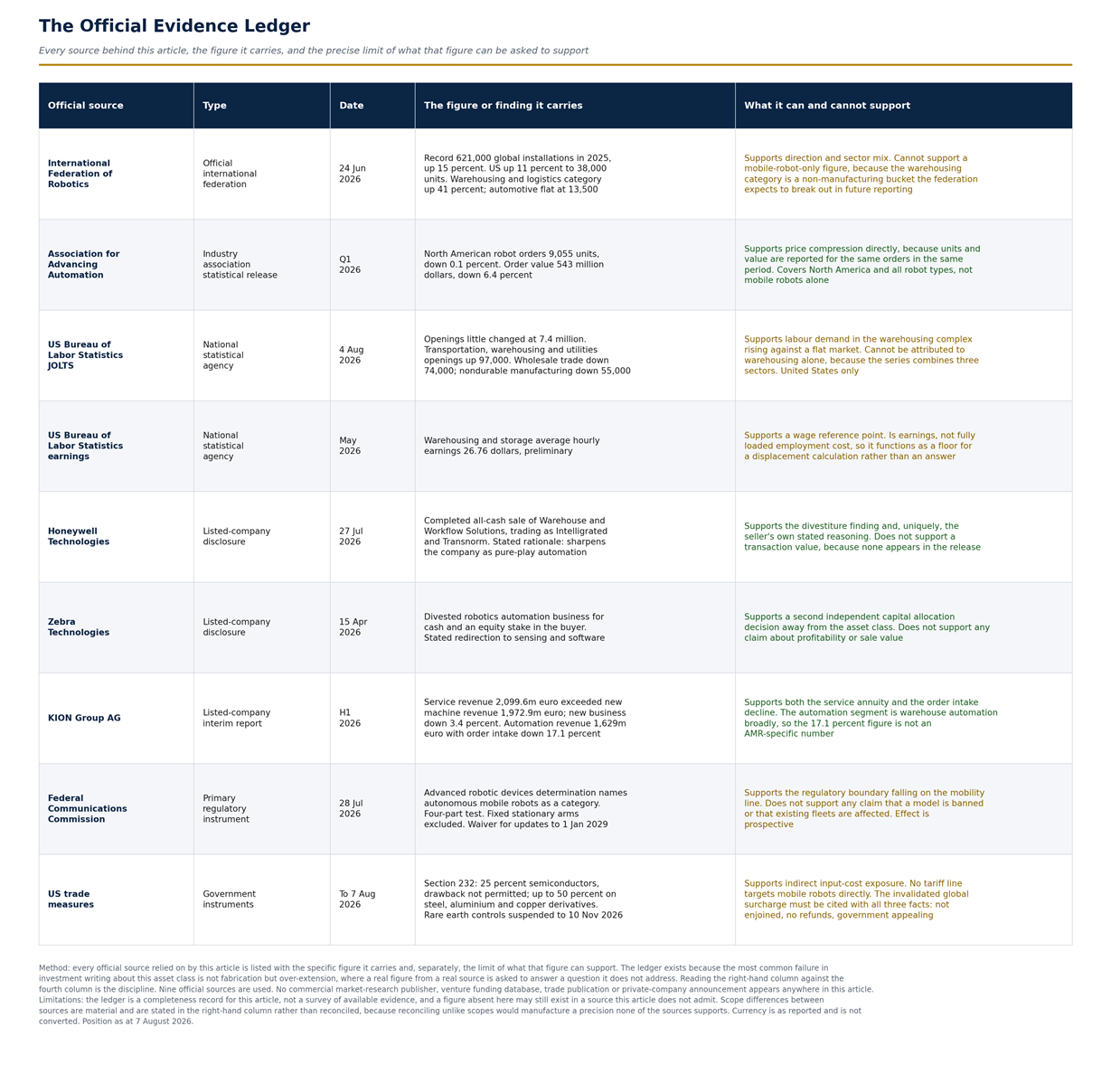
What the official record does establish is direction and it is unambiguous. The International Federation of Robotics reported global industrial robot installations reaching a record 621,000 units in 2025 up 15 percent. United States installations rose 11 percent to 38,000 units after two consecutive years of decline, the third strongest year on record. Within that total the automotive sector, historically the largest adopter, was flat at 13,500 units, while the food industry grew 30 percent and a non-manufacturing category attributed to warehousing and logistics grew 41 percent. The federation has indicated this category will likely be broken out separately in future reporting, which is itself a signal, since statistical bodies create new categories when existing ones stop describing reality.
Growth of 41 percent in the fastest-moving adjacent category, set against flat automotive demand, is a better foundation than any five-year projection. It is counted rather than modelled. The honest caveat is that the category remains a bucket rather than a clean series until that break-out happens.
Key Demand Drivers
Three structural forces are visible in official statistics rather than inferred from vendor narrative.
The first is labour demand that persists through a cooling market. The United States Bureau of Labor Statistics reported job openings little changed at 7.4 million at the end of June 2026, with hires unchanged at 5.3 million and quits unchanged at 3.2 million. Inside that flat aggregate, openings rose by 97,000 in transportation, warehousing and utilities while falling by 74,000 in wholesale trade and 55,000 in nondurable goods manufacturing. Demand for labour in the sector that operates mobile robots increased during a month when demand elsewhere in the goods economy fell. Two limits belong with that figure: the series combines transportation, warehousing and utilities, so the increase cannot be attributed to warehousing alone, and it covers the United States only.
The second is wage cost as the reference price for automation. Average hourly earnings in warehousing and storage stood at 26.76 United States dollars in the preliminary May 2026 estimate. That is earnings rather than fully loaded employment cost, so it functions as a floor for any labour displacement calculation rather than an answer. It nonetheless sets the denominator every business case is measured against.
The third is geographic reallocation driven by trade policy. Canada rose 6 percent while Mexico recorded a third consecutive year of decline, which the federation attributes to trade uncertainty affecting investment decisions. Policy expectations are routing automation spending, and uncertainty is demonstrably capable of suppressing it as well as stimulating it.
Recent Notable Investments
Restricted to official disclosure, the transactions of this period signal something closer to the opposite of conviction and each comes from the company's own release.
Zebra Technologies divested its robotics automation business in April, stating an intention to concentrate on radio-frequency identification, machine vision and artificial intelligence for the frontline, which it described as high-growth areas. Honeywell completed the divestiture of its warehouse automation business on 27 July and on 3 August, completed a further divestiture of its productivity solutions business, describing that as the final step in becoming a pure-play automation company. Honeywell has completed approximately 11.5 billion United States dollars of acquisitions since 2023, so this is not a company retreating from capital deployment. It is a company deploying capital elsewhere.
One boundary must be stated plainly. Private funding rounds appear in no official filing, so the venture side of this asset class cannot be assessed from primary documents. Growth capital may well be reaching private manufacturers. An investor should record that the claim is unverifiable from official sources, while the transactions that are verifiable run consistently in one direction.
Table 1: The Official Evidence Ledger
Key Risks
Regulatory risk moved from theoretical to concrete on 28 July 2026, when the Federal Communications Commission issued a public notice implementing a national security determination covering advanced robotic devices. The definition names autonomous mobile robots as a category, alongside humanoid and quadruped platforms, and applies a four-part test covering ground locomotion, remote or autonomous operation, combined weight above 4.4 pounds including any docking station, and an environmental sensor combined with connectivity of at least 200 kilobits per second and controlling software.
The exclusion list is where the commercial significance sits. Fixed stationary robots, including articulated, delta, gantry and selective compliance assembly designs, fall outside scope, as do connected vehicles, rail, uncrewed aircraft and medical devices regulated by the Food and Drug Administration. The regulatory boundary has been drawn precisely along the mobility line, and this asset class now carries a compliance burden its stationary counterpart does not.
The mechanism is prospective. Authorisations granted before 28 July are not revoked and a limited waiver permits software and firmware updates to previously authorised devices until 1 January 2029. The only exemption pathway runs through Conditional Approval from the Department of War, and no published criteria or timeline for that process yet exists. Nor is it settled what constitutes a new model requiring fresh authorisation. Those two ambiguities are the live commercial risk, not the rule itself.
Input risk is indirect but real. No tariff line targets mobile robots directly. Exposure arrives through components, where Section 232 measures apply 25 percent to semiconductors with drawback not permitted, and up to 50 percent on the full value of steel, aluminium and copper derivatives. A separate global surcharge was declared invalid on 7 May 2026, but collection was not enjoined, no refunds were ordered, and the government has appealed, so it continues to affect landed cost while its legality is unresolved. Chinese rare earth export controls are suspended only until 10 November 2026.
What Smart Money is Watching
The metric that separates a real thesis from a hopeful one is the gap between unit growth and value growth. The Association for Advancing Automation reported North American robot orders of 9,055 units in the first quarter of 2026, essentially flat at a decline of 0.1 percent, while order value fell 6.4 percent to 543 million United States dollars. Units held; value did not. That is price compression recorded in an association statistical release, not an opinion.
KION Group's interim report for the six months to 30 June 2026 shows the same pattern inside a single company and adds the compensating mechanism. In its industrial trucks and services segment, service revenue of 2,099.6 million euro exceeded new machine revenue of 1,972.9 million euro, with service growing slightly while new business contracted 3.4 percent. In the automation segment, revenue was 1,629 million euro but order intake fell 17.1 percent. Jungheinrich reduced its full-year guidance on 23 July.
Three metrics follow. Order value per unit, because volume growth arriving as price deflation reaches the manufacturer as nothing. Service revenue as a share of total, because that is the annuity the equipment exists to create, and it is now the larger line at a major listed operator. And order intake rather than revenue, because revenue reports the backlog while order intake reports demand.
The Investment Position
Tested against official disclosure alone, the conventional case holds in two places and fails in three. Physical adoption is accelerating in the warehousing category. The service annuity now exceeds new machine revenue at a major listed operator. Against that, growth is not converting into vendor revenue, incumbents are not capturing it, and strategic corporate owners are reducing exposure rather than accumulating it.
Table 2: The Official Disclosure Test
The reconciliation is that this asset class is becoming infrastructure. Infrastructure is deployed at scale, priced competitively, and monetised through the service relationship rather than the sale. That is a durable business and a poor one to own at hardware multiples. The investable position is therefore not the vehicle. It is the installed base, the service contract, and the software layer that governs the fleet. Honeywell and Zebra each said a version of this in their own words, and each voted with the balance sheet. An investor who reads those releases as portfolio housekeeping has missed the only evidence in this market that carries a signature.
Disclaimer
This article is published by RobotAIGeek for informational and educational purposes only. It does not constitute investment advice, financial advice, procurement advice, legal advice, or a recommendation to buy, sell, or hold any security, fund, product, or service, and no content here should be relied upon as a basis for any investment decision. References to listed companies, divestitures, acquisitions, and official statistics are analytical illustrations drawn from the cited sources and are not endorsements or assessments of any issuer. This article deliberately asserts no market size and no compound annual growth rate for this asset class, because no official source publishes one, and readers should treat any single such figure encountered elsewhere with corresponding caution. Financial figures are stated in the currencies, periods, and reporting scopes used by each company, are not converted between currencies, and have not been independently audited by RobotAIGeek. Company reporting scopes differ materially and are not directly comparable. Verdicts in the analytical frameworks presented here are judgements about the direction of available evidence rather than statistical tests or predictions of future performance. References to safety standards, certification schemes, trade measures, and regulatory determinations are provided for general orientation, are stated as current at the information cut-off date, are subject to change including through administrative and judicial proceedings that remain unresolved, and do not substitute for conformity assessment by a competent body or for independent legal counsel. Past performance and historical growth are not indicative of future results. Readers should conduct their own due diligence and obtain independent professional advice before making any procurement or investment decision. Information cut-off: 7 August 2026.