NTT and Toyota Lead Record Japan Capex
A Nikkei survey of 700+ Japanese firms shows fiscal 2026 capex at JPY 35.67 trillion, up 14.2 percent and an all-time high. NTT and Toyota lead the surge into data centres, AI factories, and chipmaking.
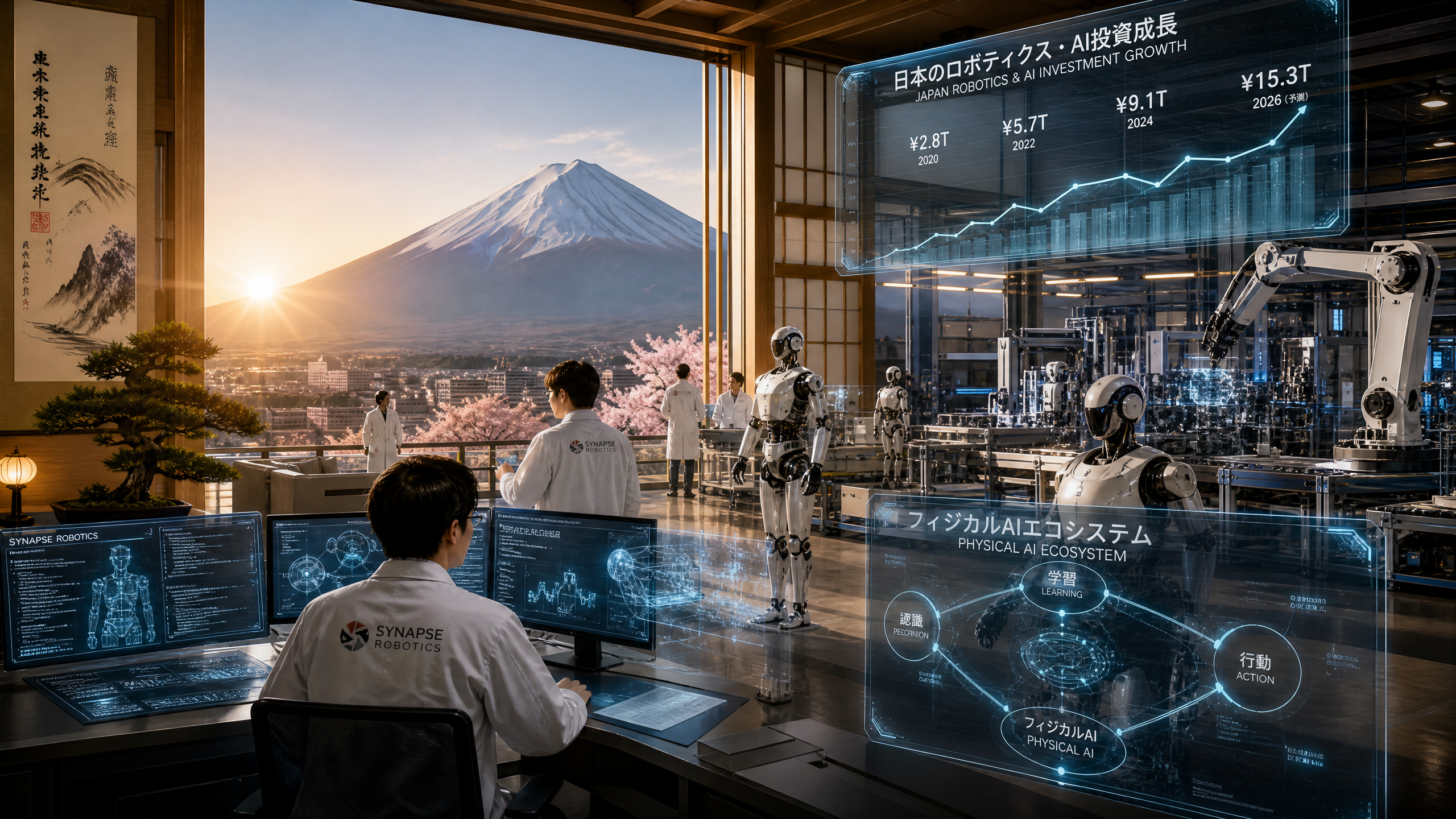
Japanese companies plan to spend JPY 35.67 trillion (US$226 billion) on capital expenditure in fiscal 2026. That figure, drawn from a Nikkei survey of more than 700 firms published on August 2, represents a 14.2 percent increase over the previous year and an all-time record. The money is flowing into data centres, semiconductor fabrication equipment, power-grid capacity, and what the survey calls AI factory investments. NTT and Toyota sit at the top of the list with the largest individual commitments.
The number matters for the robotics industry because capital expenditure is the leading indicator of factory automation demand. When companies build new production lines, they buy robots to staff them. When they upgrade existing facilities, they replace manual stations with automated cells. Japan's record capex year is, by extension, a record year for the companies that sell the machines those factories will contain.
The Scale in Context
JPY 35.67 trillion is roughly 6 percent of Japan's GDP. That proportion has not been seen since the late 1980s, when Japanese corporations were building the manufacturing base that would dominate global electronics for the following two decades. The comparison is imperfect. The 1980s spending went into physical production capacity for consumer goods. The 2026 spending is going into digital infrastructure that produces computation rather than television sets. But the scale is analogous. Japan is retooling its industrial base at a pace it has not attempted in nearly four decades.
The 14.2 percent year-on-year increase is the more telling figure. Japanese corporate capex grew by single digits for most of the 2010s. It contracted during the pandemic. The acceleration began in fiscal 2024 and has compounded each year since. The driver is not domestic demand. Japan's consumer economy remains sluggish. The driver is global demand for AI infrastructure, and Japan's positioning as a trusted supplier of the physical equipment that AI systems require.
Who Is Spending and Where
NTT's capex plan is the largest in the survey. The telecommunications company is building hyperscale data centres across Japan to serve both domestic cloud customers and international AI companies that want computing capacity in a geopolitically stable jurisdiction outside China and the United States. NTT's strategy is explicit. It is positioning Japan as the neutral ground for AI computation, a country with reliable power, advanced cooling technology, and no export restrictions on the output of its data centres.
Toyota's commitment is the second largest. The automaker is investing simultaneously in electric vehicle production lines, battery factories, and what it calls "woven" facilities that integrate software development with physical manufacturing. Toyota's Woven subsidiary, formerly Woven Planet, is building autonomous driving and robotics capabilities that require purpose-built testing and production infrastructure. The capex figure includes both traditional automotive plants and next-generation facilities that blur the line between factory and laboratory.
Nippon Steel and Honda round out the top four. Nippon Steel is expanding capacity for the specialty steels that data-centre construction requires. Honda is building production lines for its new electric vehicle platform and for the humanoid robot programme it announced in partnership with Asimo's successor technology. Each company's spending reflects a different facet of the same underlying trend. The physical world is being rebuilt to serve the computational world.
The Robotics Demand Implication
Every new factory that these companies build will contain robots. Not all of them will be humanoids. Most will be industrial arms, autonomous guided vehicles, and collaborative robots that work alongside human operators. But the total addressable market for factory automation equipment expands in direct proportion to capex spending. When Japan's largest companies collectively increase their factory budgets by 14 percent, the robot makers that supply those factories can expect order books to grow by a similar magnitude.
This is already visible in the earnings of companies like Fanuc, Yaskawa, and Kawasaki Heavy Industries. Fanuc reported order growth in its most recent quarter. Yaskawa raised its full-year guidance. Kawasaki's robot division posted record revenue. These companies are the direct beneficiaries of the capex surge that the Nikkei survey quantifies. The survey does not tell us anything that the robot makers' order books did not already suggest. But it confirms the trend with a sample size of 700 companies rather than a handful of quarterly reports.
The Company-Level Breakdown
The survey's top spenders reveal the specific bets being placed. NTT plans JPY 3.8 trillion (US$26.4 billion) in capital expenditure for fiscal 2026, the largest single-company figure in the survey. Nearly half of that goes to data-centre construction across Japan and internationally. Toyota follows with JPY 2.1 trillion, split between battery factory construction, automated assembly lines, and its Woven City experimental facility in Shizuoka Prefecture. SoftBank Group committed JPY 1.5 trillion, almost entirely to AI data-centre infrastructure through its partnership with Oracle and Nvidia.
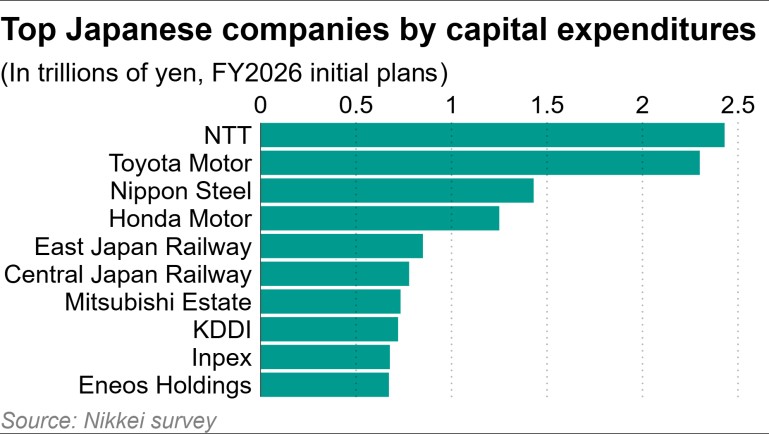
Below the top three, the spending is more diverse. Nippon Steel is investing in specialty alloys for semiconductor manufacturing equipment. Renesas Electronics is expanding domestic chip fabrication capacity. KDDI and Rakuten are building 5G and edge-computing infrastructure that will eventually serve autonomous systems. The common thread is not a single technology. It is a shared belief that physical infrastructure, built in Japan, will be the bottleneck that determines which companies capture value from the AI transition.
The semiconductor equipment makers deserve separate attention. Tokyo Electron, Disco, and Screen Holdings are all expanding production capacity for the machines that build chips. Their capex is a second-order bet. They are not building AI systems. They are building the tools that build the tools that build AI systems. Their order books reflect demand from TSMC, Samsung, Intel, and the new Japanese foundry Rapidus. Each of those customers is building fabrication capacity that will eventually produce the chips that power robots. The capex chain from Tokyo Electron to a humanoid robot on a factory floor passes through at least four intermediate steps, but the money is flowing through all of them simultaneously.
The Power Constraint
There is one factor that could slow the spending. Japan does not have enough electricity to power all the data centres its companies want to build. NTT alone is planning facilities that will require gigawatts of new generation capacity. The country's nuclear restart programme is proceeding slowly. Renewable energy deployment faces land constraints on a mountainous archipelago. LNG imports are expensive and carbon-intensive.
Several of the capex plans in the Nikkei survey include power-generation investments alongside the data-centre builds. Companies are building their own solar farms, investing in small modular reactors, and signing long-term power purchase agreements to secure supply. The power constraint is real but not fatal. It will delay some projects and increase costs for others. It will not reverse the overall trend. The demand for AI computation is too strong and the strategic imperative too clear for Japan to leave its factories unbuilt because of electricity shortages.
The Geopolitical Angle
Japan's capex record arrives at a moment when the global supply chain for AI infrastructure is fragmenting along geopolitical lines. The United States restricts chip exports to China. China restricts rare-earth exports to the United States. Both countries are building domestic capacity to reduce dependence on the other. Japan sits between them, allied with Washington but economically entangled with Beijing, and is using that position to attract investment from both sides.
NTT's data centres will serve American AI companies that want Asian capacity without Chinese jurisdiction. Toyota's factories will produce vehicles for markets that both superpowers contest. Nippon Steel's specialty alloys will go into equipment that both countries need. Japan's record capex is partly a bet on its own industrial future and partly a bet on its geopolitical position as the manufacturing partner that neither superpower can afford to alienate.
The risk is that the bet is wrong. If US-China tensions ease, the premium that Japan commands as neutral ground diminishes. If tensions escalate further, Japan may be forced to choose sides in ways that limit its market access. But for now, the money is flowing. JPY 35.67 trillion is not a hedge. It is a commitment.
The Historical Comparison
The last time Japanese companies invested at this rate relative to GDP was the late 1980s. That ended badly. The comparison is imperfect but instructive. In the 1980s, the investment was driven by asset speculation and financial engineering. Companies were borrowing against inflated land values to build capacity they did not need. The current cycle is different in one critical respect. The investment is driven by identifiable demand. AI companies need data centres. Automakers need battery factories. Semiconductor equipment makers need fabrication capacity. The demand is real and measurable in purchase orders, not in speculative projections.
But the 1980s comparison carries a warning. Japan's corporate sector has a demonstrated tendency to over-invest when confidence is high and capital is cheap. The Bank of Japan's ultra-low interest rates make capital cheap. The AI boom makes confidence high. The conditions for over-investment exist even if the underlying demand is genuine. The difference between a record investment cycle and a bubble is visible only in retrospect.
Disclaimer: This article is for informational purposes only and does not constitute investment advice, endorsement, or recommendation of any company, product, or technology mentioned.