Mapping the Shift in Global AMR and AGV Production
The International Federation of Robotics puts Asia-Pacific at almost 84 percent of intralogistics mobile robot origin. Interact Analysis puts China at 36 percent of mobile robot revenue, falling towards 27 percent by 2030. Both figures are defensible, and the gap between them is not a measurement error but the shape of the industry. Post 6 of our AMR and AGV series introduces the ARPI Production Leadership Layer Model, a five-layer decomposition of the value chain showing that leadership migrates down the stack: Chinese dominance is decisive at vehicle assembly, contested at safety certification and precision components beneath, and weakest at autonomy compute and systems integration above. With China now a net exporter of industrial robots, a pending Section 232 determination, and a rare earth control suspension expiring 10 November 2026, the analysis converts manufacturing geography into five distinct procurement risk types and the supplier questions that surface each one.
When the International Federation of Robotics (IFR) compiled the origin of the world's intralogistics mobile robots for its most recent global survey, the answer landed at almost 84 percent for the Asia-Pacific region against 11 percent for Europe and 5 percent for the Americas. When Interact Analysis published its mobile robot forecast in January 2026, it put China's share of mobile robot revenue at 36 percent, falling towards 27 percent by 2030. Both figures are defensible. Neither is wrong. A procurement team that reads them as competing claims about the same thing will misprice its next automation project, because the gap between 84 percent and 27 percent is not a measurement error. It is the shape of the industry.
That gap is the subject of this analysis. The manufacturing geography of the autonomous mobile robot (AMR) and automated guided vehicle (AGV) market has shifted decisively towards China over the past five years, and the shift is now visible in customs data rather than merely in forecasts. What has not shifted proportionally is where the money accumulates. Understanding why requires abandoning the single-number question of who leads, and replacing it with a layered one.
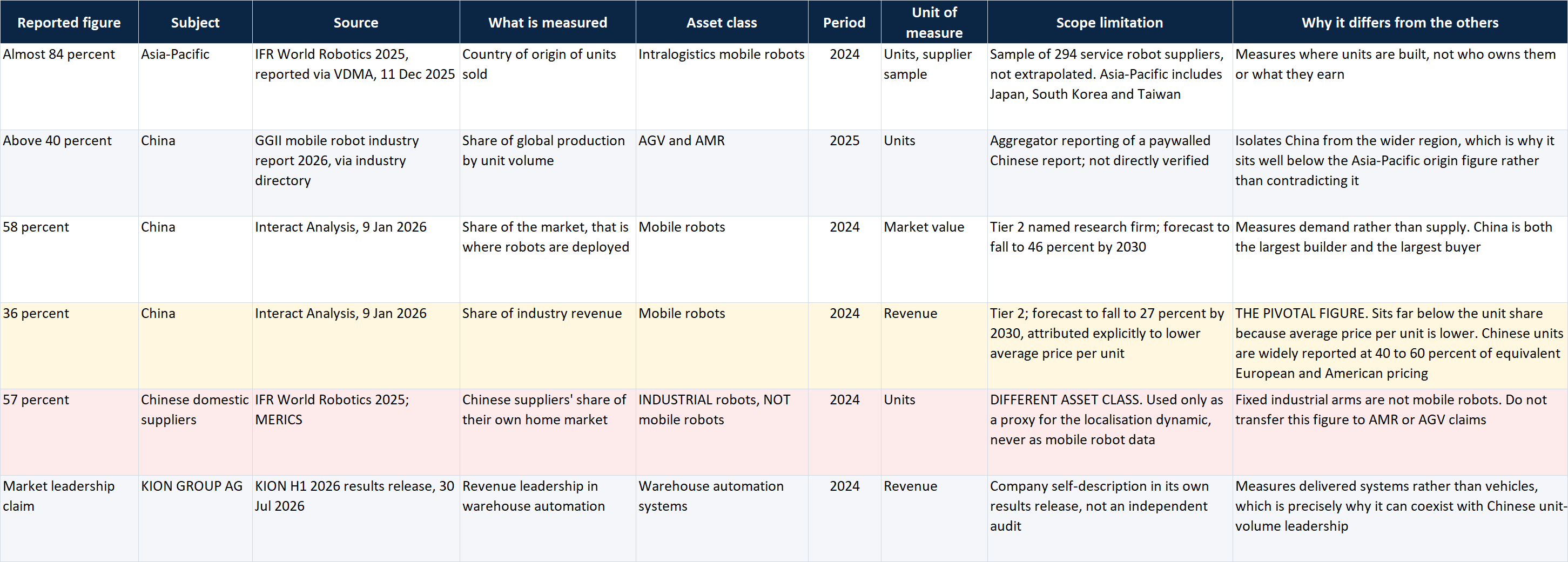
Table 1: Share Denominator Reconciliation, six competing measures of China's position
China's Market Share
The most asset-class-specific primary measure available comes from the IFR, whose most recent global robotics survey recorded 102,900 transportation and logistics robots sold worldwide in 2024, of which approximately 81,800 were mobile robots for intralogistics applications. Reported through the German Mechanical Engineering Industry Association, the origin split for those intralogistics units was almost 84 percent Asia-Pacific, 11 percent Europe, and 5 percent for North and South America combined. Two boundaries on that figure matter for anyone quoting it. The federation's service robot data is drawn from a sample of 294 suppliers rather than extrapolated to the whole industry, and the federation itself discourages comparison across its report years because sample composition changes. Equally, Asia-Pacific is not China. Japan, South Korea, and Taiwan sit inside that 84 percent.
Narrowing to China specifically requires named research. Gaogong Industry Research Institute, whose Chinese mobile robot industry report is the standard domestic reference, puts Chinese shipments above 130,000 AGV and AMR units in 2025, a 22 percent increase on the prior year, and places China above 40 percent of global mobile robot production by unit volume. Interact Analysis, measuring demand rather than production, put China at 58 percent of the mobile robot market in 2024 and forecasts a decline to 46 percent by 2030 as adoption elsewhere accelerates from a lower base. The same firm put China's share of mobile robot revenue at 36 percent in 2024, forecast to reach 27 percent by 2030, and attributed the divergence explicitly to a lower average price per unit.
The corroborating primary signal arrived from China's own customs authority. According to the General Administration of Customs, Chinese industrial robot exports reached RMB 6.29 billion, approximately USD 930 million, in the first six months of 2026, an increase of 18.6 percent year on year, shipped to 141 countries and regions. More significant than the growth rate is the threshold crossed the year before: in 2025 China became a net exporter of industrial robots for the first time, with exports exceeding imports. Industrial robots are a different asset class from mobile robots and the customs classification does not isolate AGV and AMR units, so this figure should be read as a directional marker of Chinese robotics manufacturing competitiveness rather than as mobile robot data. As a marker of direction, it is unambiguous.
Set these numbers beside each other and the apparent contradiction resolves. China builds a very large share of the world's mobile robots, buys a majority of them, and collects a minority of the industry's revenue. Each statement is true because each uses a different denominator.
How China Got Here
The policy architecture behind the shift became considerably more explicit in March 2026. The outline of the 15th Five-Year Plan covering 2026 to 2030, published by the National Development and Reform Commission, names robotics directly in its enumerated list of emerging industries to be developed and strengthened, alongside next-generation information technology, new energy, new materials, intelligent connected new energy vehicles, biomedicine, and high-end equipment. Embodied intelligence appears separately, under the plan's future industries heading with quantum technology, biomanufacturing, hydrogen and fusion energy, brain-computer interfaces, and sixth-generation mobile communications. This structural elevation means robotics which was handled largely through a subordinate ministry sub-plan, has shifted to top-level involving central ministries, provincial governments and state financial institutions.
The financing and subsidy mechanisms also operate at multiple levels. Research by the Mercator Institute for China Studies documents provincial and municipal programmes subsidising up to 30 percent of project costs for automation innovation, alongside national venture guidance funds and dedicated municipal robotics funds in Beijing, Shanghai, and Shenzhen. The industrial base matters as much as the money. Mobile robots share a component bill with electric vehicles across batteries, sensors, and power electronics, and China's established position in that supply chain converts directly into lower unit costs for mobile robot manufacturers. Domestic lidar and controller availability has compressed hardware cost structures materially since 2022.
The commercial result is the price gap that shapes every competitive dynamic in this market. Chinese AMR units are consistently reported at 40 to 60 percent of the price of equivalent European and American products, with wider ranges cited depending on payload class and software scope. That is not a discount strategy layered on a comparable cost base. It is a different cost base.
One further element deserves attention because it is frequently misread as pure strength. The Congressional Research Service assessment notes that the plan's production-led approach has already exacerbated Chinese industrial overcapacity and dependence on exports. Overcapacity is why export intensity is rising, and it is also why buyers outside China are currently being offered terms that domestic Chinese demand alone would not support.
Where Western and Japanese Players Still Lead
The clearest evidence for the durability of non-Chinese positions comes from company filings rather than commentary. KION GROUP AG, which owns Dematic and Linde Material Handling, reported first-half 2026 revenue in its Intelligent Automation Solutions segment of EUR 1.629 billion, an increase of 17.6 percent, with segment adjusted earnings before interest and taxes rising 35.3 percent to EUR 106.0 million. In its own results disclosure the group describes itself as the world's leading warehouse automation provider based on 2024 revenue. No Chinese mobile robot manufacturer reports revenue at that order of magnitude, because the segment is not selling vehicles. It is selling delivered systems.
The scale contrast becomes sharper when set against a well-known Western mobile robot brand. Teradyne reported second-quarter 2026 revenue of USD 1,329 million, of which USD 100 million came from its Robotics segment, a 33 percent year-on-year increase and the segment's fifth consecutive quarter of growth. That segment contains both Universal Robots and Mobile Industrial Robots, so the figure is not mobile robot revenue alone and no current brand-level split has been disclosed. Even taken as a combined total, it indicates that a flagship Western mobile robot brand operates inside a business unit generating roughly USD 400 million annually, which is comparable to a single Chinese mobile robot manufacturer and an order of magnitude below the integration-layer incumbents.
Two structural responses are visible in the same reporting period. Toyota Industries combined Bastian Solutions, the warehousing business of Vanderlande, and viastore under the single Toyota Automated Logistics brand effective 1 April 2026, consolidating at the integration layer rather than competing on vehicle price. KION acquired 70 percent of Smart Innovation NV, the research subsidiary of Belgian retailer Colruyt, specifically to industrialise autonomous pallet trucks capable of loading and unloading trucks without human intervention, a capability that had already been running in Colruyt distribution centres for two years. Teradyne, meanwhile, reported that United States sales rose to 32 percent of its Robotics segment and confirmed plans to open a manufacturing centre in Michigan later in 2026.
The third stronghold is functional safety. The governing standard for this asset class is ISO 3691-4, now in its 2023 second edition, with the 2020 edition formally withdrawn. The standard's own scope note is instructive for buyers navigating vendor terminology, because it treats automated guided vehicle, autonomous mobile robot, bots, automated guided cart, tunnel tugger, and under cart as names for the same regulated category of driverless industrial truck. Compliance depends on safety-rated sensing supplied predominantly by German functional-safety specialists, and certification coverage among suppliers is uneven. Among ten leading Chinese manufacturers profiled in a July 2026 industry survey, only five listed ISO 3691-4 certification at all.
The Technology Gap
An honest assessment has to separate the layers of the value chain, because leadership is not uniform across them. The framework below is this analysis's own construction rather than a finding reproduced from any single cited source, and it decomposes production leadership into five stacked layers assessed independently.
Table 2: The ARPI Production Leadership Layer Model
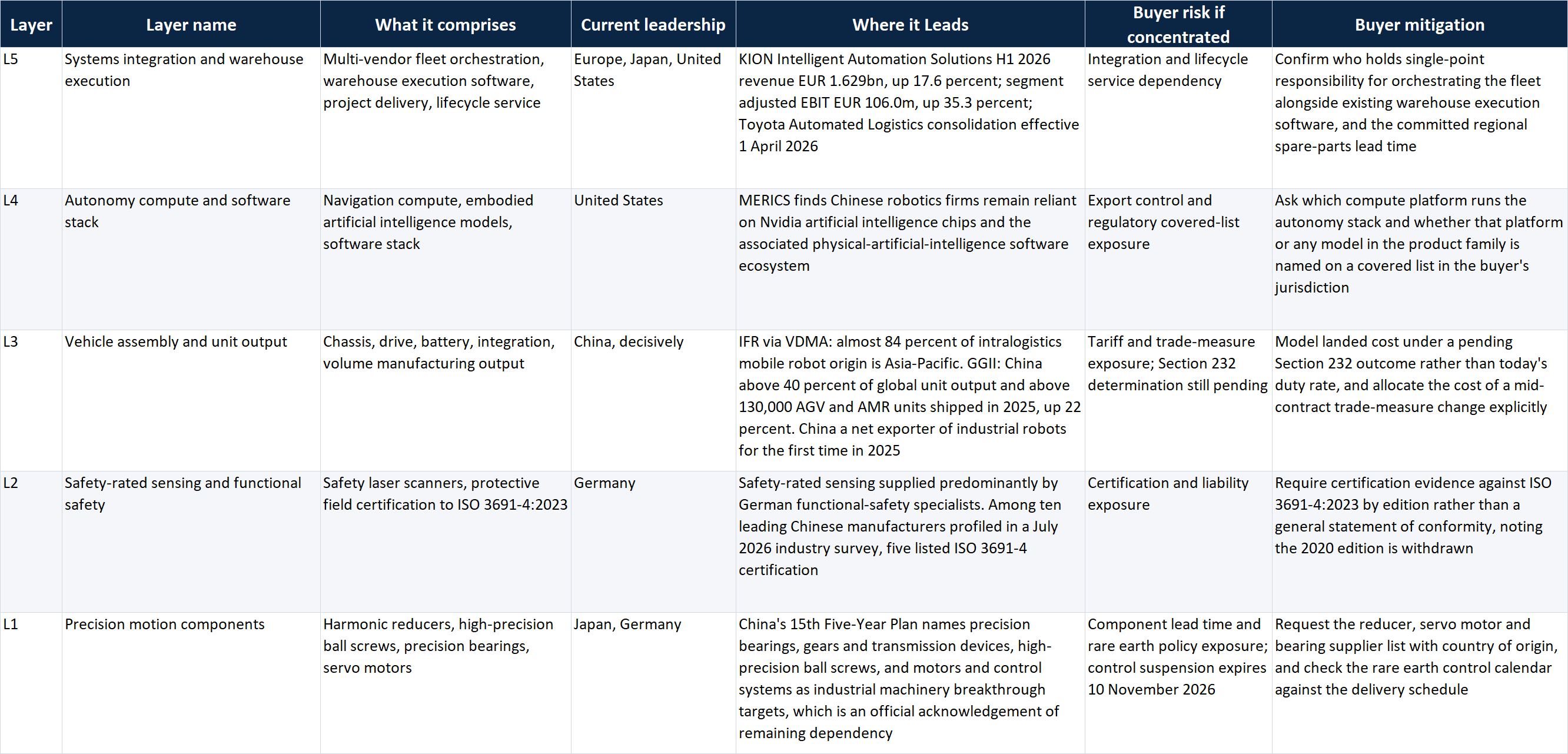
At the base sits precision motion: harmonic reducers, high-precision ball screws, precision bearings, and servo motors. Leadership here remains Japanese and German, and the most persuasive evidence is Chinese policy itself. The 15th Five-Year Plan names precision bearings, gears and transmission devices, high-precision ball screws, and motors and control systems as breakthrough targets under its industrial machinery priorities. A state does not designate a component category for a national breakthrough programme unless the domestic supply is not yet sufficient.
Above that sits safety-rated sensing and functional safety certification, where German specialists retain the position described above. The third layer, vehicle assembly and unit output, is where Chinese leadership is decisive and quantified: the origin share, the production share, the shipment volumes, and the net-exporter crossover all sit at this layer. The fourth layer, autonomy compute and the software stack, is a United States stronghold. Research by the Mercator Institute for China Studies finds Chinese robotics firms remain reliant on Nvidia artificial intelligence chips and the associated physical-artificial-intelligence software ecosystem, even as they localise hardware rapidly. The fifth and highest layer is systems integration and warehouse execution, where the KION, Toyota Automated Logistics, and Interact Analysis revenue evidence all point in the same direction.
Read as a stack, the pattern is that leadership migrates down. China's position strengthens as the layer moves closer to physical assembly and weakens at both extremes, at the precision components beneath and the integration value above. This is the structural reason a country can originate the large majority of units while capturing roughly a quarter of revenue.
The limitations of this framework should be stated plainly. The layer assignments are qualitative judgements built on evidence of unequal precision. The assembly layer rests on explicit unit-share data, whereas the component and safety layers rest on policy-target documents and certification-listing counts, because no primary body publishes component-level market share for this asset class. The evidence base also mixes asset classes, using industrial robot data only where mobile robot equivalents do not exist and labelling it accordingly. Company disclosures are not directly comparable: KION reports full warehouse automation projects, Teradyne reports collaborative arms and mobile robots combined, and Chinese manufacturers report mobile robots alone. Those scopes differ and this analysis does not rank them against one another.
What This Means for Buyers
The practical consequence is that no buyer purchases from a country. Every deployment is a bundle spanning all five layers, and the sourcing geography of each layer carries a distinct risk type that a single-vendor conversation tends to obscure.
Regulatory exposure has become the most volatile of these. On 28 July 2026 the United States Federal Communications Commission added advanced robotic devices to its Covered List alongside foreign-produced connected power inverters, with the measures effective on publication. The scope reported for this action covers new humanoid and quadruped robot models and applies only to models not yet authorised, and non-Chinese suppliers are expected to be exempted as they were under earlier restrictions on foreign drones and routers. Warehouse AMR and AGV models were not named. The significance for mobile robot buyers is precedent rather than immediate prohibition: a regulator has now established advanced robotic devices as a Covered List category and justified it on the grounds that connected robots collect data and can be remotely commandeered. Those grounds are not specific to leg count.
Trade measures remain unresolved in a way that should be modelled rather than assumed away. The Section 232 national security investigation into robotics and industrial machinery imports, opened in September 2025, remained pending with no robotics tariff imposed as at 3 August 2026, which is this analysis's information cut-off. Separately, Chinese export controls on seven categories of medium and heavy rare earth materials are suspended until 10 November 2026. Rare earth permanent magnets sit inside the traction and lift motors of mobile robots, which makes that date a live procurement planning date rather than a geopolitical abstraction. A landed-cost model built on today's duty rate is not a forecast.
The margin evidence suggests where negotiating leverage currently sits. Jungheinrich cut its full-year 2026 earnings guidance in July, lowering expected earnings before interest and taxes to a range of EUR 340 million to EUR 400 million from EUR 380 million to EUR 450 million, citing among its reasons a continuing highly competitive market environment, while explicitly leaving its Automation and Warehouse Equipment segment forecast unchanged. KION grew automation revenue 18 percent while automation order intake fell 17 percent against a record prior-year comparison. Read together, the incumbent pattern is revenue held and margin compressed, with the automation and integration layer defended. Buyers should expect competitive pricing on vehicles and firmer pricing on integration.
Supplier questions that convert the layer analysis into a procurement conversation
· Which company manufactures the reducers, servo motors, and precision bearings in this vehicle, and in which country are they produced?
· Can you provide certification evidence against ISO 3691-4:2023 by edition, rather than a general statement of conformity?
· Which compute platform runs the autonomy stack, and is that platform or any model in this product family named on a regulatory covered list in our jurisdiction?
· If a trade measure changes the landed cost between order and delivery, which party carries that cost under the contract?
· Who holds single-point responsibility for orchestrating this fleet alongside our existing warehouse execution software, and what is the committed spare-parts lead time in our region?
The Bottom Line
The production shift is settled at the layer where units are assembled and remains contested at the layers where value is captured. For procurement teams, this argues against framing the decision as a choice between Chinese and Western suppliers and in favour of pricing each layer of the bundle separately, because that is how the risks actually arrive. The vehicle is increasingly a commodity, the integration is not, and the components beneath and the compute above are where policy can intervene without warning. The buyers who will look prudent in eighteen months are the ones writing trade-measure and certification-edition clauses into contracts signed this quarter, not the ones who secured the lowest unit price in a market where the unit price was never the exposure.
Disclaimer
This article is provided for general information and industry analysis only. It does not constitute investment, procurement, legal, or professional advice, and no reader should act on it without independent verification and appropriate professional guidance. Market figures, shipment volumes, revenue disclosures, price relationships, regulatory statuses, and trade measures cited here reflect the sources available as at the information cut-off of 3 August 2026 and may change without notice. Company financial figures are drawn from published disclosures whose segment scopes differ and which are not directly comparable with one another. Regulatory and trade positions described here, including the pending Section 232 determination and the rare earth export control suspension expiring 10 November 2026, are time sensitive and should be re-verified before any commercial decision.