China's Mineral Law and AI Consumption Plan: Two Policies That Reshape the Robot Supply Chain
Two policy moves in June 2026 — China's new Mineral Resources Law regulation (effective June 15) and the Ministry of Commerce's "AI Plus Consumption" plan (released June 19) — are pulling the global robotics supply chain in opposite directions. One tightens China's grip on the rare earth and strategic mineral inputs that robots require. The other subsidizes Chinese consumers to buy the robots those minerals help build.

Two Policies, One Direction
On June 15, 2026, China's new Mineral Resources Law implementation regulation came into force. Four days later, the Ministry of Commerce released an "AI Plus Consumption" plan with 17 measures to embed robots and AI assistants into everyday Chinese life. The two policies look unrelated. They are not.
The mineral law centralizes state control over the rare earths, gallium, graphite, and tungsten that go into every robot actuator, battery, and sensor. The consumption plan subsidizes Chinese households and businesses to buy the robots those minerals help build. Together, they form a coherent industrial strategy: control the inputs, stimulate the domestic market, and use both levers to maintain the cost and supply chain advantages that make Chinese robots globally competitive.
The Mineral Law: What Changed on June 15
The Mineral Resources Law implementation regulation — approved by China's State Council on May 9, released May 20, and effective June 15 — is not a routine mining rulebook. It creates a centralized national-security framework that links mining rights, strategic reserves, emergency supply powers, export controls, and foreign investment review into a single legal structure.
The most consequential provision for the robotics industry is the three-layer strategic reserve system. China will now maintain product stockpiles of finished mineral materials, capacity reserves of production capability that can be activated in emergencies, and origin reserves of protected deposits held as strategic options. For rare earth elements — which are essential for the permanent magnets in robot servo motors and actuators — this means China is not merely storing material. It is storing optionality: the ability to surge or restrict supply based on geopolitical conditions.
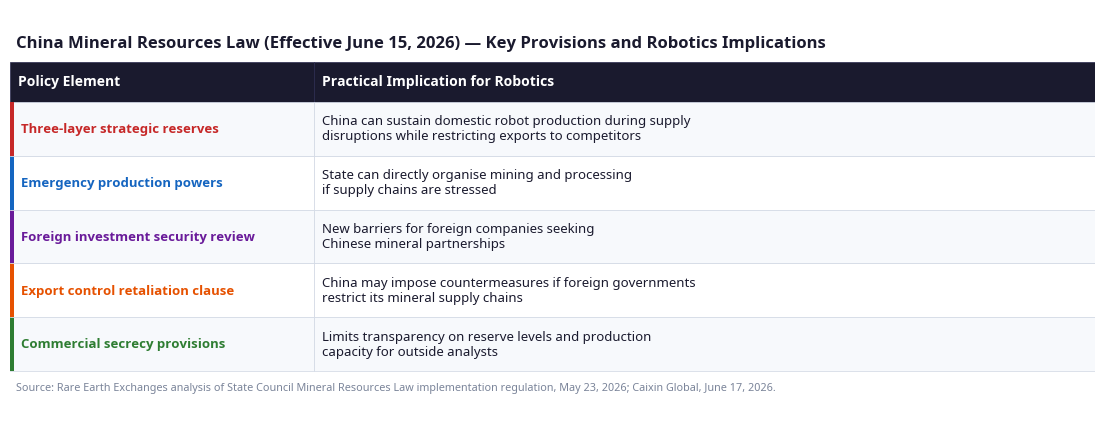
The regulation matters for robotics specifically because China controls approximately 70% of global rare earth mining and close to 90% of processing capacity. The permanent magnets in robot servo motors — which require neodymium, dysprosium, and terbium — have no near-term substitute at scale. McKinsey's June 2026 humanoid supply chain report identified magnets as the single component category where China is "massively dominant," with other categories such as bearings, sensors, and driver boards showing more diversified global supply.
The AI Plus Consumption Plan: Robots Into Millions of Homes
The Ministry of Commerce plan, released June 19 in coordination with seven other ministries, targets a different end of the supply chain. Its 17 measures aim to embed AI and robots into consumer life through new smart products, subsidies, infrastructure, and standards. The stated goal is to promote AI's entry into "millions of households and millions of shops."
At the center of the push are robots and AI life assistants — humanoid, quadruped, bionic, elderly-care, and companion machines. The plan proposes incorporating these products into consumer trade-in subsidy programs and offering interest subsidies for consumer loans. This mirrors the subsidy mechanism that drove Chinese EV adoption: reduce the upfront cost barrier, generate volume, and use that volume to drive down manufacturing costs further.
The timing is not coincidental. China's retail sales shrank for the first time since 2022 in May 2026, according to Caixin Global's June 16 report. The AI Plus Consumption plan is partly a demand stimulus measure dressed in technology policy language.
The Bigger Signal
The two policies create a structural pincer. The mineral law ensures that Chinese robot manufacturers have secure, cost-advantaged access to the inputs that Western manufacturers must source from China or pay premium prices to source elsewhere. The consumption plan ensures that Chinese robot manufacturers have a subsidized domestic market to generate the volume needed to drive costs down further.
"China is not just building robots. It is building the conditions under which Chinese robots are the only ones that can be built at competitive cost — and then subsidizing the market to buy them."
For Western robot manufacturers and integrators, the practical question is not whether to engage with the Chinese supply chain but how to manage the dependency. McKinsey's report shows that China's dominance is near-total in magnets and significant but not overwhelming in other categories. The companies that will navigate this best are those that identify which components can be sourced outside China at acceptable cost premiums and which cannot — and build their supply chain strategy around that honest assessment rather than around political preference.
What the Hard Truth Is
Most coverage of China's mineral controls focuses on the geopolitical risk. The harder truth is that the risk is already priced into the supply chain: Western humanoid manufacturers are already paying $84,000 more per robot than Chinese manufacturers because they cannot access Chinese components at Chinese prices. The mineral law does not create that gap. It institutionalizes it.
The AI Plus Consumption plan is the more underreported story. If Chinese consumers begin adopting companion and elderly-care robots at scale — driven by subsidies and an aging population — the volume effect on Chinese manufacturing costs will be larger than any government R&D program. Mass consumer adoption is what drove EV battery costs from $1,200 per kWh in 2010 to under $100 per kWh today. The same dynamic, applied to robot actuators and sensors, would compress costs in ways that no Western manufacturer can match without equivalent domestic volume.
SOURCES:
1 Rare Earth Exchanges, "Beijing Tightens Its Grip on Strategic Minerals With Sweeping New Mining Rules," May 23, 2026. https://rareearthexchanges.com/news/beijing-tightens-its-grip-on-strategic-minerals-with-sweeping-new-mining-rules/
2 Caixin Global, "China Tightens Control Over Strategic Minerals With Sweeping New Rules," June 17, 2026. https://www.caixinglobal.com/2026-06-17/china-tightens-control-over-strategic-minerals-with-sweeping-new-rules-102455094.html
3 South China Morning Post, "Rise of Robots: China Releases Plan Aimed at Increasing Consumers' AI Options," June 19, 2026. https://www.scmp.com/tech/policy/article/3357676/rise-robots-china-releases-plan-aimed-increasing-consumers-ai-options
4 Caixin Global, "China Retail Sales Shrink for First Time Since 2022," June 16, 2026.
5 Forbes, "Why Some US Robot Makers Are Reducing Dependence on China," June 17, 2026. https://www.forbes.com/sites/johnkoetsier/2026/06/17/why-some-us-robot-makers-are-reducing-dependence-on-china/
6 Strategic Metals Invest, "China Export Controls: Critical Minerals," June 18, 2026. https://strategicmetalsinvest.com/china-export-controls-critical-minerals/