


DESCRIPTION
Galileo Ex2 is an Industrial-Robot from Galileo Technology. It is built for Inspection, Monitoring, Transport. Key figures: 120 kg, 420 min runtime, 100 kg payload, 12 degrees of freedom.
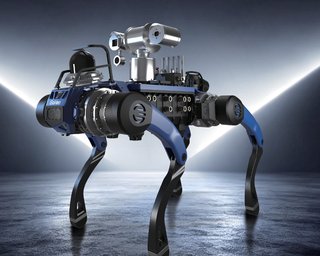
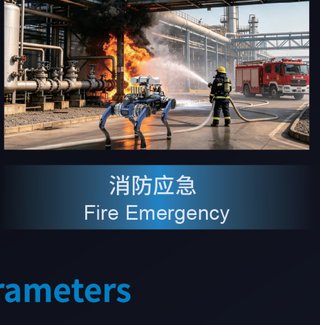
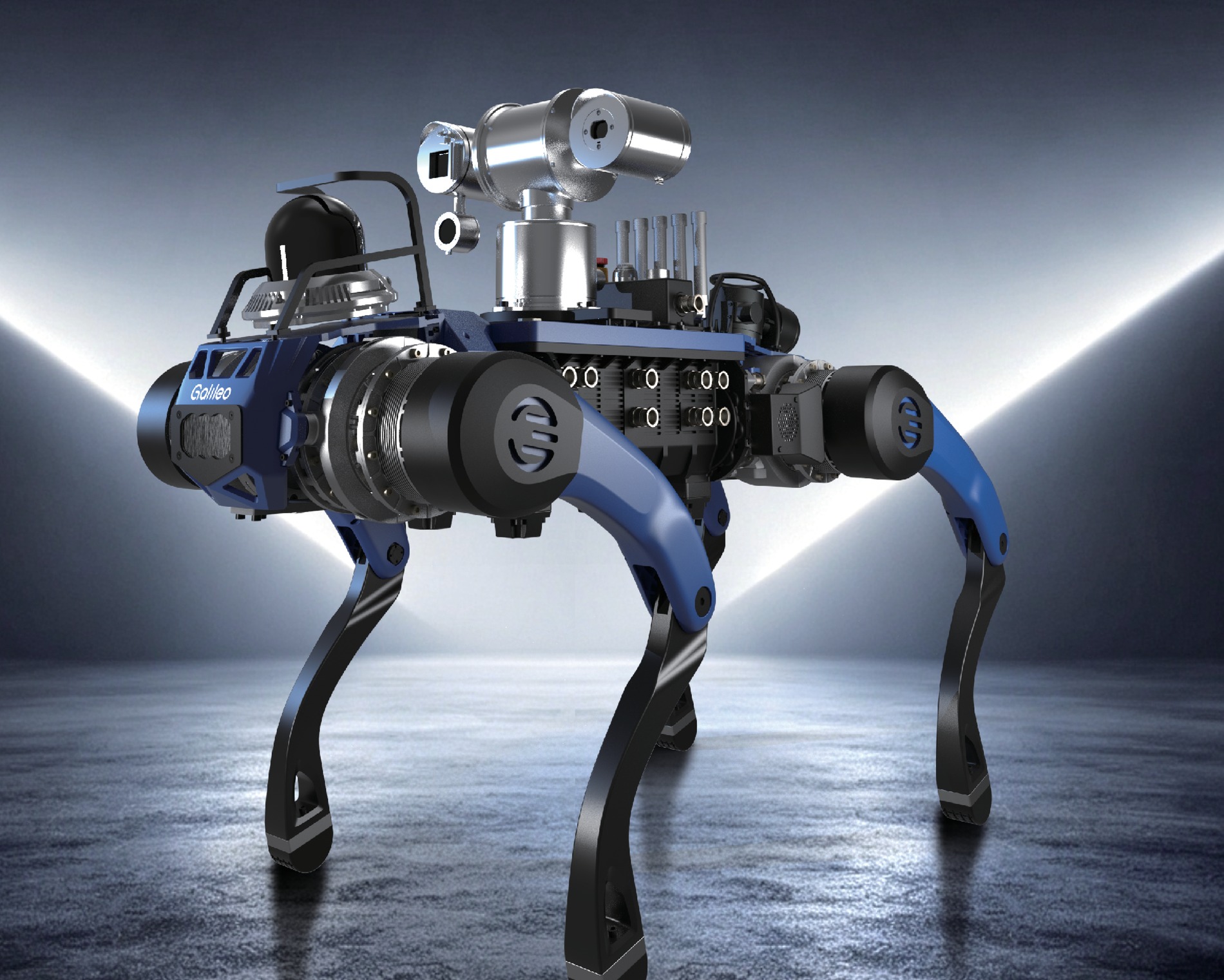
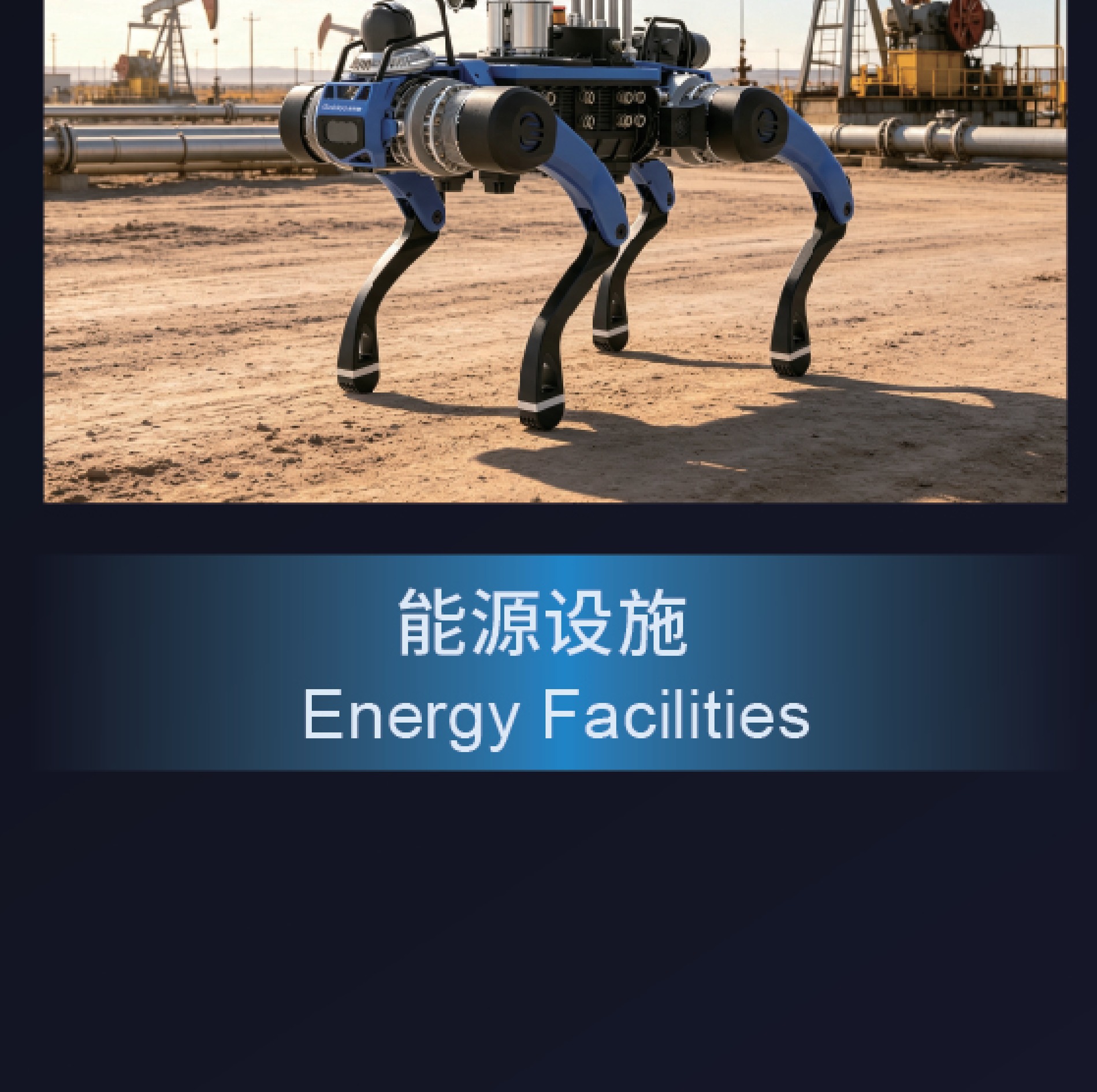
The Galileo Ex2 is an explosion-proof quadruped, and that certification is what separates it from every other legged robot in the company's range. Rated Ex II B T4 Gb, it is built to walk into places where an ordinary robot's electronics would be an ignition source: hazardous-chemical warehouses, petrochemical plants, refineries, LNG stations and live firefighting emergencies. The enclosure is fully insulated and explosion-proof, and the payload bay is modular so sensors, robotic arms or fire-suppression hardware can be swapped at the site rather than the factory. At 1,330 mm long and about 120 kg it carries 100 kg, climbs 35-degree slopes and 30 cm steps, crosses 50 cm ditches and runs seven hours — the longest endurance Galileo publishes for any of its machines. Sensing combines LiDAR with dual depth cameras, explosion-proof gimbals, infrared cameras and gas telemetry, feeding AI decision-making for real-time path planning and obstacle avoidance, while an operator can take remote control for search-and-rescue work.
FEATURES
- Ex II B T4 Gb explosion-proof rating with a fully insulated explosion-proof enclosure
- 1,330 x 610 x 880 mm at approximately 120 kg
- 100 kg load capacity
- IP66 protection
- 12 degrees of freedom on a 48 V supply
- Maximum walking speed of 1.5 m/s
- Maximum climb angle of 35 degrees, 30 cm step climbing and 50 cm ditch crossing
- 7 hour endurance, the longest in the Galileo range
- Modular payload bay for quick swapping of sensors, robotic arms and fire-suppression hardware
- LiDAR with dual depth cameras, explosion-proof gimbals, infrared cameras and gas telemetry sensors
- AI decision-making for real-time path planning, obstacle avoidance, target tracking and material transport
- Autonomous navigation and obstacle avoidance supported
- remote teleoperation for search-and-rescue and hazardous-site inspection
- Optional wireless charging
TECHNICAL SPECIFICATIONS
| Physical | |
| Weight | 120 kg |
|---|---|
| Dimensions | L 1.33 m × W 610 mm × H 880 mm |
| Payload | 100 kg |
| Mobility | |
| Movement Type | Quadruped |
| Degrees of Freedom | 12 |
| Speed | 5.4 km/h |
| Environment | Explosive-hazard zones rated Ex II B T4 Gb; IP66; rough ground, stairs and slopes |
| Actuators | Bionic quadruped with 12 degrees of freedom in a fully insulated explosion-proof enclosure with a modular payload bay |
| Power | |
| Battery Life | 7 h |
| Sensing & Compute | |
| Sensors | LiDAR x1, dual depth cameras, explosion-proof gimbal, infrared camera, gas telemetry sensor |
| Software / AI | AI decision-making algorithms for real-time path planning, obstacle avoidance, target tracking and material transport; remote teleoperation |
TECHNICAL SPECIFICATIONS
| Physical | |
| Weight | 120 kg |
|---|---|
| Dimensions | L 1.33 m × W 610 mm × H 880 mm |
| Payload | 100 kg |
| Mobility | |
| Movement Type | Quadruped |
| Degrees of Freedom | 12 |
| Speed | 5.4 km/h |
| Environment | Explosive-hazard zones rated Ex II B T4 Gb; IP66; rough ground, stairs and slopes |
| Actuators | Bionic quadruped with 12 degrees of freedom in a fully insulated explosion-proof enclosure with a modular payload bay |
| Power | |
| Battery Life | 7 h |
| Sensing & Compute | |
| Sensors | LiDAR x1, dual depth cameras, explosion-proof gimbal, infrared camera, gas telemetry sensor |
| Software / AI | AI decision-making algorithms for real-time path planning, obstacle avoidance, target tracking and material transport; remote teleoperation |
Images
 martti
 martti
 martti
 martti
 martti
Image Contributions
Videos
ROBOT FORUMS
Loading forums...
RATINGS
FREQUENTLY ASKED QUESTIONS
What is the Galileo Ex2?
The Galileo Ex2 is an explosion-proof quadruped, and that certification is what separates it from every other legged robot in the company's range.
Who makes the Galileo Ex2?
The Galileo Ex2 is made by Galileo Technology, a robotics company based in China.
How much does the Galileo Ex2 cost?
Galileo Technology has not publicly announced pricing for the Galileo Ex2. You can enquire through RobotAIGeek for current pricing.
What is the Galileo Ex2 used for?
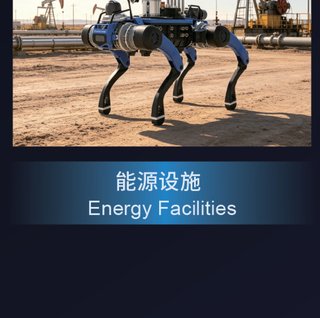
The Galileo Ex2 is designed for inspection, monitoring, transport, and firefighting emergency response. It is used in energy, manufacturing, and security & patrol settings.
What is the payload capacity of the Galileo Ex2?
The Galileo Ex2 has a payload capacity of 100 kg.
How much does the Galileo Ex2 weigh?
The Galileo Ex2 weighs 120 kg.
How fast is the Galileo Ex2?
The Galileo Ex2 can move at speeds of up to 5.4 km/h.
What is the battery life of the Galileo Ex2?
The Galileo Ex2 runs for 7 h on a charge.
COMPARE WITH SIMILAR ROBOTS
See how this robot stacks up against its closest alternatives
- Galileo Ex2 vs MagicDog Y1
- Galileo Ex2 vs Galileo S1
- Galileo Ex2 vs Galileo S1-W
- Galileo Ex2 vs Hypertron T01
- Galileo Ex2 vs MOVENEW P1