
Xiaomi’s Humanoid Factory Trial Is Progress, Not Proof of Full Autonomy
Xiaomi reports high station success rates for its humanoid robot on three automotive factory tasks, including flexible interior covers and box folding. The evidence shows bounded station progress with meaningful manipulation content, but lacks cycle, uptime, intervention, and cost data required to claim broad labor replacement.
Xiaomi’s Humanoid Factory Trial Is Progress, Not Proof of Full Autonomy
Xiaomi’s humanoid factory trial matters because it moves the discussion from walking robots in demos to repeated contact with awkward automotive parts, factory work orders, and imperfect material handling conditions. That is the right arena for judging industrial humanoids, but it is also where the limits become clearer. The trial shows meaningful steps in compliant manipulation and two arm coordination, and it shows integration with factory systems. It does not provide the full production evidence set that manufacturing buyers use to size cost, risk, and staffing impact across a shift or a quarter.
What Xiaomi’s Trial Does and Does Not Prove for Auto Assembly
Buyers asking whether Xiaomi proved humanoids can replace workers across automotive assembly should answer no. Xiaomi reported strong station level progress in three bounded tasks, yet did not publish cycle time, throughput, total operating hours, part volume, intervention rate, cost per task, or commercial availability. That leaves the economic case unproven.
Xiaomi reported that its humanoid robot reached a 98 percent bilateral operation success rate at a self tapping nut loading station after one quarter, one percentage point below the stated human operation pass rate. The program then moved to two final assembly logistics tasks: sorting centre console side covers, and folding and recycling material boxes. For each of those new tasks, Xiaomi reported a 90 percent success rate.
Why does this matter if it is not full autonomy? Because the cover sorting task involves large, irregular, flexible automotive workpieces. That forces the robot to combine whole body motion, balance, compliant contact, two hand coordination, end force sensing, and in hand adjustment. Those are meaningful capabilities for stations where parts bend, jam, catch, and refuse to behave like computer aided design models.
Think of the trial like a new driver tested on three fenced courses rather than granted a license for every road. The robot shows it can handle defined routes and recover from some awkward contacts, but factory autonomy requires evidence across longer shifts, more parts, failures, and economics.
What should procurement teams take from it now? Treat the results as evidence of improving manipulation quality and systems integration in constrained stations, not as evidence of broad autonomous factory labor. The next questions should center on station uptime, cycle economics, intervention thresholds, recovery logs, safety validation, maintenance burden, and integration cost.
A Bounded Factory Trial With Real Manipulation Content
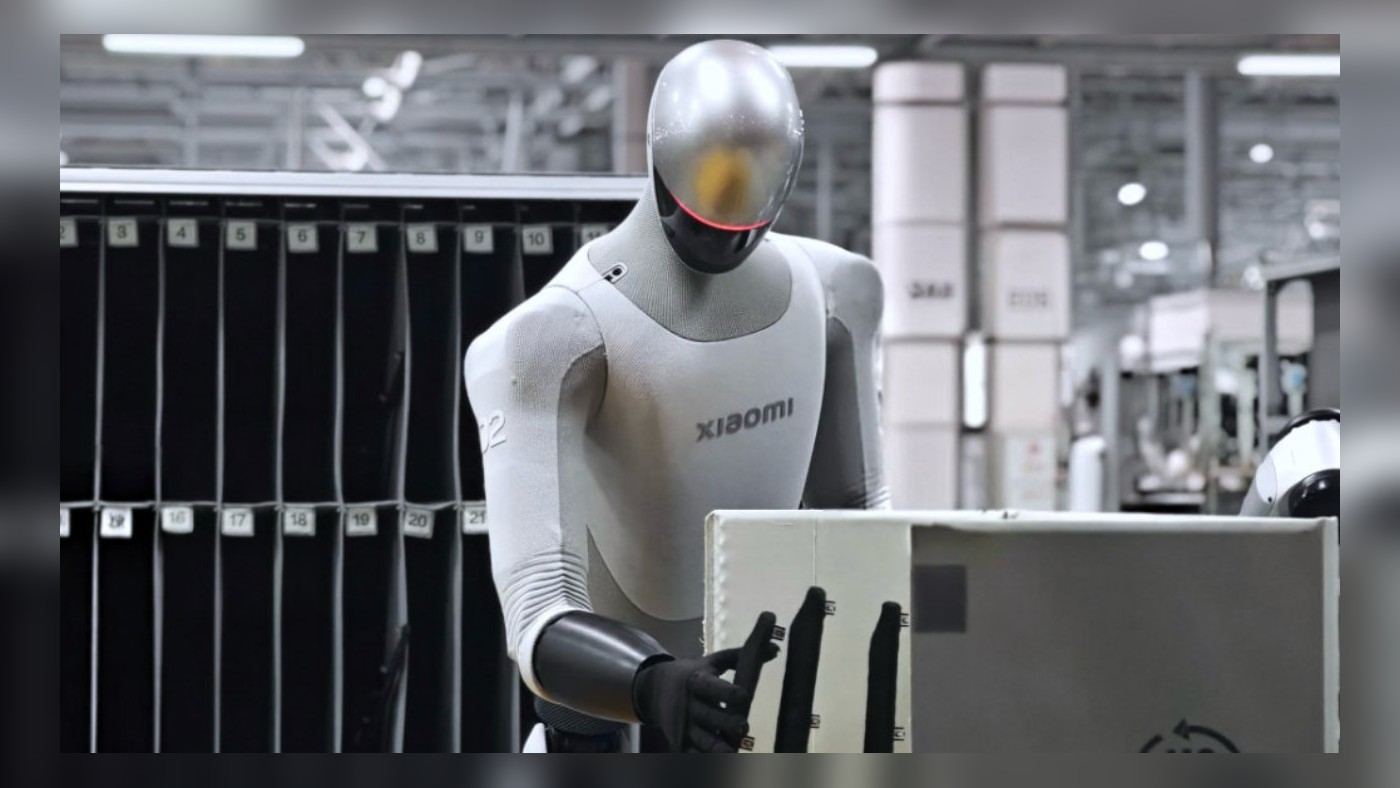
Xiaomi, the Beijing headquartered consumer electronics and electric vehicle manufacturer expanding into proprietary humanoid robotics, disclosed a factory trial in its automotive plant through a Xiaomi Robotics Division article dated 14 July 2026. The robot began earlier in the year at a self tapping nut loading station. After one quarter, Xiaomi reported that the station’s bilateral operation success rate reached 98 percent, one percentage point below the stated human operation pass rate.
The robot was then moved into two final assembly logistics tasks. The first involved sorting centre console side covers. The second involved folding and recycling material boxes. Xiaomi reported a 90 percent success rate for each of those new tasks. This sequence reflects a measured transfer from a fastener related station to two logistics tasks with different object behaviors, fixture interactions, and visual occlusion.
The cover sorting task is the more technically instructive. Xiaomi describes it as the first time its robot has sustained long duration work on flexible automotive workpieces. The robot must retrieve a specified cover from a three row bin and place it into the corresponding slot of a rack cart. This is not just pick and place in the conventional sense. Large, irregular, flexible parts can deform during grasping, snag on neighbouring parts, catch during insertion, and shift in ways that are hard to model in advance.
Xiaomi says the robot uses whole body motion control, balance while reaching for distant parts, compliant contact control based on end force sensing, two hand cooperation, and fine in hand adjustment using proprioception in the dexterous hand. The active compliance strategy is meant to let the robot recover when a cover catches or jams during placement rather than forcing a brittle stop at the first unexpected contact. These are the ingredients that matter when rigid assumptions fail and the robot must adapt within a safe envelope.
The material box task is less visually dramatic but operationally relevant. The robot opens tabs, folds boxes, coordinates both arms at production cadence, pushes stacks of folded boxes, and coordinates timing across multiple robot cells. Xiaomi says the multi robot operation is running stably in the trial environment. In practice, this points to timing, area sharing, and work status communication between robots, all governed by upstream and downstream signals.
The robots also connect to factory systems. In the cover task, the system tells the robot which cover to retrieve and which rack slot to use. At the box folding station, robots synchronize status through the factory system. Xiaomi also states that remote intervention is retained for dangerous or irreversible failures. That combination of integration and safeguarded oversight is a sensible maturity posture for stations with flexible parts.
That last point is not a weakness to hide. It is the correct way to read the maturity level. Industrial automation earns trust through defined boundaries, known failure modes, and engineered recovery paths. A humanoid that is still learning reliable manipulation around flexible parts should have remote intervention paths, fault handling, and conservative escalation rules. Buyers should expect this and then press for the numbers that make those interventions manageable at scale.
What 98 Percent Station Success Still Does Not Tell You
A 98 percent reported success rate at a bounded station is a useful achievement. It is not the same as full factory autonomy. The company did not publish the production KPIs that tie station success to line economics.
· Station success is not line economics. Xiaomi did not publish cycle time, throughput, units handled, total runtime hours, or labor equivalent cost. A station can be highly accurate and still miss the economic target if each cycle is too slow, if failures take too long to recover, or if supervision cost offsets labor savings.
· Success rate is not the same as intervention rate. Xiaomi disclosed that remote intervention remains available for dangerous or irreversible failures. That is appropriate, but buyers need to know how often intervention is required, what qualifies as reversible, how long recovery takes, and whether remote support can cover multiple deployed cells at scale.
· One station does not generalize across the plant. The self tapping nut loading station, the cover sorting task, and the material box task each have specific geometry, fixtures, work instructions, and failure modes. A humanoid may perform well in one bounded process and struggle with another task that appears similar to a non specialist.
· The 90 percent success rate in the newer logistics tasks is not yet a mature production benchmark. In high volume automotive operations, a 10 percent unsuccessful task rate can be a major burden unless failures are low risk, quickly recoverable, and isolated from line flow. Xiaomi’s disclosure does not provide enough detail to calculate the operational cost of those unsuccessful attempts.
· The robot still uses a workaround in the box folding task. Xiaomi states that to fold the second face of a box, the robot first reorients the box so the tab faces the robot. An experienced worker can open the tab without that extra step. Xiaomi plans to improve the biomimetic dexterous hand and test that skill later. This is exactly the type of detail buyers should value. It shows where robotic dexterity still lags human hand skill in seemingly simple work.
· A company posted uncut video is useful supporting material, but it is not independent certification. The companion video page describes the cover sorting footage as continuous and uncut and repeats the claim that this is Xiaomi Robotics’ first long duration flexible workpiece operation in an automotive factory. That helps viewers assess the station behavior shown, but it does not replace audited uptime, safety, cycle, maintenance, and intervention data.
“Xiaomi’s trial should be treated as a manipulation and recovery milestone, not a labor replacement milestone. The commercial proof will come when station success is paired with cycle time, uptime, intervention rate, safety validation, and cost per completed task.”
How It Compares With BMW Figure Robot
BMW Figure Robot ("Figure") reported an eleven month deployment, active assembly line deployment within ten months, operation every working day, 10 hour weekday shifts, more than 90,000 parts loaded, more than 1,250 runtime hours, and contribution to more than 30,000 BMW X3 vehicles. The task was sheet metal loading.
Figure also reported a key performance indicator set: an 84 second total cycle, a 37 second loading requirement, more than 99 percent successful placement per shift, and zero human interventions per shift. These are company reported figures, not independent audit results. The emphasis is on shift structure, volume, and cycle targets that buyers can compare to takt time.
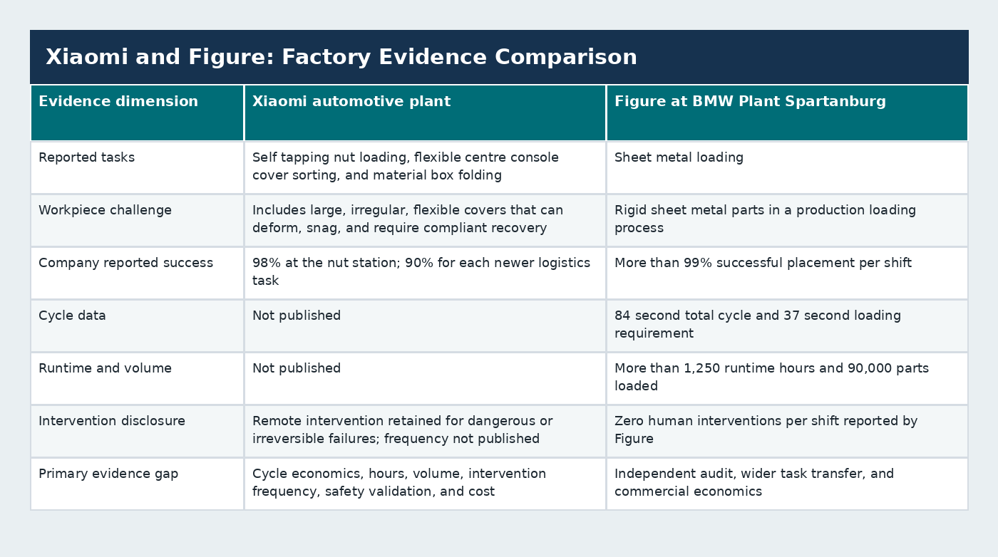
For buyers, the difference is evidence shape and object class. Figure disclosed more operational metrics that manufacturing teams can test against production schedules and throughput. Xiaomi disclosed station success rates and technical details around flexible part handling, but not cycle, hours, volume, or intervention rate. Xiaomi’s cover task places more emphasis on deformation, snag recovery, in hand adjustment, and compliant insertion. Figure’s account places more emphasis on sustained line participation, cycle KPI reporting, and intervention free shifts.
A procurement manager should not ask which company is ahead based on these disclosures alone. The better question is which evidence set is closer to the buyer’s own station risk. If the need is repetitive rigid part loading with strict cycle reporting, Figure’s disclosed KPI format is more directly relevant. If the need is handling of awkward flexible interior parts, Xiaomi’s trial speaks to a harder manipulation class, but the economic data gap remains material.
Questions buyers should ask before budgeting
Xiaomi’s trial supports a more disciplined buying framework for humanoid robots in automotive environments. The following evidence should be requested before any purchase decision or paid pilot expansion.
1. Cycle time by task state
Ask for nominal cycle time, recovery cycle time, and worst case cycle time. A 90 percent success rate can be acceptable or unacceptable depending on how long the remaining cases take and whether they block production.
2. Intervention frequency and severity
Remote intervention is not a problem by itself. The missing data is frequency, duration, staffing ratio, and failure classification. Buyers should distinguish between advisory remote support, human approval, manual reset, and physical rescue.
3. Uptime and maintenance windows
Ask for operating hours, mean time between stoppages, battery or charging strategy, hand wear, sensor cleaning requirements, calibration effort, and spare part needs.
4. Fixture and packaging dependency
If a humanoid works only after bins, racks, cartons, and slot tolerances are adjusted, those costs belong in the project model. In many factories, changing the work environment can be more expensive than the robot.
5. Safety case and cell design
Humanoids working near people, carts, bins, and line side logistics need clear safety analysis. Buyers should ask how force limits, reach envelopes, remote intervention, emergency stops, and human entry into the work area are handled.
6. Transfer to adjacent tasks
Do not assume that success in cover sorting transfers to other interior trim parts. Request a structured task transfer test with parts that vary in stiffness, size, occlusion, and insertion tolerance.
7. Data ownership and auditability
Station logs should be exportable and reviewable. If success rates are only summarized by the vendor, buyers cannot validate improvement or diagnose losses.
The Practical Meaning and Next Proof Point
Xiaomi has shown that its humanoid program is not only a corporate research image project. The disclosed factory trial has real manufacturing content: bilateral work, flexible part contact, compliant recovery, two arm coordination, box folding, multi robot synchronization, and factory system linkage.
At the same time, the disclosure stops short of what procurement teams need for a production investment case. Xiaomi reported success rates, but not the operating data that converts capability into costed deployment. The strongest reading is measured progress in bounded automotive stations, not proof of general purpose humanoid labor. That distinction matters because humanoid robotics is entering a phase where the market will reward evidence quality.
Videos will still attract attention, but manufacturing buyers will compare cycle time, uptime, intervention burden, safety approval, integration cost, and task transfer. Figure’s BMW disclosure is stronger on operational KPI detail. Mercedes and Apptronik show a strategic pilot path with teleoperation and employee knowledge transfer. Xiaomi contributes a valuable signal on flexible part manipulation and compliant recovery, with clear remaining evidence gaps.
For automation buyers, the Xiaomi trial should raise interest, not loosen standards. The right response is to ask sharper questions, define station acceptance criteria, and require data that links robot motion to factory economics. Xiaomi has moved the humanoid conversation closer to the production floor. The next credible milestone is audited, repeatable performance under buyer relevant operating conditions.
This analysis synthesizes official company statements and publicly available operating disclosures.
Disclaimer: This analysis is for informational purposes only and does not constitute investment, financial, or procurement advice. The views expressed are based on public information and industry trends as of the publication date. No vendor is endorsed, and no technology performance is guaranteed.














