
Xiaomi Releases Robotics-1 With 100,000 Hours of Embodied Training Data
Xiaomi Robotics has released the Robotics-1 Vision-Language-Action model, trained on over 100,000 hours of real-world trajectories to address the data scarcity bottleneck in embodied AI.
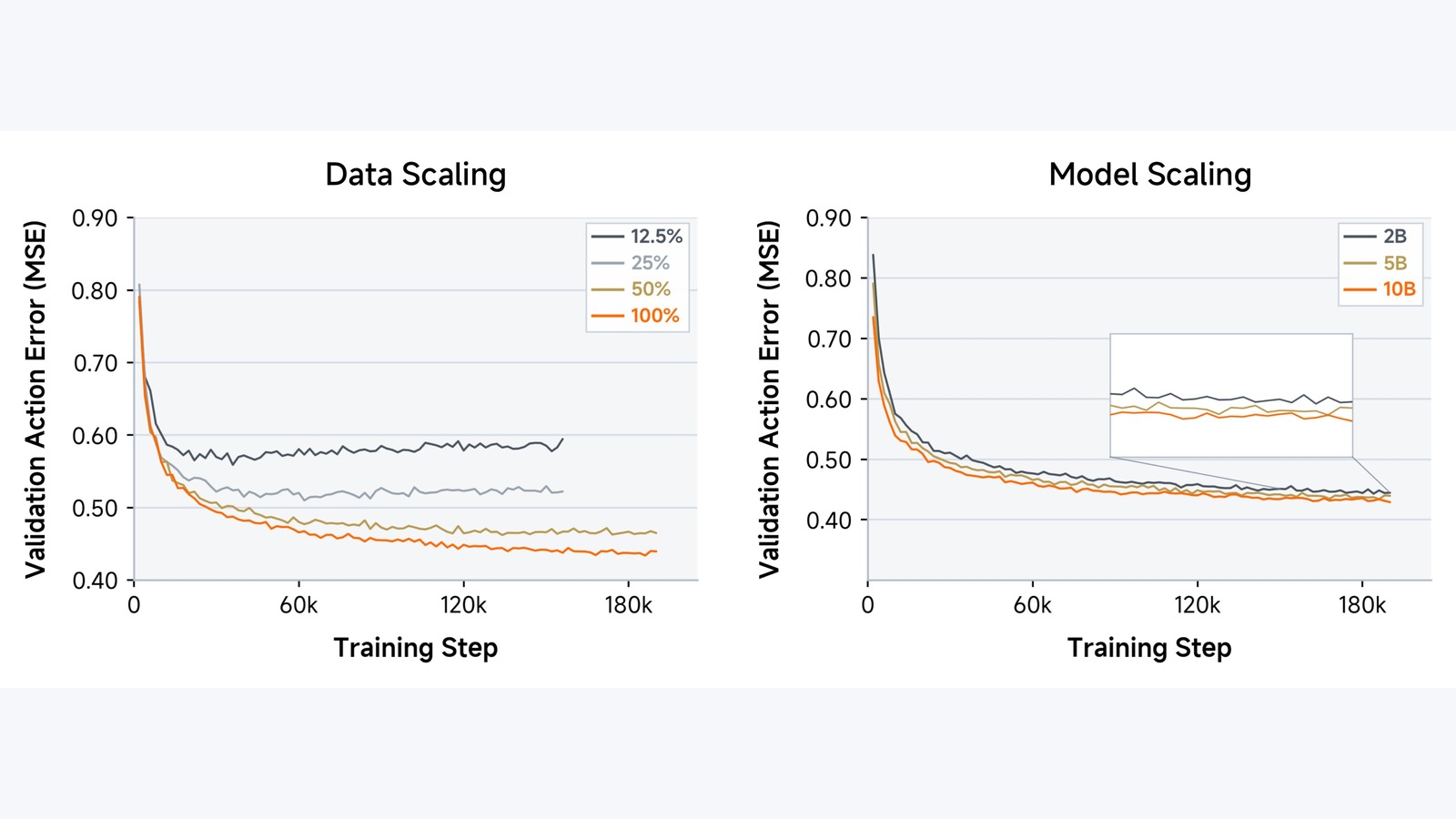
The robotics industry has largely missed out on the artificial intelligence scale boom due to a fundamental constraint: data scarcity. While large language models ingest the entire internet, traditional robot trajectory labeling requires manual segmentation by task semantics and language annotations. This labor-intensive process has capped how far policy models could scale. On July 16, 2026, Xiaomi Robotics released Xiaomi-Robotics-1, a ready-to-use robot foundation model trained on over 100,000 hours of real-world manipulation trajectories, demonstrating that large-scale embodiment-free pre-training can break the robot data bottleneck.
Xiaomi Robotics, the robotics division of the global consumer electronics and smart manufacturing company, focuses on developing advanced robotic systems and embodied artificial intelligence. The release of Xiaomi-Robotics-1 represents a significant step in their effort to build scalable, general-purpose robot control models. The model is designed for mobile manipulation tasks in real-world environments, such as household chores including tidying a sofa, sorting a shoe cabinet, putting away kitchenware, phone packing, printer refilling, laundry loading, and box packing. The core technical achievement is the demonstration that large-scale embodiment-free pre-training can break the robot data bottleneck, enabling predictable scaling that translates to better out-of-the-box real-robot performance.
What does Xiaomi’s data and benchmark evidence establish, and what still remains unproven outside the reported evaluation settings?
Xiaomi’s evidence establishes that large-scale embodiment-free pre-training improves out-of-the-box real-robot performance and enables high data efficiency, achieving a 75 percent success rate with under 10 hours of demonstrations per task. However, the model’s reliability in unstructured, novel environments outside the reported evaluation settings remains unproven, as the post-training relied heavily on in-house data collected in specific real homes.
The Scale of the Release and the Training Architecture
The core achievement of Xiaomi-Robotics-1 is the sheer volume of its training data. The model is a Vision-Language-Action system trained on over 100,000 hours of real-world manipulation trajectories. This scale is unprecedented in open-source robotics and directly addresses the data scarcity problem that has hindered the development of generalist robot policies. The model scales predictably with data volume and model size, and this scaling translates to better out-of-the-box real-robot performance in unseen environments.
The training process consists of two distinct stages. The pre-training stage utilizes 100,000 hours of embodiment-free trajectories spanning more than 1,700 scenarios, including household, commercial premises, industrial sites, and outdoor spaces. To handle this massive dataset, an automatic annotation pipeline powered by a vision-language model is used to describe state transitions. The post-training stage uses over 10,000 hours of cross-embodiment datasets, including over 7,200 hours of in-house real-robot data collected in real homes, filtered open-sourced robot data, and high-quality embodiment-free data. This stage aligns the model with real robot embodiments and instruction-following capabilities.
The underlying architecture is a Mixture-of-Transformers that couples a pre-trained vision-language model, specifically Qwen3-VL, with a diffusion transformer. This combination allows the model to process complex visual and linguistic inputs and translate them into precise, continuous control actions. The use of a diffusion transformer is particularly notable, as it enables the generation of smooth, high-fidelity trajectories that are essential for delicate manipulation tasks. This architectural choice reflects a growing consensus in the embodied artificial intelligence community that combining the reasoning capabilities of large language models with the generative power of diffusion models is the most promising path toward general-purpose robot control.
Translating Technical Complexity into Human Stakes
Imagine trying to teach a child to clean a room, but you can only show them how to pick up one specific toy in one specific corner. If you move the toy or change the room, the child is completely lost. This is how traditional robots learn. They require painstaking, manual instruction for every single variation of a task. Xiaomi-Robotics-1 changes this by letting the robot watch 100,000 hours of people doing chores in thousands of different rooms. Instead of learning one specific movement, the robot learns the general concept of cleaning up, allowing it to adapt to new rooms and new objects much faster. It bridges the gap between narrow, programmed actions and generalized, adaptable behavior.
This shift from task-specific programming to generalized learning is the fundamental promise of embodied artificial intelligence. It means that robots can eventually be deployed in environments they have never seen before, performing tasks they were not explicitly programmed to do. For a hospital administrator, this means a robot that can navigate a crowded hallway and deliver supplies without needing a pre-mapped route. For a warehouse manager, it means a system that can handle new types of packaging without requiring weeks of reprogramming. The human stakes are high, as this technology has the potential to automate a vast range of physical tasks, fundamentally altering the nature of work and productivity.
The Reality of Deployment Proof Versus Simulation Benchmarks
While the benchmark results are impressive, it is crucial to distinguish between verified capability in a controlled setting and deployment proof in the real world. The model achieves state-of-the-art results on four mainstream simulation benchmarks: RoboCasa (74.5 percent), RoboCasa365 (57.4 percent), VLABench (59.1 percent), and RoboDojo (13.93). It also demonstrates high data efficiency, adapting to new tasks with under 10 hours of demonstrations per task on average.
However, the reality of deployment is often more complex than simulation benchmarks suggest. The post-training phase relied heavily on over 7,200 hours of in-house real-robot data collected in real homes. While this is a significant dataset, it still represents a finite set of environments. The true test of Xiaomi-Robotics-1 will be its performance in unstructured, novel environments that differ significantly from its training data. The gap between a successful demonstration and a reliable, scalable deployment remains a significant hurdle for the robotics industry.
Many observers assume that a high success rate in a benchmark translates directly to commercial viability. The hard truth is that a 75 percent success rate is unacceptable in most commercial applications. In a manufacturing setting, a robot that drops a component 25 percent of the time is a liability, not an asset. In a healthcare environment, the tolerance for error is even lower. The transition from a research breakthrough to a deployable product requires bridging this reliability gap, which often involves extensive site-specific engineering and rigorous safety testing. The benchmarks prove that the model can learn efficiently, but they do not prove that it is ready for unsupervised deployment in critical applications.
Comparing Open Robotics Stacks and Performance Metrics
The official report positions Xiaomi-Robotics-1 against the pi0 baseline, highlighting significant improvements in task success rates, particularly when adapting to new tasks with minimal real-robot demonstrations.
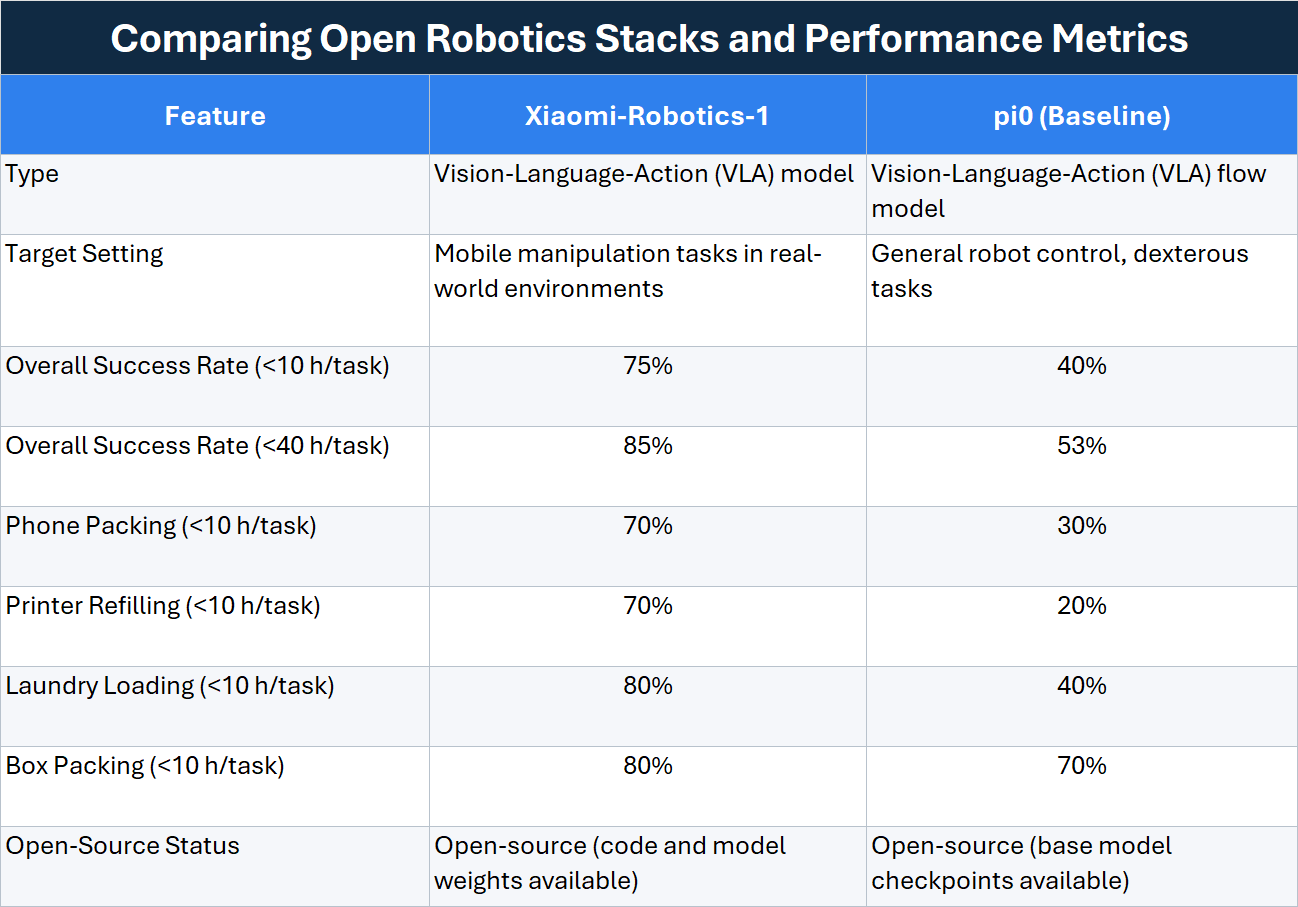
Note: Data based on efficient adaptation to new tasks with minimal real-robot demonstrations. pi0 is used as the primary baseline in the official Xiaomi-Robotics-1 report.
The comparison reveals a substantial leap in data efficiency. Achieving a 75 percent overall success rate with less than 10 hours of task-specific data is a critical milestone. It suggests that the pre-training phase successfully imbued the model with a robust understanding of physical interactions, allowing it to generalize from a small number of demonstrations. This is particularly evident in complex tasks like laundry loading, where Xiaomi-Robotics-1 achieves an 80 percent success rate compared to the baseline's 40 percent.
Commercial and Operational Implications for Automation Buyers
The release of Xiaomi-Robotics-1 as an open-source model with code and model weights available has significant implications for robotics researchers and developers. By providing a ready-to-use foundation model trained on a massive dataset, Xiaomi is lowering the barrier to entry for developing advanced robotic systems. This could accelerate the development of new applications and deployments across various industries.
"Xiaomi-Robotics-1 demonstrates that large-scale embodiment-free pre-training can break the robot data bottleneck, enabling predictable scaling that translates to better out-of-the-box real-robot performance."
For procurement teams and automation buyers, the availability of open-source foundation models like Xiaomi-Robotics-1 introduces new considerations. While these models offer powerful capabilities, they also require significant technical expertise to implement and adapt to specific use cases. The model requires a two-stage training process and relies on a complex architecture. Buyers must weigh the potential benefits of these advanced models against the integration challenges and the need for specialized engineering talent.
Furthermore, the open-source nature of the release changes the competitive dynamics of the robotics market. It challenges proprietary models by offering a highly capable alternative that can be customized and deployed without licensing fees. However, the total cost of ownership must account for the computing resources required for post-training and inference, as well as the engineering effort needed to integrate the model with specific hardware platforms.
The robotics industry is moving from a paradigm of narrow, task-specific programming to one of generalized, data-driven learning. Xiaomi-Robotics-1 is a clear signal of this shift, demonstrating the power of large-scale data collection and pre-training. As these models continue to improve and become more accessible, they will fundamentally change how robots are developed, deployed, and integrated into our daily lives. The focus will increasingly shift from hardware design to data acquisition and model training, as the intelligence of the system becomes the primary differentiator.
This analysis synthesizes company statements and public market or policy information.
Disclaimer: This article is provided for informational purposes only and does not constitute investment, financial, legal, procurement, or other professional advice. Readers should verify specifications, pricing, availability, regulatory requirements, and commercial terms directly with the relevant company or authority before making decisions.














