
WeRide Introduces WITT Physical AI Cognitive Foundation Model
WeRide has unveiled WITT, a Physical AI Cognitive Foundation Model utilizing Atomic Physical Facts to enhance autonomous driving capabilities and reduce processing costs.
The pursuit of autonomous driving has long been characterized by a tension between the promise of artificial general intelligence and the rigid demands of physical reality. While the industry frequently highlights the potential of generative models to simulate intricate environments, the actual deployment of autonomous vehicles requires systems that can reliably interpret and act upon verified, real world data. The introduction of the World Intelligence Toward Truth model by WeRide on July 17, 2026, represents a deliberate shift toward grounding artificial intelligence in verifiable physical facts rather than relying solely on simulated approximations. This approach attempts to bridge the gap between cognitive reasoning and physical execution, a critical challenge in the scaling of autonomous driving technologies.
The autonomous driving sector has historically struggled with the transition from controlled testing environments to the unpredictable nature of public roads. Early approaches relied heavily on rule based systems, which proved brittle when confronted with novel situations. The subsequent shift toward machine learning and neural networks offered greater flexibility but introduced new challenges related to interpretability and verification. As the industry moves toward foundation models, the debate centers on whether these models should prioritize generative capabilities for simulation or cognitive capabilities for real world interaction. The WeRide WITT model clearly aligns with the latter, emphasizing the extraction and verification of physical facts from operational data.
This distinction is not merely academic; it has profound implications for the safety, reliability, and scalability of autonomous systems. Generative models, while powerful for creating training data, can sometimes produce outputs that are plausible but factually incorrect. In a digital context, this might result in a nonsensical sentence or a distorted image. In the context of autonomous driving, such an error could lead to a catastrophic failure. By grounding its cognitive framework in Atomic Physical Facts, the WITT model seeks to mitigate this risk, ensuring that the system understanding of the environment is strictly aligned with physical reality.
What is the WeRide WITT Physical AI Cognitive Foundation Model?
WeRide introduced the World Intelligence Toward Truth Physical AI Cognitive Foundation Model on July 17, 2026, in Guangzhou, China. The model utilizes Visual Language Model capabilities to establish a fact based cognitive framework built on Atomic Physical Facts, reducing token costs by up to 98 percent.
The development of WITT is situated within the broader operations of WeRide, a company headquartered in Guangzhou, China, that specializes in autonomous driving solutions ranging from Level 2 to Level 4 capabilities. WeRide operates a fleet of more than 3,000 autonomous vehicles across more than 40 cities in 12 countries. The company core technology focuses on integrating advanced artificial intelligence with physical vehicle operations, aiming to provide scalable and reliable L2 to L4 autonomous driving solutions. The introduction of WITT is positioned as a foundational enhancement to their existing technology stack, specifically targeting the efficiency and accuracy of data processing in real world environments.
The architecture of WITT is fundamentally different from traditional end to end neural networks or purely generative world models. By focusing on Atomic Physical Facts, the system breaks down intricate driving scenarios into verifiable, discrete elements of information. The model operates through four core capabilities: Fact Extraction, Fact Reasoning, Fact Verification, and Fact Curation.
Translating Sensor Data into Verifiable Physical Facts
This structured approach allows the system to process information more efficiently. Because the model is dealing with discrete, verified facts rather than attempting to process and interpret every pixel of a video feed simultaneously, it requires significantly less computational power. This efficiency is reflected in the reported capability to process up to 10,000 minutes of vehicle operation video per day on a single Graphics Processing Unit. By relying on verified facts, the system reduces the likelihood of generating incorrect or nonsensical outputs based on flawed reasoning or incomplete data. In the context of autonomous driving, minimizing such errors is critical for ensuring safety and reliability.
Evaluating the Competitive Environment of Autonomous Driving Models
The autonomous driving industry is currently exploring several different architectural approaches to foundation models, each with its own strengths and limitations. The following table provides a comparison of the WeRide WITT model against other notable systems in the market, based on publicly available information.
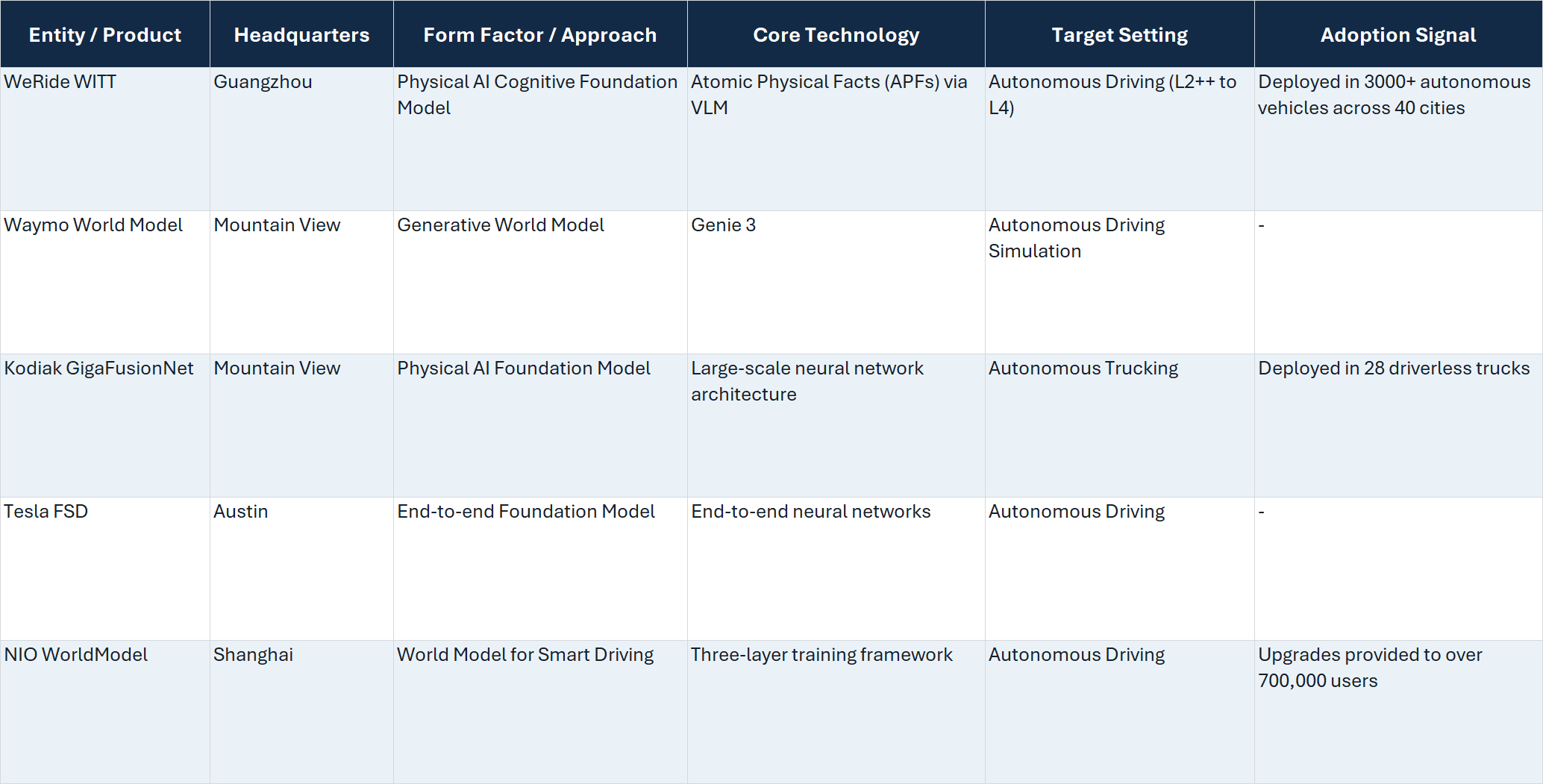
Comparison based on company-disclosed specifications and public first-party materials. N/A means no verified public value was disclosed.
The comparison highlights a divergence in strategies among leading autonomous driving companies. While Waymo focuses on generative world models for simulation, and Tesla pursues end to end neural networks trained on vast amounts of customer data [4], WeRide approach with WITT emphasizes the extraction and verification of physical facts from operational data. This distinction is significant because it reflects different philosophies regarding how artificial intelligence should interact with the physical world. Generative models excel at creating realistic simulations for training, but they may struggle with the unpredictability of real world edge cases. End to end models can learn advanced behaviors directly from data, but their decision making processes are often opaque, making it difficult to verify their safety and reliability.
Kodiak GigaFusionNet, another Physical AI Foundation Model, focuses on autonomous trucking and utilizes a large scale neural network architecture to ingest multimodal sensor data. This approach shares some similarities with WITT in its focus on physical applications, but the specific methodologies differ. NIO WorldModel, on the other hand, employs a three layer training framework for smart driving, highlighting the diversity of architectural choices within the industry. The choice of architecture has profound implications for the performance, scalability, and verifiability of the resulting systems.
Assessing the Adoption and Implementation of Physical AI
The adoption of the WITT model must be evaluated across several dimensions, including availability, reliability, economics, and implementation. In terms of availability, WeRide operates a fleet of more than 3,000 autonomous vehicles in more than 40 cities across 12 countries. The company WRD 3.0 Advanced Driver Assistance System solution has been selected for nearly 30 vehicle programs. This widespread deployment suggests that the underlying technology is mature enough for commercial application, rather than being confined to a research and development environment.
The reliability of the system is predicated on its fact based cognitive framework. By relying on Atomic Physical Facts, the model aims to provide a more verifiable and transparent decision making process compared to traditional black box neural networks. However, the reliance on high quality operational data implies that edge cases and long tail scenarios still necessitate extensive simulation and validation efforts. This is why rare long tail scenarios are returned to the WeRide GENESIS system for simulation training and scenario expansion. The economic implications of the WITT model are primarily driven by its efficiency gains. The company claims that the model reduces token costs by up to 98 percent and delivers up to 200 times greater data processing efficiency compared to general purpose artificial intelligence models.
Implementation of such a system requires significant infrastructure, particularly in terms of data collection and processing capabilities. The ability to process up to 10,000 minutes of vehicle operation video per day on a single GPU is a notable technical achievement, but it also underscores the massive volume of data required to train and maintain a Physical AI Cognitive Foundation Model. Organizations looking to adopt similar technologies must be prepared to invest heavily in data pipelines, storage, and computational resources, as well as the specialized talent required to develop and manage these advanced systems.
The Misconception of General Purpose Models in Physical Environments
A common misconception in the coverage of artificial intelligence is the assumption that general purpose foundation models, such as those used for natural language processing or image generation, can be seamlessly adapted for physical applications like autonomous driving. This perspective overlooks the fundamental differences between digital and physical environments. In a digital environment, an error by an artificial intelligence model might result in a nonsensical sentence or a distorted image. In a physical environment, an error can have severe, real world consequences. General purpose models are often optimized for broad capabilities and creative generation, which can lead to unpredictable behavior when faced with novel situations.
The WeRide WITT model addresses this limitation by explicitly focusing on verifiable physical facts. By constraining the model reasoning to Atomic Physical Facts, the system prioritizes accuracy and reliability over broad, generalized capabilities. This approach acknowledges that Physical AI requires a different architectural foundation than digital artificial intelligence. It is not enough for a model to generate a plausible response; it must generate a response that is strictly aligned with the physical realities of the environment. The distinction between generative simulation and fact based cognition is critical for understanding the future trajectory of autonomous driving technologies.
The reliance on general purpose models for physical tasks also introduces significant inefficiencies. These models are typically trained on vast amounts of diverse data, much of which is irrelevant to the specific requirements of autonomous driving. This results in models that are computationally expensive to run and difficult to optimize for specific hardware platforms. By focusing specifically on the extraction and verification of physical facts, the WITT model is able to achieve significant efficiency gains, reducing token costs and improving data processing speeds. This targeted approach is essential for deploying artificial intelligence in resource constrained environments, such as the embedded systems found in autonomous vehicles.
"The model introduces the concept of Atomic Physical Facts (APFs) to establish a fact-based cognitive framework for Physical AI."
Strategic Implications for Technology Evaluators and Operations Leaders
For procurement managers, operations leaders, and technology evaluators, the introduction of models like WITT signals a shift in how autonomous systems should be assessed. The focus is moving away from raw parameter counts and generalized capabilities toward metrics that reflect efficiency, verifiability, and performance in specific physical contexts. When evaluating autonomous driving solutions, organizations must prioritize systems that can demonstrate a clear and verifiable understanding of the physical world, rather than relying solely on simulated performance metrics.
The economic claims associated with the WITT model, specifically the significant reduction in token costs and the high efficiency of data processing, highlight the importance of computational efficiency in the deployment of autonomous systems. As these systems scale, the cost of processing and storing the massive volumes of data generated by vehicle sensors will become a major factor in the overall total cost of ownership. Evaluators must carefully consider the hardware requirements and operational costs associated with different architectural approaches. Systems that can optimize data processing without compromising safety or reliability will have a distinct advantage.
It is also important to recognize the limitations and non disclosures associated with current foundation models. In the case of WeRide WITT, specific pricing models, hardware costs, detailed parameter counts, and training compute requirements remain unspecified. Additionally, the reliance on high quality operational data means that extensive simulation and validation efforts are still required to address rare long tail scenarios. Organizations must conduct thorough due diligence to understand the full scope of requirements and potential risks before committing to a specific technology platform.
This analysis synthesizes company statements, official filings, and public market activity available as of July 17, 2026.
Disclaimer: This article is for informational purposes only and does not constitute financial, investment, legal, or procurement advice. Product specifications, pricing, and availability may change, so readers should verify details directly with the relevant company before making decisions.














