Waymo Is Entering Singapore on Singapore's Timetable
Singapore hosted the world's first robotaxi trial in 2016. It gets commercial robotaxis in 2028. The twelve-year gap is not technical lag — it is a policy choice, and the LTA put it in writing this week. Waymo has entered a market that publicly reserves the right to slow it down.

The LTA release contains a sentence about driver retraining that no other Waymo market has written down.
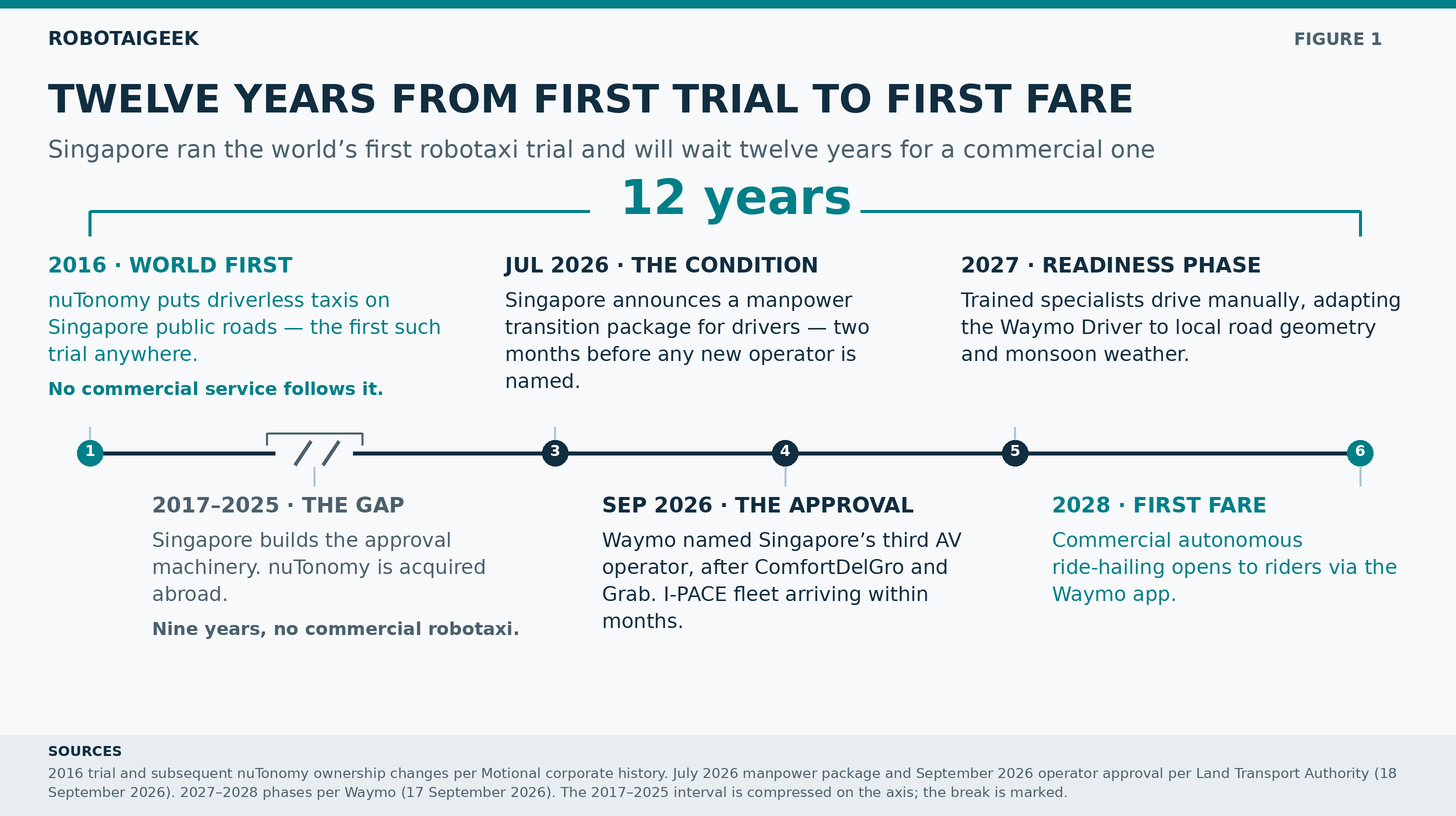
Singapore ran the world's first public robotaxi trial in 2016, when nuTonomy put driverless taxis on the roads of one-north. Commercial robotaxi service arrives in 2028 — twelve years, and one Waymo, later.
Waymo announced its Singapore entry on 17 September 2026, and the coverage since has treated the country's regulatory clarity as the draw. The clarity runs both ways. As of September 2026, Waymo is the third company approved as an autonomous vehicle operator in Singapore, joining ComfortDelGro and Grab, per the Land Transport Authority's 18 September release — and that release states that the Government "will not allow autonomous vehicle deployment to run ahead of our ability to retrain and support affected drivers." No other market hosting Waymo has put that sentence in writing.
What Waymo Announced in Singapore
Waymo announced on 17 September 2026 that it will launch fully autonomous, all-electric ride-hailing in Singapore in 2028, working with the Ministry of Transport and Land Transport Authority. Jaguar I-PACE vehicles arrive within months, trained specialists drive manually through 2027, and public service opens via the Waymo app in 2028.
The sequence matters more than the date. Waymo's own announcement sets out three phases: an initial I-PACE fleet arriving in the coming months as local operations are established, a 2027 readiness phase in which trained autonomous specialists drive manually to adapt the Waymo Driver to local road geometry and monsoon weather, and commercial launch in 2028. Co-CEO Tekedra Mawakana framed it as the same methodical framework guiding the company's US growth and its work toward Tokyo, London, and Munich.
Which Companies Are Approved AV Operators in Singapore?
Three companies are approved AV operators in Singapore as of September 2026 — ComfortDelGro, Grab, and Waymo, named the newest operator in the Land Transport Authority's 18 September 2026 release. All autonomous vehicles must pass a safety assessment at CETRAN, the Centre of Excellence for Testing and Research for Autonomous Vehicles, before carrying passengers on public roads, using tests developed by LTA and CETRAN with input from the Traffic Police.
Why Singapore Waited Twelve Years
The closest structural parallel is not another transport market. It is pharmaceutical approval, where a company does not launch and negotiate afterwards — it runs the trials the regulator specifies, in the order specified, and the regulator holds the approval. Singapore built that apparatus for driving, with CETRAN as the trial site and LTA as the approving authority, and Waymo's three phases map onto it almost exactly.
The world's first public robotaxi trial ran in Singapore in 2016 and commercial service arrives in 2028, and the twelve-year span in Figure 1 shows where the intervening time went.
Waymo has roughly 4,000 vehicles running in about fifteen US cities, according to figures circulating in coverage of the announcement and not confirmed by the company. In Singapore it has agreed to two years of driving with nobody in the back seat.
The Retraining Clause LTA Wrote
The LTA release does something the Waymo announcement does not. Alongside welcoming the operator, it commits the Government to helping drivers prepare early, to supporting them in acquiring new skills, and to assisting willing drivers into roles the growing AV sector creates — building on a manpower transition package announced in July 2026, two months before Waymo's entry was made public.
Then it states the limit: deployment will not be allowed to run ahead of the state's ability to retrain and support affected drivers.
Read as ministerial throat-clearing, that is unremarkable. Read as what it is — a published condition on a private operator's scaling rate, issued by the authority that grants the approvals — it is a different kind of document. Singapore is not promising to cushion the transition after the fact. It is reserving the right to set the speed, and it said so in the same release that said welcome. That is a lever no US market has given itself, where deployment has consistently preceded any retraining framework.
Singapore gated the robots behind the drivers.
Whose Clock Sets the Pace
Waymo names safety validation and the LTA names retraining capacity, and the two stated constraints in Figure 2 govern different stretches of the same timeline.
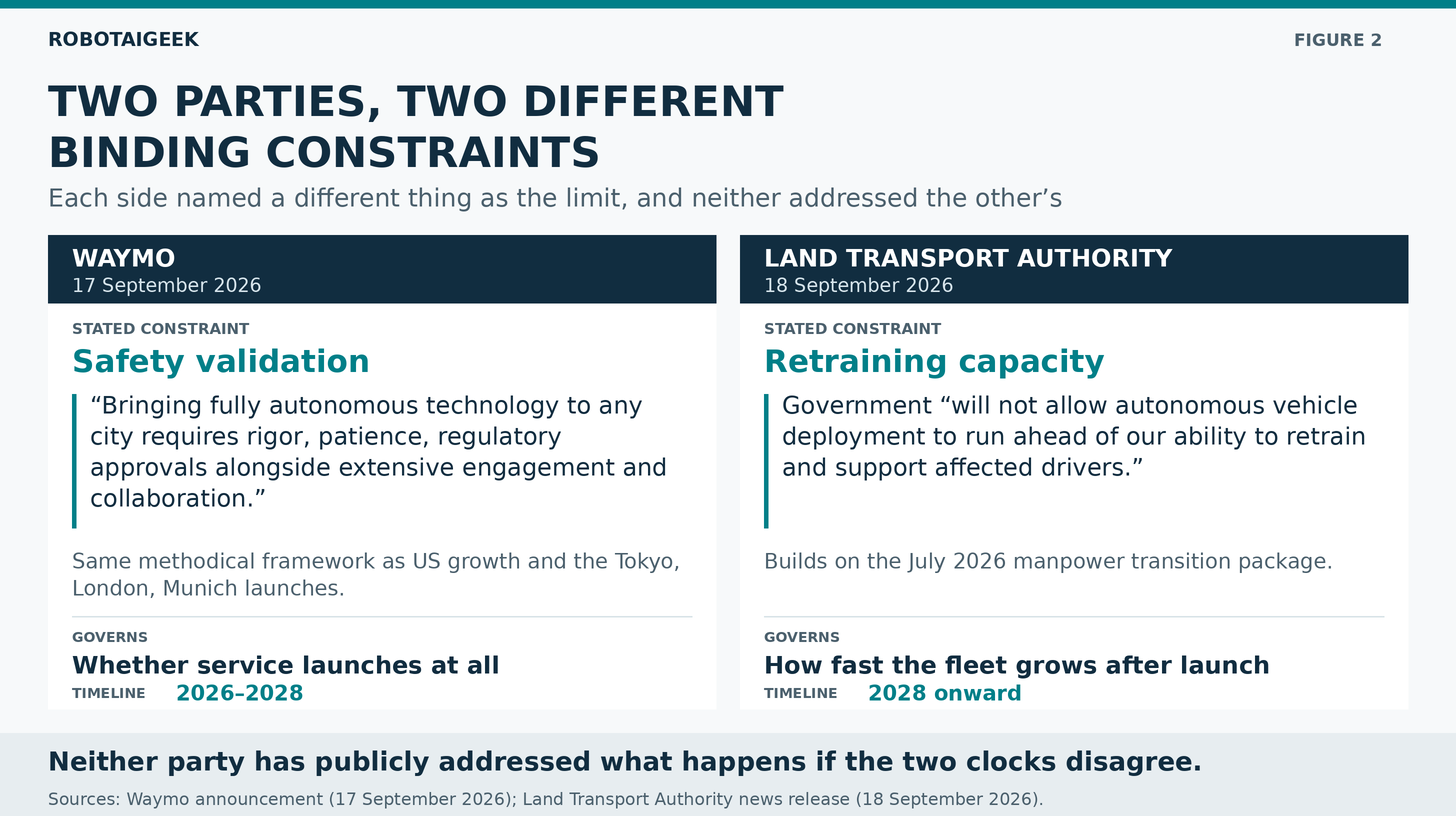
The LTA's position is equally well-founded, and it has the institutional apparatus behind it — a manpower package legislated in July 2026, before this announcement existed. The two constraints simply bind at different moments: one decides whether 2028 happens, the other decides what 2029 and 2030 look like. What neither release addresses is the case where they conflict, and the question of who holds the throttle in a market that has written the answer down is one Waymo has not faced in any jurisdiction it currently operates.
nuTonomy put the world's first public robotaxi on Singapore roads in 2016 and the country will not have a commercial one until 2028 — a sequence that reads as caution until you read the LTA release, which describes it as deliberate rationing of deployment against retraining capacity. The Jaguar I-PACEs arriving in the coming months will spend their first two years with a person at the wheel, learning what the rain does to lane markings on the PIE. Every government watching this announcement is watching a country that welcomed a frontier operator and kept the brake pedal, and wrote both facts into the same press release.
If Waymo clears its CETRAN assessment ahead of schedule, what gives first — the 2028 launch date, the retraining timetable, or the LTA's stated commitment not to let deployment outpace it? The answer depends on how many of Singapore's point-to-point drivers have moved into new roles by then.
This development connects to our coverage of how automation reshapes work, where the task-level view explains why driver transition is rarely a clean substitution.
1. When exactly will Waymo start operating in Singapore?
Commercial service is planned for 2028, with vehicles arriving much sooner. Waymo said an initial fleet of all-electric Jaguar I-PACE vehicles will arrive within the coming months of its 17 September 2026 announcement, followed by a 2027 readiness phase where trained specialists drive manually. Public autonomous ride-hailing through the Waymo app is intended for 2028.
2. Why is Waymo taking two years before carrying passengers?
Singapore requires a CETRAN safety assessment before any autonomous vehicle carries passengers on public roads. The 2027 readiness phase has trained autonomous specialists driving manually so the Waymo Driver can adapt to local road geometry and monsoon weather patterns. Waymo described this as the same methodical framework guiding its US growth and its work toward Tokyo, London, and Munich.
3. What happens to taxi and private-hire drivers in Singapore?
The Land Transport Authority stated on 18 September 2026 that the Government will not allow autonomous vehicle deployment to run ahead of its ability to retrain and support affected drivers. LTA committed to helping drivers acquire new skills and assisting willing drivers into roles created by the AV sector, building on a manpower transition package announced in July 2026.
4. Is Waymo the only self-driving company operating in Singapore?
No. Waymo joins ComfortDelGro and Grab as Singapore's approved autonomous vehicle operators, per the LTA's 18 September 2026 release. Singapore's involvement goes back further — nuTonomy, later part of Motional, operated what is recorded as the world's first public autonomous taxi trial in Singapore in 2016.
5. Why did Waymo choose Singapore for its first Southeast Asian market?
Waymo co-CEO Tekedra Mawakana cited Singapore's reliability, sustainability, and human-centric progress. Practically, Singapore has a defined approval pathway — a CETRAN safety assessment with tests developed by LTA and CETRAN with Traffic Police input — which gives an entering operator a specified finish line rather than an open-ended negotiation. Waymo is also working toward launches in Tokyo, London, and Munich.
Schema note: This numbered FAQ block is structured for FAQPage schema markup; figures carry ImageObject markup, the AEO Answer Block carries speakable markup, and the article carries NewsArticle schema with the author as a Person entity.