Teleoperated Humanoid Robots Successfully Perform Laparoscopic Surgery in Animal Trials
A research team at UC San Diego has successfully used a teleoperated humanoid robot to perform laparoscopic gallbladder removal in pigs, as highlighted in Nature Medicine on July 31, 2026. The research demonstrates the feasibility of using general-purpose humanoid morphology with standard surgical instruments for complex procedures, challenging the dominance of purpose-built surgical robots like Intuitive Surgical's Da Vinci system and potentially enabling surgical access in standard operating rooms without specialized equipment.
A New Paradigm in Surgical Robotics
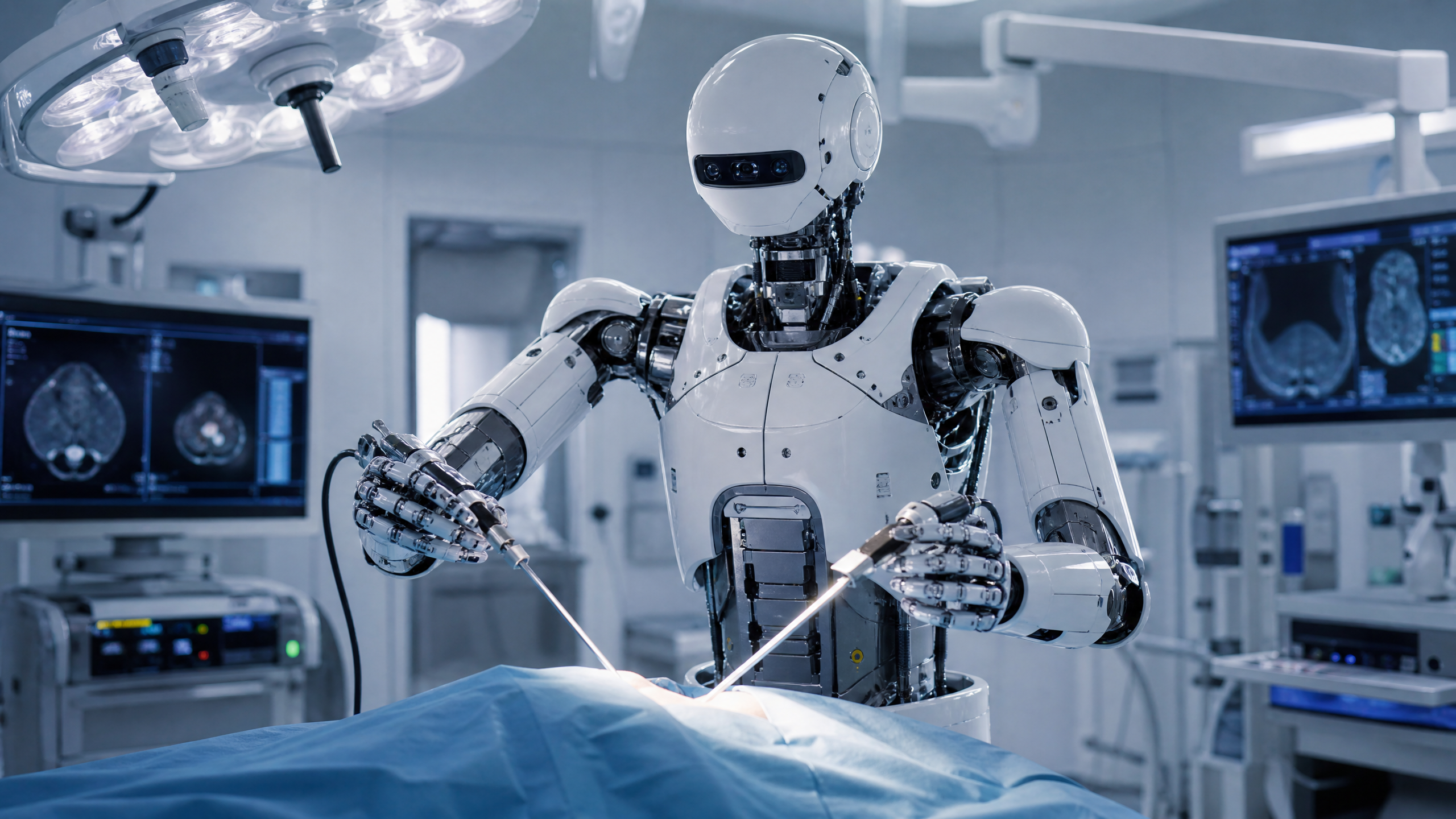
The boundaries of medical robotics are expanding beyond purpose-built, single-function machines toward general-purpose systems that could fundamentally alter the economics and accessibility of robotic surgery. According to a research highlight published in Nature Medicine on July 31, 2026 (based on a full research paper published in Nature on July 8), researchers at the University of California, San Diego have successfully utilized a teleoperated humanoid robot to perform complex laparoscopic surgery.
The research team demonstrated that a general-purpose humanoid robot, controlled remotely by a human surgeon through a teleoperation interface, could successfully perform a cholecystectomy (gallbladder removal) in a porcine (pig) model. The procedure is a standard benchmark in surgical robotics research because it requires precise tissue manipulation, careful dissection around critical anatomical structures, and controlled application of surgical energy, all within the confined space of the abdominal cavity.
This marks a significant milestone in evaluating the feasibility of using anthropomorphic robotic systems in the highly constrained and safety-critical environment of an operating room. While the research is still in the animal trial phase, the successful demonstration opens a new research direction that could eventually complement or challenge existing surgical robotics paradigms.
General-Purpose vs. Purpose-Built Surgical Systems
Historically, surgical robotics has been dominated by highly specialized, purpose-built systems designed exclusively for the operating room. The industry standard, Intuitive Surgical's Da Vinci system (with over 8,000 systems installed globally), utilizes a massive, multi-arm console that requires specialized operating room setups, proprietary EndoWrist instruments that must be replaced after a set number of uses, and extensive surgeon training on the specific platform.
The UC San Diego research takes a radically different approach. By using a humanoid robot with human-like arms and hands, the system can theoretically integrate into standard operating rooms designed for human surgeons, utilizing standard, off-the-shelf surgical instruments rather than expensive proprietary tools. The human surgeon operates the robot via a teleoperation interface, translating their natural hand movements into precise robotic manipulation at the surgical site with tremor filtering and motion scaling.
This distinction has profound economic implications. The Da Vinci system costs approximately US$1.5 to US$2.5 million per unit, with annual maintenance contracts exceeding US$150,000 and proprietary instrument costs adding US$700 to US$3,500 per procedure. A general-purpose humanoid that could perform surgery using standard instruments would dramatically alter the cost structure of robotic surgery, potentially making it accessible to hospitals and clinics that cannot currently justify the capital expenditure of a dedicated surgical robot.
Technical Approach and Results
The UC San Diego team's approach leverages advances in humanoid dexterity and teleoperation that have been developed primarily for industrial and service applications. The humanoid robot used in the study features articulated arms with sufficient degrees of freedom to replicate the range of motion required for laparoscopic port placement and instrument manipulation.
The teleoperation system translates the surgeon's hand movements into corresponding robotic movements with high fidelity, while providing haptic (force) feedback to the surgeon so they can feel tissue resistance and avoid applying excessive force. This bidirectional communication between surgeon and robot is critical for surgical safety, as it prevents the robot from inadvertently damaging delicate anatomical structures.
The successful completion of the cholecystectomy in the porcine model demonstrates that the humanoid morphology can achieve the precision and control required for a clinically relevant surgical procedure. The research team conducted a systematic evaluation of feasibility, assessing task completion, procedure time, tissue damage, and instrument control accuracy across multiple trials.
Competitor Comparison: Surgical Robotics Approaches

As detailed in the comparison table, the commercial surgical robotics market is currently led by Intuitive Surgical (Da Vinci Xi, SP, and the new Da Vinci 5), Medtronic (Hugo RAS system), and CMR Surgical (Versius). All of these systems rely on proprietary architectures with custom-designed arms, instruments, and software ecosystems that create significant vendor lock-in for hospitals.
The teleoperated humanoid approach remains strictly in the research phase at the animal trial stage, and clinical trials in humans are likely several years away pending extensive safety validation and regulatory approval. However, if this technology can be commercialized, it could disrupt the existing business models of incumbent manufacturers, which rely heavily on the recurring revenue generated by proprietary instrument sales, maintenance contracts, and training programs.
The research also has implications beyond surgery. A humanoid robot capable of performing surgical procedures could theoretically be repurposed for other hospital tasks, such as patient transport, room sanitization, pharmacy operations, or materials handling, when not required in the operating room. This multi-purpose capability would drastically alter the return-on-investment calculation for hospital administrators compared to a single-purpose surgical robot that sits idle between procedures.
Future Implications for Healthcare Access
While clinical trials in humans are likely years away, requiring extensive safety validation, regulatory submissions, and ethical review, the implications of this research are profound for global healthcare access. Advanced teleoperation capabilities could democratize access to specialized surgical care, allowing expert surgeons in major medical centers to operate on patients in remote, rural, or underserved locations without requiring the installation of multi-million-dollar, purpose-built robotic consoles at the remote site.
This telemedicine application is particularly relevant for military medicine, disaster response, and healthcare delivery in developing nations, where the infrastructure and capital to support traditional surgical robots is unavailable but the need for advanced surgical care is acute. A deployable humanoid robot with standard surgical instruments could theoretically be set up in a field hospital or rural clinic and operated by a specialist surgeon hundreds or thousands of miles away.
The Nature Medicine research highlight brings renewed attention to the convergence of humanoid robotics and healthcare, a field that has enormous potential but also faces significant regulatory, ethical, and safety hurdles before clinical deployment becomes reality. The UC San Diego team's work represents an important early step in validating the fundamental feasibility of this approach.
Regulatory Pathway and Timeline to Clinical Use
The path from successful animal trials to clinical deployment in human patients is long and heavily regulated, particularly in the United States where the Food and Drug Administration oversees medical device approvals. A humanoid robot used for surgery would likely be classified as a Class III medical device, requiring the most stringent premarket approval pathway including extensive clinical trials demonstrating safety and efficacy in human subjects.
Based on historical precedents in surgical robotics, including the original Da Vinci system's approval timeline, the UC San Diego team's technology could require five to ten years of additional development, safety testing, and clinical trials before receiving regulatory clearance for human use. This timeline assumes continued positive results in animal models, successful transition to cadaver studies, and eventually carefully controlled human clinical trials with extensive safety monitoring.
However, the teleoperation aspect of the system may accelerate certain regulatory considerations. Because a human surgeon remains in direct control of the robot at all times, with the robot serving as a remote extension of the surgeon's hands rather than an autonomous decision-maker, the regulatory framework may be somewhat more straightforward than for fully autonomous surgical systems. The surgeon's continuous oversight provides a safety layer that purely autonomous systems cannot offer, potentially simplifying the risk-benefit analysis that regulators must conduct.
For the broader medical robotics industry, this research validates a new category of surgical system that could eventually coexist with traditional purpose-built platforms. The market may evolve toward a tiered model where expensive, specialized systems like Da Vinci serve high-volume surgical centers, while more affordable, general-purpose humanoid systems extend robotic surgery access to smaller hospitals, rural clinics, and developing nations.
The intersection of humanoid robotics and surgical medicine represents one of the most consequential potential applications of physical AI, where the stakes are measured not in productivity gains or cost savings but in human lives. The UC San Diego team's successful demonstration in animal models provides the foundational evidence that this convergence is technically feasible, setting the stage for the years of rigorous safety validation and clinical testing that must precede any deployment in human patients.
Disclaimer: This article is for informational purposes only and does not constitute financial, investment, or technical advice. Readers should conduct their own due diligence before making procurement or investment decisions based on this information.