
Taiwan's First Rescue Robot Dog Passes Its Fire Trial at 120 Degrees Celsius
Taiwan's Industrial Technology Research Institute has cleared a domestically built quadruped robot for firefighting duty after the machine walked through smoke and heat up to 120 degrees Celsius, marking Taiwan's first verified fire rescue robot dog.
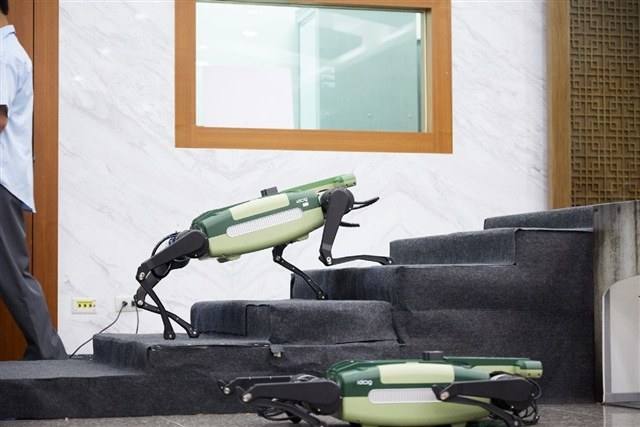
Taiwan's Industrial Technology Research Institute has cleared its first domestically developed quadruped robot for firefighting duty, after the machine walked through smoke, heat, and a simulated 100 degree Celsius ceiling environment to become Taiwan's first fire rescue robot dog to pass formal functional verification.
The test, is a notable step for Taiwan's robotics sector because it moves a national robot dog program beyond a stage demonstration and into documented hazardous environment testing. The platform operated roughly two meters from a live fire source inside a test chamber where the ceiling temperature reached 100 degrees celsius. According to the report, the robot itself withstood heat up to 120 degrees celsius while maintaining mobility and control.
The result does not mean the robot is already in broad service with fire departments, and it does not prove that it can survive every condition inside an active structure fire. It does, however, establish a public benchmark for thermal endurance, mobility, and operator control in a controlled fire environment. For a rescue robot, that is the difference between a promising walking machine and a candidate tool for emergency response.
The Development
ITRI, Taiwan's government backed applied research institute, unveiled the robot dog platform on July 8, 2026, alongside Taiwan's Ministry of Economic Affairs, following more than a year of joint development. Days later, the platform had completed a formal fire trial in which it moved through smoke and operated near a live fire source without losing function.
The program produced two prototypes rather than a single model. The larger unit is designed for firefighting reconnaissance and inspection inside underground tunnels, industrial facilities, and other dangerous spaces where human entry may be delayed by smoke, heat, toxic gas, unstable surfaces, or limited visibility. That larger prototype is described as capable of carrying roughly 20 kilograms of equipment, which could include cameras, sensors, communication gear, thermal imaging equipment, or other mission payloads.
The smaller unit is intended for autonomous navigation and collaborative transport tasks. A key correction is important here: the 5 kilogram figure refers to payload capacity, not the smaller robot's weight. In practical terms, that means the smaller robot is designed to carry about 5 kilograms of tools, samples, sensors, or supplies while working alongside human responders or other robotic systems.
The distinction matters because payload is one of the most important specifications for field robotics. A 5 kilogram robot would be a very different machine from a robot that can carry 5 kilograms. In emergency response, payload capacity determines whether a robot can carry a gas sensor, a compact medical kit, a radio relay, a water sample container, or a small tool package into a hazardous area.
Taiwan's First Fire Rescue Robot Dog
The robot platform was developed by ITRI in cooperation with the Ministry of Economic Affairs and a group of Taiwanese manufacturing and technology partners. The named partners include Solomon Technology, Compal, Inventec, Nexcom, and Teco Electronics.
Each partner brings a different part of Taiwan's electronics and industrial supply chain into the project. Solomon Technology contributed system integration capabilities. Compal and Inventec bring large scale device manufacturing experience from decades of contract electronics production. Nexcom supplies embedded computing and industrial computer hardware. Teco Electronics adds experience in motors, industrial control, and electromechanical systems.
That mix is strategically important. Fire rescue robots are not only software platforms and not only mechanical platforms. They require rugged mechanical design, durable actuation, thermal protection, sensor integration, onboard computing, wireless communication, battery management, and operator controls. A robot that walks well in a showroom may fail quickly in a fire response environment if any one of those layers is not designed for heat, smoke, impact, dust, water spray, or unpredictable terrain.
Taiwan's approach appears to be centered on a national reference design rather than a closed robot product owned by one company. ITRI and MOEA have positioned the platform as an open and customizable core architecture that Taiwanese companies can adapt for firefighting, tunnel inspection, patrol, inspection, and other field applications.
More than Another Robot Dog Demo
Quadruped robots are no longer rare. Companies in the United States, China, Europe, Japan, and South Korea have shown or sold robot dogs for industrial inspection, mapping, security patrol, research, entertainment, and public demonstrations. Many of those systems can climb stairs, follow operators, carry cameras, and traverse uneven ground.
What makes this Taiwan program distinct is the combination of public safety testing and supply chain strategy. ITRI is not merely showing that a robot can walk. It is trying to demonstrate that Taiwan can build a modular, domestically sourced quadruped platform that can be adapted by multiple manufacturers and validated for difficult field conditions.
That model resembles how Taiwan became central to personal computers, servers, networking equipment, and semiconductors. Taiwan's global strength has often come from manufacturing depth, component specialization, and reference designs that many customers can customize, rather than from a single consumer facing robotics brand.
Applied to robotics, that strategy could allow Taiwan to compete in a different way from larger branded quadruped makers. Instead of trying to immediately dominate the global robot dog market under one name, Taiwan could become a supplier of components, reference architectures, sub systems, integration services, and finished variants for hazardous environment robots.
For fire rescue and industrial inspection buyers, this matters because procurement rarely depends on robotics performance alone. Buyers also care about repairability, replacement parts, vendor diversity, upgrade paths, training, cost, and whether a platform can be adapted to local operational requirements. A national reference design may create more flexibility than a single proprietary platform if enough manufacturers build around it.
Use Case
A fire rescue robot dog is a four legged machine built to go where human firefighters should not have to go first. In a fire, the first minutes are often filled with uncertainty. Responders need to know where the heat is concentrated, whether smoke is hiding obstacles, whether there are hazardous materials inside, whether a tunnel is passable, and whether people may be trapped beyond the entry point.
A robot can enter before a human team, send back video and sensor readings, and help commanders decide whether conditions are safe enough for entry. In industrial sites, underground tunnels, power facilities, ports, and transportation systems, that early information can reduce risk for firefighters and maintenance crews.
The robot does not replace firefighters. It gives them another way to see into a dangerous space before committing people. That is why heat tolerance matters so much. A robot that loses mobility, communication, or sensor function as temperature rises may become debris instead of a useful tool. Passing a verification trial near live fire and withstanding heat up to 120 degrees Celsius is therefore a meaningful proof point.
Significance to the Public Safety
Fire departments and industrial safety teams have wanted reliable robotic reconnaissance tools for years. The problem is that many mobile robots are optimized for offices, warehouses, construction sites, or controlled industrial environments. Fire scenes are different. They combine high heat, smoke, water, slippery surfaces, fallen objects, low visibility, radio interference, and time pressure.
A wheeled robot can struggle with stairs, hoses, debris, and uneven ground. A tracked robot can be more stable and rugged, but may be slower or less agile in tight spaces. A quadruped robot offers a different compromise: it can step over obstacles, climb certain stairs, adjust posture, and move through environments designed for humans. That is why robot dogs are increasingly considered for inspection and emergency response work.
ITRI's verification gives Taiwanese responders and potential export customers a documented benchmark. The robot operated in a chamber with a 100 degree Celsius ceiling temperature and tolerated heat exposure up to 120 degrees Celsius. That is a concrete claim procurement teams can compare with other platforms. It also gives competing robot makers a clearer standard to answer, especially if they are pitching hazardous environment inspection.
The timing matters commercially. Taiwan's electronics manufacturers are seeking a larger role in the global robotics supply chain as demand grows for quadrupeds, humanoids, autonomous mobile robots, and specialized inspection systems. A verified fire rescue platform gives that effort a credible public case study. It shows a robot built through Taiwanese research and manufacturing partnerships performing in one of the harshest real world categories for mobile machines.
The Industry Reality
The result should be treated as a significant milestone, not as proof of full market readiness. A controlled chamber trial is not the same as deployment in a real building fire, chemical plant incident, subway tunnel emergency, or disaster zone.
Real incidents introduce variables that are difficult to replicate in a single test. Floors may collapse. Water spray may hit electronics. Smoke may block cameras. Heat may rise unevenly. Wireless communication may degrade through concrete, steel, or underground structures. Debris may jam joints. Batteries may behave differently under sustained thermal load. Operators may have to control the robot while also managing radio traffic, personnel movement, and changing command priorities.
ITRI and MOEA have described this stage as functional verification, which is a necessary milestone before broader field trials. Public information does not yet confirm large scale purchases by Taiwan's fire authorities. Pricing, production timing, service plans, spare part availability, and operator training requirements have not been publicly released.
Those missing details matter. Fire departments do not buy robots only because they pass a test. They need maintenance support, ruggedized accessories, standard operating procedures, safety certifications where applicable, training hours, battery logistics, and assurance that the robot can be repaired quickly after damage. A rescue robot that cannot be serviced after field use will not remain operational for long.
Competitive Landscape
Taiwan is entering a robotics category that already has strong international players. Boston Dynamics helped define the modern quadruped robot category with Spot, which has been used for inspection, mapping, security, and research. Chinese companies such as Unitree have pushed lower cost quadruped platforms into broader circulation. Other firms in Europe and Asia are developing legged robots for defense, industrial inspection, academic research, and public safety.
Most of those systems are not identical to ITRI's fire rescue concept. Some are general purpose platforms that can be adapted with payloads. Others are research machines or commercial inspection robots. A fire rescue robot needs more than legged movement. It needs thermal protection, rugged sensing, operator confidence, field communications, and a mission package designed around public safety work.
Taiwan's opportunity is not necessarily to produce the flashiest robot dog. Its opportunity is to produce a reliable, manufacturable, customizable platform with a strong supplier base behind it. If Taiwanese companies can offer multiple variants, one for fire reconnaissance, one for tunnel inspection, one for industrial patrol, and one for collaborative transport, the platform could become more attractive to buyers who want practical tools rather than showcase robots.
What to Watch Next
The next milestone is a pilot deployment with local fire departments or industrial safety teams. A real pilot would show how the robot performs when operators are under time pressure, communications are imperfect, and environmental conditions change quickly.
A second milestone is commercialization by one or more of the industry partners. If Solomon Technology, Compal, Inventec, Nexcom, Teco Electronics, or another Taiwanese company announces a purchasable variant with specifications, pricing, training, and support, the project will move from research milestone to market entry.
A third milestone is the appearance of the platform at international safety, fire protection, or robotics trade shows. Export interest would validate the idea that Taiwan's supply chain can support public safety robotics beyond the domestic market.
The most important signal may be whether the open reference design attracts additional Taiwanese companies. If the platform becomes a base for multiple specialized robot variants, Taiwan could build a robotics ecosystem rather than a single product line. That would fit the country's traditional strength in modular electronics manufacturing and could give it a practical route into the global market for autonomous and semi autonomous field robots.
Sources:
1. Digitimes: Surviving 120C: Taiwan's rescue robot dog passes its trial by fire July 10, 2026
2. Digitimes: Taiwan just built its own robot dog, its first mission fighting fires
3. Taipei Times: MOEA launches domestic quadruped robot research
4. TaiwanPlus: Taiwan launches national robot dog R&D platform
5. China Times: MIT style robot dog debuts, clears 100C fire test
Disclaimer: This article is based on publicly available sources cited below and is provided for general informational purposes only. Claims about robot performance, trial conditions, partner roles, timelines, and deployment status are attributed to the cited reporting and public announcements. RobotAIGeek has not independently verified every technical claim made by the organizations named in the source material. Specifications, availability, procurement status, and deployment plans may change as official filings, translations, supplier announcements, or agency statements are updated. Nothing in this article should be treated as investment, legal, safety certification, procurement, or engineering advice. Readers should consult primary sources and qualified professionals before making decisions based on this content.














