
Taisei and Fanuc's New AI Warehouse Doubles Storage Space in Japan
Japanese construction group Taisei and robot maker Fanuc have jointly developed an AI powered automated warehouse system that roughly doubles storage capacity within the same building footprint, using industrial robots, facility engineering, and AI driven layout optimization to increase storage density in constrained industrial real estate.
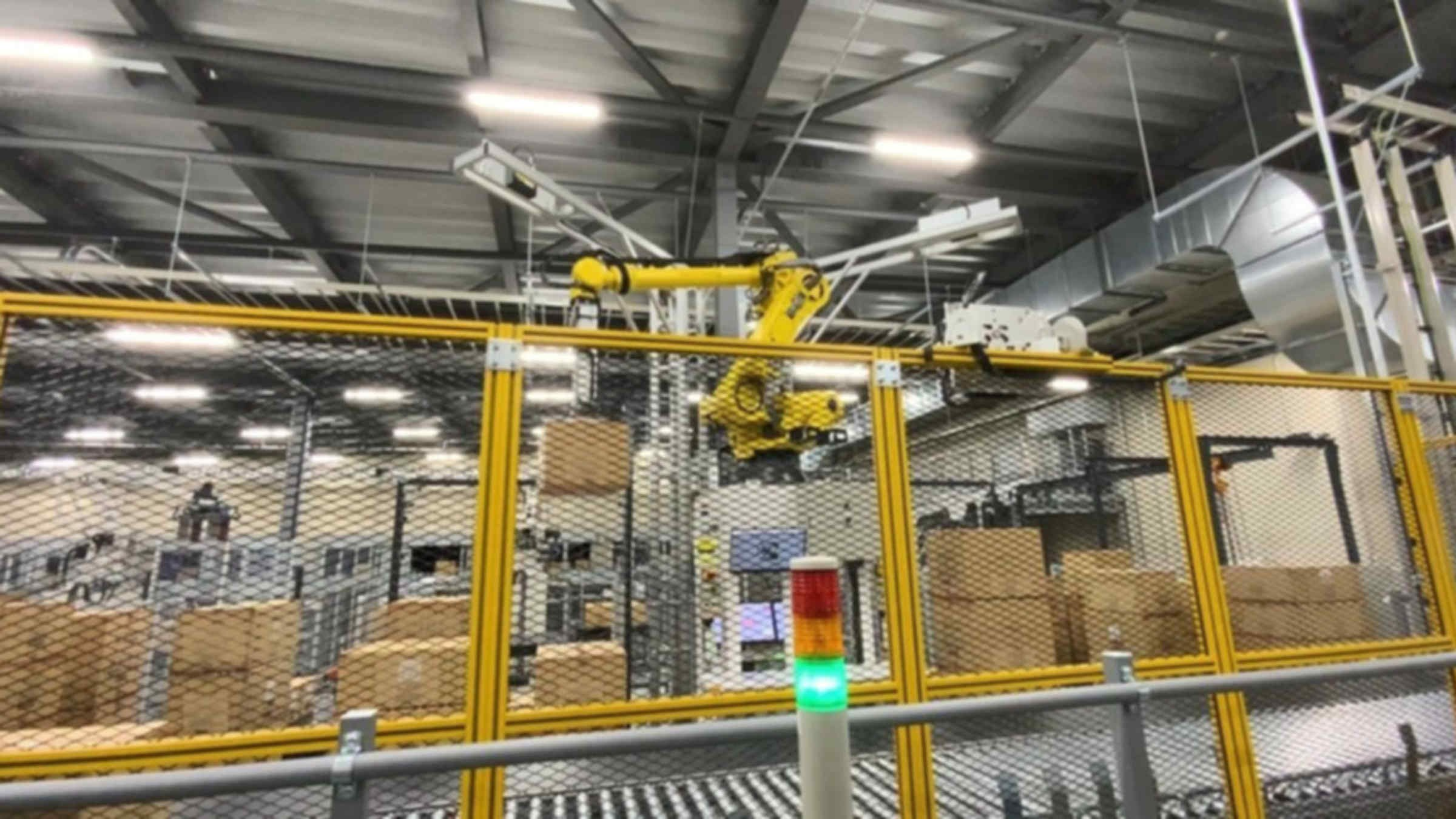
Taisei Corporation, one of Japan's largest general contractors, and Fanuc, one of the world's best known industrial robot makers, have jointly developed an AI powered automated warehouse system that roughly doubles storage capacity within the same building footprint, according to a Nikkei Asia report published July 9, 2026.
The core claim is simple but commercially significant: by combining Fanuc's industrial robots and control technology with Taisei's construction and facility engineering expertise, the two companies say warehouse operators can store about twice as much inventory in the same physical space. In a country where industrial land is expensive, logistics facilities are often constrained by geography, and labor shortages are forcing more automation into warehouses and factories, that kind of density improvement could change the economics of facility planning.
The system uses artificial intelligence to optimize how goods are stored, retrieved, and moved inside a warehouse. Rather than treating the storage layout as a fixed design established during construction, the AI layer is intended to keep adjusting placement and movement patterns as inventory changes. That distinction matters. A conventional warehouse usually locks in much of its efficiency at the design stage, through aisle width, shelf configuration, storage height, and the planned routes used by workers or machines. An AI managed warehouse can instead treat the facility as a constantly changing optimization problem.
Nikkei Asia's report did not disclose detailed throughput rates, exact storage density figures, or the underlying AI algorithms. It framed the collaboration around the headline space efficiency claim, not a full engineering specification. That leaves several important questions open, including what baseline Taisei and Fanuc used for comparison, what kind of goods the system is best suited to handle, and whether the reported doubling applies to a new build, a retrofit, or both.
Combining Capabilities
The Taisei and Fanuc system appears to combine three layers of capability. The first is physical facility design, where Taisei brings experience in construction, industrial buildings, and logistics infrastructure. The second is robotic handling, where Fanuc contributes industrial robots, controllers, and factory automation equipment. The third is software optimization, where artificial intelligence is used to determine how goods should be stored and moved to make better use of the available space.
That combination is important because warehouse density is not only a robotics problem. A robot can pick, place, or move goods, but storage efficiency also depends on ceiling height, floor loading, fire safety rules, access paths, maintenance zones, material flow, and the placement of production or shipping areas. A system that claims to double storage capacity must therefore be designed around the building as much as around the robot.
Taisei's role suggests that the companies are not merely offering a robot cell that can be dropped into an existing warehouse. They are likely positioning the system as a facility level solution, where building layout, storage infrastructure, robot motion, and inventory management are planned together. For customers, that could mean a more complex sales process but also a clearer return on investment if the result reduces the need for additional land or new warehouse construction.
Building on an Existing Playbook
This is not Taisei's first move into high density robotic storage. In 2024, the company commercialized the T Robot Storage Production System, developed with AutoStore and Toyo Kanetsu. That system placed robotic storage and retrieval directly above production floor space inside factories, instead of requiring a separate ground floor warehouse area. It used AutoStore's modular three dimensional grid storage technology, with robots operating above the grid to move bins to production stations.
The 2024 system showed Taisei's interest in using vertical space and integrated automation to shrink the footprint of factory logistics. The new Fanuc collaboration appears to extend the same space efficiency philosophy, but with a different partner and likely a different technical architecture. AutoStore is known for cube based storage, where bins are stacked densely in a grid and robots retrieve them from above. Fanuc, by contrast, has deep experience in industrial robots, motion control, CNC systems, and factory automation. Its contribution may allow a more flexible robotics and control environment, depending on how the system is implemented.
The key technical question is whether the Taisei and Fanuc system can match the density of fixed grid storage while offering greater flexibility across different warehouse layouts and product types. Grid systems can be extremely dense, but they are structured around a specific storage architecture. A more flexible AI managed facility might trade some architectural simplicity for adaptability, especially in operations where inventory mix changes frequently or where the warehouse must connect directly to production lines.
The Simple Explanation
Most warehouses are designed once. Engineers decide where shelves, aisles, conveyors, workstations, and staging areas should go. Once the facility is built, that structure tends to remain largely fixed, even if the product mix changes. The result is that many warehouses operate with layouts that were optimized for yesterday's assumptions.
An AI optimized warehouse changes that logic. It uses live data about inventory, demand, robot availability, order priority, and travel paths to decide where items should be stored and how they should be retrieved. Fast moving goods can be placed where robots can access them quickly. Slow moving goods can be packed more densely. Routes can be adjusted to prevent congestion. Storage patterns can change as demand shifts.
Doubling space efficiency does not mean the building becomes twice as large. It means the same building can hold roughly twice as much inventory by using vertical space, tighter storage patterns, better movement coordination, and less wasted aisle or buffer space. In practice, the exact gain will depend heavily on the current warehouse design. A traditional manually picked warehouse with wide aisles and low shelving may offer far more improvement potential than a facility that already uses advanced automated storage.
Significance of the Partnership
Industrial and warehouse real estate in Japan is expensive and increasingly scarce, especially around Tokyo, Osaka, Nagoya, major ports, and highway interchanges. Logistics operators need to be close to customers, factories, ports, and transport corridors, but the most useful sites are often the hardest and most expensive to expand. In that environment, density is not a secondary metric. It directly affects the cost structure of the business.
If a warehouse operator can store twice as much inventory inside the same building, it may avoid leasing a second site, reduce transport between facilities, and defer new construction. For manufacturers, denser storage located closer to production lines can also reduce internal material handling time. That can improve factory flow, reduce work in progress buffers, and make just in time operations more resilient.
Labor is another factor. Japan's aging workforce makes manual warehouse staffing increasingly difficult. Automation does not only reduce direct picking labor. It can also reduce dependence on experienced workers who know where inventory is located, how to rearrange space during peak periods, and how to resolve congestion manually. AI driven storage management can encode some of that operational intelligence into the system.
For Fanuc, the partnership is strategically notable because it moves the company further beyond selling individual robots and controllers. The value proposition here is not a single robot arm. It is a measurable facility outcome: more storage capacity within the same building footprint. That is a higher value sales model, and it aligns Fanuc with broader automation trends where customers want integrated solutions rather than isolated hardware.
Industry Reality and Open Questions
The public information on this Taisei and Fanuc system remains limited. Nikkei Asia reported the collaboration and the headline claim, but it did not publish detailed engineering specifications. Buyers should therefore treat the doubling figure as a promising claim that requires site specific validation.
The most important missing detail is the comparison baseline. Doubling storage efficiency compared with a conventional warehouse is credible if the starting point is low density manual shelving and wide human accessible aisles. Doubling against an already automated high density facility would be much harder. Without knowing the baseline, the number is difficult to generalize.
Throughput is another critical unknown. A warehouse can be dense but slow, or fast but less dense. The most valuable systems improve both density and operational flow, but there are often tradeoffs. If goods are packed very tightly, retrieval may require more intermediate movement. AI can reduce that penalty by predicting demand and placing goods intelligently, but performance depends on the quality of forecasting, the speed of robots, and the mechanical design of the storage system.
Reliability and maintainability also matter. High density automation can create operational concentration risk. If a key robot, lift, control system, or software layer fails, access to inventory may be disrupted. Industrial buyers will want to understand redundancy, manual override options, service intervals, spare parts availability, and how the system behaves during peak demand or partial failure.
Competitive Landscape
Warehouse automation is now one of the most competitive areas in robotics. Amazon has built large scale robotic fulfillment centers using both acquired and internally developed systems, optimizing for speed, order density, and control over its own logistics network. AutoStore has become a major global player by selling dense cube storage systems through integrator partners. Other companies focus on autonomous mobile robots that move shelves or carts, robotic picking arms that handle individual items, or software platforms that optimize warehouse execution.
The Taisei and Fanuc approach appears to sit between several of these models. It is not simply a mobile robot fleet, because the construction and space design element is central. It is not clearly the same as AutoStore's fixed cube model, because the announced system emphasizes Fanuc robotics and AI optimization. It is also not equivalent to Amazon's vertically integrated internal fulfillment model, because Taisei and Fanuc are likely targeting external industrial and logistics customers.
That positioning could be attractive for Japanese manufacturers and logistics firms that want proven industrial vendors rather than newer robotics startups. Fanuc's reputation in factory automation gives the system credibility with conservative industrial buyers. Taisei's construction experience gives it a role in new builds and retrofits, where physical facility constraints can determine whether automation succeeds.
Strategic Perspective
For logistics operators and manufacturers in Japan, the Taisei and Fanuc system is most relevant where land acquisition is the binding constraint. Dense urban logistics corridors, port adjacent warehouses, and factory sites with limited expansion options are the clearest candidates. The technology is less compelling where operators can cheaply add more floor area, unless labor savings and flow improvements are also strong.
Buyers should ask for a like for like comparison against their own current facility design. They should request storage density figures, throughput rates, energy consumption, maintenance assumptions, uptime guarantees, system availability, and retrofit requirements. They should also ask whether the AI optimization is integrated with warehouse management systems and enterprise resource planning software, since real value depends on the system working with existing operational data.
The capital decision should not be based only on the headline doubling claim. It should be modeled against avoided rent, avoided construction, reduced labor needs, faster order cycle times, lower internal transport costs, and improved resilience during demand spikes. In high cost locations, the payback period could be attractive. In low cost locations, the same system might need a stronger productivity argument.
The Bigger Signal
The partnership reflects a broader convergence between construction, robotics, and AI. Historically, a company might first build a warehouse, then buy racking, then add conveyors or robots, then integrate software. That sequential approach often leaves efficiency gains on the table because each layer is optimized separately. Taisei and Fanuc are instead pointing toward a model where the building and the automation system are designed together from the beginning.
That matters for the future of industrial real estate. As robots become more central to logistics, warehouses may look less like human workplaces with added automation and more like machine optimized infrastructure with human access designed around supervision, exception handling, and maintenance. Ceiling height, column spacing, mezzanine design, power distribution, sensor placement, and safety zones will become part of the automation architecture.
Japan is a logical market for this shift. It has high industrial capability, severe demographic pressure, and strong incentives to use space efficiently. If Taisei and Fanuc can prove the system in named deployments, the model could also be relevant in South Korea, Singapore, Taiwan, parts of China, and dense European logistics markets where land constraints and labor shortages are similar.
What to Watch Next
The most useful next disclosure would be a named pilot site with published storage density and throughput metrics before and after installation. That would allow buyers and competitors to evaluate the doubling claim more clearly.
It will also be important to see what product categories the system handles. Pallets, bins, cartons, raw materials, and finished goods each create different automation challenges. A system that works well for standardized bins may not work as well for irregular items or mixed case fulfillment.
Another question is whether Fanuc and Taisei will package the system as a Japan focused construction and automation offering or expand it into international markets. Fanuc already has a global footprint, while Taisei has deep domestic construction strength. International expansion may require local construction partners, regional integrators, and adaptation to different building codes.
The final issue is competitive response. AutoStore, Amazon style fulfillment integrators, mobile robot vendors, and Japanese factory automation companies are all competing for the same core customer problem: how to move more goods with less space and less labor. Taisei and Fanuc's advantage may be the combination of building design and industrial robotics. The market will decide whether that integrated approach beats more modular automation systems.
About Taisei and Fanuc
Taisei Corporation traces its roots to 1873 and is one of Japan's largest general contractors, alongside other major construction groups such as Kajima, Shimizu, and Obayashi. Beyond conventional building and infrastructure work, Taisei has been developing logistics and factory automation capabilities, including its 2024 T Robot Storage Production System.
Fanuc, founded in 1972 and headquartered in Yamanashi Prefecture, is one of the world's largest suppliers of industrial robots, CNC systems, and factory automation equipment. Its customers span automotive, electronics, logistics, machinery, and other manufacturing sectors.
The pairing is deliberate. Taisei understands buildings, retrofits, and industrial facility constraints. Fanuc understands robots, controls, and automation hardware. Together, they are targeting a problem that neither construction firms nor robot makers can fully solve alone: how to redesign storage as an intelligent, automated, space efficient system.
Sources:
1. Nikkei Asia: Japan's Taisei, Fanuc develop AI warehouse that doubles space efficiency, July 9 2026
2. Taisei Corporation: T Robot Storage Production System commercialization announcement
3. AutoStore: AutoStore Enhances Warehouse Flexibility in Japan
Disclaimer: This article is based on the publicly available sources cited below and is provided for general informational purposes only. RobotAIGeek has not independently verified every claim made by the companies or publications named in the source material. Figures, timelines, technical claims, and deployment details may be revised as official filings, translations, customer case studies, or company statements are updated. Nothing in this article should be treated as investment, legal, engineering, or procurement advice. Readers should consult primary sources and qualified professionals before making decisions based on this content.














