
Pudu Robotics Showcases Industrial D7 at WAIC
Pudu Robotics gave its next-generation PUDU D7 its first offline public showcase at WAIC, highlighting an industrial semi-humanoid design for manufacturing and logistics.
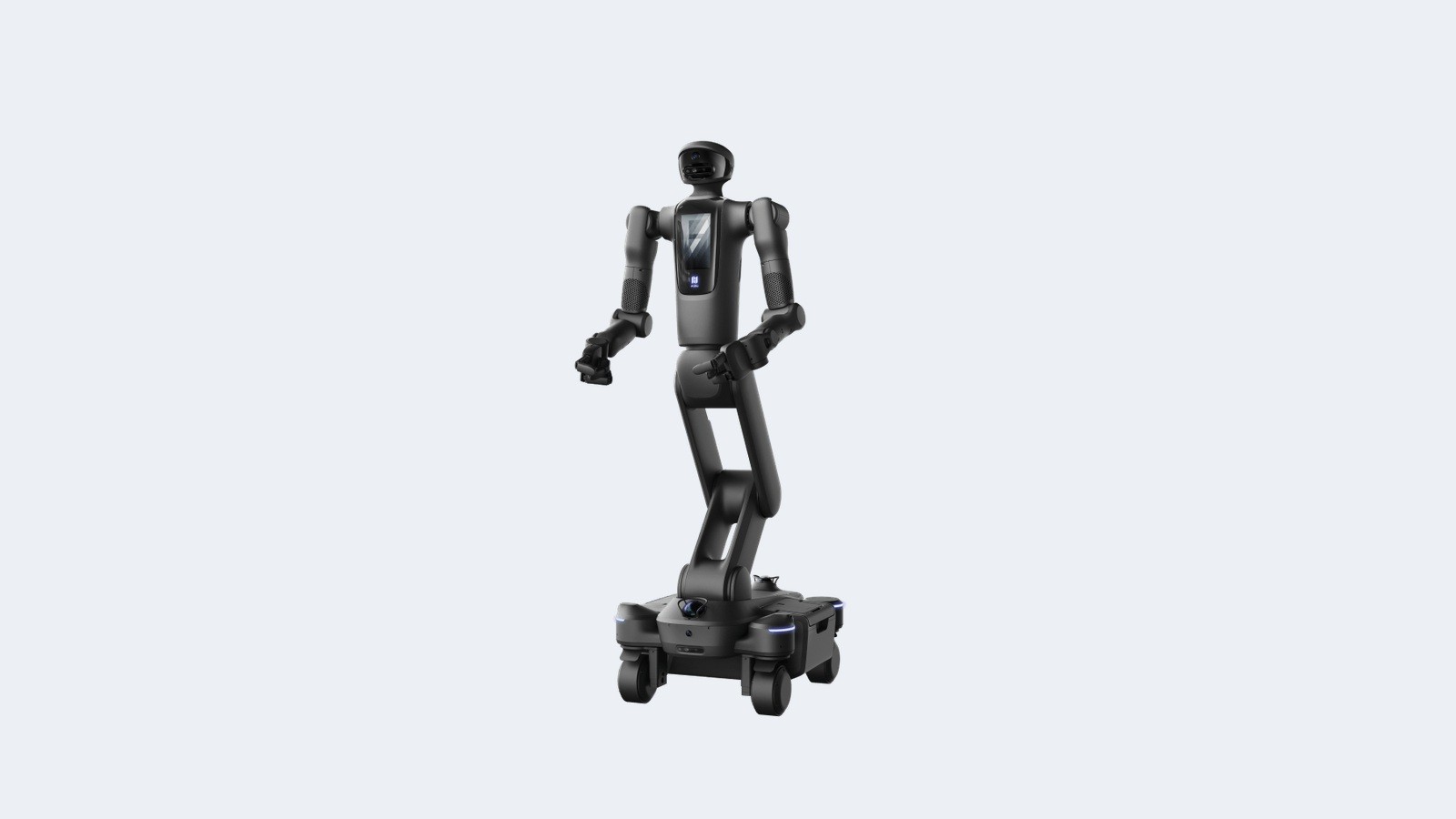
The transition from specialized service robots to generalized industrial physical agents represents a fundamental architectural shift in automation strategy. On July 17, 2026, Pudu Robotics hosted its Pudu AI Technology Briefing at the 2026 World Artificial Intelligence Conference in Shanghai, presenting the PUDU D7 in its first offline public showcase. Pudu had launched the next-generation industrial semi-humanoid on June 1, 2026. The July 17 appearance demonstrated how the product fits the company's expansion from commercial service robotics into manufacturing and logistics tasks.
The strategic significance of the PUDU D7 lies in its hybrid form factor, which combines a human-like upper body with a wheeled omnidirectional chassis. This design choice prioritizes stability, payload capacity, and continuous operation over the bipedal locomotion pursued by other humanoid developers. By focusing on practical utility in structured industrial settings, Pudu Robotics aims to deliver immediate value to procurement managers and operations leaders seeking reliable automation solutions. The PUDU D7 is built on PuduFM, the company's embodied intelligence foundation model, and utilizes the PuduAgent OS, indicating a strong emphasis on software-driven adaptability and intelligent task execution.
What is the PUDU D7 and how does it function in industrial settings?
The PUDU D7 is an industrial-grade semi-humanoid robot developed by Pudu Robotics, launched on June 1, 2026, and showcased in Shanghai on July 17, 2026. It features a human-like upper body with robotic arms and a wheeled omnidirectional chassis, designed for material handling, high-reach picking, and warehouse logistics.
Pudu Robotics, headquartered in Shenzhen and Hong Kong, was founded in 2016 and initially focused on commercial service robotics, including food delivery and commercial cleaning robots. The company has achieved significant scale, shipping over 130,000 units globally across its product portfolio, with a presence in more than 85 countries and regions. The PUDU D7 represents a strategic expansion into industrial delivery and general embodied AI, building on the company's experience in mobile robotics and autonomous navigation. The core technology driving the PUDU D7 is PuduFM, an embodied intelligence foundation model that includes a physical Visual-Language-Model module, a Physics Intuition Model, and action-expert modules.
The physical specifications of the PUDU D7 reflect its industrial focus. The robot stands 165 centimeters tall and weighs 45 kilograms. Its bionic arms have a reach of 65 centimeters and operate with 30 degrees of freedom, which can be expanded to 50 degrees with a dexterous hand attachment. The PUDU D7 supports a payload capacity of up to 14 kilograms and can operate at heights of up to 2 meters, making it suitable for high-reach picking tasks. It features an end-point precision of 0.1 millimeters, ensuring accuracy in material handling. The robot's mobility is provided by a 360-degree omnidirectional chassis capable of a maximum speed of 2 meters per second and maintaining stability on slopes up to 10 degrees. Powered by a battery exceeding 1 kilowatt-hour, the PUDU D7 can operate continuously for over 8 hours.
Understanding the Shift to Physical Agents
To understand the significance of the PUDU D7, it is helpful to think of traditional industrial robots as highly specialized tools, like a fixed conveyor belt or a robotic arm bolted to a factory floor. These tools are excellent at performing a single, repetitive task with high precision, but they lack flexibility. If the production line changes, the robot must be reprogrammed or replaced. In contrast, a physical agent like the PUDU D7 is more like a versatile factory worker. It can move around the facility, perceive its environment, and adapt to different tasks, such as moving materials from a warehouse shelf to a production line.
The intelligence of the PUDU D7 is managed by the PuduAgent OS, which serves as the robot's operating system. This system utilizes interactive Visual-Language-Models, long and short-term memory modules, and safety guardrails to process information and make decisions. When a facility manager assigns a task, the PuduAgent OS interprets the command, uses the PuduFM foundation model to understand the physical requirements of the task, and coordinates the robot's sensors and actuators to execute the action safely and efficiently. This software-defined approach allows the robot to learn and adapt over time, reducing the need for rigid programming and enabling it to handle a wider variety of tasks in dynamic industrial environments.
The decision to use a wheeled omnidirectional chassis rather than bipedal legs is a critical architectural choice. While bipedal robots offer the promise of moving through stairs and highly unstructured terrain, they are currently expensive, and often struggle with stability and payload capacity. By opting for a wheeled base, Pudu Robotics ensures that the PUDU D7 can carry significant payloads, operate continuously for long shifts, and maintain high stability on flat factory floors. This pragmatic approach prioritizes immediate industrial utility and reliability over the long-term, generalized capabilities of bipedal humanoids.
Competitive in Industrial Robotics
The industrial robotics market is highly competitive, with various form factors and approaches vying for dominance. The following table compares the PUDU D7 with other notable industrial and semi-humanoid robots based on available public data.
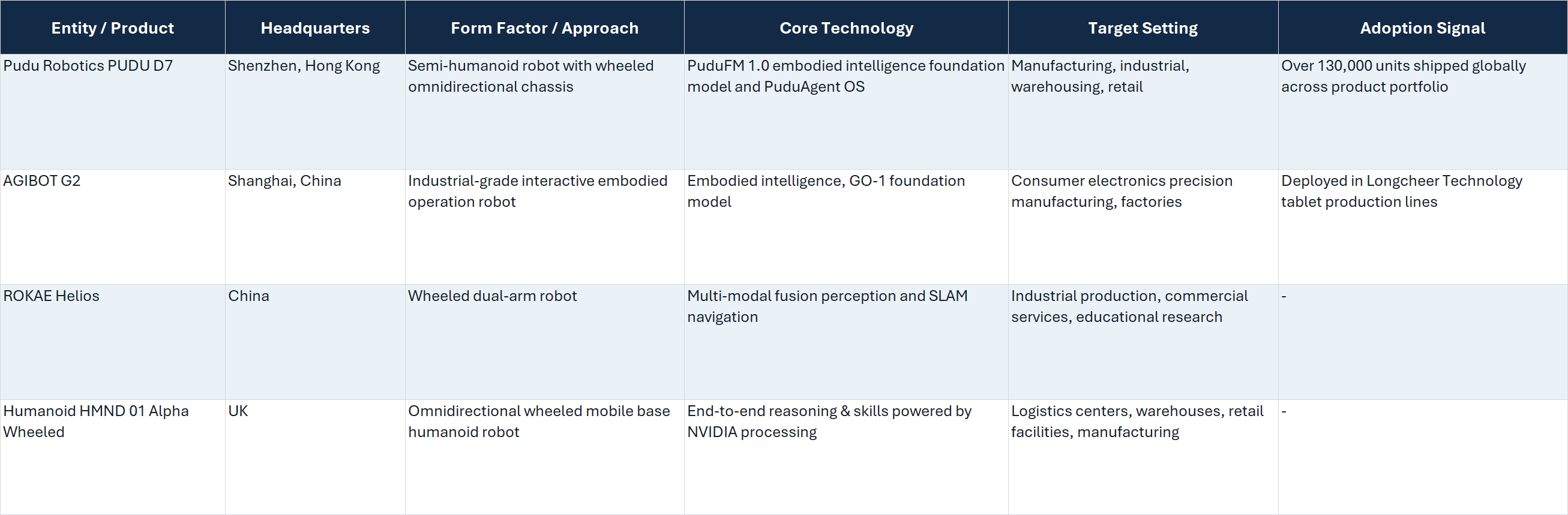
Comparison based on company-disclosed specifications and public first-party materials.
The comparison highlights the diversity of approaches in the sector. While Pudu Robotics and ROKAE focus on wheeled or semi-humanoid designs that prioritize stability and payload, companies like AGIBOT are deploying interactive embodied operation robots in precision manufacturing environments. The choice between these form factors depends heavily on the specific requirements of the target setting, with wheeled bases currently offering advantages in continuous operation and payload capacity on structured floors.
The Pragmatic Reality of Form Factors
A common misconception in the coverage of embodied AI is the assumption that bipedal humanoid robots are the inevitable and superior form factor for all general-purpose tasks. This narrative often overlooks the immediate practical requirements of industrial environments, where stability, payload capacity, and continuous operation are paramount. The PUDU D7 demonstrates that a semi-humanoid design, combining a human-like upper body with a wheeled base, offers a more pragmatic and reliable solution for current industrial applications. By prioritizing functional utility over biological mimicry, Pudu Robotics addresses the actual needs of procurement managers and operations leaders who require robust automation today, rather than aspirational capabilities tomorrow.
"The transition from specialized service robots to generalized industrial physical agents represents a fundamental architectural shift in automation strategy, prioritizing immediate industrial utility and reliability over the long-term, generalized capabilities of bipedal humanoids."
Strategic Implications for Operations Leaders
For procurement managers, operations leaders, and technology evaluators, the D7's first offline showcase signals a maturing market for industrial physical agents. The shift toward software-defined, adaptable robots offers the potential to automate material handling and logistics tasks that previously required human intervention or rigid, single-purpose automation systems. Evaluators should focus on the integration capabilities of the PuduAgent OS and the practical limitations of the wheeled chassis when assessing the PUDU D7 for their facilities.
Sourcing teams must consider the total cost of ownership, including the infrastructure required to support continuous data collection and model training for the PuduFM foundation model. While the exact pricing of the PUDU D7 remains undisclosed, the potential for increased operational flexibility and efficiency makes it a compelling candidate for pilot deployments in structured manufacturing and warehousing environments. The success of these early deployments will depend on the robot's ability to seamlessly integrate with existing workflows and demonstrate reliable performance in real-world conditions.
The continuous evolution of embodied intelligence models like PuduFM will be a critical factor in the long-term viability of physical agents. Operations leaders should monitor the development of these models and their ability to generalize across different tasks and environments. As the technology matures, the distinction between service robots and industrial agents will continue to blur, driven by advances in software architecture and pragmatic hardware design.
The exact price or cost of the PUDU D7, specific customer names, deployment numbers, and detailed specifications of the dexterous hand attachment beyond the increase in degrees of freedom are not disclosed in the primary sources. The robot relies on a wheeled omnidirectional chassis, which limits its ability to move through stairs or highly uneven terrain compared to bipedal humanoid robots. The continuous learning and evolution capabilities depend on the quality and volume of data collected in real-world environments, which may pose challenges in highly unstructured or novel settings.
This analysis synthesizes company statements, official filings, and public market activity available as of July 17, 2026.
Disclaimer: This article is for informational purposes only and does not constitute financial, investment, legal, or procurement advice. Product specifications, pricing, and availability may change, so readers should verify details directly with the relevant company before making decisions.














