
Orbbec and Robbyant Launch EGO RGB-D for Physical AI
Orbbec introduces the EGO RGB-D series at WAIC 2026, a head-mounted data collection product for physical AI, featuring native depth computation and integration with Robbyant's LingBot-Depth 2.0 model.
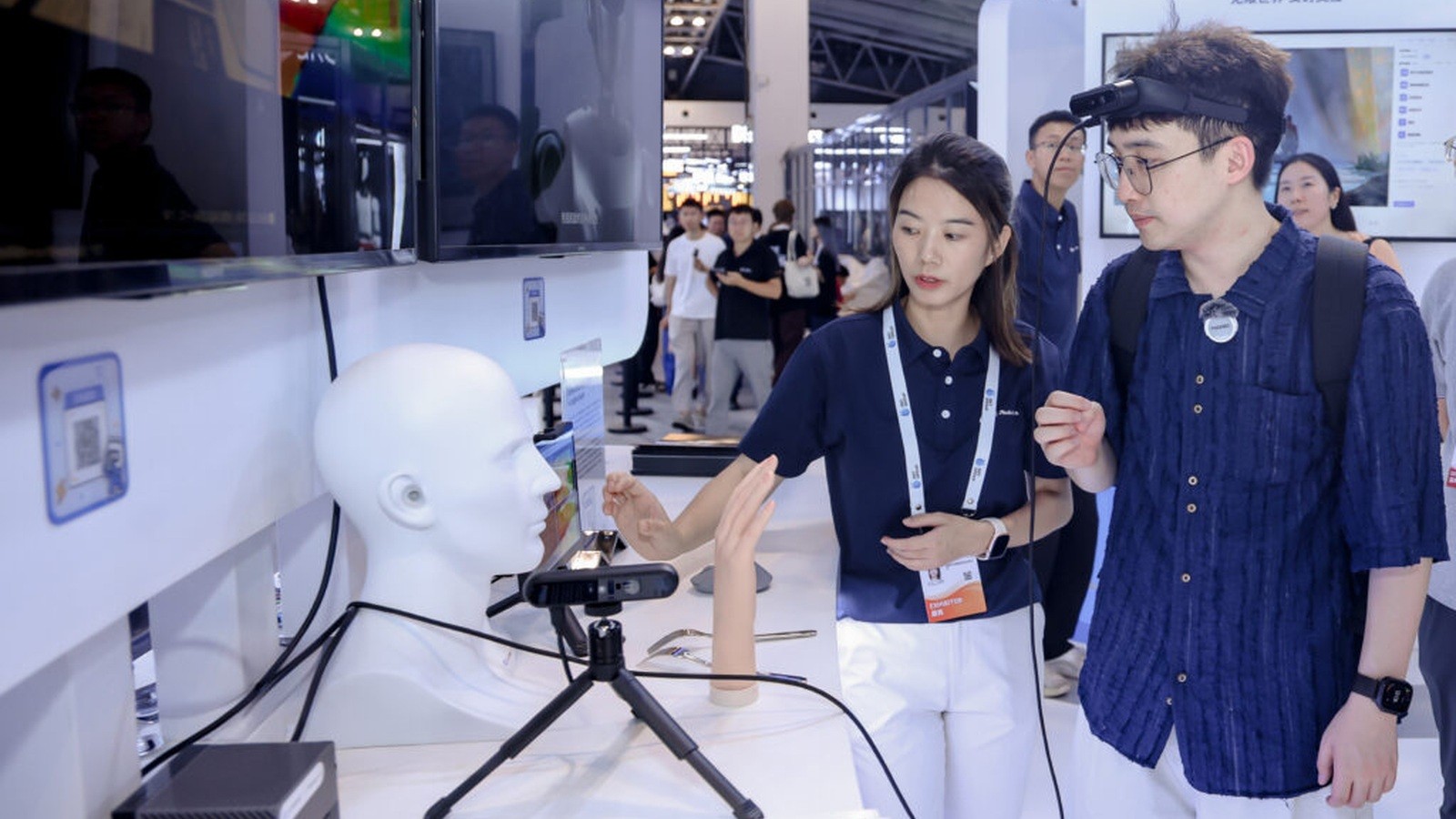
The rapid evolution of physical artificial intelligence and embodied robotics has exposed a critical bottleneck in the development pipeline: the acquisition of high-quality, synchronized, and spatially accurate training data. As the industry moves beyond simulated environments and into real-world applications, the demand for robust data collection hardware has intensified. Observation of the current market reveals that many existing solutions struggle to provide the necessary combination of precise depth sensing, temporal synchronization, and seamless integration with advanced machine learning models. This gap has prompted leading technology providers to engineer specialized hardware platforms designed explicitly for the rigorous demands of physical artificial intelligence data collection.
What is the Orbbec EGO RGB-D series and how does it advance physical artificial intelligence data collection?
The Orbbec EGO RGB-D series is a head-mounted data collection product designed for physical artificial intelligence, introduced at the 2026 World Artificial Intelligence Conference in Shanghai on July 17, 2026 [1]. Developed by Shenzhen-based Orbbec Inc., the system utilizes Gemini 330 series 3D cameras and the MX6800 depth engine chip to perform onboard depth computation directly within the camera [1].
The 2026 World Artificial Intelligence Conference, which opened in Shanghai on July 17, 2026, served as the launch venue for a significant advancement in robotics data collection hardware [1]. During the event, Orbbec showcased the EGO RGB-D series, a core component of its newly released Robot-Free Data Collection Hardware Platform, at the Robbyant LingBot Booth [1]. This product introduction addresses the growing industry requirement for specialized equipment capable of capturing the nuanced interactions necessary for training advanced physical artificial intelligence models.
Orbbec Inc. is headquartered in Shenzhen, China, operating from the Orbbec Technology Building in the Nanshan District [1]. The company is recognized as a provider of robotics and artificial intelligence vision technologies, leveraging in-house chips and comprehensive system architectures to deliver high-performance 3D vision sensors [1]. Orbbec's solutions cater to various industries, including robotics, 3D scanning, and biometrics, offering research, development, and manufacturing capabilities [1]. The company's focus on proprietary silicon, such as the MX6800 depth engine chip, enables onboard processing that reduces latency and improves the quality of the captured data, which is essential for real-time robotic applications [1]. This vertical integration, from chip design to final product assembly, allows Orbbec to maintain tight control over the performance characteristics of its sensors, ensuring they meet the stringent requirements of physical artificial intelligence research and deployment. The company's established presence in the 3D vision market provides a strong foundation for its expansion into specialized data collection hardware, leveraging years of experience in optical engineering and sensor manufacturing. The ability to design and produce its own silicon gives Orbbec a significant advantage in optimizing hardware for specific computational tasks, such as depth processing.
The Orbbec EGO RGB-D series is specifically engineered as a head-mounted, first-person data collection tool tailored for physical artificial intelligence, embodied intelligence, and vision-language-action model training [1]. The system is particularly focused on tabletop fine-manipulation scenarios, where precise spatial understanding is critical [1]. Built upon the foundation of Orbbec's Gemini 330 series 3D cameras, the EGO RGB-D series employs the proprietary MX6800 depth engine chip to execute onboard depth computation directly within the camera hardware [1].
The Mechanics of Synchronized Depth Sensing and Model Enhancement
Understanding the technical mechanics of the Orbbec EGO RGB-D system requires examining the integration of hardware-level depth computation and software-level model enhancement. The core challenge in physical artificial intelligence data collection is capturing the environment exactly as a robot would perceive it, with accurate depth information that aligns perfectly with visual data. The EGO RGB-D addresses this by utilizing the MX6800 depth engine chip to process depth information onboard the camera, rather than relying on external computational resources [1].
The hardware capabilities are augmented through the integration with Robbyant's LingBot-Depth 2.0 model, which has been customized specifically for data collection scenarios [1]. The model functions to complete missing depth information, refine object edges, and enhance overall spatial structure details [1]. This combination of native chip-level depth output and model-based enhancement addresses common issues in 3D sensing, such as noisy data around object boundaries or missing depth values in challenging lighting conditions or with specific materials [1]. The synergy between the hardware and software components is a defining characteristic of the EGO RGB-D system. The hardware provides a solid, synchronized foundation of raw data, while the software model refines and enhances that data, filling in gaps and correcting anomalies that are inherent to optical sensing technologies. This two-tiered approach ensures that the final dataset is of the highest possible quality, ready for immediate use in training advanced artificial intelligence models. The customization of the LingBot-Depth 2.0 model for data collection specifically highlights the targeted nature of this solution, designed to address the unique challenges of preparing data for machine learning applications. The model's ability to refine object edges is particularly important for manipulation tasks, where the robot must accurately identify the boundaries of the objects it is interacting with.
Benchmark testing demonstrates the efficacy of this integrated approach. The LingBot-Depth 2.0-based enhancement capability achieved the lowest root mean squared error in 12 of 16 test configurations [1]. In specific evaluations, such as the ClearGrasp D415 transparent-object benchmark, the system recorded a root mean squared error as low as 0.010, with 98.1 percent of evaluated pixels meeting the D105 accuracy threshold [1].
Evaluating Data Collection Alternatives in the Robotics Sector
The market of physical artificial intelligence data collection includes various approaches and form factors, each designed to address specific operational requirements. The following table outlines key alternatives and competitors in the market, highlighting their core technologies and target settings based on available data.
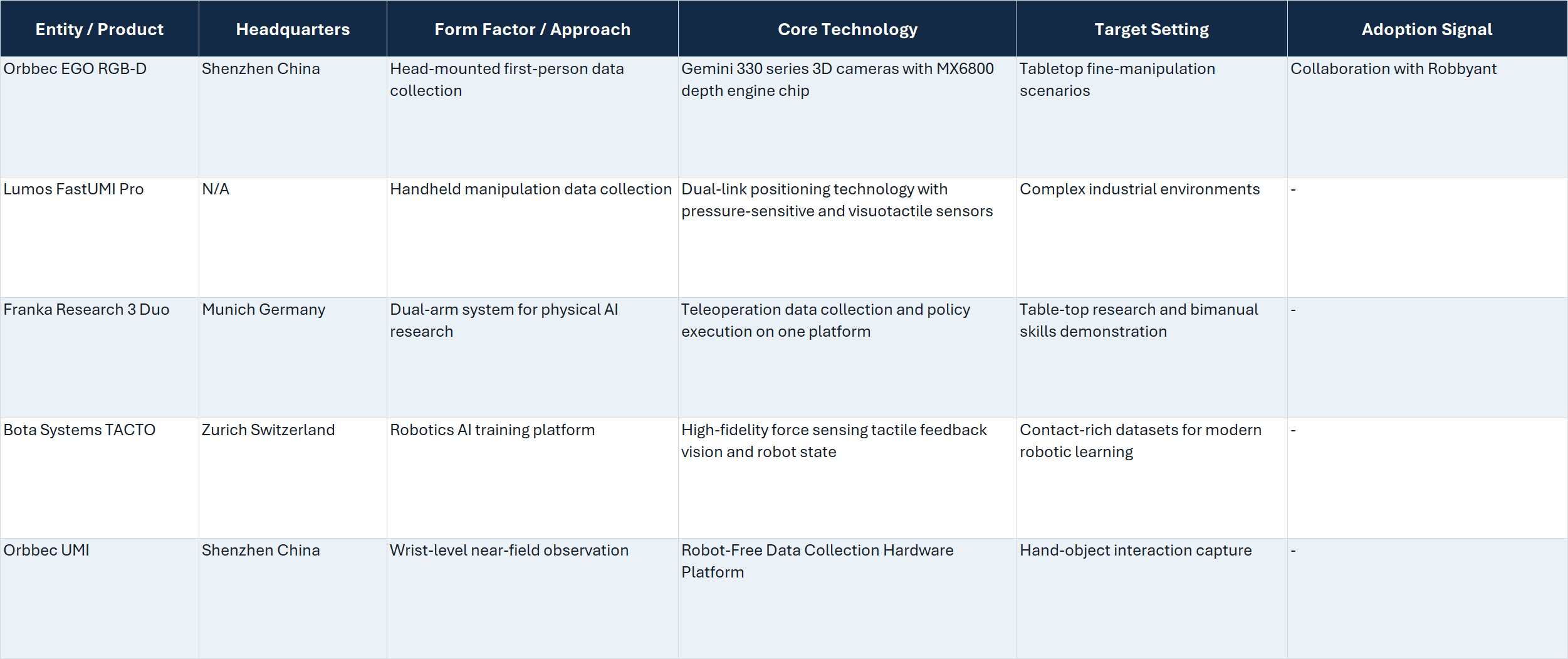
Comparison based on company-disclosed specifications and public first-party materials.
The comparison reveals a diverse range of solutions tailored to different aspects of robotic training. While the Orbbec EGO RGB-D focuses on head-mounted, first-person data collection for tabletop scenarios, alternatives like the Lumos FastUMI Pro offer handheld manipulation data collection suited for industrial environments [3]. The Franka Research 3 Duo provides a dual-arm system that integrates teleoperation and policy execution on a single platform, catering to table-top research and bimanual skills demonstration [4].
Adoption Analysis: Availability, Reliability, Price, and Implementation
The adoption of the Orbbec EGO RGB-D series can be analyzed through availability, reliability or evidence, price or economics, and implementation.
The Orbbec EGO RGB-D series was showcased at the 2026 World Artificial Intelligence Conference on July 17, 2026 [1]. However, the commercial version of LingBot-Depth 2.0 is already available [1]. This indicates that while the technology has been demonstrated, widespread deployment is still pending. The timeline suggests that organizations interested in adopting the technology must plan for a future rollout, potentially integrating the system into their research pipelines in the coming year. The gap between demonstration and commercial availability is a common occurrence in the hardware sector, but it requires careful planning on the part of potential adopters.
The reliability of the system is supported by benchmark testing. The LingBot-Depth 2.0-based enhancement capability achieved the lowest root mean squared error in 12 of 16 test configurations [1]. Specific evaluations, such as the ClearGrasp D415 transparent-object benchmark and the DIODE-Indoor block-masked benchmark, demonstrate significant improvements in data accuracy and reductions in error rates [1]. The collaboration with Robbyant, Ant Group's embodied artificial intelligence company, provides additional validation of the technology's applicability in real-world scenarios [1]. The empirical evidence provided by the benchmark results offers a strong foundation for assessing the system's reliability, giving potential users confidence in the quality of the data it produces. The involvement of a major industry player like Ant Group further bolsters the credibility of the solution.
Specific pricing for the Orbbec EGO RGB-D is not disclosed in the primary source [1]. The economic impact of the system will depend on its cost relative to alternative data collection methods and the potential savings achieved through improved model performance and reduced training time. Organizations evaluating the system must consider the total cost of ownership, including the initial hardware investment, any associated software licensing fees, and the potential return on investment generated by more efficient and effective artificial intelligence development. The lack of transparent pricing information complicates the evaluation process, requiring potential buyers to engage directly with the manufacturer to obtain accurate cost estimates.
The implementation of the Orbbec EGO RGB-D series involves integrating the head-mounted hardware with the LingBot-Depth 2.0 model. The system is designed for tabletop fine-manipulation scenarios, requiring users to adapt their data collection processes to this specific form factor [1]. The onboard depth computation provided by the MX6800 chip simplifies the hardware setup by reducing the need for external processing units, potentially streamlining the implementation process for research and development teams [1]. The integration with Robbyant's software model suggests a streamlined workflow, where data is captured, processed, and enhanced within a cohesive ecosystem, reducing the friction often associated with combining disparate hardware and software tools. The success of the implementation will depend on the ease with which researchers can incorporate the system into their existing data pipelines.
Limitations and Risk
While the Orbbec EGO RGB-D series presents significant advancements in data collection, there are inherent limitations and risks associated with the technology. The LingBot-Depth 2.0 model is customized specifically for data collection scenarios, which may limit its generalizability without further adaptation [1]. Models trained on highly specific datasets may struggle to perform accurately in environments that deviate significantly from the training conditions. This specialization means that the system may not be suitable for all types of robotic applications, requiring users to carefully evaluate its applicability to their specific use cases. The focus on tabletop scenarios, for example, may limit the system's utility for tasks involving large-scale navigation or outdoor environments. This delay in availability could impact organizations relying on immediate access to advanced data collection tools for their research and development timelines. The reliance on a future release date introduces a degree of uncertainty, as production delays or changes in specifications could alter the final product's capabilities or availability. Organizations must weigh the potential benefits of the technology against the risks associated with adopting an unreleased product.
"The Orbbec EGO RGB-D series is a line of head-mounted, first-person data collection products purpose-built for physical AI, embodied intelligence, and VLA/world model training, with a particular focus on tabletop fine-manipulation scenarios." [1]
References:
[2] Orbbec Robot-free Data Collection Hardware Platform.
[3] Multimodal Data Collection System Lumos FastUMI Pro.
[4] FRANKA RESEARCH 3 DUO Prototype.
[5] Physical AI Robotics AI Training Platform.
This analysis synthesizes company statements, official filings, and public market activity available as of July 17, 2026.
Disclaimer: This article is for informational purposes only and does not constitute financial, investment, legal, or procurement advice. Product specifications, pricing, and availability may change, so readers should verify details directly with the relevant company before making decisions.














